
AI search optimization is usually under-budgeted because teams price the subscription and ignore the people who check prompts, rewrite evidence, secure reviews, and approve claims. For a UK B2B software company, the labour around the tool can cost more than the tool itself.
AI search optimization in 2026 is a staged operating cost, not a one-off SEO project. A small UK software business can start with staff time and free audits, move to roughly $49 to $375 a month for monitoring and content support, and spend several thousand pounds a month when an agency also produces content, manages reviews, and handles implementation.
Why UK software teams are adding this line to the budget
AI search now influences B2B vendor research, so a UK software team should fund answer inclusion and buyer proof alongside conventional website traffic. Forrester’s January 2026 business-buying research reported that generative AI searches were becoming an entry point for B2B buyers, while colleagues and trusted external voices still influenced validation.
The UK implication is practical. A procurement software company selling to British finance teams may need clearer product pages, implementation evidence, customer reviews, comparison content, and sales material that all describe the same product boundaries. A single technical fix cannot cover those surfaces.
Forrester’s February 2026 analysis recorded a click-through rate for AI-using buyers at around one tenth of the comparable rate for other search behaviour, while B2B companies reported traffic declines of 10% to 40% over the previous year. That changes the cost discussion: a finance director should not judge AI search optimization only by organic sessions when the buying conversation may happen inside an answer.
There is also a validation cost. In a May 2026 release, Gartner reported that 45% of surveyed B2B buyers had used generative AI to research vendors or products, while 69% preferred to validate AI-generated information with sales representatives. Your sales team therefore becomes part of the AI search optimization budget.
The figures above are not UK-only benchmarks. Use them as planning signals for a UK team, then validate demand through your own sales notes, assisted-conversion questions, and buyer interviews. That distinction matters when a board asks for a precise UK return figure that the available research does not provide.
The cost is a stack, not a subscription
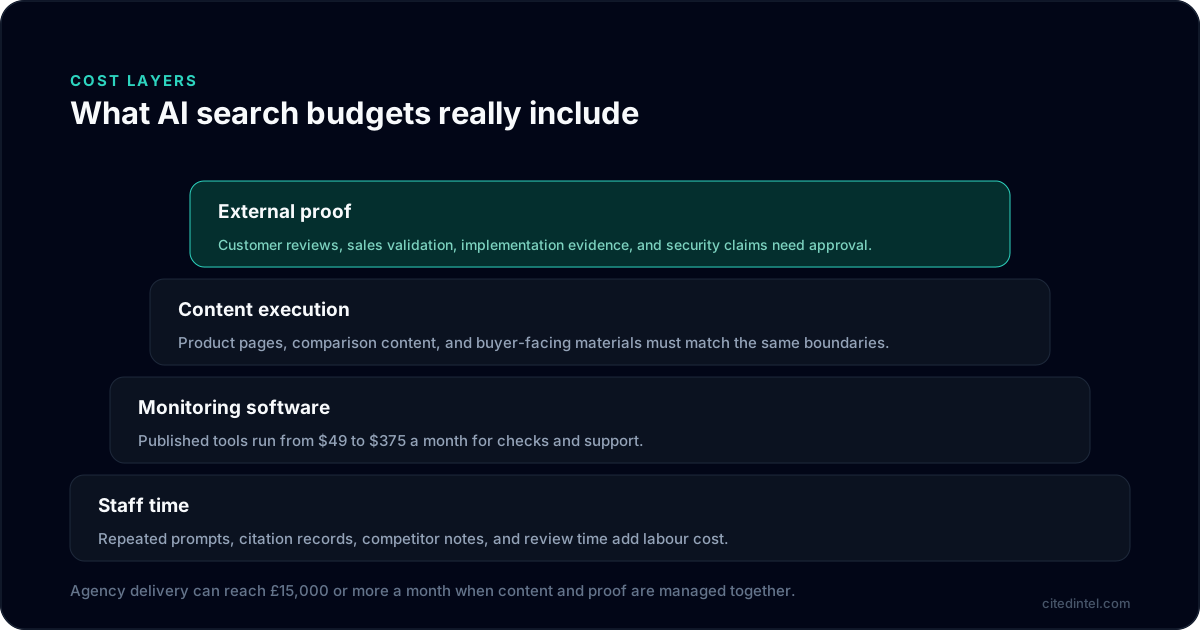
The real cost of AI SEO has four layers: staff time, software, execution, and external proof. A useful budget separates them because a low subscription can still sit beside a large workload.
| Cost layer | What you pay for | What a UK procurement software team should count |
|---|---|---|
| DIY labour | Prompt checks, analysis, rewriting, approvals, and recording evidence | Product marketing time, subject-matter review, sales feedback, and rechecks |
| Monitoring software | Prompt capacity, brands, projects, engines, alerts, and reporting | Whether one owner can cover UK buying questions without manual spreadsheet work |
| Content execution | New or revised pages, proof, documentation, and implementation | Product pages, comparison pages, pricing, security material, and case studies |
| External presence | Reviews, profiles, customer evidence, and digital PR | Review-platform upkeep and proof that procurement buyers trust outside your site |
My view is that the software line should be the easiest line to approve. The difficult question is whether the UK team has enough publishing and review capacity to act on what the monitoring finds.
Free checking still has a staff cost
DIY AI search optimization costs staff time even when the software bill is zero. A reliable manual check needs a fixed question set, several answer engines, repeated runs, citation records, competitor notes, and a dated change log.
A March 2026 empirical study of AI visibility across Perplexity, OpenAI SearchGPT, and Google Gemini measured variation through repeated sampling. The lesson for a UK content lead is simple: one answer is an observation, not a baseline.
For a UK procurement platform, the prompt set might include:
- Category fit: Which procurement platforms suit a UK mid-market manufacturer with a small purchasing team?
- Compliance: Which tools support UK procurement workflows, supplier records, and approval controls?
- Comparison: How does a procurement platform compare with an ERP module for indirect purchasing?
- Implementation: Which product can launch without a long professional-services programme?
- Commercial fit: Which vendors publish pricing or explain the variables that change the quote?
- Risk review: Which platforms provide useful security, integration, and data-residency information?
Each run needs a row for the date, engine, prompt, brands mentioned, recommendation order, cited sources, missing evidence, and next action. The staff cost is the number of hours multiplied by the loaded hourly rate of the person doing the work, plus review time from product, legal, and sales.
Manual work is sensible for validation. It becomes expensive when a UK team covers several product lines, buyer roles, markets, or languages. At that point, a free checker can reveal a problem, but it cannot remove the recurring recording and comparison work.
You can use the free AI search check to establish an initial record before paying for monitoring. Treat the output as a starting point for a dated audit, not as a monthly measurement system.
What each software tier actually buys
AI search monitoring prices range from free access to custom enterprise contracts, and the useful difference is capacity rather than a badge on the pricing page. Compare prompt volume, refresh frequency, project limits, engine coverage, and whether the platform helps you produce the fix.
| Tier or approach | Published price | What it buys | Where it fits |
|---|---|---|---|
| Manual or free | £0 plus staff time | A small set of checks and a basic record | Early validation for one UK product and a few buyer questions |
| Foglift Launch | $49 per month | Higher monitoring capacity than free access, with one brand and weekly monitoring | A small team testing recurring coverage |
| Foglift Growth | $129 per month | Up to 11,500 monthly tokens, up to ten brands, and monitoring as often as twice daily | Several brands or a wider prompt programme |
| Foglift Enterprise | Custom | Custom limits and hourly monitoring | Large portfolios and governance requirements |
| Citedintel Starter | Free | Two full audits with eight buyer-intent prompts each | One owner diagnosing a focused UK programme |
| Citedintel Pro | $375 per month | Up to 150 checks, two engines, one project with six brand changes per cycle, threat alerts, Competitive Pulse, and AI-drafted assets | Teams covering several buying questions and publishing fixes |
Foglift’s pricing page, published in March 2026 and updated in August, lists Free, $49 Launch, $129 Growth, and custom Enterprise pricing. The tiers increase monitoring tokens, brand limits, and refresh frequency. A UK buyer should also check currency conversion, VAT treatment, contract terms, and whether usage is pooled across product lines.
Citedintel costs $375 per month for Pro, with custom pricing for Enterprise and a demo-led Agency Pro; the Starter tier is free. Starter includes two full audits, while Pro includes up to 150 checks, two engines, one project with six brand changes per cycle, threat alerts, Competitive Pulse, and AI-drafted assets.
The distinction is execution. A monitoring-only subscription tells a UK product marketer where a procurement competitor appears or which source supports the answer. A platform with prioritised content and implementation support can connect that gap to a page, review, or proof asset that needs work. Neither replaces subject-matter approval.
Citedintel covers the major assistant services used for buyer research, including ChatGPT, Perplexity, Claude, and Gemini. Enterprise coverage can add Google AI Overviews or another engine on request. The right tier depends on the buyer questions you need to repeat, not the number of employees in the company.
Agency retainers rise with delivery responsibility
There is no defensible 2026 industry benchmark for a typical AI SEO agency retainer. Gartner’s February 2026 guidance raises questions about scope, governance, and lock-in around agency AI platforms, while McKinsey’s June 2026 analysis describes agencies moving towards proprietary data, governance, and outcome-linked services.
The figures below are working planning bands for scoping a UK engagement, not a published market average. Ask an agency to map its fee to deliverables before comparing retainers.
- Strategy only: Plan roughly £1,500 to £3,000 for an initial audit, priority questions, evidence review, and a roadmap.
- Ongoing monitoring: Plan roughly £3,000 to £7,500 per month for recurring analysis, reporting, prompt expansion, and review meetings.
- Execution included: Plan roughly £7,500 to £15,000 or more per month when the agency also writes content, manages technical changes, supports sales material, and coordinates external proof.
Those ranges rise when the brief covers several UK products, multiple languages, regulated claims, public-sector procurement, or a wider European market. A legal reviewer, technical writer, product specialist, and digital PR lead each add approval or delivery time.
A procurement software agency brief should state the number of buyer questions, engines, markets, new assets, revised assets, review profiles, and implementation owners. It should also state what happens when a recommendation changes, a competitor publishes new proof, or an engine cites a source your team cannot control.
The agency versus in-house decision depends on execution capacity rather than ideology. The agency and in-house comparison is useful for that decision, but do not treat a lower retainer as a lower total cost if your team still has to rewrite every page and chase every review.
The hidden content bill sits across the buying record
AI search optimization creates content work across the buying record, not only a queue of new blog posts. For a UK procurement product, the likely work includes the product page, supplier-management documentation, ERP comparisons, implementation guidance, pricing explanation, security answers, customer evidence, review profiles, and sales enablement.
McKinsey’s May 2026 Global B2B Pulse Survey reported that buyers used an average of ten channels during purchasing, with generative AI among the leading channels for finding and assessing suppliers. A content budget that funds only articles leaves the sources buyers use to validate a procurement platform underdeveloped.
Use a simple asset register to cost the work:
- Owner: Name the person responsible for the asset and the subject-matter reviewer.
- Evidence: List the product document, customer proof, policy, or third-party source supporting each material claim.
- Change: Record whether the work is a rewrite, a new page, a review request, a profile update, or a sales-material correction.
- Approval: Mark product, security, legal, and commercial sign-off where the claim needs it.
- Recheck: Set the date when the buyer question will be run again after publication.
The cost formula is straightforward: production hours, review hours, implementation hours, and rework hours, each multiplied by the relevant loaded rate. A junior writer may draft quickly, but a procurement claim about integrations, data handling, or approval controls can spend longer in review than in writing.
My view is that publishing volume is a poor buying target. A single revised comparison page with accurate product limits can support more buyer decisions than six broad articles that never answer implementation or commercial questions.
Review-platform presence is part of the investment
Review-platform presence belongs in the AI search budget because independent profiles and customer evidence can affect confidence in an answer. The cost includes profile completion, review requests, customer approvals, category placement, response management, and keeping product claims aligned.
G2’s April 2026 research reported that 51% of B2B software buyers started research with an AI chatbot more often than Google. The same research identified review sites as the leading source buyers said would increase confidence in an AI answer.
For a UK procurement company, review work should ask customers to describe the buying context, supplier complexity, implementation conditions, and product boundary. A generic request for praise creates weak evidence. A specific request about approval workflows or supplier onboarding produces language that helps another buyer assess fit.
Review work also carries governance costs. A customer quote may need permission, a product claim may require an updated screenshot, and a public response may need approval from support or legal. Put these steps on the asset register rather than treating reviews as free traffic.
Procurement software exposes the difference between monitoring and proof
The evidence burden in AI search optimization depends on the category. Procurement software carries a different proof requirement from healthcare SaaS or developer tools, even when both teams buy the same monitoring tier.
For procurement platforms
UK procurement buyers ask about supplier onboarding, approval chains, ERP connections, implementation effort, pricing logic, and audit records. Budget for comparison pages, implementation documentation, security material, and customer evidence from companies with similar purchasing complexity.
For healthcare software
Healthcare software requires more review time for clinical, privacy, security, and regulatory claims. A low-cost monitoring tier may identify the missing answer, but subject-matter approval can become the largest part of the programme.
For developer tools
Developer-tool buyers need documentation, integration examples, migration guidance, reliability information, and community proof. Content production may move faster, but technical review is still required when an AI answer describes supported environments or deployment limits.
Choose one category first. A UK team that tracks procurement, healthcare, developer tools, and unrelated consumer products in one broad prompt set will have trouble deciding which evidence gap deserves the next pound.
Build a first-month estimate from real work
You can estimate the first month of AI search optimization without buying a large platform. Use the following sheet with data collected in September 2026.
- Choose five questions: Write one category, one comparison, one implementation, one commercial, and one risk question for your UK product.
- Run each question repeatedly: Check each question in three widely used answer services, then record the date, answer, mentioned brands, recommendation order, and cited sources.
- Count the labour: Record minutes spent running checks, copying evidence, reviewing claims, discussing changes, and publishing updates. Multiply the total by the staff member’s loaded hourly rate.
- Mark the missing proof: Label each gap as owned content, customer evidence, review profile, third-party source, product clarification, or sales inconsistency.
- Price the fix: Add writing, subject-matter review, design, development, legal approval, customer permission, and publication time for the first three gaps.
- Set the purchase threshold: Compare that staff cost with $49, $129, or $375 monthly software options, allowing for currency conversion and tax.
A useful result is a sheet that says, “the next £X funds these three evidence changes and this recurring coverage,” rather than “we need an AI SEO tool”. Citedintel gives teams a structured way to move from those UK buyer questions to diagnosis, draft assets, and repeat checks; see how the platform supports that workflow.
Match the spend to the stage you are in
The right spend changes as the number of buying questions and publishing owners increases. A founder validating demand should not buy an enterprise contract, while a UK software business with several product lines should not pretend a spreadsheet is a measurement system.
| Stage | Recommended spend | Decision rule |
|---|---|---|
| Demand validation | Free checks plus staff time | Use five to ten UK buying questions and confirm that answer inclusion is worth tracking |
| One product, one owner | Low-hundreds-per-month software plus internal writing time | Choose recurring checks when manual records are taking time away from publishing fixes |
| Several product lines | Higher-tier monitoring plus a defined content budget | Pay for more prompts, projects, alerts, and assets when one owner cannot maintain coverage |
| Cross-market programme | Agency or internal specialists with review and implementation capacity | Use external support when language, regulation, third-party proof, or publication volume exceeds the team’s capacity |
Pay for DIY when you are still testing whether AI search shortlists matter to your category. Pay for software when repeated measurement has become a weekly operating task. Pay for an agency when the expensive constraint is execution across content, technical changes, reviews, and markets.
I would show the board three numbers: monitoring cost, staff cost, and fix cost. That framing prevents a $375 subscription from disguising a £5,000 content backlog, and it prevents an agency retainer from being judged against software alone.
For UK B2B software, AI search optimization is worth funding when it connects a real buyer question to a published proof change and a later check. Start with the smallest spend that can produce that evidence, then increase the budget only when the workload, product range, or market coverage makes the next tier necessary.
Parth Sesodia, Founder, Cited
Frequently asked questions
How much does AI SEO cost for a UK B2B software company?
Costs range from staff time and free checks to $49 to $375 per month for published software tiers. Agency support can range from about £1,500 for an initial strategy project to £15,000 or more per month when content, implementation and external proof are included.
What are the best AI SEO tools for monitoring buyer questions?
The article compares Foglift and Citedintel by prompt capacity, engine coverage, refresh frequency, project limits and execution support. The right tool depends on how many buyer questions, brands and markets your team needs to monitor, not simply on company size.
How do I use GEO for a UK procurement software company?
Start with category, comparison, implementation, commercial and risk questions that UK buyers ask. Run them repeatedly across several answer services, record citations and missing evidence, then improve product pages, security information, comparisons, customer proof and sales material.
What is the difference between AI search monitoring and AI SEO execution?
Monitoring shows which brands and sources appear when buyers ask relevant questions. Execution fixes the gaps through revised pages, documentation, reviews, technical changes and sales material, with subject-matter approval before the claims are published.
Can a small UK software company manage AI search optimisation in-house?
Yes, if the team starts with a focused set of five to ten buyer questions and records repeated checks manually. Move to paid software when weekly measurement takes time away from publishing fixes, and consider an agency when content, reviews, implementation or market coverage exceed internal capacity.