
One ChatGPT prompt, “best compliance-friendly payroll software for 200-person teams,” can settle a US shortlist before your site sees a single visit. The recommendation layer now sits in front of your funnel, and it is measurable.
US buyers lean on those answers to compare options, which means any brand can get named, compared, or quietly dropped while the shortlist forms. Generative engine optimization is the work of earning that presence, and answer engine optimization is the companion work of making your pages quotable enough to hold up inside the answer itself.
AI search adoption in the United States is already a buying signal
US buyers are already seeing assistant answers and search-page recaps during ordinary research, and that changes what gets noticed first. A marketing team selling into the US market has to treat AI search optimization as part of the buying path, not as a fringe search metric.
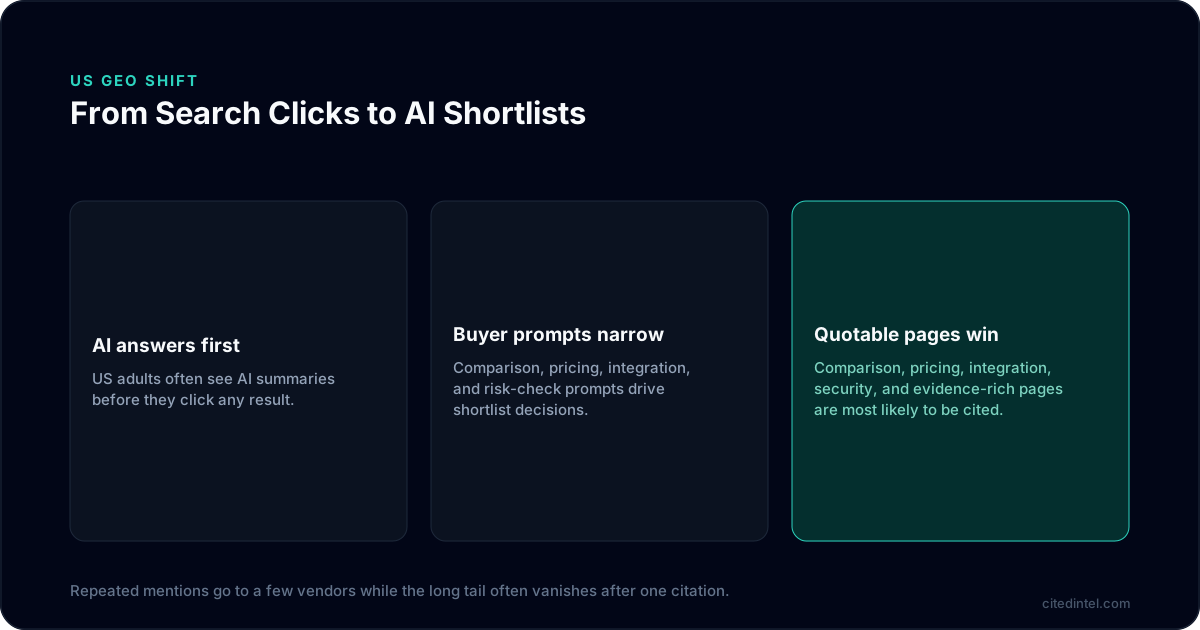
The clearest public signal is exposure. Pew reported that 65% of US adults notice AI summaries while browsing search results from time to time, and another 45% say those summaries show up often or very often; Pew also found that people exposed to those summaries were less likely to click through than people who did not see them Pew Research Center Pew Research Center.
The sharper check is whether the assistant keeps your brand in the comparison set long enough for the buyer to evaluate it, even when a rival has the cleaner proof trail.
In the US, the first GEO win is rarely the purchase decision itself. It is the moment your brand lands on the assistant’s working list before the buyer starts checking other sources.
How US research habits have shifted
Gartner’s January 2026 survey found that 51% of consumers said GenAI changed their research habits, and among those people, 71% said they changed how they phrase queries, often making them more specific, question-based, and conversational Gartner.
That matters in the US because software buyers already expect comparison, pricing, and proof. OpenAI’s search and shopping research experiences now put web citations and source-backed answers directly into the product research flow OpenAI OpenAI.
- Buyer expectation: US buyers increasingly ask “which one should I choose” instead of “what is this category.”
- Answer behavior: The engines reward pages that compare, explain tradeoffs, and show pricing or implementation detail.
- Revenue effect: If a buyer accepts the assistant’s first shortlist, your sales team meets a colder or warmer room depending on who was named.
Google is saying the same thing in its own terms. Its May 2025 guidance tells publishers to earn AI search optimization by being useful, original, and structured, not by trying to manipulate the answer surface Google Search Central.
For software vendors in the US, the practical read is this: SEO still earns discovery, but AI answer visibility now sits beside it. In crowded categories, a small set of answer slots can absorb attention from hundreds of vendors, and the pages that win those mentions usually explain tradeoffs, proof, and fit instead of listing features alone. The job is to make one page legible to a buyer, a rep, and a model without flattening the message.
Prompt patterns tell you what the engine is trying to answer
US prompts are usually comparative, specific, and business-shaped. The engine is not trying to “learn about your category” in the abstract; it is trying to answer the next decision question a buyer is ready to ask.
Prompt families tell you more than keyword lists do. A PMM or growth lead can read the prompt and know whether the answer needs category framing, proof, pricing, implementation detail, or risk handling, which makes the content brief easier to assign and review.
| Prompt family | What a US buyer is really asking | Example prompt | Content that tends to get cited |
|---|---|---|---|
| Shortlist | Who should make the cut? | Best product analytics platform for a PLG startup with a small team | Comparison page with fit criteria, tradeoffs, and pricing context |
| Integration check | Will this fit our stack? | CRM software that works with HubSpot and Snowflake | Integration page with named systems, setup notes, and edge cases |
| Risk check | What is the downside? | Downsides of cloud security vendors that rely on AI detection | Objection-handling page with limits, controls, and third-party proof |
| Pricing check | Can we afford it? | Martech tools with transparent pricing for midmarket teams | Pricing page or comparison page that says what is included and what is not |
| Workflow check | How does the job get done? | Best logistics tech for cross-border shipping teams | Use-case page with step-by-step workflow, integrations, and operational detail |
These examples matter because US buyers type the way they think. They ask for pricing transparency, named integrations, and tradeoffs because the US market has a deep review culture and a lot of vendor choice. For a buyer comparing software, the prompt is a filter for proof, not a request for category trivia, so the page needs language the assistant can reuse in a shortlist and a reason to keep the brand in the frame without reading like boilerplate.
Examples that map to real US buying questions
In CRM, buyers ask for pipeline reporting, revops fit, and migration risk. In HR software, they ask about hiring workflows, compliance, and onboarding. In payments, they ask about fees, settlement speed, and whether a tool handles platform pricing.
The pattern repeats in less obvious categories. A cybersecurity buyer asks about detection accuracy and incident response. A martech buyer asks about attribution and data residency. A legal tech buyer asks about document review, audit trails, and firm size fit. The prompt should echo the decision criteria the assistant can surface in a comparison, not just a keyword theme.
- CRM: “CRM for a revenue team that needs strong reporting and simple admin.”
- HR software: “HR software for distributed hiring with onboarding and policy controls.”
- Payments: “Payments infrastructure with clear pricing for platform businesses.”
- Legal tech: “Legal software for contract review with audit trail and approval steps.”
- Developer tools: “Dev tools with fast setup and solid docs for small teams.”
For a content lead, the point is not to cover every prompt family at once. The job is to make one page answer one buyer question better than the competing pages around it, then test whether that page is the one the assistant can cite fastest. Keep the page anchored to one decision, one proof set, and one likely follow-up question, then watch whether the same question keeps pulling the same source into the answer.
From live audits on Citedintel
In audits run on Citedintel as of August 2026, we see the same US pattern in AI assistants: a small number of vendors are repeatedly surfaced, and a long tail disappears after one mention. That concentration is why GEO in the United States is a shortlist problem, not just a visibility problem, because the engine is choosing who gets to compete in the first place.
The audits also show a second pattern that matters to agencies and startup founders. When a brand is absent from AI answers, the reason is usually not one missing blog post, it is a missing proof layer across comparison pages, review presence, and support content. In practice, the engine needs a place to point when it explains fit, not just a homepage to quote.
| Observed pattern | What it looks like in US prompts | What usually fixes it |
|---|---|---|
| Repeat mentions | The same vendor keeps showing up in comparison answers | Better category positioning and stronger comparison coverage |
| Source gaps | The engine cites review sites or third-party pages instead of the brand | Clearer evidence pages, fresher docs, and stronger external proof |
| Price opacity | The answer avoids a brand when pricing is unclear | A pricing page that says enough to anchor the comparison |
| Low trust lift | The assistant names a competitor with stronger review density | Review presence, customer proof, and updated third-party citations |
Many teams miss the proof-layer gap in the US. The engine is not only reading your homepage, it is choosing among pages that already sound like stronger evidence, which means the best citation target is often a comparison or proof page instead of the brand page itself.
Why US categories are harder than they look
The United States is crowded in the categories that matter most to B2B software. Five answer slots can be fought over by dozens of credible vendors, and in mature categories the review layer often influences which brands the model feels safe naming.
G2 and Reddit both matter more in the US than many teams expect. Buyers trust peer language, and AI systems often reflect that trust when they assemble comparisons or risk answers.
The fastest winnable prompt families in the US are comparison, pricing, and risk-check prompts. Pure “what is X” queries are too generic and too crowded; the buyer-intent prompts carry better commercial value and clearer page-level fixes. If the team can only tune one thing, tune the page that answers a shortlist question with a named alternative and a concrete reason to choose or skip it.
Improving GEO visibility means fixing the highest-value pages first
The right order in the US is to repair the pages that steer the shortlist, then check whether the answers change. A brand does not need a sitewide rewrite first; it needs the pages that can move a buyer from curiosity to comparison.
For a product marketing lead inside a software company selling into business teams, that usually means comparison pages, pricing pages, integration pages, and one or two evidence-rich use-case pages. For an agency, it means the pages that can be updated quickly and defended with proof when the client asks why the engine should cite them, not the pages that simply add more words and hope for lift.
| Page type | What it should solve | US-specific note | What good looks like |
|---|---|---|---|
| Comparison page | Which vendor belongs on the shortlist | US buyers expect direct tradeoffs and pricing context | Named alternatives, fit criteria, and a plain verdict |
| Pricing page | Whether the cost is worth checking further | Transparency matters more in the US than in many markets | Clear plan structure or at least clear pricing logic |
| Integration page | Whether the product works with the stack | US teams often ask about Salesforce, HubSpot, Snowflake, Okta, and Slack | Specific systems, setup notes, and failure points |
| Security page | Whether risk is acceptable | Security questions are common in US procurement and midmarket buying | Controls, certifications, and current policy language |
| Docs or help center | Whether the tool sounds real and current | Freshness matters because assistant answers favor recent operational detail | Current screenshots, process steps, and plain language |
Google’s AI guidance backs that up. The search team says useful, original, structured content wins better than pages built to look synthetic Google Search Central.
One limitation belongs here: if your category has little AI-assisted buying behavior yet, GEO should not outrank basic positioning and review building. In that case, the brand first needs clearer category language and proof, then answer-engine work pays off because the assistant needs stable signals before it can cite you with confidence.
First-page changes that matter most
Begin with the top block of the page. The opening should say what the product is, which buyer it serves, and why it differs from alternatives in the US market.
Then add the proof that answer engines can lift without guesswork. A good US page gives the engine names, comparisons, current details, and enough context to avoid sounding like marketing copy or a placeholder summary. A compact proof block can do the heavy lifting: named alternatives, one concrete fit criterion, one implementation note, and one current fact the assistant can quote.
- Entity clarity: Name the category, buyer, and use case in the first few lines.
- Comparison depth: Name alternatives and explain the tradeoff.
- Evidence density: Add reviews, customer proof, docs, and third-party references.
- Freshness: Update pricing, product facts, and screenshots when they change.
Tracking AI search metrics needs a weekly review loop
Weekly AI search monitoring in the US should answer one question: are we showing up in the prompts that shape a shortlist? If a team cannot answer that quickly, the page work becomes guesswork.
The manual version takes real time. A small team usually needs a few hours a week to run prompts on a fixed schedule, record mentions, and compare the outputs by category or prompt family so the same question gets the same treatment every week. The point is not volume, it is a stable baseline that shows when one page starts to change the answer.
A simple US weekly prompt routine
- Pick 10 prompts: Use 3 comparison prompts, 3 pricing prompts, 2 integration prompts, and 2 risk prompts pulled from actual sales conversations.
- Run four engines: Test the same prompts in ChatGPT, Perplexity, Claude, and Gemini at the same weekly checkpoint.
- Log four fields: For each answer, record whether your brand was mentioned, whether it was framed well, what source types appeared, and which competitor showed up instead.
- Mark the gap: Note whether the missing proof is on the site, in reviews, or in third-party coverage.
- Choose one fix: Update the page most likely to change a shortlist answer, not the page that is simplest to edit.
That workflow produces a usable read for a VP of Marketing or a founder who wants to know where the brand is invisible. The output is a simple map: which prompt family named you, which rival kept appearing, and which page the engine seemed willing to cite. Citedintel compresses that cycle by turning the audits, diagnosis, drafts, and weekly re-checks into one system, which is why teams use the free Citedintel audit or /demo after the first manual pass.
Teams that want a lighter process before committing to software can use a spreadsheet. The key is consistency, because answer engines change faster than annual reporting cycles and the same prompt can move up or down after a page update.
What to watch each week
Track mention rate, position, and source type. Then read the pattern with a marketing lens, not a vanity lens.
When your brand is mentioned but framed poorly, the page likely needs clearer positioning or stronger proof. If your competitor is cited and you are not, the gap is usually evidence, freshness, or category fit.
- Mention rate: Are we named at all?
- Framing: Are we described as a fit or an afterthought?
- Source mix: Do the answers rely on our pages, review sites, or third-party coverage?
- Competitive pulse: Which vendors keep appearing together in the same answers?
AI-driven sales enablement starts before the first meeting
AI-answer intelligence helps sales because it shows the beliefs a buyer may already have before the first call. If an assistant has repeated one vendor, the rep inherits that bias, whether the brand earned it or not.
This is especially true in the US, where pricing transparency, review density, and third-party validation shape trust fast. A sales team needs to know which competitor is being surfaced, which objection is likely, and which proof point is missing from the buyer’s mental model.
McKinsey’s recent B2B work points in the same direction, describing gen AI as increasingly embedded across buying and selling workflows McKinsey.
The useful handoff is simple. Marketing gives sales the prompt set, the brands that keep appearing, and the pages that are shaping the answer. Sales uses that to sharpen objection handling by naming the same competitor and proof gap the buyer is likely to have seen in the assistant.
A rep does not need a perfect attribution model to benefit from AI answer intelligence. The rep needs to know which names the buyer is likely to have seen already.
That distinction keeps the conversation grounded. AI search optimization affects the story buyers bring into the call, but it should not be oversold as closed-loop proof of revenue.
What to hand to sales
Give sales the prompt family, the competitor set, and the evidence gap. That is enough to improve early conversations without making the team chase a dashboard nobody trusts, and it gives reps the language to answer the same objection the buyer saw in the assistant.
- Prompt sheet: The 10 to 12 questions buyers ask most often.
- Competitor notes: The vendors that keep getting cited in US answers.
- Proof map: Which pages support the brand, and which ones still look thin.
- Objection list: The risk points the assistant keeps surfacing.
A U.S. prompt check to run today
Use this quick check to see whether your US answer layer is pointing at the right pages. You only need one category and one spreadsheet, plus a way to mark whether the answer needs comparison, pricing, integration, or proof.
- Choose one category: Pick the product line most tied to this quarter’s pipeline, such as legal tech, martech, logistics tech, or developer tools.
- Write five prompts: Use one shortlist prompt, two pricing or comparison prompts, one integration prompt, and one risk-check prompt.
- Run the prompts: Test them in every answer engine you monitor, and write down every brand that appears before your own.
- Score the page: Mark whether the answer needs a comparison page, pricing page, integration page, or third-party proof.
- Pick one rewrite: Fix the page that would matter most if a US buyer asked the same question on a sales call tomorrow.
For the repeatable version of that process, Citedintel turns the prompt check into a weekly operating system that keeps the prompt set, competitor set, page notes, and rewrite target in one place.
What this means for the next quarter
US GEO work should concentrate on the prompts that shape shortlists, not on vague visibility goals. The teams that keep winning make their comparison pages, pricing pages, and evidence pages easier for engines to trust by naming alternatives, showing the decision criteria, and keeping proof current, because those are the pages that can change what the assistant says next and what a rep hears on the call. A practical check is whether the page hands the engine a named alternative, a decision rule, and one current fact it can quote without guessing.
That means a tighter operating plan for the next quarter: pick the category, run the weekly prompt check, fix the highest-value page, and keep the proof current. If a competitor is already being named in AI answers, the fastest response is not to publish more content volume, it is to strengthen the evidence on the pages the assistant can cite with the least friction, then rerun the same prompts and check whether the shortlist changed. If the shortlist does not move, the signal is usually weak proof, stale pricing, or a page that does not match the buyer’s wording. Treat the answer layer as an editorial system, not a traffic trick. One practical rule: update the page that can change a comparison answer before you touch pages that only add more background.
In the United States, generative engine optimization is becoming a practical discipline, not a theory. The brand that is cited in the answer layer enters the sales conversation earlier, with more trust and less friction.
Keep reading
- AI-Sourced Pipeline: The Buyer Prompts That Impact Revenue at Every Funnel Stage
- Using AI Search to Increase Revenue and Pipeline: The RevOps Playbook
- How to Rank in AI Search with a Practical GEO Playbook
Frequently asked questions
How do I show up in AI search for my software category?
Start with the pages that shape shortlists: comparison, pricing, integration, security, and use-case pages. Then run a weekly prompt set across ChatGPT, Perplexity, Claude, and Gemini to see whether your brand is mentioned, framed well, and cited from the right source types.
What is the difference between GEO and answer engine optimization?
In this article, GEO is the work of getting your brand mentioned and cited inside AI answers, while answer engine optimization is making your pages quotable enough to be used as the answer itself. GEO is about being named in the shortlist; AEO is about becoming the answer text.
What pages matter most for AI search optimization?
The article says comparison pages, pricing pages, integration pages, security pages, and fresh docs or help center content are the highest-value fixes. Those are the pages AI systems can trust when they need tradeoffs, fit, pricing context, or implementation detail.
How often should we check AI search mentions?
The recommendation here is a weekly operating spec. The manual version uses the same prompts on the same day each week so you can track mention rate, framing, source mix, and competitive repeats without guessing.
Why does pricing transparency matter for GEO?
In the article's audit patterns, price opacity is one of the common reasons a brand gets left out of AI answers. When pricing is unclear, engines often lean toward competitors whose pages make the comparison easier.