
In Riyadh, a clean procurement prompt can surface a competitor before your brand shows up. If that happens on the first shortlist question, your traffic report may still look healthy while the deal moves without you.
This guide treats the Gulf as one market, with extra weight on Saudi Arabia and Qatar. The UAE moves differently enough to earn its own playbook.
For GCC enterprises, generative engine optimization is the work of making a brand easy for AI answers to verify, cite, and recommend. AI search optimization and answer engine optimization overlap, yet they play different roles: the wider visibility work decides whether a brand enters the answer at all, while AEO concentrates on making each page a source engines can trust when they assemble comparisons and shortlists.
Why the GCC behaves differently in AI search
GCC buyers bring country, compliance, and deployment constraints into the query, so the answer layer has to satisfy procurement, not just curiosity. If you market B2B SaaS, a generic “regional coverage” page is too vague to survive that filter.
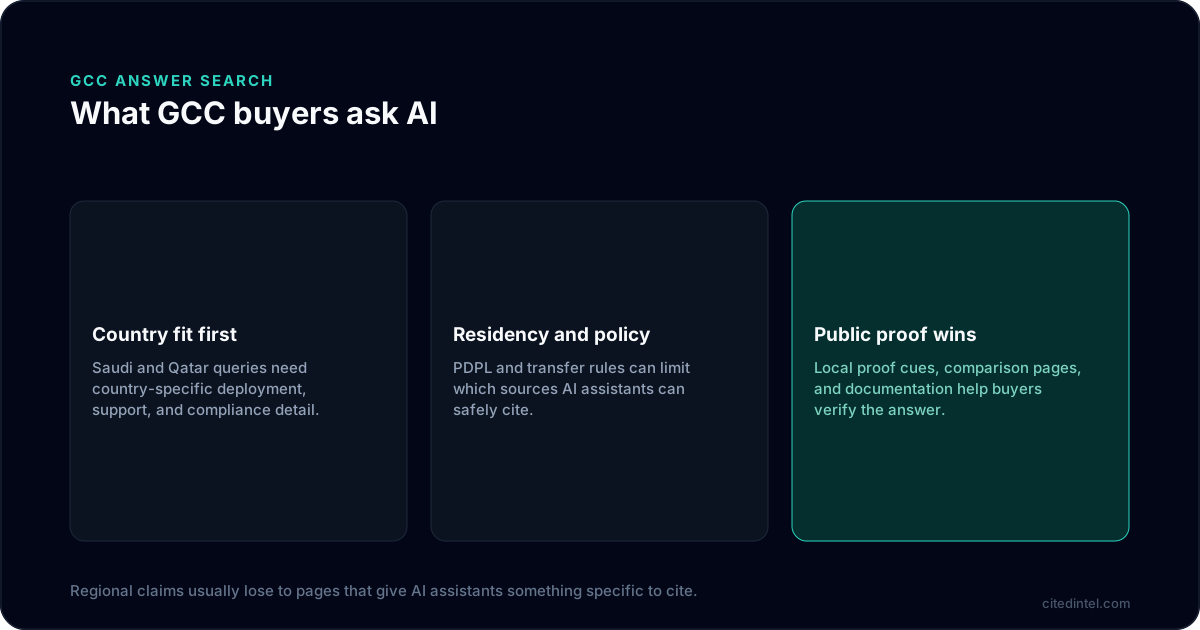
The region also has hard policy constraints. Saudi Arabia’s PDPL applies to entities processing personal data in the Kingdom and to data related to residents there, including some processing outside the Kingdom, and its transfer rules create a real answer-eligibility constraint for source material that depends on residency or data movement Saudi legal and regulatory framework, Saudi PDPL. Qatar’s personal data law also regulates processing and restricts cross-border transfer when it would violate the law or cause serious harm, which makes hosting posture and transfer language relevant in the sources AI can safely lean on Qatar legislation portal, Qatar Law No. 13 of 2016 text.
That frame matters because one regional brief rarely satisfies Saudi, Qatari, and UAE procurement at the same depth. A single page may name the category, but it seldom carries the country detail needed to win the same citation across markets. The sturdier pattern is one market page per priority country, with deployment language, support language, and a local proof cue the assistant can lift verbatim.
Platform updates keep confirming the same shift. Google says AI Overviews has become one of its most successful Search launches in the last decade and that query types showing AI Overviews are driving more usage, while overall organic click volume has stayed relatively stable year over year Google Search AI update, Google AI search update. OpenAI says ChatGPT shopping research is built to research deeply across the internet, ask clarifying questions, and produce a buyer’s guide from cited sources, with results based on public information rather than ads OpenAI shopping research. The implication is practical: the page has to read like evidence, not promotion.
What changed for buyers
Forrester’s 2025 buyer research says 94% of business buyers use AI, and twice as many buyers now rate AI-powered answers from chat or search as a more useful information source than anything else, ahead of vendor websites, product experts, and sales Forrester on zero-click buying. That is not a theoretical shift. It means your first job is not to write more copy, but to make the first cited page carry the market, category, and proof in one pass.
It means the prompt that forms the shortlist may be the first commercial interaction. If you sell CRM, HR tech, logistics software, martech, or healthcare SaaS into the Gulf, the first page that answers has to carry country, deployment, and proof signals the model can surface without guesswork. Build for the question behind the question: can this vendor work here, under these rules, with this team, and what page will prove it?
How buyers in Saudi Arabia and Qatar actually phrase prompts
GCC prompts are usually constraint-heavy. They combine category, country, language, compliance, and implementation details because buyers are testing whether a vendor can survive procurement, not just marketing.
Put that structure into your own pages. If your pages only answer broad category questions, the model has little to cite when someone looks for Saudi support, Qatar hosting, Arabic documentation, or a multi-country rollout. The quickest review is to check whether each market page names the deployment model, support language, and country-specific constraint in one scan. If any of those elements is absent, the page may still rank, but it is weak fuel for an answer engine.
- Saudi rollout: "Best HR software for a Saudi B2B company that needs Arabic support, payroll fit, and Microsoft 365 integration."
- Qatar compliance: "Which CRM is credible for a Qatar group that needs data handling clarity and local implementation help?"
- Multi-country logistics: "Best logistics software for a regional distributor operating in Saudi Arabia, Qatar, and Oman with fleet visibility."
- Martech fit: "What marketing automation platform works for Arabic and English campaigns across Saudi Arabia and Qatar?"
- Procurement detail: "Which vendor has the clearest documentation on residency, integrations, and onboarding for Gulf buyers?"
The recurring pattern is simple: the buyer is not asking whether you are a good company, they are asking whether you are a safe bet for this country and this workflow. If your copy sounds global and abstract, it is easy to skip, which means the answer engine has no reason to quote it back. A stronger move is to name the market, the use case, and the proof type together, so the model can quote one block instead of rebuilding the answer from separate pages.
Arabic and English both matter
In the Gulf, a buyer may compare vendors in English and then ask follow-up questions in Arabic about support, compliance, or contract language. That turns AI search optimization into a bilingual evidence problem, not an English SEO problem with a few extra keywords. A practical check is whether your Arabic page keeps the same product name, market terms, and proof points as the English page.
One clean Arabic comparison page, if it is genuinely useful, is often worth more than another polished slogan page. The assistant needs a source it can reuse, and it has to carry the same product name, market terms, and proof as the English version. A quick bilingual check is whether the Arabic page can answer the same buyer question without changing the category label or softening the constraint.
What live Gulf audits show
The signal is directional, not universal, but it explains why first-mention visibility matters so much in GEO and AEO. In practice, first mention is a proxy for which page the model found easiest to defend with evidence.
Methodology. The sample used here was limited to GCC-relevant prompts in Saudi Arabia and Qatar, plus wider Gulf prompts where the answer clearly applied to a multi-country buying context. The audit set spans product categories commonly bought in the region, including CRM, HR tech, logistics software, martech, healthcare SaaS, legal tech, and cybersecurity. The working audit was run in a mix of AI assistants during August 2026.
Worked example. Prompt: “Best HR software for a Saudi company that needs Arabic support and payroll fit.” Answer: “For Saudi Arabia, the strongest options are Vendor A, Vendor B, and Vendor C, because they have clearer local implementation and compliance documentation.” Citedintel source: Vendor A’s Saudi landing page and implementation documentation. The useful signal is not the brand list alone, but whether the answer can point to a source the model can trust.
The point of this block is not to romanticize measurement. It is to make the audit falsifiable, so a marketing lead can disagree with it, rerun it, and see what changed. If the same prompt keeps naming the same competitor first, that is a content signal that the page stack is missing a stronger proof cue, not a keyword problem.
The visibility problem most teams miss
Brands often assume SEO traffic means AI search optimization is healthy. In practice, a page may hold a strong position in search and still miss the shortlist because assistants favor a competitor with cleaner evidence and more explicit regional fit.
At this point, GEO and AEO become two separate tasks. GEO is the work of improving how often your brand shows up in AI answers for buying prompts, while AEO is the narrower task of becoming a source worth citing when the model has to answer at all. If those two goals are mixed together, teams ship pages that rank without being cited, or get cited without shaping the shortlist. The cleanest split is to ask whether the page earns mentions, earns citations, or manages both, then fix the weaker side first.
In payments infrastructure, the split shows up fast. A broad payments page can win clicks, while another vendor gets named in the answer because it has tighter documentation, a sharper comparison page, and clearer deployment detail. That is the gap between traffic and shortlist inclusion, and a quick read is whether your page states settlement, coverage, and compliance on the same screen.
| Buyer signal | What AI answers need | What weak content gives them |
|---|---|---|
| Country fit | Named markets, rollout details, support coverage | “Regional coverage” with no specifics |
| Compliance | Residency, transfer posture, governance language | Generic security claims |
| Implementation | Docs, onboarding steps, integration detail | Feature lists |
| Trust | Public proof, third-party references, clear entity signals | Homepage copy only |
The table looks plain because the work is plain. If the assistant cannot quickly map your brand to the category and the country, it will choose the source that makes that mapping easiest. A sharper check is whether your page states the market, the category, and the proof in the first screen, not three clicks later. That first screen should leave no ambiguity about where you operate and why the page belongs in a shortlist answer.
A practical GCC visibility sprint for AI answers
Prioritize the fixes that move you from vague to citeable. In the GCC, entity clarity and country-specific proof usually lift prompt coverage first, while comparison pages and documentation tend to move citation rate and shortlist inclusion. The simplest filter is whether a Saudi or Qatar prompt could identify your category, market, and proof without guessing.
Pick one measurable result for each change: either more prompts where your brand appears, or a higher chance that the answer cites your page instead of a competitor's. If the result is unclear after a week, the page change was too vague to move the answer layer.
| Priority | Fix | Minimum bar | What it tends to move | ROI line |
|---|---|---|---|---|
| 1 | Entity clarity | Consistent product name, category, and market language across site, review listings, partner pages, and social profiles | Prompt coverage | Raises the chance that a Saudi or Qatar buyer prompt connects your brand to the right category before shortlist formation. |
| 2 | Country page | One page per priority market with support, language, deployment, and local contact detail | Prompt coverage and citations | Makes it easier for AI answers to mention you for country-specific questions that influence pipeline early. |
| 3 | Comparison page | At least one explicit competitor comparison or one “best for” page with tradeoffs, fit, and exclusions | Citation rate | Helps you enter shortlist prompts where the buyer is choosing between named vendors. |
| 4 | Proof page | Public documentation on security, integrations, onboarding, policies, and support | Citation rate | Raises the chance that your brand is cited when the buyer asks for evidence, not just a polished pitch. |
Entity clarity means one thing: if a buyer or model asks “what are you?” the answer is obvious in one line. If you are a logistics software company, say that plainly. If you are healthcare SaaS, say that plainly. Do not make the model infer it from a feature menu.
For category depth, the same fix plays differently by sector. A martech vendor usually needs campaign language and bilingual workflow detail. A healthcare SaaS company needs documentation and data-handling clarity. A logistics software vendor usually wins by showing country rollout and operational fit.
The catch: if you have almost no public proof, the recommendation layer will not save you. You may need to publish the evidence first, then measure again.
A GCC prompt pass you can run by hand
Run this before your next content meeting. It gives you a visible answer-layer signal without turning the exercise into a spreadsheet project.
- Pick three markets: Saudi Arabia, Qatar, and one other GCC country that matters to your pipeline.
- Choose one category: pick the one you actually sell, such as HR tech, logistics software, martech, healthcare SaaS, or legal tech.
- Write six prompts: One best prompt, one comparison prompt, one compliance prompt, one implementation prompt, one Arabic prompt, and one multi-country rollout prompt.
- Test three assistants: Send each prompt through ChatGPT, Claude, and Gemini, then rerun the two most commercial prompts in Perplexity.
- Record the outputs: Capture the names, the first brand, the cited proof, the gap, and the next page to publish.
| Prompt | Assistant | Brands named | First brand | Citedintel proof | Gap | Action |
|---|---|---|---|---|---|---|
| Best HR software for a Saudi company that needs Arabic support | ChatGPT | Vendor A, Vendor B, Vendor C | Vendor A | Saudi implementation page | No Arabic support page | Publish Arabic support page |
| Which CRM is credible for a Qatar group that needs data handling clarity? | Claude | Vendor D, Vendor E | Vendor D | Security and policy docs | No Qatar-specific page | Create Qatar fit page |
| Best logistics software for Saudi Arabia, Qatar, and Oman | Gemini | Vendor F, Vendor G, Vendor H | Vendor F | Country rollout page | No comparison page | Publish comparison page |
| ما هو أفضل برنامج موارد بشرية في السعودية مع دعم عربي؟ | Perplexity | Vendor A, Vendor I | Vendor A | Arabic support page | Thin Arabic documentation | Expand Arabic docs |
| Best HR software for Qatar with onboarding detail | ChatGPT | Vendor A, Vendor B | Vendor B | Onboarding guide | Missing local proof | Add Qatar proof page |
| Best CRM for a Saudi company with Microsoft 365 integration | Gemini | Vendor D, Vendor A, Vendor E | Vendor D | Integration docs | Weak comparison page | Publish comparison asset |
When the workflow has to run at volume, your audit tool can automate the audit, diagnosis, and next-page recommendation without asking your team to rebuild the test set every week.
What to watch weekly after the sprint
Track four things, not twelve. Which prompts mention you, which brand appears first, what proof gets cited, and whether the answer changed after you published the fix.
That weekly view is enough to separate a content problem from an evidence problem. If your prompt coverage is low, you likely need clearer entity signals. If your citations lag behind mentions, the page needs better proof.
- Prompt coverage: Did your brand show up at all for the prompts that matter?
- First mention: Was your brand named first, or only after the competitor?
- Proof quality: Did the answer cite a page that actually helps the buyer decide?
- Market fit: Did the answer reflect Saudi Arabia, Qatar, or a wider Gulf rollout accurately?
In AI search, first mention is often the commercial battle. A committee rarely debates every option equally once the answer layer has already framed the shortlist. That makes the opening citation more than a vanity metric, because it often decides which vendor gets the next question.
What content wins the answer layer in GCC procurement
The content that wins is usually the least glamorous. It is the page a buyer can scan in under two minutes and still have enough evidence to keep going. In practice, that means the page answers category, country, and proof in the same visit instead of making the model assemble them from fragments. A practical test is whether the page still works as a standalone citation if the assistant never sees the homepage.
For GCC software vendors, the recurring winners are country pages, comparison pages, docs, and proof pages. That applies to CRM, HR tech, martech, logistics software, healthcare SaaS, and legal tech. The reason is mechanical: those page types give the model a market, a use case, and a proof trail in a form it can cite.
| Asset | Why it matters | Best use |
|---|---|---|
| Country page | Shows local support, language, and rollout fit | Saudi Arabia, Qatar, or wider GCC landing pages |
| Comparison page | Helps AI answers resolve shortlist questions | Us vs competitor or best-for pages |
| Docs | Supplies technical proof and implementation detail | Integrations, setup, security, compliance |
| Proof page | Makes claims citeable | Public policies, references, certifications, reviews |
In legal tech, that may mean governance detail and data-handling language. For logistics software, it may mean rollout and country coverage. For martech, it may mean Arabic and English campaign workflows, not another glossy platform overview.
As of August 2026, this is the kind of document-rich evidence environment where AI search engines tend to favor pages they can explain back to a buyer. The compound effect comes from making the page legible as a source, not just rankable as a result: a crawler can find it, but the answer layer still needs one line it can quote back, a market it can name, and a proof point it can reuse.
How I would sequence content for Gulf answer visibility
Begin with the country where pipeline already matters, then build outward from there. One strong Saudi page and one credible Qatar page usually beat five vague regional claims because the model has something concrete to attach to each market, plus a source it can cite without inventing the missing detail.
Do not treat SEO and GEO as separate universes. SEO still gets the page found. GEO and AEO decide whether the answer layer uses it when a buyer turns to an assistant for help, or when a model reaches for a source during comparison. The practical edit is to keep ranking pages, but add proof blocks that answer engines can quote back, such as deployment scope, support language, and transfer posture. If the page can only persuade a human after a sales call, it is probably too thin for the answer layer, so it needs a public proof block first.
If you already have decent rankings, use them as the base. Then add clearer entity language, sharper comparisons, better proof, and a weekly prompt check that records first mention, cited source, and market fit. The practical route to AI search optimization in the Gulf is to make the page easier for the model to defend than the competitor page, then verify it every week.
The winners here will not be the noisiest. They will be the ones the assistant can name, justify, and repeat to a committee without inventing the local details itself. That is why the strongest Gulf pages feel like source material, not campaign copy.
Frequently asked questions
How do I show up in AI search in Saudi Arabia and the GCC?
Start with clear entity language, then publish country pages, comparison pages, docs, and proof pages that answer Saudi, Qatar, and wider Gulf buyer prompts. The article argues assistants cite brands that can prove residency, compliance, implementation, and regional fit.
What is the best GEO strategy for B2B software in the Gulf?
Use a weekly GEO routine: track buyer prompts, monitor which brands assistants name, and turn evidence gaps into pages you can publish. The fastest wins usually come from adding country-specific proof and comparison content, not from rewriting homepage copy.
Why do competitors get recommended instead of my brand in AI search?
Because assistants favor brands with clearer regional evidence, stronger documentation, and more explicit country fit. If your site only says 'regional coverage' or 'trusted by enterprises,' the model has little to cite.
What content helps with AI search optimization in the GCC?
The article points to four asset types: country pages, comparison pages, docs, and proof pages. Those are the pages that help answer committee-style procurement questions about support, compliance, integrations, and rollout fit.
Should I optimize for Arabic or English AI search prompts?
Both. The article says GCC buyers may mix English category terms with Arabic operational detail, or switch languages entirely depending on the question. One strong Arabic comparison page can matter more than a pile of generic English slogans.