
AI search can put a rival on the shortlist before your brand is mentioned, so the demo request arrives after the decision has already started. For example, ChatGPT can surface “best payroll software for a 200-person company in the UK” before your brand enters the discussion.
Shaping your site so assistants have a defensible reason to name your brand is the heart of generative engine optimization, and it pairs with answer engine optimization in the United Kingdom because buyers use assistants to compare options, narrow choices, and check explanations before they click. As of August 2026, that behavior is mainstream: Ofcom says 54% of UK adults use AI tools such as ChatGPT, and its 2025 research shows ChatGPT logged 1.8 billion UK visits in the opening eight months of 2025, compared with 368 million over the same stretch of 2024.
AI search adoption in the UK
AI-assisted research is now routine in the United Kingdom, so AI search optimization has to be checked alongside classic SEO. The practical question is whether your brand surfaces when UK buyers ask assistants to compare vendors, narrow choices, and explain the tradeoffs.
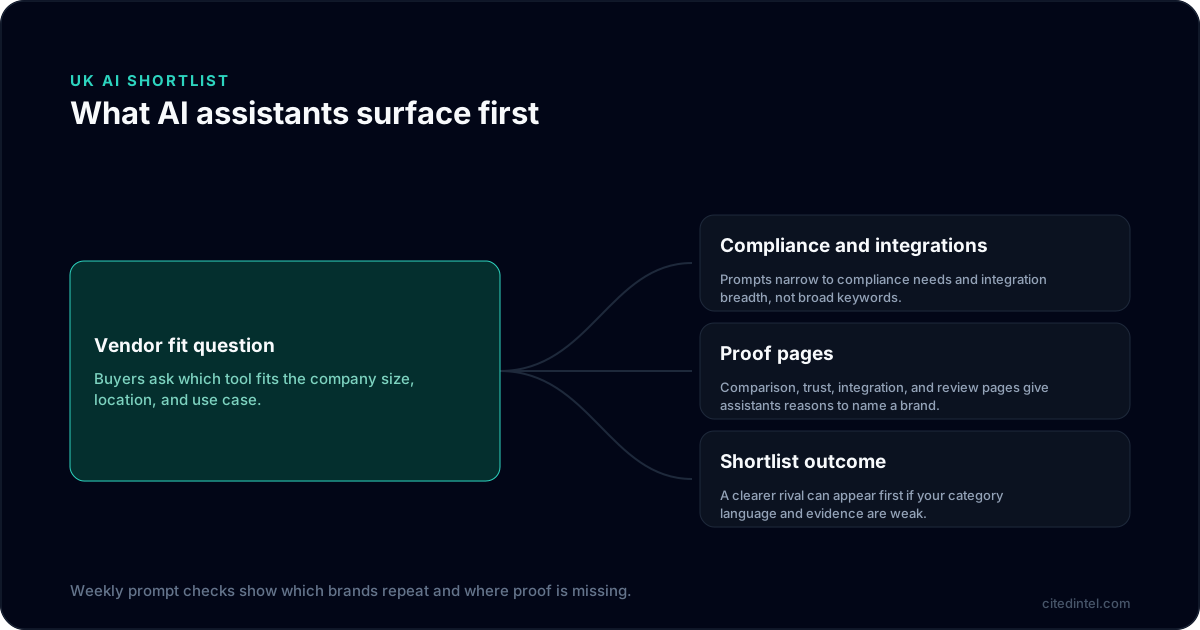
Ofcom’s GenAI search research says UK adults already use generative AI to compare options, narrow choices, and seek explanations. That matches B2B buying closely, because a PMM, growth lead, or founder is rarely asking for trivia when they use an assistant. They are asking which tool fits, which one has proof, and which vendors are safe enough to shortlist. The implication is simple: answer the fit question first, then back it with proof the engine can quote.
In my read, the UK is one of the clearest early GEO markets because the buying base is dense in mid-market software, fintech, and agency-led procurement. That creates repeatable prompt patterns around implementation risk, integration breadth, compliance, and vendor credibility. If you sell into the UK and your category language is fuzzy, AI answers will pick a clearer rival. The practical edge is not volume, it is having one page that says what you are for in language a buyer would use.
What changed recently
Two changes matter for GEO in the UK. First, Google says AI Overviews now drive more than 10% growth in searches where they appear in its biggest markets, which means the answer layer now behaves like part of search, not a bolt-on feature. Second, Microsoft is positioning Copilot’s newer research features for in-depth analysis and decision support, which means procurement teams can use assistants before they reach your site.
That shifts the work for UK marketers. Classic SEO still matters, but rankings alone do not reveal when the answer layer names you, skips you, or hands the slot to a rival with cleaner proof. A VP of Marketing at a scaling software company needs both lenses, because the recommendation now arrives before the visit.
| What UK buyers do | What that means for GEO | What to track |
|---|---|---|
| Compare vendors in ChatGPT, Claude, Gemini, and Copilot | Build pages that answer comparison and proof questions directly | Brand mentions, position in the answer, and which rivals appear |
| Use AI to narrow a long list before visiting sites | Make your category and fit obvious in the first paragraph | Prompt families that trigger citations |
| Ask for explanations and source-backed reasoning | Publish evidence the engines can quote and check quickly | Missing proof points and weak citations |
The UK lesson is blunt. If you only optimize for the blue link, you are optimizing for the second decision, not the first one. The first decision is whether the assistant names you at all.
What buyers type in the UK
Real UK prompts are usually narrower than broad SEO keywords. They include company size, location, compliance pressure, implementation constraints, or a local business model. UK GEO becomes winnable when the query itself carries the buying filter, because the prompt already signals which vendor profile belongs in the answer. The better check is whether the query gives the engine enough context to separate one buyer profile from another without your brand name.
- HR software: “best HR software for UK companies with offices in London and Manchester” or “HR platform for multi-location hiring and holiday approval.”
- Payments: “payments infrastructure for UK fintechs that need Faster Payments and strong compliance.”
- Logistics tech: “software for UK logistics teams that need route planning, driver tracking, and ERP integration.”
- Cybersecurity: “best cybersecurity platform for UK mid-market firms with small internal IT teams.”
- Martech: “martech tools for B2B SaaS teams in the UK that need attribution and HubSpot integration.”
- Product analytics: “product analytics software for a London startup comparing event tracking and warehouse support.”
- Developer tools: “developer tools for UK SaaS teams that need docs, API stability, and pricing clarity.”
- Legal tech: “legal software for UK teams that want contract review, audit trails, and low admin overhead.”
- Healthcare SaaS: “healthcare software for UK clinics that need booking, patient records, and trust signals.”
These prompts matter because AI answers reward specificity. A generic “best software” page gets filtered quickly. A page that echoes the buyer’s phrasing, UK spelling, and procurement constraints is more likely to be reused, because it gives the assistant a clean fit signal for the comparisons buyers are already asking for. Before publishing, look for one constraint that repeats in the prompt and make that the lead line. If the page still sounds like a scaffold instead of a buying answer, it is not ready to be cited.
Why brands still disappear in AI answers
Brands disappear in AI answers when a competitor has clearer evidence, cleaner entity coverage, or more obvious fit. In the UK, that usually happens before the marketing team realizes the recommendation engine has taken over the shortlist.
Many teams make the wrong diagnosis here. They blame low organic traffic, but the real problem is that the assistant named someone else first. Bloomberg’s reporting in 2025 captured the measurement pain well, because site owners struggled to separate AI Overview effects from broader search changes, and the same blur now applies to GEO in the UK unless you track prompt-level mentions on the same fixed queries each week.
What usually drives a mention
In UK B2B software, the brands that show up most often usually have one or more of four things in place. If you want to win recommendations in chat-based research, these are the assets that matter first: a review footprint the model can trust, comparison pages that separate you from rivals, consistent entity language, and proof pages that remove ambiguity.
- Review gravity: visible third-party reviews and public proof give the engine a stable name to reuse.
- Comparison pages: direct vendor comparisons make the category and the tradeoff easy to quote.
- Entity coverage: consistent brand, product, and category language reduces ambiguity.
- Structured proof: integrations, pricing cues, implementation detail, and feature pages give the answer engine something concrete to lift.
A London agency lead usually sees this up close. One client’s homepage says “platform,” another says “suite,” and the review pages use a different category label entirely. AI answers resolve that confusion by choosing the brand with the simplest story.
Broad thought leadership often loses to a rival’s unglamorous comparison page. The answer engine is not rewarding volume. It is rewarding clarity.
Where the evidence matters most in the UK
The proof stack shifts by category, but the pattern stays stable. UK buyers want to know if the tool fits local processes, local risk, and local decision-making. Use that as a filter: if a proof page does not help an assistant answer those three checks, it is not doing GEO work yet. A useful test is whether the page names the local process, the local risk, and the buying constraint in plain language.
| Category | What UK AI answers tend to reward | What to publish first |
|---|---|---|
| Fintech and payments | Compliance language, control, ecosystem fit, and local payment rails | Comparison pages and trust pages with precise terminology |
| Logistics tech | Scheduling, routing, invoicing, ERP integration, and rollout detail | Use-case pages and integration pages |
| Martech | Attribution, CRM sync, reporting depth, and implementation clarity | Competitor comparisons and integration hubs |
| HR software | Multi-location workflows, payroll adjacency, and admin simplicity | Feature pages mapped to buyer questions |
| Legal tech | Low ambiguity, authority, and auditability | Careful category pages and evidence pages |
Google’s own guidance still points the same way: good AI visibility comes from unique, satisfying, non-commodity content. Generic “UK software” copy rarely earns citations because it does not give the system anything local, specific, or checkable to repeat. A tighter test is whether the paragraph still makes sense after swapping in a rival’s name. The right page should leave the model with one clear entity, one buying use case, and one piece of proof it can repeat.
Tracking AI search optimization in the UK market
Track AI search optimization in the UK by watching who is named, in which prompt families, and in what position inside the answer. This weekly view tells a marketing team whether the brand is being recommended or quietly skipped.
The useful unit is a prompt set, not a vanity score. A demand gen lead at a software company should care whether a specific UK buying query returns the right brand names, not whether a dashboard looks busy.
Weekly UK prompt watchlist
Keep the list short and repeatable. The point is to spot movement before the sales team hears competitor objections in the first call. Use one fixed prompt set, keep the wording unchanged, and compare the same assistants on the same weekly cycle so you can tell whether a page change actually moved the answer layer. Treat it like a smoke test: if the same prompt keeps returning the same rival, the page still needs work. The goal is not broad coverage, it is a stable read on one buying question at a time.
- Buyer prompts: the UK query patterns your category attracts at your deal size.
- AI share of voice: how often your brand appears across that fixed prompt set.
- Competitive pulse: which rivals keep appearing alongside you.
- Evidence gaps: the missing review, comparison, integration, or trust page behind a weak result.
Read the trend over weeks, not one-off sessions. AI results can wobble, especially in categories where the language is still forming. A three-week flatline in the same prompt set usually means your pages are not being used, or your category wording is too vague to hold. The practical response is to tighten the page assigned to that query before you add more content elsewhere.
AI search analytics differ from classic SEO reporting in one important way. Search rankings can look healthy while answer-layer visibility is weak. If the assistant is recommending someone else, the shortlist is already tilting away from you.
How to read the findings
Three patterns matter more than raw mention volume. First, lead mentions beat fallback mentions. Second, mentions that line up with your clearest category are more valuable than broad mentions. Third, the same rival appearing repeatedly is usually a content problem, not a random model quirk. That gives you a simple triage rule: fix the page assigned to the query, then check whether the competitor still anchors the answer.
For a fintech founder selling into the UK, that distinction matters. If the same regulated competitor keeps getting named, your homepage probably needs clearer category language, and your trust pages probably need more evidence that an engine can cite cleanly.
One candid limitation: if your category is very new, AI answers may be noisy for a while. In that case, a weekly read is still useful, but the conclusions should stay tentative until the prompt language settles.
What to prioritize before anything else
Start with pages that answer buying questions, not pages that merely describe the category. UK buyers usually ask who is safe, who integrates, and who has enough proof to survive internal review.
If you manage content for a UK B2B SaaS company, the first fixes are usually comparison pages, integration pages, and trust pages. Those three page types give answer engines the most usable material in the shortest time.
A practical priority order
Use this sequence when the team has limited bandwidth. It is the fastest way to make GEO visible without rewriting the whole site at once: choose the page built to answer the buying query, then support it with the proof the assistant can quote. If two pages compete for the same query, choose one owner and fold the weaker paragraph into it. One prompt, one owner page, one set of evidence links.
- Fix entity coverage: keep the brand, product, and category names consistent across the site, review profiles, and third-party references.
- Publish comparison content: answer the question buyers actually ask, including who you are not for.
- Add evidence pages: surface integrations, compliance language, customer proof, and implementation detail.
- Refresh stale pages: update the pages that still describe last year’s product shape or old packaging.
- Brief sales: share the rivals and objections that AI answers keep surfacing.
Many UK teams overinvest in top-of-funnel education and underinvest in proof. That tradeoff looks tidy in a content calendar, but it loses answer share because assistants need pages they can quote, compare, and map back to a real buying problem. The fix is not more commentary, it is more pages that carry product evidence, comparison language, and implementation detail, so the answer layer has something concrete to reuse in one prompt family at a time. Start by asking which page would still help if a buyer stripped away the brand name and asked only for the buying decision.
The best pages in this category answer the next buying question inside the page, not after a click back to search. That means one page should settle fit, proof, and next step without making the assistant hunt across the site. If the answer needs three pages to feel complete, the assistant will usually borrow from a cleaner rival instead.
The ROI bridge from mention rate to pipeline
GEO does not need a fantasy attribution model to justify it. You need a conservative bridge from mention rate to the funnel stages you already measure.
Use this logic with a UK sales leader: when the brand appears more often in high-intent answer sets, more buyers reach the site already primed with your name. That shifts the sales conversation before the first demo, even if the final conversion path still includes human review, procurement, and comparison work.
| Visibility change | Likely effect | What sales hears |
|---|---|---|
| Brand starts appearing in comparison prompts | More qualified visitors and fewer cold introductions | “We saw you in ChatGPT and wanted to check fit.” |
| Rival stops dominating the answer set | Less objection pressure at the start of the call | Fewer repeated competitor name checks |
| Trust pages become more citeable | Higher confidence before the demo | Questions shift from “are you credible?” to “how do you implement?” |
The case is strong enough to justify the work internally. You are not promising attribution that nobody can verify. You are showing that AI answers shape which brands get discussed first, which is a real commercial advantage.
When a UK agency reports to a client, this is the clean way to frame it: AI answer visibility affects who enters the shortlist conversation, but the revenue effect still depends on product fit, sales execution, and the rest of the funnel.
A quick UK answer check for this week
A useful GEO audit starts smaller than most teams expect. The point is not perfect coverage, it is to see whether one UK prompt family keeps returning your brand or a rival. Keep one note template and one rule for what counts as a mention so the read stays comparable week to week.
- Pick one prompt family: choose one UK category and one buyer question, for example “HR software for UK companies with multi-location hiring and holiday approval.”
- Test three assistants: run the same prompt across your chosen assistants, then note the first three brands named in each.
- Tag the reason: mark each mention as driven by reviews, comparison pages, entity clarity, structured proof, or general authority.
- Score your own brand: give your brand 1 if it is named and 0 if it is absent, then note whether it appears first or only after alternatives.
- Rewrite one page: update the page that best matches the prompt, then run the same prompt again the next day.
Do that every week and you will see which page types move the answer layer. Citedintel turns the manual check into a broader AI search monitoring workflow when the prompt set gets too large for a spreadsheet, while keeping the same prompt family and note structure intact.
What the manual path costs
The manual version is workable, but it takes time. A small team can spend 30 to 60 minutes per prompt family once you include running the queries, logging results, and discussing the gaps with content and sales. That is why the process works best when one owner keeps the prompt set fixed and records only the names, citations, and missing proof points, so week-over-week reads stay comparable instead of turning into a pile of one-off observations.
That time cost is acceptable for a one-off check. It becomes painful when you want to watch a fixed set of UK prompts every week, across multiple assistants, and keep the notes organized enough to act on, which is why the same prompt family should always carry the same note fields and mention rules.
What UK teams should stop doing
Stop writing as if the first job is the click. In UK GEO, the first job is to become the brand the answer engine trusts enough to name, compare, or cite.
That means comparison pages need sharper tradeoffs, product pages need cleaner entity language, and PR needs proof points a model can reuse. If a page sounds built for internal approval instead of buyer judgment, assistants will usually pass it over.
Three local anti-patterns
These are the mistakes I see most often in the UK. They are easy to make and hard to recover from once a rival becomes the default answer.
- Generic UK pages: publishing mass-made “UK software” pages with no local evidence, no local spelling, and no buying context. Google’s AI experiences and other answer engines increasingly filter machine-sounding copy.
- London-only vanity: assuming a London office mention is enough. In the UK, buyers care more about proof, fit, and implementation detail than office prestige.
- Agency echo: publishing content that sounds like a pitch deck instead of a buyer answer. That tone gets skipped in AI Overviews and in chat-based research.
Content cannibalization is the other trap. If a regional page, a category page, and a blog post all try to answer the same prompt, they split the citation and weaken each other. Consolidate the winner, merge the overlapping paragraphs, and assign one page the main job.
The AI-slop trap is real in the UK because the market now has enough AI-written material to make machines wary of machine-sounding pages. The pages that earn citations are the ones with actual evidence, clear local language, and a reason to exist beyond ranking a keyword.
One more thing I keep telling teams: do not publish a separate regional page just because the country name is available in a template. If the UK page adds no UK-specific buying language, it is dead weight. The page has to earn its existence by changing the prompt answer, not by repeating the same claims with a flag in the header. A better regional page names local constraints, local proof, and local reasons to choose you, then gives the assistant one region-specific answer to reuse, such as compliance wording, rollout detail, or a local integration cue.
How UK teams should use AI-answer intelligence with sales
Sales teams use AI-answer intelligence best when it shows which competitors are appearing in buyer conversations and which proof points are missing. That gives the account team a cleaner opening, without pretending the assistant caused the deal.
A practical handoff looks like this: marketing shares the prompt set, the names that keep recurring, and the questions that trigger your strongest citations. Sales uses that to shape objection handling, demo framing, and follow-up language.
This is especially useful in the UK mid-market, where procurement often wants reassurance before a formal evaluation even starts. If the assistant already positioned a rival as the safer choice, sales needs to know that before the first call.
Citedintel’s value here is simple: it helps you see whether your brand is present in the answer layer and where the missing evidence sits, so sales can work from reality instead of assumptions. That is the right level of truth for a team selling software into the United Kingdom.
Run a free audit if you want the first pass on the UK prompt set, or use the comparison hub if you are choosing a GEO tool for a broader rollout.
Comparing options first? The ranked list of GEO checkers, trackers and analysis platforms covers published pricing for all ten tools.
Related reading
- Generative Engine Optimization Strategies to Increase Leads for UK B2B SaaS
- How to Measure AI Search ROI: Attribution When Buyers Ask AI First
- Why AI search shortlists keep recommending the same brands
Frequently asked questions
How do I show up in AI search in the UK?
Start with the prompts your buyers actually ask, then build the pages those assistants can quote. The article says comparison pages, trust pages, integration pages, and consistent entity language are the fastest way to get named. Track the same prompt set every week so you can see whether your brand appears first, appears late, or is missing.
What is the best AI SEO tool for GEO tracking?
The article does not rank tools, but it does say you need a fixed prompt set, repeated weekly, across assistants like ChatGPT, Claude, and Gemini. If the prompt list gets too large for a spreadsheet, Citedintel is positioned as the monitoring layer that turns manual checks into a broader workflow.
Why does my brand keep disappearing from AI answers?
The usual reasons are weaker proof, fuzzier entity coverage, or a competitor with clearer category language. In the article, the brands that keep getting named tend to have reviews, comparison pages, structured proof, and consistent naming across the site and third-party references.
What should UK B2B teams publish first for GEO?
Publish the pages that answer buying questions, not just category pages. The article recommends starting with comparison pages, integration pages, and trust pages because they give answer engines the clearest material to cite.
How do I measure AI search optimization?
Use a small, repeatable prompt family and track who is named, in what position, and which rivals show up with you. The article also suggests tagging each mention by the reason it appeared, such as reviews, comparison pages, entity clarity, or structured proof.