
In Singapore B2B buying, AI assistants can shape vendor shortlists before a brand gets any website click. If assistants leave your brand out of those answers, analytics can look healthy while the real shortlist hardens elsewhere.
Winning that layer means getting your company named, framed, and trusted inside the answers that shape vendor selection. Generative engine optimization covers that discovery work across answer surfaces, while answer engine optimization is the narrower task of making an assistant pull the right facts from your pages without drift.
Why Singapore is where the first AI shortlist gets formed
Singapore often becomes the place where a regional software decision turns into an AI answer. A buyer asks in English, compares two or three vendors, then carries that pattern into Malaysia, Indonesia, Thailand, Vietnam, or the Philippines.
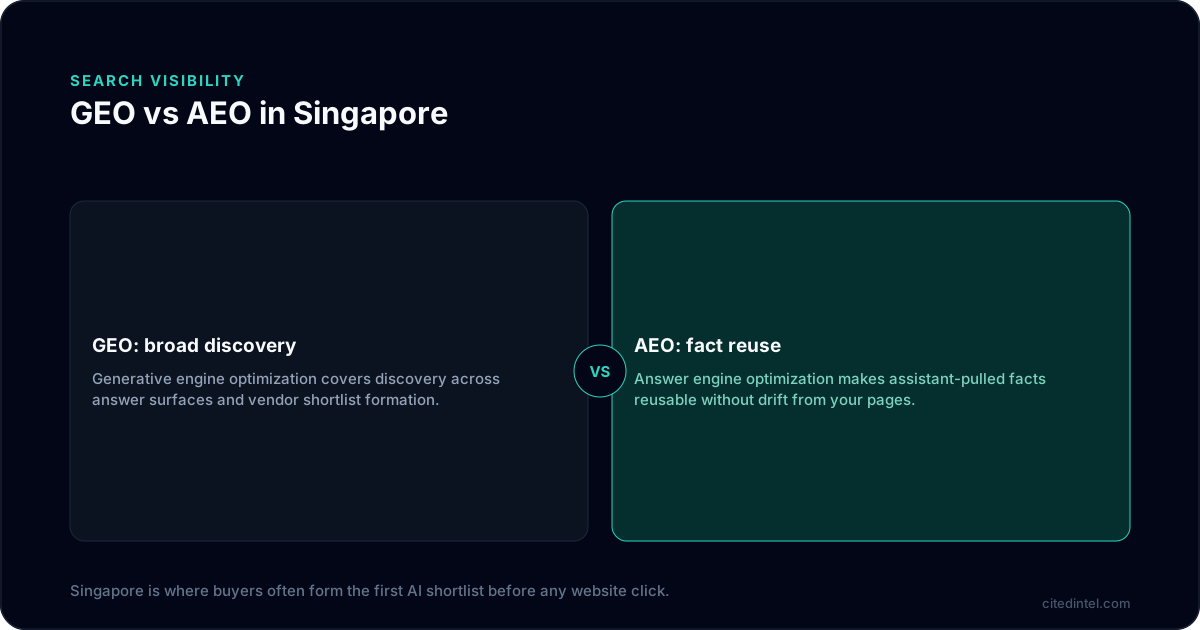
Singapore deserves attention for GEO and AEO because the regional shortlist often takes shape there before anyone reaches a final click. If your brand is missing from that moment, the deal can drift before your team ever sees the visit.
My take: Singapore matters less because it is “important” and more because it concentrates HQ buying, comparative research, and evidence-heavy procurement in one place. That concentration makes it a useful stress test for answer coverage: if a buyer can compare vendors cleanly here, the same page structure often travels across regional evaluation.
OpenAI’s ChatGPT Search announcement and usage study point to answer-seeking and source-linked research moving into the main research workflow, not staying on the margins.
AI search optimization in Singapore
AI search optimization, measured properly, is the portion of buyer prompts where your brand is named, described correctly, and recommended for the right problem. It only matters if you can test it against a fixed prompt set and compare results across AI assistants.
Measurement here is a weekly prompt ledger, not a brand feeling. If you show up in broad prompts but disappear when the prompt mentions Singapore HQ, SEA rollout, or procurement criteria, the visibility is not yet useful for buying decisions in Singapore.
GEO reaches farther: it aims to earn mentions and recommendations inside AI-generated research and comparison responses, while answer engine optimization stays closer to the mechanics of helping the assistant pull the right facts from pages the model can trust without friction.
What buyers in Singapore ask
These are procurement-shaped prompts, not casual curiosity. For a B2B software company, this is the level of specificity your comparison pages, proof pages, and docs need to answer.
| Category | How a Singapore buyer may phrase it | What the assistant needs to answer well |
|---|---|---|
| HR tech | “What HRIS tools are easiest to roll out for a Singapore HQ with employees in Malaysia and Indonesia?” | Country support, implementation boundaries, proof of rollout |
| Martech | “Which martech stack is best for a regional B2B team in Singapore that cares about attribution and email deliverability?” | Use-case fit, comparison pages, reporting depth |
| Logistics tech | “What logistics software do Singapore operators use for cross-border shipment visibility into Malaysia and Vietnam?” | Cross-border workflow fit, API docs, proof from similar operations |
| Product analytics | “What product analytics tool should a SaaS team in Singapore use if product and engineering need self-serve dashboards?” | Docs depth, event modeling guidance, pricing transparency |
| Legal tech | “Which contract review tools fit a Singapore legal team that needs audit trails and access control?” | Compliance pages, workflow fit, trust language |
The recurring structure is category, Singapore context, and constraint. In practice, assistants tend to reuse comparison pages, docs, implementation notes, and evidence pages more than polished brand copy, so those pages need to surface the tradeoff in the same language buyers use, with the constraint stated early in the page.
The current buying shift
B2B buyers are already using generative AI as part of the buying journey, and that changes what content needs to do. Microsoft Research, June 2026 found that people use M365 Copilot for information retrieval, analysis, decision making, and strategizing, which makes trusted and myth-busting content more important.
That is not fringe behavior. It means your category page is no longer competing only with search results, it is also competing with the answer surface buyers consult before they click.
McKinsey’s analysis of AI-powered search argues that AI summaries are now a mainstream discovery channel and that roughly half of Google searches already surface AI summaries, which is why GEO complements SEO rather than replacing it.
In OpenAI, May 2026, the company said work-related usage on personal accounts became more consistent, with research-heavy tasks like information retrieval among the fastest-growing uses. That is a good sign that buyers are bringing AI into discovery and evaluation earlier in the process.
My take: if your content strategy still treats AI answers as experimental, you are already late. The answer surface now sits inside ordinary research behavior, including for buyers in Singapore and other markets where vendor selection starts with a question and a shortlist, not a click.
What to track every week
Track prompts, mentions, competitor framing, and evidence gaps every week. If the report cannot change what you publish next, it is just a scorecard, not a decision tool. The useful output is a publish queue tied to the missing asset, not a vanity report.
Use at least 12 live prompts per category, split across Singapore HQ, SEA rollout, and procurement questions. Treat a weekly drop of more than two assistant mentions across that prompt set as a publish or refresh signal, not background noise. Keep the prompts stable so you can tell whether a content change moved the answer or only changed the wording around it.
- Buyer prompts: Keep one fixed set for each category, then add market-specific variants for Singapore HQ and neighboring markets.
- Assistant coverage: Record whether an AI assistant mentions your brand, then note position and framing, not just presence.
- Evidence gaps: List the missing asset that blocks recommendation, such as a comparison page, security page, integration page, pricing context, or regional rollout page.
- Action rule: If three of ten prompts cite a competitor more clearly than your brand, treat that as a publish-now signal.
Use that visibility reading as a proxy for what the market is learning before sales gets involved. Read it alongside prompt themes, competitor framing, and missing proof, since the metric is directional and should never be mistaken for closed-loop attribution. If the same missing proof keeps appearing, that is the next page to ship.
Singapore-specific GEO moves that actually help
To improve generative engine optimization in Singapore, make your company easier to identify, simpler to stack against alternatives, and easier to trust. The fastest lift usually comes from content and evidence work, not from recycled search advice or more blog volume, because assistants need a clear entity, a clear tradeoff, and a page they can cite.
1. Tighten entity clarity first
Your homepage is not enough. AI answer engines need to connect your brand to a category, a geography, and a real problem without guessing, especially when a Singapore buyer is comparing vendors for a regional rollout.
Use consistent wording across your site, including profiles, partner pages, and speaker bios. If you sell payments infrastructure in Singapore, state that clearly. If you work with regional HR teams, say that clearly as well.
2. Publish comparison and shortlist pages
Comparison content is often the cleanest way to help an assistant explain fit. A Singapore buyer asking about CRM, HR tech, cybersecurity, or product analytics wants a shortlist, not a manifesto, so the page should name the rival, the decision criterion, and the deployment limit.
Use a comparison page when two conditions are true: the category has at least two credible alternatives, and your sales team already hears the same comparison question more than once a month. If you cannot state the tradeoff in one sentence, the page is probably too early. A useful test is whether the opening line can name the decision criterion before the assistant does.
Why AI search shortlists keep recommending the same brands explains the broader pattern. In Singapore, the practical version is simple: the page that names the tradeoff, the deployment constraint, and the evidence set is the page assistants are more likely to reuse.
3. Build evidence pages, not just feature pages
AI systems and procurement teams both need sources they can quote without guesswork. In Singapore, that often means security pages, implementation guides, integration notes, pricing context, and local compliance language that spell out scope and limits, plus a line on where the product should not be used.
A martech vendor with a clear deliverability page, or a logistics platform with a clear cross-border workflow page, can win more answer coverage than a brand with a more polished homepage. That is not because the homepage is useless, it is because proof pages answer the next question faster.
4. Refresh the pages buyers validate
Freshness matters in Singapore because regional buyers are used to comparing current evidence. Update the pages that speak to integrations, regions served, pricing details, docs, and support model.
My take: if a page can be used in procurement, review it at least monthly, and if it is a comparison or integration page, check it every two weeks against the questions buyers keep repeating. Stale proof is one of the easiest ways to lose AI search optimization without noticing, especially when the assistant reuses older wording from a page buyers no longer trust.
5. Earn third-party proof where buyers already check
Review sites, partner ecosystems, trade publications, and analyst mentions still matter because assistants pull from sources outside your site. If you are invisible there, you are making the answer engine do too much of the work.
For a Singapore team, that is especially true when the buyer needs regional credibility. A vendor with clear third-party references is easier to recommend than one that only explains itself.
What this looks like by category
The proof that works in Singapore changes by category. A PMM selling product analytics needs different evidence than a founder selling logistics tech or legal software, because the procurement questions are different.
| Category | What buyers care about in Singapore | Content AI can reuse |
|---|---|---|
| Product analytics | Self-serve setup, event modeling, engineering load, pricing clarity | Docs, implementation guides, comparison pages, FAQ on tracking and governance |
| Payments infrastructure | Local payment methods, regional expansion, reliability, compliance language | Integration docs, country coverage pages, security and operations pages |
| Logistics tech | Cross-border visibility, APIs, warehouse or shipment workflow fit | Use-case pages, API references, regional rollout pages, comparison content |
| Healthcare SaaS | Data handling, patient workflow fit, trust, rollout support | Security pages, implementation notes, feature pages tied to workflows |
| Legal tech | Access control, audit trails, contract review workflows | Compliance pages, demos, workflow pages, buyer-friendly FAQs |
For product analytics, docs depth usually matters most. For logistics tech, regional rollout clarity often matters first. For healthcare SaaS, the trust layer has to be obvious before an assistant can recommend anything with confidence.
A single content template rarely works across categories. The real test is whether your content answers the next procurement question in the language the assistant can reuse.
A hands-on Singapore prompt check
Run this by hand before your next content meeting. You can spot the first gap without opening a dashboard.
- Reuse the same prompt set across a few assistants you already use.
- Test the prompts one by one:
- “Best [category] software for a Singapore-based team selling across Southeast Asia”
- “Which [category] vendors are simplest to roll out for a Singapore HQ with teams in Malaysia and Indonesia?”
- “Compare [your brand] with [top competitor] for a Singapore buyer who needs evidence before purchase”
- “What should a procurement team in Singapore ask before choosing [category] software?”
- For each response, record four items: whether your brand is mentioned, where it appears, what proof is cited, and which competitor gets framed as the safe choice.
- Circle the missing asset you can publish first: comparison page, security page, integration page, pricing page, or regional rollout page.
One neutral option is to use a repeatable prompt-check workflow in our platform, then move from detection to publishable fixes. The useful output is a publish queue keyed to the missing asset, not a dashboard that only reports mention counts.
How this helps sales without pretending attribution is neat
AI answer intelligence helps sales in Singapore by showing what the buyer may already believe before the call starts. That matters because many deals arrive pre-shaped by assistant recommendations, which means the rep is often responding to an existing narrative instead of starting one.
Share the prompts, the competitors that keep showing up, and the evidence buyers trust. Do not oversell this as closed-loop attribution unless you can prove it.
The practical value is simpler: marketing can hand sales a monthly view of what the market is seeing, which objections are likely to surface, and which competitors are getting the most favorable framing. That is more useful than a battlecard that only lists talking points, because it tells reps which proof page to send before the first call.
Closer to the register, OpenAI’s Shopping Research and product discovery updates make that direction hard to ignore in 2025. For a Singapore HQ buyer, that means the first shortlist can be formed before sales ever gets a meeting request, so proof pages have to do the early work instead of waiting for a demo request. If your site cannot answer the comparison, pricing, or rollout question, the assistant will supply the missing answer itself.
Where this stops working
Pause AI search optimization work if your category page is unclear, your positioning is still shifting, or your site is blocking crawlers in obvious ways. Fix the basics first.
That limitation matters because a weak website gives answer engines little to work with. If the brand, category, and proof are muddy, the assistant may still mention you, but it will not reliably frame you the way you want.
Once the entity, docs, comparisons, and proof are in place, AI search optimization in Singapore becomes much more measurable. Without that foundation, the work is only guesswork dressed up as strategy.
Singapore is the gateway, but only within limits
Singapore is the Southeast Asia GEO gateway when a regional HQ uses one vendor decision to set the standard for three to five nearby markets. It is not a universal gateway for every category, and it matters less when buying is local, price-led, or tightly regulated by country.
The falsifiable version of the claim is simple. If your product sells country by country with little regional coordination, Singapore matters less as a gateway and more as one market among others, which changes how much weight you give to regional proof pages and comparison pages built for SEA rollout.
For software businesses that do sell regionally, the logic is straightforward: if you can win the AI answer in Singapore, you improve your odds of being included in the regional shortlist, and the same evidence work usually raises your AI search optimization elsewhere in SEA too.
Frequently asked questions
How do I show up in AI search in Singapore?
Start by making your brand easy to identify as a category fit, a geography fit, and a real use-case fit. Then publish comparison pages, docs, security details, pricing context, and regional proof that AI systems can quote. The article's core point is that answer engines reuse clear evidence, not vague positioning.
What is AI search optimization for B2B software?
It is the share of buyer-intent AI answers where your brand is mentioned, framed well, and recommended for the right problem. In B2B, that matters because buyers can form a shortlist inside ChatGPT, Claude, Gemini, Copilot, or Perplexity before visiting your site.
Why is Singapore so important for GEO?
Singapore is often the regional HQ and decision seat for Southeast Asia, so one answer can influence multiple country rollouts. The article argues that if you win the answer layer in Singapore, you often shape how a team evaluates software across the region.
What should I track every week for AI search optimization?
Track the actual buyer prompts, your share of voice in answers, which competitors get framed as safest, and the evidence gaps that repeat. The article recommends running the same prompt set across ChatGPT, Claude, Gemini, and Perplexity so you can compare how each one answers.
What content do AI assistants reuse most for Singapore buyers?
Comparison pages, implementation guides, security pages, integration notes, pricing context, and third-party proof come up repeatedly. Those assets make it easier for assistants to explain fit, risk, and rollout details to procurement-heavy buyers.