
Someone researching CRM in India can ask ChatGPT for “best CRM for Indian SMBs with INR pricing,” and your competitor can show up before your sales team ever hears the lead name. That is a costly miss, because the shortlist is already set when the visitor reaches your site.
Changing that outcome starts with shaping how AI assistants describe, compare, and surface your brand when Indian buyers research software. Generative engine optimization, or GEO, earns those mentions; answer engine optimization, or AEO, builds pages an assistant can quote without guessing once it finds you.
Where GEO wins in India, and where it does not
GEO wins in India when a buyer is comparing options, asking about pricing in INR, checking local fit, or trying to shortlist vendors without talking to sales yet. It has less leverage when the query is already branded, procurement-led, or tied to a known implementation path.
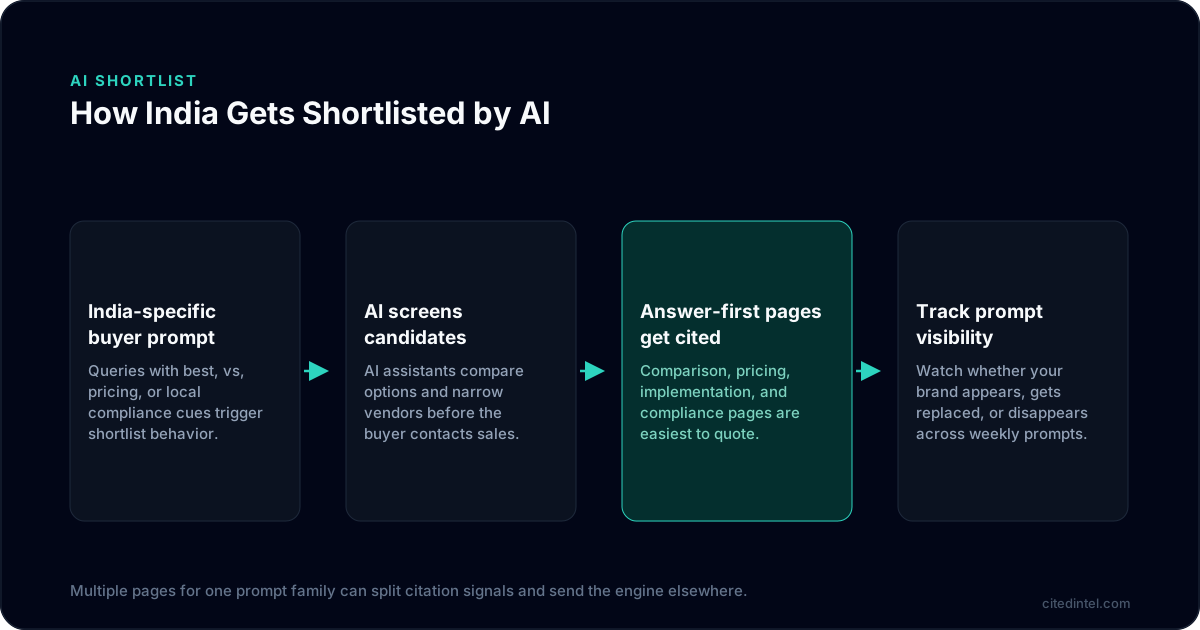
My view: that is the first filter Indian teams should use. A prompt like “best HR software for Indian startups,” “CRM pricing in INR,” or “DPDP compliant vendor” gives GEO room to shape the shortlist; a login, renewal, or support query sits outside that window and should not be counted as GEO territory.
The India-specific part matters. Buyers often ask a model to do the tedious filtering work they used to do with tabs and spreadsheets, especially in SMB-heavy categories where price, support, and setup time decide the shortlist. That is why OpenAI’s shopping research update and its March 2026 product-discovery note matter for B2B software too: the first pass now happens in ChatGPT, where the model sorts candidates, refines the filter, and narrows the list.
India is also a good place to take GEO seriously because AI use at work is already normal. Stanford HAI’s 2026 AI Index says India was among the countries where more than 80% of employees reported regular or semiregular AI use at work, while also showing a sharper rise in AI nervousness than many peers. That mix pushes buyers toward proof, comparison pages, and trust signals instead of loose brand claims.
One clean rule: if the prompt contains “best,” “vs,” “pricing,” “alternative,” “for Indian teams,” or a local compliance cue, GEO has room to win.
What the live audits show
Live audits of AI answers in India show a familiar pattern: a few brands get repeated, and many strong brands are mentioned once or not at all. That is what AI search optimization looks like before a team starts tracking it.
The useful reading is not “who has the biggest site.” The useful reading is “which brand does the model trust for this prompt family, and why.” For a product marketer inside a software company, that is the split between a homepage that looks healthy in analytics and a comparison page that actually makes the shortlist.
| India prompt family | Buyer intent behind the prompt | What usually gets cited | What usually loses |
|---|---|---|---|
| CRM | Who fits Indian SMB pricing and workflows? | Comparison pages with pricing, onboarding, and support detail | Generic feature pages |
| HR software | Which tool handles payroll, attendance, and local compliance? | Pages with Indian payroll and compliance proof | Global messaging without local proof |
| Payments infrastructure | Which vendor fits UPI, reconciliation, and finance workflows? | Implementation and documentation pages | Abstract platform language |
| Developer tools | What works with current stack, docs, and security review? | Docs, integration pages, and security pages | Brand-led claims with thin proof |
That table points to the core problem. Indian teams often publish for ranking, then wonder why AI answers recommend a competitor with thinner traffic but stronger evidence. The assistant is reading for proof, not for the page that looks best in a board deck or the page with the most polished headline, so the local detail has to be visible on the page itself.
The same pattern repeats in martech, logistics tech, cybersecurity, legal tech, and healthcare SaaS. The model favors the page that resolves the purchase question in the buyer’s language, not the page that sounds most like a manifesto, which is why a page with one concrete proof block often outperforms a polished brand essay.
How Indian buyers phrase AI prompts
Indian buyers usually prompt like they are trying to narrow a vendor list quickly, not like they are writing a keyword brief. They ask for price in INR, local compliance, Indian SMB fit, and the software stack they already use.
Those prompt patterns are winnable because they are specific. A broad category page can lose to a tighter comparison page that mirrors the question, names the local filter, and lays out the evidence in a format the assistant can quote without stitching together missing parts.
- CRM shortlist: “best CRM for Indian SMBs with INR pricing and WhatsApp support” usually needs a comparison page with pricing, support, and workflow detail.
- HR software check: “HR software for India with payroll and attendance” usually needs a page that names payroll handling, attendance flows, and compliance coverage.
- Payments evaluation: “payment gateway for SaaS in India with recurring billing” usually needs an implementation page or a comparison page with recurring payment and reconciliation language.
- Logistics tech fit: “best logistics software for Indian D2C brands” usually needs a category-fit page with dispatch, returns, and tracking detail.
- Cybersecurity review: “DPDP compliant security vendor for Indian startup” usually needs a proof page with controls, data handling, and audit language.
- Martech question: “works with Shopify, Tally, and HubSpot in India” usually needs an integration page, not a brand story.
- Product analytics: “product analytics tool for B2B SaaS teams in India” usually needs a page that speaks to event tracking, reporting, and team workflows.
For a founder-led marketing team, the practical point is blunt: Indian prompts often blend category, local qualifier, and buying friction in one sentence. If the page does not mirror all three, the engine has an easy reason to skip it, because the missing piece is usually the local constraint the buyer cares about most. A quick page check is whether the H1, one comparison table, and one proof line each carry the India cue, with the same wording repeated in all three places.
I’d start with the prompt families that are most local and most commercial, not the broadest ones. “Best CRM for Indian SMBs,” “pricing in INR,” “DPDP compliant,” and “works with Tally” are easier to win than vague top-of-funnel questions because the buyer has already stated the filter.
What to publish so AI answers can trust you
Pages earn citations when they remove ambiguity fast. The opening lines should answer the question, and the rest of the page should stack verifiable evidence a buyer can check without hunting for it.
For software teams selling into India, the highest-yield pages are comparison pages, pricing pages, implementation pages, compliance pages, and category-fit pages. Prioritize those first, because each one answers a different buyer objection and gives the assistant a place to quote proof instead of guessing. Treat the page type as a response to the prompt family, not as a generic content slot.
| Page type | What Indian buyers need | What the page should prove | Why AI answers cite it |
|---|---|---|---|
| Comparison page | Which vendor fits the use case? | Tradeoffs, local fit, and current pricing language | It answers the shortlist question directly |
| Pricing page | Can we afford it in INR? | Current pricing frame, contract qualifiers, and plan differences | It reduces the need for a sales call |
| Implementation page | How hard is setup with our stack? | Integrations, onboarding steps, and support path | It matches feasibility prompts |
| Compliance page | Can we trust this vendor with data? | Security, privacy, and handling details | It answers risk-filter prompts |
Google said in April 2026 that AI-driven shopping experiences depend on the basic product data brands provide, and messy data makes products harder to discover. For B2B software, the analog is direct: incomplete pricing, thin docs, stale integration pages, and missing proof make you easier to skip because the assistant cannot assemble a clean citation trail.
So generic thought leadership rarely wins the answer layer. A model can summarize your opinion, but it cannot safely recommend your product unless the page contains usable facts, current dates, and evidence the engine can trust. McKinsey’s 2025 research also found that AI search often leans on third-party sources, reviews, and comparison content, with brand sites representing only a slice of referenced sources. A better diagnostic is whether one sentence from the page can stand on its own without a rep patching the gap; if not, the answer layer will usually pass it over.
My view: teams pour too much effort into awareness content and not enough into answer pages. In India, that mistake is expensive because buyers are price-sensitive, comparison-heavy, and often ready to shortlist before they ever fill out a form. A cleaner test is whether the opening panel shows price, fit, and proof before the reader has to scroll, because that is the material an assistant can quote without guessing.
What a strong opening looks like
Lead with the answer, then state the local proof. A weak opening says the product “helps teams scale,” while a strong one says the product fits Indian buyers who need INR pricing, local support, and a short implementation path.
A page built that way is easier for an AI assistant to quote because the subject, the use case, and the local qualifier are all visible immediately. Add one comparison block, one pricing cue, and one proof line, and the page stops feeling like a brand brochure.
What marketing teams should track weekly
Track AI search optimization weekly if your category gets comparison traffic in India. The practical unit is not impressions, it is whether the model names you, names a competitor, or skips you for the prompt families that matter.
Keep the workflow simple. One owner should own the weekly check, one backup should review outliers, and product marketing should own the comparison gaps while content owns the page edits.
- Buyer prompts: keep 10 to 20 prompts per core category, written the way Indian buyers ask them, including INR, India, and compliance qualifiers.
- AI share of voice: note whether your brand appears, how often it appears, and whether it is first, second, or missing in AI answers.
- Competitive pulse: record which competitor is getting recommended instead, and on which prompt family.
- Evidence gaps: tag missing pricing, missing comparison tables, missing docs, stale reviews, or weak third-party mentions.
The weekly discipline is simple. If the brand drops from the answer, loses the comparison slot, or disappears from pricing prompts for two consecutive checks, the page owner should hear about it within seven days.
Citedintel’s value here is plain. Citedintel tracks how AI assistants answer buyer-intent prompts, then turns the gaps into the content, review, and digital PR work a team can actually publish. If you are still doing this by hand, a single weekly cycle can eat several hours across prompting, logging, review, and rewrite decisions.
The manual path is workable for one category and a handful of prompts. It gets painful once you are tracking multiple products, multiple assistants, and more than one market.
AI in marketing trends in India
Indian marketing teams are already using AI in content, SEO, and demand gen, which changes who wins the answer layer. The teams that use it well do not just publish faster; they keep a standing prompt set, watch for stale pages, and refresh the evidence before competitors notice the gap, which is why the answer layer is becoming a content operations problem as much as a search problem.
That creates a second-order effect. If your competitors are using AI to produce more content but not better evidence, they may flood the site with pages that look busy and still fail to earn citations. The check is blunt: any page that cannot surface price, fit, or proof before the reader has to scroll, it is busy work, not answer work.
The slop trap is real in India because it is easy to generate localized pages that say the same thing in twenty ways. A pile of “best CRM in India” pages with swapped city names, no local proof, and no real differentiation tends to get skipped, not rewarded. A cleaner approach is to keep one India page per prompt family and make the proof do the differentiation, then retire any near-duplicates that compete for the same prompt family.
What separates a page that earns citations from one that gets passed over is not prose polish. It is clarity, specificity, current proof, and a visible reason the engine should trust the page for this prompt and this market.
That is especially true for founder-led teams and agencies in India. When the same small team owns product marketing, content, SEO, and brand, the winning move is usually one sharp comparison page plus one proof page that settles the local objections, not a stack of thin regional variants.
Run these prompts before your next sprint
To test India visibility, use one page and a small prompt set. The point is to see where AI answers mention you, where they replace you, and which proof is missing. Keep the prompt family tight so the same local qualifier, pricing cue, and use case are reused in each check, then track whether the same evidence gap keeps causing the drop on the same query.
- Pick one category: choose a real India-facing prompt family, such as CRM for Indian SMBs, HR software with payroll, or payments infrastructure with UPI and reconciliation.
- Run one assistant: ask ChatGPT the same prompt, then note whether your brand appears, disappears, or is replaced by a competitor.
- Check the page: mark the page weak on opening answer, comparison set, pricing, local qualifier, docs, or proof.
- Write one fix: rewrite the first two sentences, add one comparison table, or publish the missing pricing or compliance detail.
- Log the result: record the prompt, the engine, the answer, and the gap in a spreadsheet so next week’s check is comparable.
- Set the trigger: if you lose three of ten tracked prompts, or lose the same comparison slot twice, escalate the page.
For teams that want that workflow without manual logging, Citedintel turns the weekly review into a repeatable queue, with the prompt set, answer gap, and page fix kept together instead of scattered across sheets.
Pros, cons and cautions
The upside of GEO in India is clear: it helps you enter the shortlist before a buyer reaches your site. The downside is that bad execution can split your own citation signals, waste time on weak regional pages, and create more noise than visibility.
Content cannibalization is the first risk. If you publish a location page, a category hub, and a blog post all chasing “best CRM for Indian SMBs,” the model can split the citation across pages or pick the wrong one. Make one page the primary answer and let the others support it with narrower proof, not duplicate intent.
The fix is consolidation, not more pages. Keep one primary page for the prompt family, one supporting comparison page, and one proof page, then make the internal linking and headings tell the engine which page owns the query. A simple anchor like “pricing, implementation, and compliance” can help the primary page stay in charge.
The second risk is the slop trap. Google AI Overviews and answer engines are filtering machine-sounding pages more aggressively, so mass-generated India pages with swapped city names and no evidence backfire.
A page that earns citations has a human opening, current dates, a specific local use case, and evidence a buyer can verify. A page that gets skipped sounds templated, repeats the same claim in different words, and does not add anything a real buyer needs.
The third risk is local laziness. In India, do not hide pricing behind a contact form if the prompt family is price-led, and do not publish generic “APAC” language when the buyer asked about India-specific support, INR, or DPDP. Those shortcuts read as evasive, and they remove the very facts the assistant needs to keep you in the answer.
One candid limitation: if your buying motion is mostly relationship-led or locked inside procurement, GEO will matter less than in categories where Indian buyers shortlist by comparison. It still helps, but it should not replace field marketing, partner motions, or sales coverage.
What not to overdo
Do not turn every page into a GEO page. That creates repetitive copy and makes the site harder to trust, not easier.
Do not copy the same India template across categories either. A CRM buyer, a healthcare SaaS buyer, and a developer tools buyer ask for different proof, different comparisons, and different local constraints.
Do not publish a forest of “best in India” pages without a real reason each page exists. A smaller set of sharper pages, refreshed weekly, usually beats a pile of thin regional variants.
The practical stance is simple. Own a few high-value prompts in India, make one page answer each one, and refresh the evidence as the market changes. If the opening view does not show price, fit, or proof, treat the page as draft copy for human eyes, not material for answer surfaces. That discipline keeps the answer layer tied to the pages that can actually carry a citation and gives you a clear standard for edits.
Use Citedintel if you want that tracked, compared, and handed back as a working queue instead of a one-off audit.
Related reading
- ChatGPT SEO in the UAE: How Brands Get Chosen
- How to Track AI Search Traffic with Google Search Console (Weekly Workflow)
- Organic GEO Strategies to Drive Growth for Global B2B Software Brands
Frequently asked questions
How do I show up in AI search in India?
Start with the prompt families buyers actually use, like "best CRM for Indian SMBs" or "pricing in INR." Then publish one page that answers the question fast, adds local proof, and makes pricing, compliance, or integration details easy to quote.
What is the best AI SEO tool for tracking ChatGPT recommendations?
The article argues for tracking weekly AI search optimization across multiple engines instead of guessing from traffic. Citedintel is positioned as the workflow that logs prompts, compares answers, and turns gaps into content and PR work.
Which pages do AI engines cite most for B2B software?
Comparison pages, pricing pages, implementation pages, and compliance pages show up most often because they answer shortlist, cost, setup, and risk questions directly. Generic feature pages usually lose to pages with more specific proof.
What is the difference between GEO and AEO?
GEO is the work of earning mentions in AI answers and recommendations. AEO is the work of making the page itself worth quoting once the engine finds it.
How often should we check AI search optimization?
The article recommends a weekly check for categories that get comparison traffic in India. Track whether your brand appears, which competitor replaces you, and which evidence gaps keep showing up.