Ranked by four checkable tests · Reviewed August 2026
The 10 Best Generative Engine Optimization (GEO) Tools in 2026, From Free Checkers to Trackers and Full Platforms
Ten generative engine optimization tools for 2026, from free GEO checkers to tracking tools and analysis platforms, ranked by what changes AI answers: live buyer prompts, diagnosis, execution and re-measurement.
Building for B2B SaaS specifically? See the AI SEO stack for B2B SaaS — a discipline-by-discipline build guide rather than a ranked list.
Can ChatGPT actually read your site? Check free.
30+ technical GEO checks, a 0-100 score and the exact fixes — in about a minute. No signup.
Every tool is scored on four checkable criteria: live buyer prompts, diagnosis, execution and re-measurement. Each claim is verifiable on the vendor's own product and pricing pages.
The disclosure
This list is maintained by the team behind Citedintel, the generative engine optimization platform that closes the loop across buyer intent and funnel stages. Entry #1 is ours; the rubric exists so you do not have to take that on faith.
The pricing
Quoted where vendors publish it, checked at our August 2026 review. Where pricing is sales-led, we say so instead of guessing.
The pattern behind the numbers: the click is migrating into the answer, and the visitors who still click out of AI surfaces convert at rates classic search rarely sees. The tools below exist to win that answer, and they go about it very differently.
The four tests every tool is scored on
A generative engine optimization (GEO) tool measures how AI engines such as ChatGPT, Perplexity, Claude and Gemini answer buyers' questions, diagnoses why brands win or lose those answers, and helps close the gap. The same discipline is called answer engine optimization (AEO) when the focus is winning citations inside the answers; the strongest tools cover both.
A GEO tool earns its keep by changing what AI engines answer, not by producing another dashboard. These four tests separate the tools that run that job from the tools that report on it.
Test 1
Live answers on real buyer prompts
Does the tool ask AI engines fresh questions your buyers would ask, and store the full answers, or does it serve cached scores and periodic samples? Fresh answers are what make movement attributable to your work.
Test 2
Diagnosis, not just detection
When you lose a recommendation, does the tool explain why, content gap, missing third-party presence, technical block, with the answer text as evidence? A score without a reason is a starting point for guesswork.
Test 3
Execution inside the tool
Does the tool draft the fix, briefs, page drafts, technical corrections, or does the work leave the platform as a to-do list? The distance between insight and published fix is where most GEO programs stall.
Test 4
Verified outcomes
After a fix ships, does the tool re-ask the same prompts and show the before and after? Without re-measurement, nobody can tell which work moved the answers.
Checker, tracker or platform: know which kind of GEO tool you are shopping for
The category hides three different products behind one label. Most disappointing tool purchases are a type mismatch, not a vendor mismatch.
GEO checkers
Searched as: GEO checker, GEO checking tool, AI visibility grader
A GEO checker runs a one-time scan of how AI engines currently present your brand and returns a grade or snapshot, with no ongoing measurement.
Checkers answer one question: do you have a problem? HubSpot's AEO Grader does it free with no signup. Citedintel's free audits go a level deeper, storing the full AI answers across engines rather than a single grade. A checker is the right first step and the wrong place to stop: one snapshot cannot show a trend or attribute change to your work.
On this list: HubSpot AEO Grader (#9), Citedintel free tier (#1).
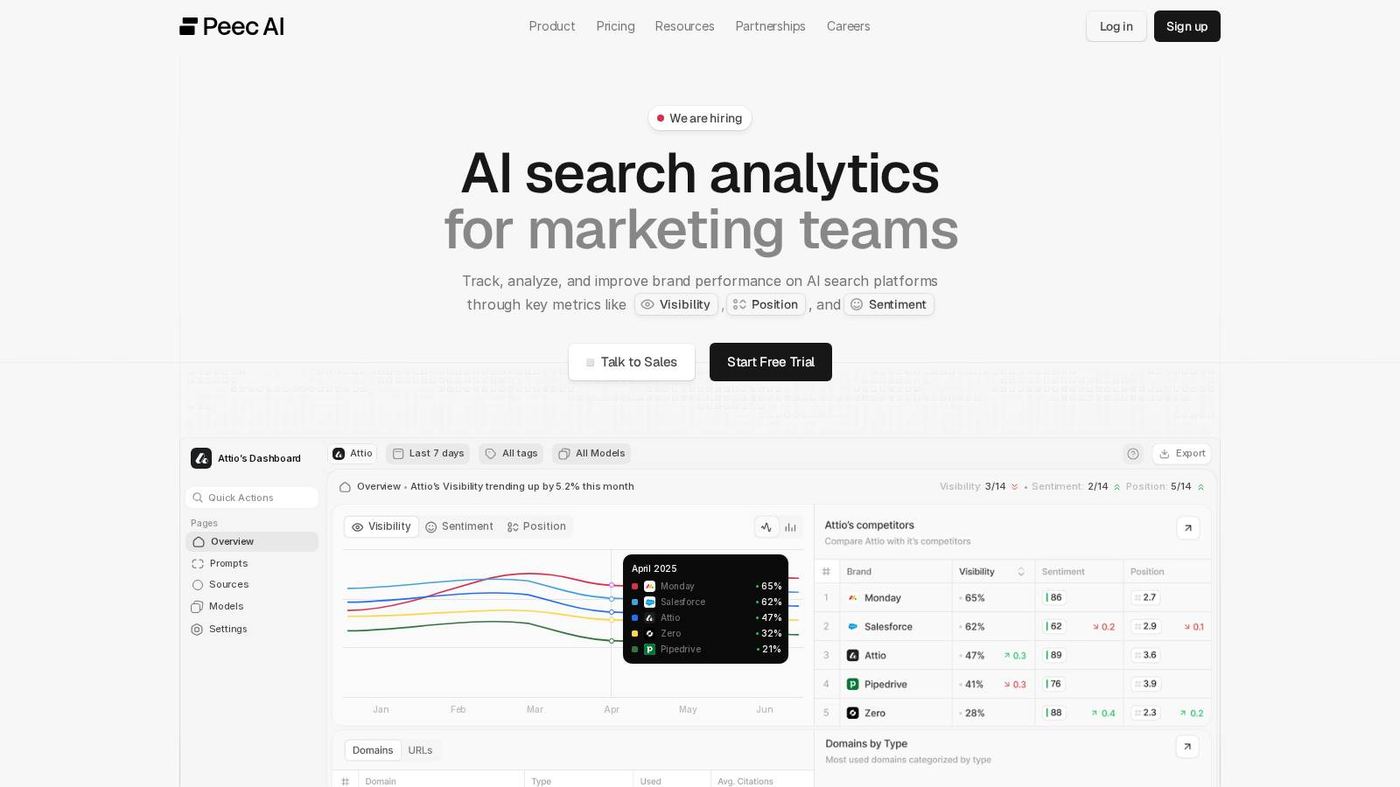
A GEO tracker re-checks a fixed prompt set on a schedule and reports brand mentions, citations and share-of-voice movement over time.
Trackers are the scoreboard. Otterly.ai starts at $29/mo and monitors which of your URLs AI answers cite. Peec AI adds multi-brand workspaces with unlimited seats. The Semrush AI Toolkit puts tracking inside the SEO suite you may already run. What a tracker does not do is explain why you lost an answer or produce the fix; that work stays with your team.
On this list: Otterly.ai (#7), Peec AI (#5), Semrush AI Toolkit (#8).
A GEO analysis platform adds diagnosis and execution to tracking: it explains why answers are lost, produces the fix, and re-measures after it ships.
Platforms run the loop the other two types only report on. Citedintel is the enterprise platform in this group: programs scoped per use case, funnel stage and market, executed with cannibalization and compliance guardrails, re-measured every audit; Starter and Pro serve early-stage brands. Profound brings enterprise depth and panel data; AthenaHQ correlates citations with revenue; Searchable wires findings into GA4 and CRM data; Scrunch AI fixes AI legibility at the infrastructure layer; BrightEdge consolidates with an enterprise SEO incumbent.
On this list: Citedintel (#1), Profound (#2), AthenaHQ (#3), Searchable (#4), Scrunch AI (#6), BrightEdge (#10).
Each entry lists what it covers, what it costs and where it falls short. The comparison table at the end shows all ten side by side.
The ranking
Ordered by how much of the loop each tool closes (evidence, diagnosis, execution, re-measurement), then by the depth of evidence behind each number. Buying motion, self-serve or sales-led, does not affect rank.
01
Citedintel
citedintel.com
The enterprise platform that closes the loop: evidence, diagnosis, execution with guardrails, re-measurement
Citedintel runs all four tests as one workflow. Every audit asks ChatGPT and Perplexity (plus Claude, Gemini, Google AI Overviews, AI Mode and more on Enterprise) fresh buyer-intent prompts and stores the answers verbatim. Every lost recommendation is diagnosed with the answer text as evidence. An agent roster drafts the missing content, grounded in the citations competitors currently win, and each audit lands a pitch-ready earned media list: the exact pages AI cites, with an outreach draft and the editor's contact. The next audits then re-measure share of voice, sentiment and endorsement, so outcomes are verifiable rather than asserted. Disclosure: this is our product, which is why the rubric above exists. Judge it against the same product pages you would check for any other entry.
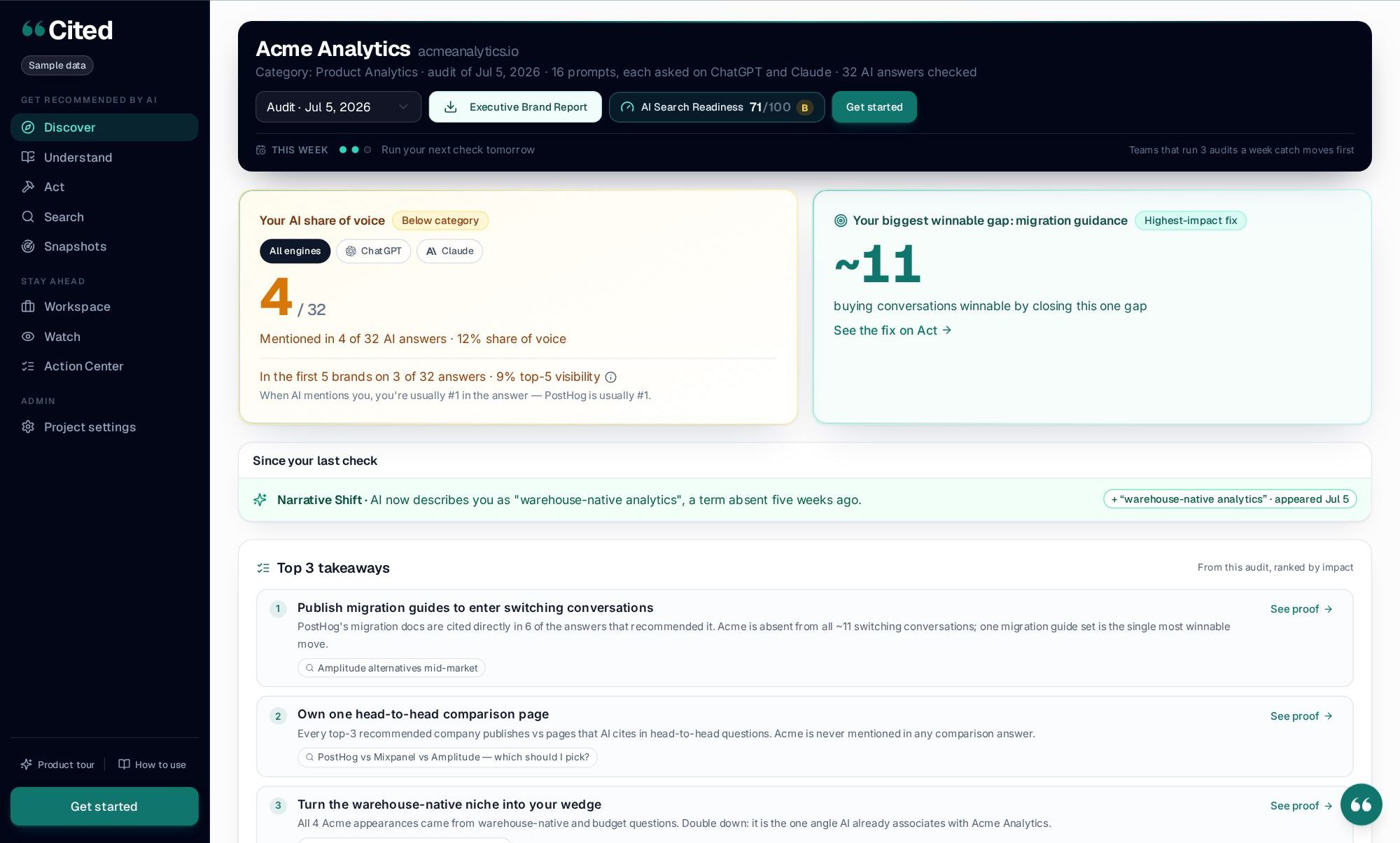
Inside Citedintel: the Discover view puts AI share of voice, mention counts and the single biggest winnable gap on one screen, with the verbatim answers one click away.
Where it is strong
Shows the exact AI answers where buyers hear a competitor's name instead of yours
Explains why you lost each answer using the answer text itself, never a black-box score
Writes the content that wins the answer back, grounded in sources engines already trust
Re-checks the same questions after you publish, so you can prove the answers changed
Covers software shortlists and shopping recommendations alike, 30+ technical checks included
What to weigh
Core plans cover ChatGPT and Perplexity; Claude, Google AI Overviews and AI Mode require Enterprise
SOC 2 Type 2 certification is in progress rather than complete, so enterprise security reviews may need the roadmap conversation
Pricing: Enterprise programs scoped per use case, funnel stage and market · Agency Pro, book a demo · Starter free and Pro $375/mo for early-stage brands
Best for: Enterprise brands across B2B, B2C, luxury and D2C that run AI search as a program; early-stage brands on Starter and Pro
02
Profound
tryprofound.com
Enterprise-depth measurement with the broadest data foundation
Profound is the reference platform at the enterprise end: coverage across 10+ engines, answer measurement enriched by a large consumer-consented conversation panel, bot-crawl analytics, and agentic features that act on findings. Security posture (SOC 2) and multi-market depth make it a fit for large organizations with procurement requirements.
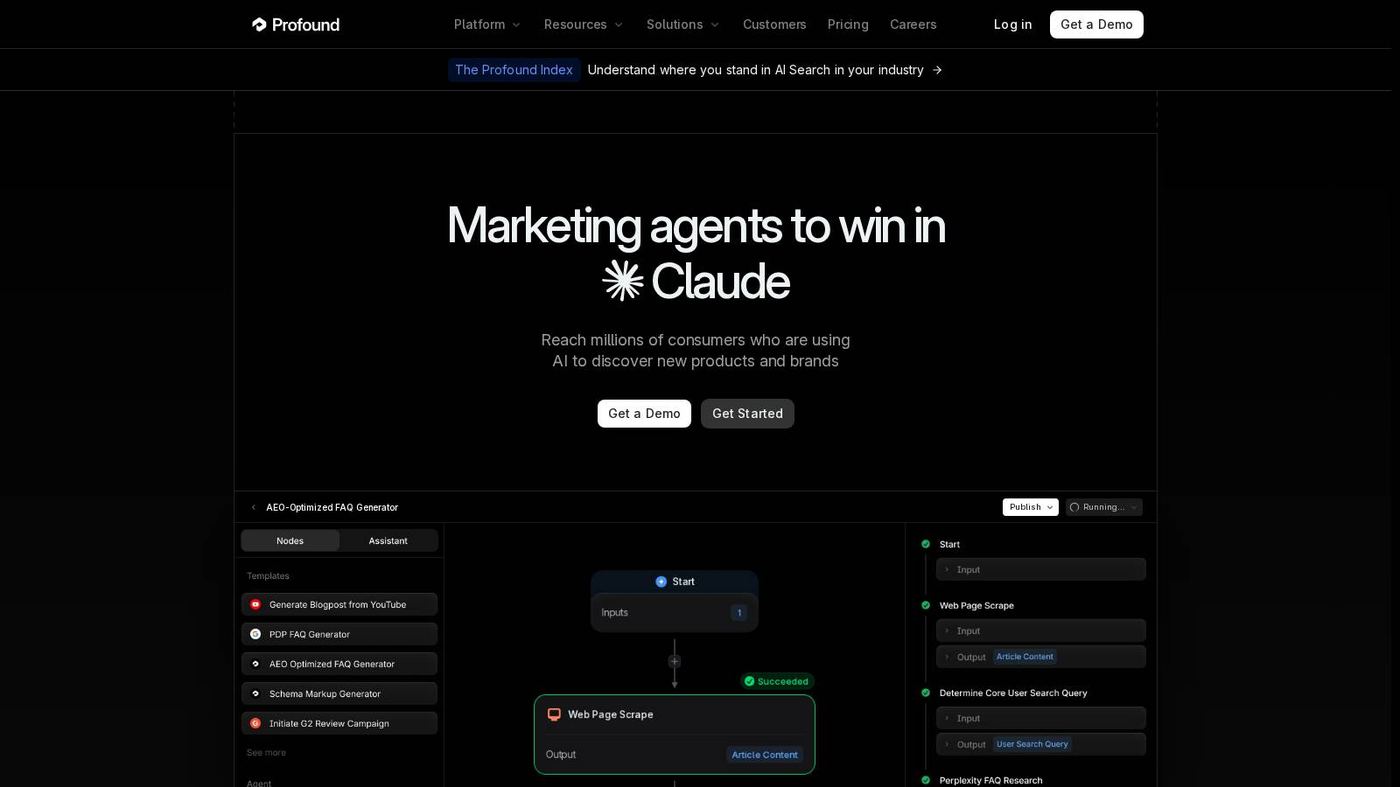
Profound's homepage leads with enterprise-scale answer measurement and its consumer conversation panel.
Where it is strong
Broadest engine coverage on the list and unique conversation-panel data
Bot-crawl analytics show how engines actually consume your site
Agentic workflows move it beyond reporting
SOC 2 security posture clears procurement reviews at large organizations
What to weigh
Sales-led motion with no published self-serve pricing, so evaluation requires a demo cycle
Scope and price point are matched to enterprise programs rather than small teams
Pricing: Sales-led, custom quotes (no published self-serve pricing as of August 2026)
Best for: Enterprises that need maximum engine coverage, panel data and procurement-grade security
03
AthenaHQ
athenahq.ai
Mid-market platform with optimization agents and revenue correlation
AthenaHQ pairs visibility tracking with optimization agents that suggest or perform fixes, and stands out for correlating AI citations with commerce data through Shopify and GA4 integrations. That revenue link makes it one of the stronger choices for teams that must defend GEO spend with pipeline numbers.
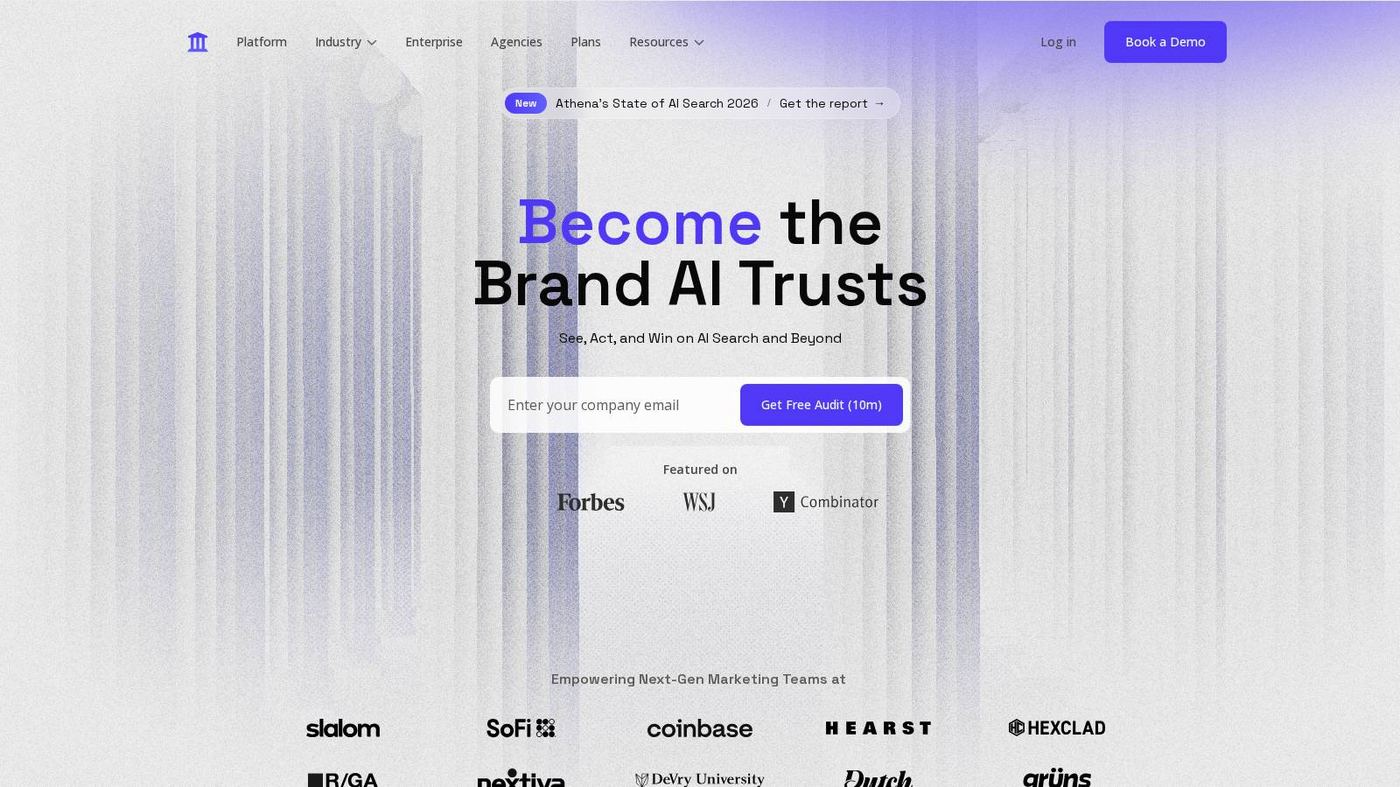
AthenaHQ pitches the citation-to-revenue link on its homepage, the feature that separates it from plain trackers.
Where it is strong
Optimization agents move findings toward fixes
Citation-to-revenue correlation via Shopify and GA4
Positioned and priced for mid-market teams
Published pricing means evaluation without a demo cycle
What to weigh
Published pricing starts around $295/mo, above entry-level monitoring tools
Per-response billing components can make costs scale with tracking volume
Pricing: From about $295/mo (published as of August 2026)
Best for: Mid-market and commerce teams that need AI visibility tied to revenue data
04
Searchable
searchable.com
Prompt tracking plus analytics integrations and an actionable task queue
Searchable tracks buyer prompts across ChatGPT, Perplexity, Gemini, Copilot and Google AI Overviews, connects AI-influenced sessions to GA4, Search Console, HubSpot and Salesforce, and turns findings into a prioritized Actions queue exportable to tools like Linear. Technical audits check AI-crawler access and schema gaps with developer-ready fixes.
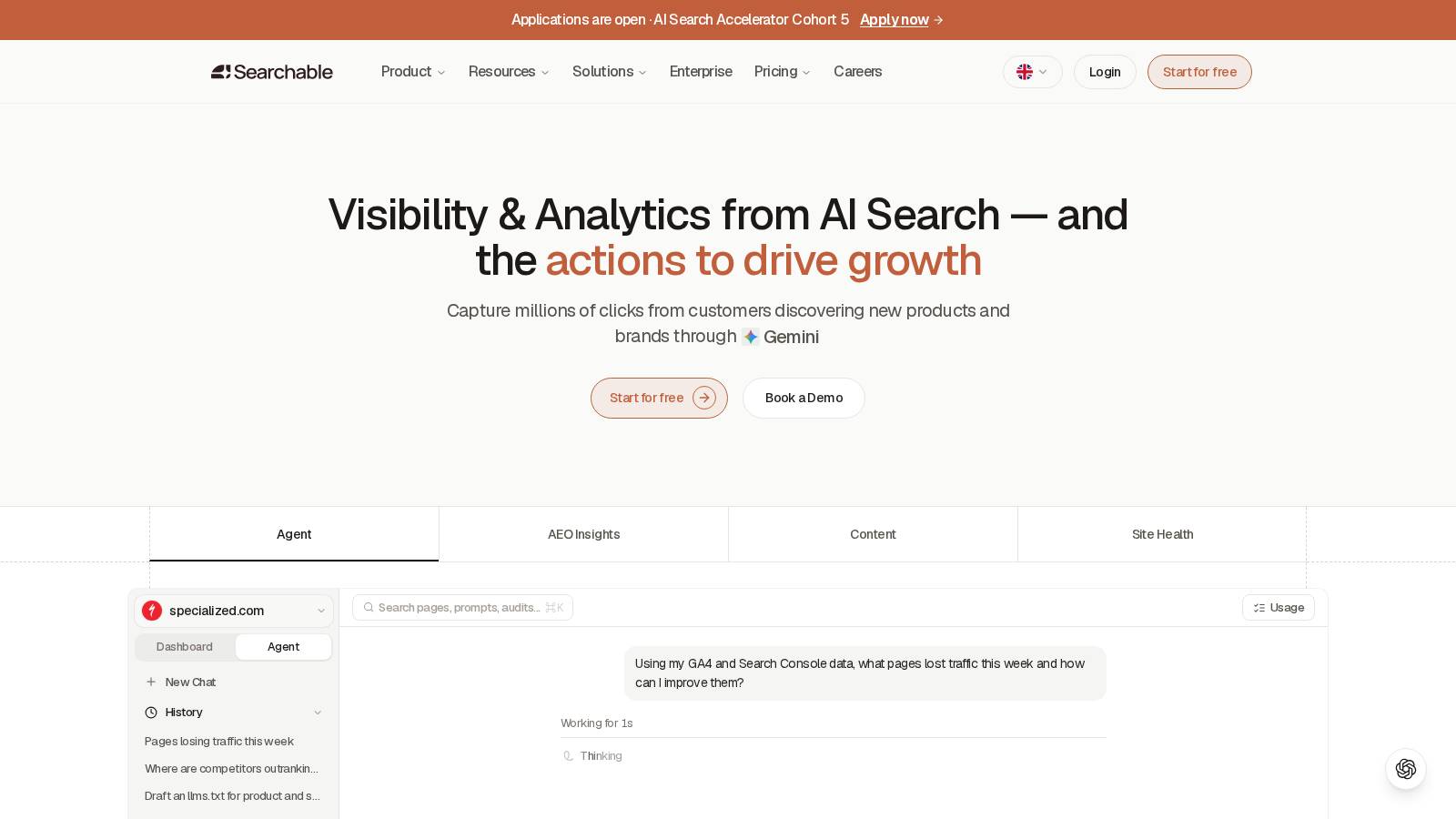
Searchable's homepage centers on prompt tracking plus the analytics integrations that wire AI visibility into GA4 and CRM data.
Where it is strong
Strong analytics integrations (GA4, GSC, HubSpot, Salesforce) for traffic attribution
Actions queue with export to project management tools
Technical AI-readiness audits with code-level fixes
Wide base engine coverage including Copilot and Google AI Overviews
What to weigh
Advanced engines (Claude, Grok, Copilot beyond base coverage) are add-ons or higher tiers
Content execution centers on tasks and recommendations rather than drafted pages
Best for: Teams that live in GA4/CRM data and want AI visibility wired into existing analytics
05
Peec AI
peec.ai
Agency-friendly multi-brand tracking with unlimited seats
Peec AI delivers clean visibility scores across models with granular tracking down to SKUs and entities, unlimited seats on every plan, and multi-brand workspaces that fit agency rosters. It is one of the most usable trackers at its price point for teams that primarily need reliable measurement.
Peec AI's homepage leans into the agency use case: multi-brand workspaces, unlimited seats, consistent scores.
Where it is strong
Unlimited seats and multi-brand setup suit agencies
Granular entity and SKU-level tracking
Accessible mid-market pricing
Consistent scoring across models makes trends comparable run to run
What to weigh
Focus is measurement; diagnosis and content execution stay largely with your team
Engine coverage on base plans is narrower than enterprise platforms
Pricing: From about $90/mo to $205/mo depending on tier (published as of August 2026)
Best for: Agencies and multi-brand teams that need dependable tracking with open seat counts
06
Scrunch AI
scrunchai.com
Agent Experience Platform: serve AI-optimized content at the edge
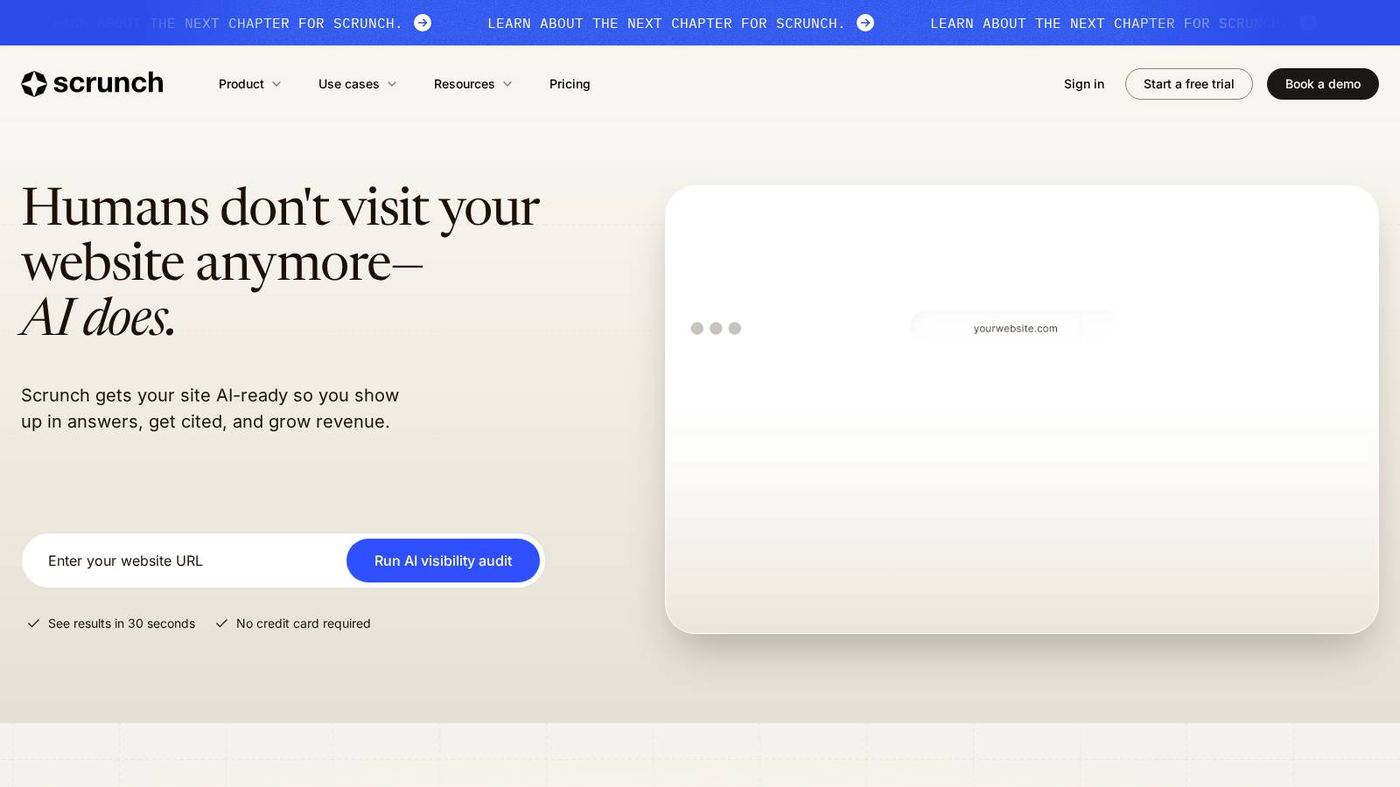
Scrunch AI approaches GEO from the infrastructure side: beyond tracking, its Agent Experience Platform lets technical teams serve AI-crawler-optimized versions of pages at the edge, changing what engines read without rebuilding the site. That makes it the most differentiated execution story on this list for engineering-led organizations.
Scrunch AI's homepage frames GEO as an infrastructure problem: change what AI crawlers read without rebuilding the site.
Where it is strong
Edge-served AI-optimized content is a unique execution lever
Strong fit for technical teams that can own infrastructure
Enterprise security posture
Deploys alongside the existing CMS without a site rebuild
What to weigh
Requires engineering involvement to get full value
Sales-led pricing, published entry points start around $250+/mo
Pricing: From about $250+/mo, larger scopes sales-led (as of August 2026)
Best for: Engineering-led teams that want to fix AI legibility at the infrastructure layer
07
Otterly.ai
otterly.ai
The most accessible entry point for AI mention monitoring
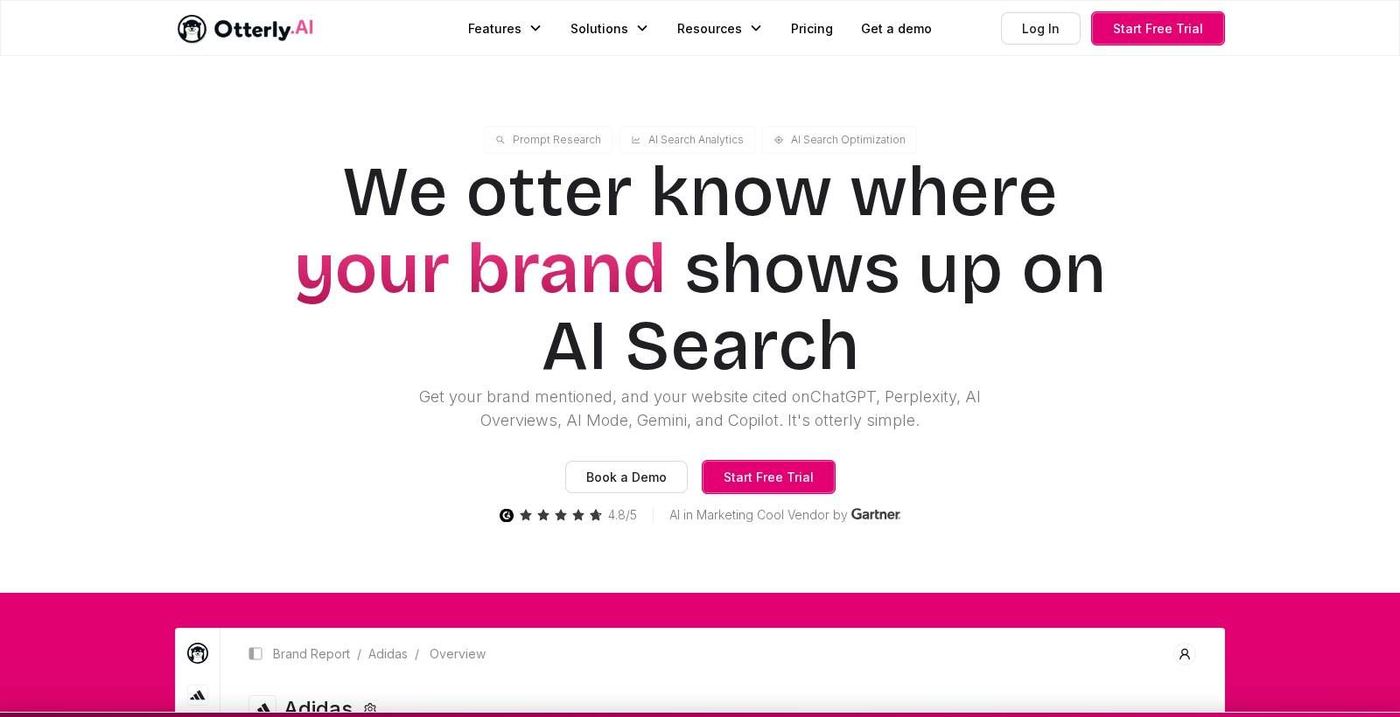
Otterly.ai made AI search monitoring affordable: brand mention and citation tracking, link monitoring across AI answers, and simple reporting from $29/mo. For a solo marketer or small brand that needs to know whether AI answers mention them at all, it is the lowest-friction starting point on this list.
Otterly.ai's homepage makes the entry-level promise plain: know whether AI answers mention you, from $29/mo.
Where it is strong
Lowest published entry price in the category
Simple setup and readable reports
Covers the core monitoring questions for small brands
Link monitoring shows which of your URLs AI answers cite
What to weigh
Monitoring-first scope: diagnosis and content work happen outside the tool
Prompt volumes and engine coverage scale with higher tiers
Pricing: From $29/mo (published as of August 2026)
Best for: Small brands and solo marketers who need affordable visibility monitoring
08
Semrush AI Toolkit
semrush.com
AI visibility inside the SEO suite your team already runs
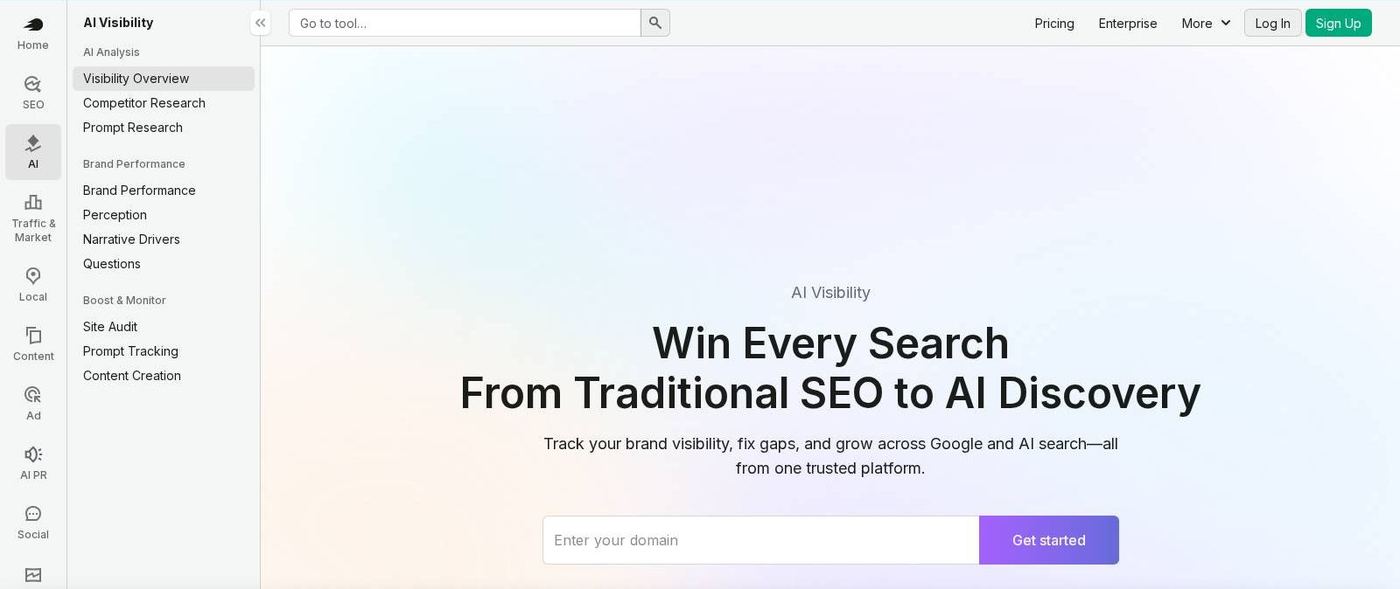
Semrush's AI Toolkit adds AI mention tracking and visibility measurement to the most widely deployed SEO platform. For teams already paying for Semrush, it is the lowest-integration-cost way to get a first read on AI visibility alongside classic rank tracking, with familiar reporting.
The Semrush AI Toolkit page: AI visibility tracking presented as an extension of the SEO suite many teams already run.
Where it is strong
No new vendor if you already run Semrush
AI visibility next to classic SEO data in one interface
Published add-on pricing
Semrush keyword and domain data gives AI mentions classic-search context
GEO features are an extension of an SEO suite rather than a dedicated workflow
Pricing: $99/mo add-on to a Semrush subscription (published as of August 2026)
Best for: Existing Semrush customers who want AI visibility without a second platform
09
HubSpot AEO Grader
hubspot.com
A free snapshot of your AI answer presence
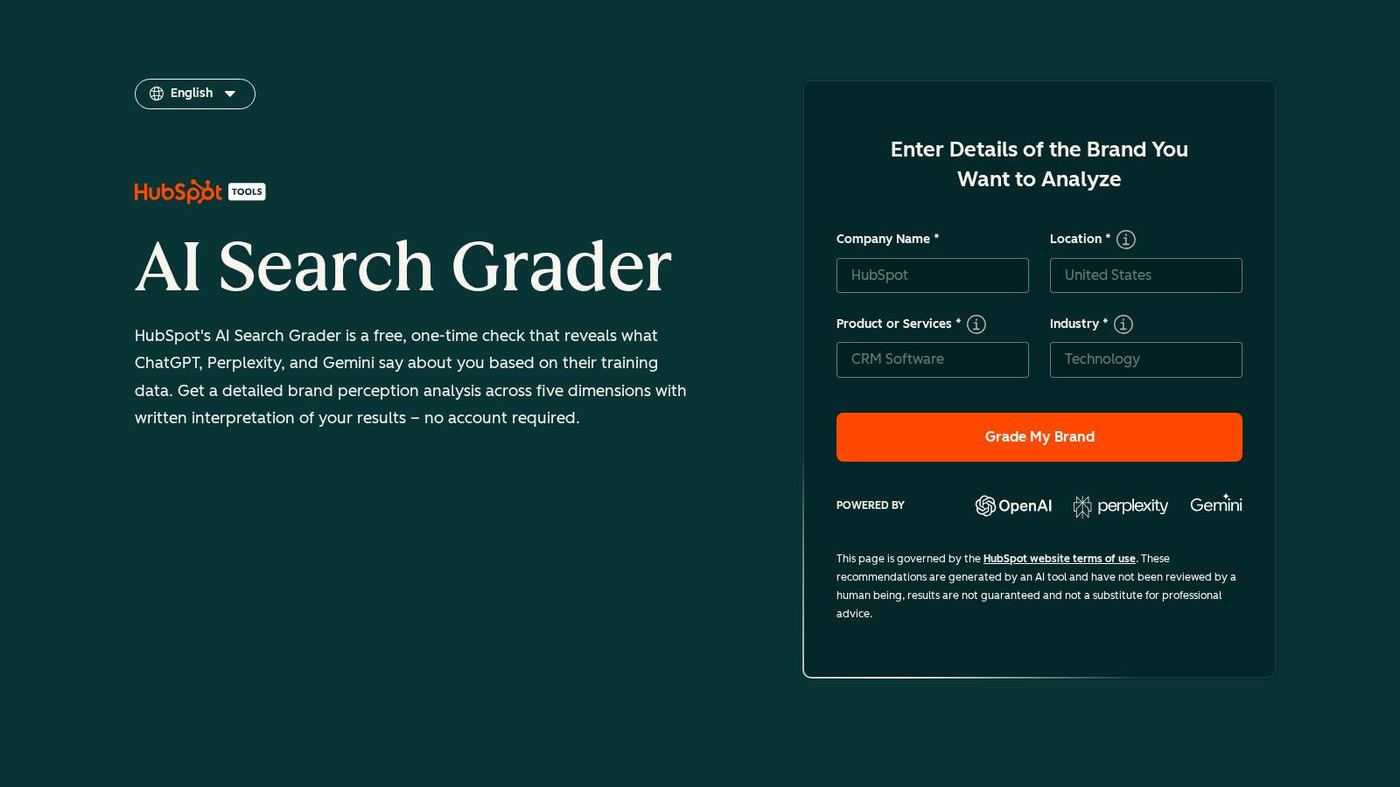
HubSpot's AEO Grader gives any brand a free, no-signup read on how it shows up in AI answers. It is a diagnostic snapshot rather than a platform: useful for making the case internally that AI visibility needs owning, before any budget exists.
HubSpot's AEO Grader: a free, no-signup grade of your AI answer presence, the fastest first artifact for an internal pitch.
Where it is strong
Free, instant, no procurement conversation needed
Good first artifact for an internal pitch
Backed by HubSpot's content ecosystem for follow-up education
Repeatable anytime for a quick pulse check at zero cost
What to weigh
One-off snapshot: no continuous tracking, prompt sets or history
No diagnosis or execution layer; it grades, then hands off
Pricing: Free
Best for: Making the internal case that your brand has an AI visibility problem
10
BrightEdge
brightedge.com
Enterprise SEO suite extending into AI answer tracking
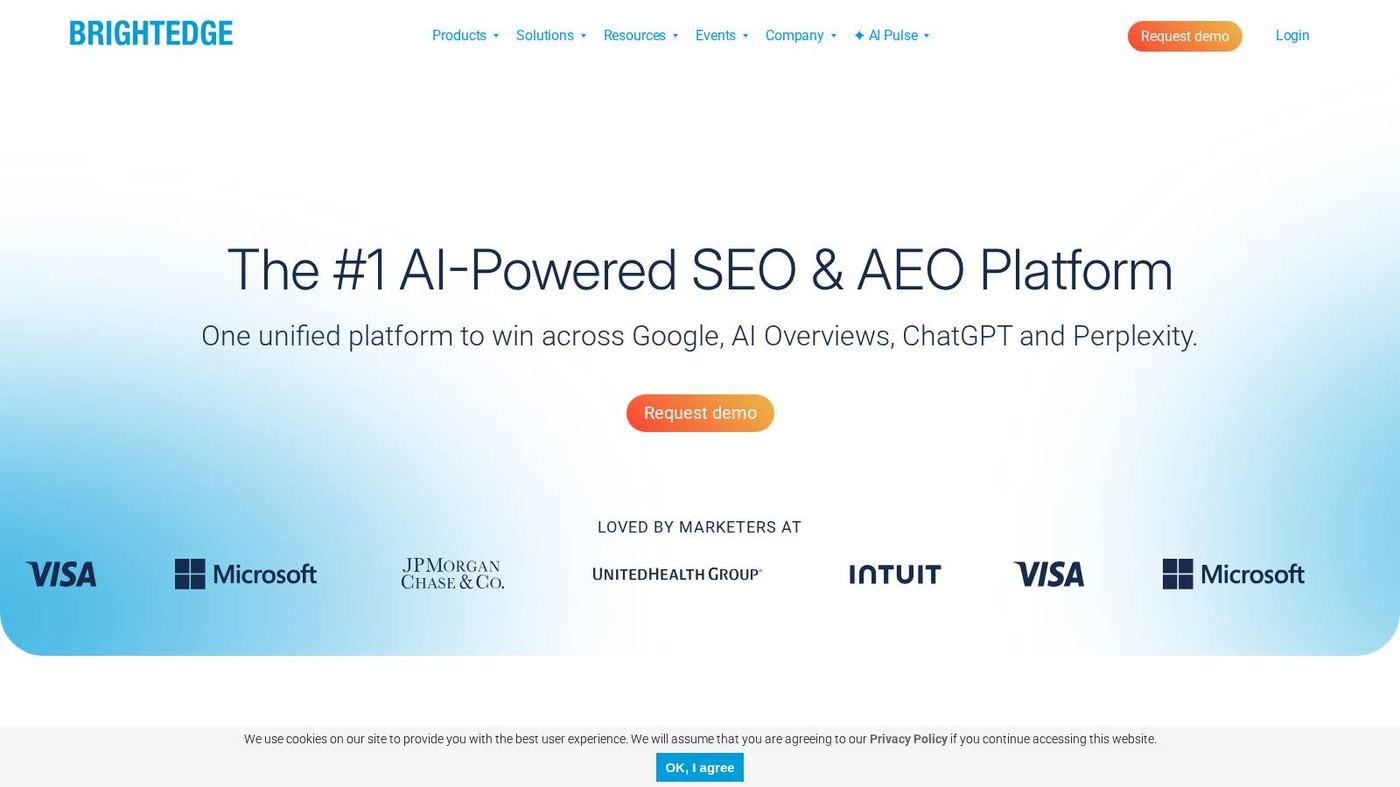
BrightEdge brings AI Overviews and AI answer tracking into an established enterprise SEO platform, which suits organizations that want GEO signals governed inside the same vendor relationship, data warehouse and reporting stack as their SEO program.
BrightEdge's homepage positions AI answer tracking inside the enterprise SEO stack large organizations already govern.
Where it is strong
Single vendor for enterprise SEO plus AI answer tracking
Established data infrastructure and account support
Strong Google-surface coverage including AI Overviews
Years of rank-tracking history give AI answer trends classic-search context
What to weigh
Sales-led pricing and enterprise contracts
AI answer features sit inside an SEO-first platform, deepest on Google surfaces
Pricing: Sales-led, custom quotes (as of August 2026)
Best for: Enterprises consolidating SEO and AI visibility under one incumbent vendor
Pricing quoted from vendor pricing pages and published reviews in August 2026; sales-led vendors do not publish rates. Verify current pricing on each vendor's site before buying.
All ten compared at a glance
Tool type, coverage of the four tests, and pricing entry points as published in August 2026. The type column is the fastest comparison shortcut: checkers grade once, trackers monitor, platforms close the loop.
Tool
Type
Live buyer prompts
Diagnosis
Execution
Re-measurement
Entry price
Citedintel
Platform
Every audit, answers stored
Per lost answer, with evidence
Drafts under guardrails
Every audit
Enterprise program; Pro $375/mo for early-stage brands
Profound
Platform
Panel-enriched tracking
Enterprise-depth analysis
Agentic actions
Trend reporting
Sales-led
AthenaHQ
Platform
Tracked per run
Gap analysis
Agent suggestions
Trend + revenue
~$295/mo
Searchable
Platform
Tracked prompts per model
Gap identification
Task queue + exports
Session attribution
$125/mo
Peec AI
Tracker
Scored per model
Score-level insight
Recommendations
Score trend
~$90/mo
Scrunch AI
Platform
Crawler-level visibility
Technical diagnosis
Edge-served content
Crawl verification
~$250/mo
Otterly.ai
Tracker
Scheduled checks
Mention detail
Reporting focus
Mention trend
$29/mo
Semrush AI Toolkit
Tracker
Daily samples (~25/day)
Mention analytics
SEO-suite guidance
Visibility trend
$99/mo add-on
HubSpot AEO Grader
Checker
One-time snapshot
Grade feedback
Educational
Single snapshot
Free
BrightEdge
Platform
Google-surface tracking
SEO-suite insight
SEO workflows
Suite reporting
Sales-led
Want the head-to-head detail on any pairing? The Compare GEO Tools hub breaks down Citedintel against Profound, Searchable, Semrush, Peec, Otterly and AthenaHQ, feature by feature.
How to choose from this list
The right tool depends on where your program is, not on which vendor shouts loudest.
You have no baseline yet
Start free: run HubSpot's AEO Grader for a snapshot, then a free Citedintel audit for the full answer-level baseline across your category. Budget conversations go differently when you arrive with numbers.
You need monitoring on a small budget
Otterly.ai from $29/mo answers the basic question, do AI answers mention us, without a platform commitment. Upgrade the day you need to know why you lose and what to publish.
You run AI search as an enterprise program
Citedintel is the only entry that closes all four tests as one program: fresh answers, diagnosis with evidence, drafts under guardrails, re-measurement, scoped per use case, funnel stage and market. Early-stage brands start on Starter (free) or Pro ($375/mo).
You run an agency roster
Peec AI's unlimited seats or Citedintel's Agency Pro (pooled audits, per-client reports, white-label options) fit multi-brand work; choose by whether clients pay you for measurement or for outcomes.
You are enterprise with procurement requirements
Profound for panel data and the broadest engine coverage, Scrunch AI for infrastructure-level execution, BrightEdge for consolidation with an SEO incumbent, or Citedintel Enterprise for the loop at scale: tone-of-voice fixes and briefs grounded in agentic site, citation and competitor checks, higher limits, Google AI Overviews and AI Mode included.
New to the discipline itself?
Tools execute a strategy. The GEO Hub covers the strategy: frameworks, the 90-day plan, and how to measure it.
Citedintel is a generative engine optimization (GEO) platform, built by the team behind this ranking. It audits how ChatGPT, Claude, Perplexity and Gemini answer real buyer questions, keeps the verbatim answers, and drafts the fixes. It is scored under the same rubric as every other tool here.
It depends on the depth you need. Suite add-ons like the Semrush AI Toolkit give a first read on AI mentions inside a familiar interface, capped at modest daily prompt volumes. Dedicated GEO tools ask more of your buyers' real questions, store the full answers, and in some cases diagnose and draft the fix. Teams usually start with the suite add-on and move to a dedicated tool the month AI answers become a pipeline conversation.
The published range runs from free (HubSpot's AEO Grader, Citedintel's free audits) through $29/mo entry monitoring (Otterly.ai), $90 to $500/mo for self-serve trackers (Peec AI, Searchable, AthenaHQ), to enterprise programs (Profound, BrightEdge, larger Scrunch AI scopes, Citedintel Enterprise, with a separate Whitelabel & Custom track for agencies). Citedintel prices enterprise programs per project, one use case × one funnel stage × one market, so cost tracks the buying conversations covered rather than seats; Starter (free) and Pro ($375/mo) serve early-stage brands. The bigger cost difference is workflow: tools that only report leave the diagnosis and content work as headcount you pay for elsewhere.
Four jobs, in order. Ask AI engines your buyers' real questions and keep the answers. Explain each lost recommendation with evidence. Produce the fix, or at minimum a concrete brief. Then re-ask the same questions after you publish, so the outcome is measured rather than assumed. A tool that stops after the first job is a scoreboard: useful, but the game still has to be played somewhere else.
No. Best GEO software, best GEO optimization tool and best generative engine optimization platform all describe the products this page ranks. Vendors pick the label by ambition: tool usually means monitoring, platform usually means the full workflow from audit to published fix and re-measurement. The four tests above matter more than the label.
For a free grade with no signup, HubSpot's AEO Grader. For a free check that stores the full AI answers instead of a single score, Citedintel's free audits. A checker tells you whether you have an AI visibility problem; the day you need to know why, or whether your fixes worked, you have outgrown checkers and need a tracker or a platform.
On a small budget, Otterly.ai: from $29/mo it monitors which of your URLs AI answers cite. For attribution you can act on, Citedintel stores every answer with its citations, shows which sources engines lean on when they recommend a competitor instead of you, and re-measures after you publish. At enterprise scale, Profound adds crawl analytics that show how engines consume your site.
A checker grades your AI presence once. A tracker re-checks a prompt set on a schedule and charts mentions and share of voice over time. An analysis platform adds the other half of the job: diagnosing why answers are lost, producing the fix, and re-measuring after it ships. Typical path: checker to make the internal case, tracker when you need a trend, platform when AI answers become a pipeline number someone owns.
AI Rankings · You vs competitors
Live
#BrandAI SOVTrend
1BBrightstack34%
2YYour brandYou27%
3NNimbusly19%
4CCorefleet11%
5VVantapoint6%
Your buyers already asked AI. Reach them before your competitors