
Europe GEO fails when teams treat DACH and the Nordics as one writing job. The stronger move is market-specific evidence for the same category, because AI assistants reward the clearest proof, not the broadest translation layer.
As of August 2026, AI SEO in Europe is a revenue problem, not a content experiment. McKinsey says gen AI is already among the top five channels buyers use for supplier discovery and evaluation, and Gartner now treats answer engine optimization as a core capability that needs metrics and feedback loops. McKinsey, 2026 Gartner, August 2026
Why DACH and the Nordics should not be treated as one Europe page
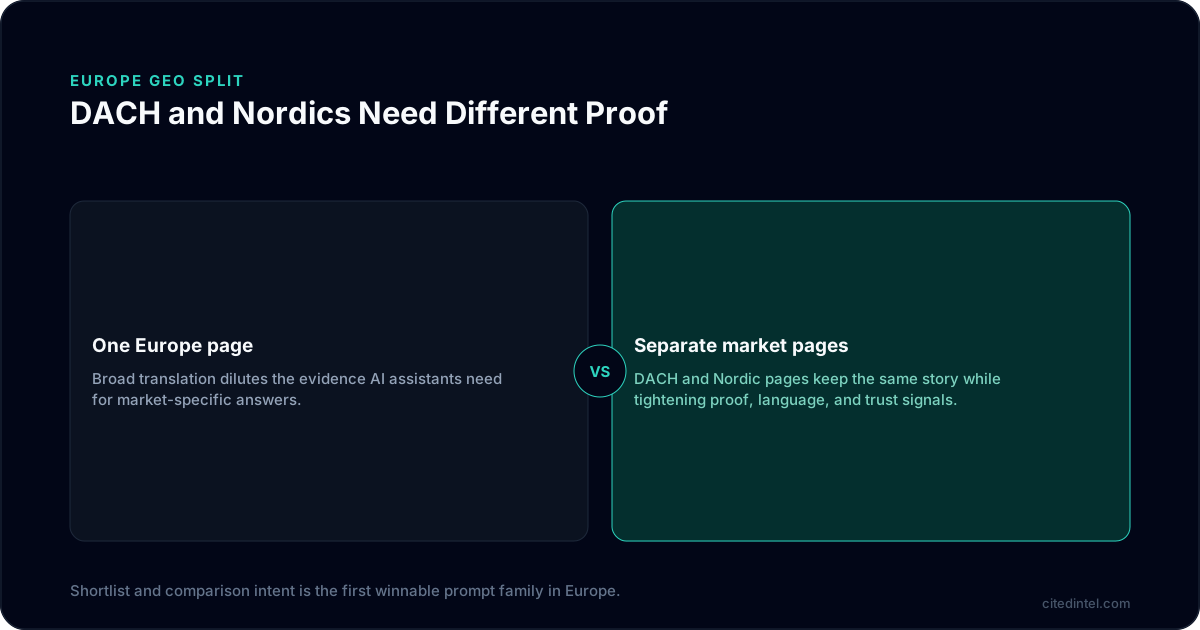
DACH and the Nordics need different GEO pages because the proof standard, language choice, and source mix are not the same. If you sell B2B software into Europe, one “Europe” page usually dilutes the exact evidence AI answers need.
My view: the first winnable prompt family in Europe is comparison-heavy shortlist intent, not generic discovery. McKinsey’s March and April 2026 Europe research points to AI being used for research and comparison already, with 63% of respondents saying they use AI tools for comparison and product research. That makes “which vendor should I choose” and “what should I compare” the most practical first targets for generative engine optimization in Europe. McKinsey, April 2026 McKinsey, March 2026
The local wrinkle matters. English-language evaluation is common in software buying across Europe, especially in tech-forward teams, but local-language prompts grow faster in more traditional industries and in compliance-sensitive buying paths. A German procurement lead often asks for implementation risk, data handling, and works council fit, while a Nordic buyer is more likely to tolerate concise English if the evidence is immediate.
That is why a single Europe hub should not chase one keyword set. It should split into market-specific prompts, page types, and trust assets, then keep the same commercial story while changing the proof language. A generic “best software in Europe” page will usually lose to a sharper market page with named integrations, local references, and a direct comparison block.
What answer engines are doing to B2B buying in Europe
Answer engines are moving supplier discovery into the recommendation layer before the first sales conversation. In Europe, that means AI search optimization has to protect shortlist visibility, because buyers are asking assistants for options, criteria, and tradeoffs before they talk to a vendor.
The research direction is clear as of August 2026. McKinsey’s 2026 B2B Pulse Survey says gen AI is already one of the top five channels buyers use for supplier discovery and evaluation, alongside supplier websites, in-person interaction, web search, and videoconferencing. G2’s 2026 AI Search Insight Report says nearly 7 in 10 B2B software buyers chose a different vendor than expected in their last buying cycle because of guidance from an AI chatbot. McKinsey, 2026 G2, April 2026
That changes how Europe buyers phrase prompts. They are less likely to ask for a raw product list and more likely to ask for a vendor recommendation framed by market, compliance, integration, or operating model. The best content response is a page that maps one prompt family to one decision job.
| Prompt family | What the buyer is really doing | Page that tends to earn the citation | Evidence that matters in Europe |
|---|---|---|---|
| “Best CRM for a sales team in Germany” | Shortlisting under operational risk | Comparison page | Implementation detail, GDPR language, local support, named integrations |
| “Which HR software works for a Nordic company with cross-border hiring” | Testing fit across markets | Criteria page | Payroll coverage, English-first docs, country-specific compliance references |
| “Compare payments platforms for EU expansion” | Comparing cost and coverage | Direct comparison page | Settlement markets, currencies, pricing structure, PSD2-related detail |
| “Best developer tools for teams using EU data centers” | Checking trust and deployment | Trust page | Data residency, security posture, docs quality, third-party validation |
OpenAI’s Deep Research positioning is useful context here because it is built for web browsing and analysis across text, images, and PDFs. That is a clue for the page formats answer engines can lift: pages with evidence, named entities, and comparison structure beat thin summaries every time. OpenAI, January 2025
Google AI Overviews and other answer layers also filter noisy, machine-sounding pages more aggressively now. Reuters Institute noted in 2026 that AI Overviews were appearing at the top of about 10% of U.S. Search results and were rolling out rapidly elsewhere, which matters for Europe because the same visibility pressure is landing in multiple markets at once. Reuters Institute, 2026
So the practical split is this. GEO is the wider work of earning visibility inside AI-generated answers. AEO is the narrower page-level work of being the quotable, citable source the engine can lift. For Europe, both matter, but AEO usually wins first in comparison and compliance-heavy queries.
Prompts across Europe
European buyers rarely ask one clean prompt. They move through research, shortlist, and validation prompts, and those prompts change by market and category. The point of AI search monitoring is to keep a living log of the exact wording buyers use.
Here are prompt families worth tracking weekly for B2B software companies selling into Europe. I would start with these before I spent time on broader thought leadership.
- CRM: “Best CRM for a mid-market sales team in Munich” and “compare CRM platforms with German language support.”
- HR software: “Which HR software is easier to deploy across Sweden and Denmark?” and “HR tech with works council-friendly documentation.”
- Payments: “Best payments infrastructure for EU expansion” and “which provider handles multi-currency payouts in Europe.”
- Logistics tech: “Logistics software that integrates with SAP and regional carriers” and “best warehouse tools for cross-border fulfillment.”
- Cybersecurity: “Which security platform is most suitable for a regulated German business?” and “compare cybersecurity vendors with EU data residency.”
- Martech: “Best martech stack for a B2B company selling across DACH and Benelux” and “marketing automation with local support in Europe.”
- Product analytics: “Product analytics tool for a privacy-sensitive EU product team” and “analytics platform that handles consent cleanly.”
- Developer tools: “Best developer tools with European data hosting” and “compare observability platforms for enterprise deployment.”
- Legal tech: “Legal software for a cross-border team” and “which contract platform supports multilingual review workflows.”
- Healthcare SaaS: “Healthcare SaaS with strong compliance evidence in Europe” and “which vendor has the clearest audit trail for patient data.”
These prompts are winnable because they are specific, comparative, and proof-driven. They also map to the way AI assistants are being used as a research layer in Europe, not just as a novelty. That is the part generic AI SEO advice misses.
One practical caution: if your site has three pages trying to own “best CRM for Germany,” answer engines will often split the citation or ignore all three. Consolidate the intent into one canonical comparison page, then support it with internal links from the country page, the integration page, and the compliance page. Fragmentation is a self-inflicted citation leak.
What DACH buyers need that Nordic buyers may not
DACH buyers usually need more evidence per claim. Nordic buyers usually need the same evidence, but they want it shorter, cleaner, and easier to scan. That difference shapes how you write the page, not just how you translate it.
For DACH, the page should answer risk questions early. That means implementation detail, legal wording, data handling, support coverage, and named customer proof belong near the top. For the Nordics, concision matters more, but brevity cannot replace proof.
A useful way to think about the region is by category pressure, not by country stereotype. A cybersecurity vendor in Germany needs compliance and governance pages because buyers test operational risk. A product analytics vendor in Sweden may get more traction from a clean comparison page and concise docs. A legal tech vendor in Denmark often needs a trust page that proves the product can sit inside a professional workflow.
My view: too many Europe pages overinvest in local language and underinvest in evidence structure. Language helps indexing. Evidence gets cited. A translated brochure with no comparison table and no third-party proof usually loses to a plain English page that answers the exact buying question faster.
Use this as a regional rule set:
- DACH emphasis: build compliance pages, implementation pages, and comparison pages with explicit local terminology and a visible proof stack.
- Nordic emphasis: build concise comparison pages, product explanation pages, and docs that can be quoted without a lot of editing.
- Shared baseline: keep reviews, customer references, and third-party mentions current across both markets.
There is also a market reality worth keeping in mind as of June 2026. McKinsey says Central Europe trails Western Europe by 16 percentage points in enterprise AI adoption, but the commercial gap is not a reason to wait. It is a reason to be early on answer engine optimization while competitors still think traditional SEO is enough. McKinsey, June 2026
What to do this quarter
Run this as a quarter-long AI search optimization plan for Europe, not as a loose content refresh. The goal is to own a few high-value prompts in the markets that matter, then see whether those prompt wins show up in sales conversations.
Start with pages that answer comparison questions, then add trust pages, then add local proof. For a PMM or demand gen lead at a B2B software company, that usually means one comparison page for each core category, one compliance or trust page for each market where risk questions come up, and one integration page for each ecosystem that appears in deals.
- Comparison first: ship one clear comparison page for each priority market and category pair, even if the traffic volume is lower than a broader blog topic.
- Trust second: add market-specific trust pages where buyers ask about data residency, works councils, governance, audits, or regulated deployment.
- Integration third: publish pages that name the systems your buyers already run, because answer engines like concrete connections.
- Evidence layer: collect reviews, analyst references, partner mentions, and customer logos that are relevant to the market, then keep them current.
That cadence is where Citedintel fits naturally for teams that do not want to run this manually forever. Citedintel audits how ChatGPT, Claude, Perplexity, and Gemini answer buyer-intent prompts, then points to the missing content and evidence that would change the result. You still need good pages, but you stop guessing where the citation gap sits. Why Citedintel
Here is the one candid limitation: if your category has very little third-party proof in Europe, no tool can invent it. In that case, the first quarter is still about getting the evidence base in place, which may mean reviews, partner coverage, docs, and market-specific references before you expect steady citation gains.
Where measurement breaks, and how to fix it
Click-based reporting misses most of the answer-layer story. If you only measure rankings and visits, you will miss the prompts where AI assistants are already naming a competitor or skipping you entirely.
For Europe, the measurement fix is a weekly visibility log at the prompt level. Track which prompts return your brand, a competitor, or no useful answer, then tag each prompt by market, language, and buying stage. That gives you an AI search optimization metric that maps to the buyer’s actual research path.
Gartner’s February 2026 note on “Beyond Clicks” is the right conceptual warning here: answer engine optimization needs new metrics because click-based measurement misses the answer layer. Its August 2026 webinar framing goes one step further and says AEO has to become a core capability with feedback loops, not a side channel report. Gartner, February 2026 Gartner, August 2026
Use a weekly sheet with these fields:
| Field | What to capture | Why it matters |
|---|---|---|
| Prompt | The exact buyer wording | Shows how people really ask |
| Market | DACH, Nordics, France, Benelux, or Southern Europe | Surfaces local differences |
| Language | English, German, Swedish, Danish, Dutch, and so on | Shows whether local wording changes the result |
| Assistant | ChatGPT, Claude, Perplexity, Gemini | Different engines often cite different sources |
| Result | You, a competitor, or no citation | Lets you see who owns the answer layer |
| Missing proof | Comparison, review, integration, compliance, or fresh docs | Turns the gap into a publishing task |
The manual path takes real time. Expect several hours a week if you are checking prompts by hand across a few markets, because the work includes prompting, recording, and reviewing the answer patterns. Automation compresses the repeat checks and the reporting, which is why Citedintel’s weekly re-check loop matters for teams that cannot keep that cadence manually.
Pros, cons and cautions
The candid risk with GEO in Europe is content cannibalization. If your site has three country pages, two blog posts, and one comparison page all trying to own the same prompt, answer engines may split the citation or choose none of them. Consolidate the intent into one canonical page, then let the supporting pages feed it with internal links and distinct proof roles.
The other risk is AI-slop. Google AI Overviews and similar answer layers are getting better at skipping machine-sounding pages, especially mass-produced regional variants with swapped city names and thin local proof. A page earns citations when it gives a direct answer, shows the evidence, and sounds like a person who has actually seen the buying process.
What not to do in Europe is just as important. Do not publish a German page that is a literal translation of an English homepage with the city name changed. Do not spray out Nordics country pages with the same structure and zero local proof, then expect assistants to treat them as distinct sources.
The pages that get cited are the pages that reduce buyer uncertainty fast. That usually means a comparison block, a named integration, a trust signal, and one sentence that answers the actual prompt without any filler around it.
One DACH prompt, one Nordic prompt, today
Use this self-serve check today. It gives you a visible result fast, and it shows where your Europe GEO coverage is thin.
- Write one DACH prompt and one Nordic prompt for each of these stages: research, shortlist, validation.
- For each prompt, note the page you expect to surface.
- Circle prompts where your page does not contain a comparison table, named integration, review proof, compliance detail, or market-specific explanation.
- Mark any prompt where a competitor would be easier to cite than your brand.
- Choose one gap to fix this week, and write the page type next to it.
If that looks manageable, Citedintel can automate the scaled version by checking prompt coverage across engines and turning the gaps into editable content drafts. Start free
What good looks like by the end of the quarter
By the end of the quarter, you should know which prompts you own, which competitors keep appearing, and which markets need a different proof stack. If you cannot answer those three things, the program is still content planning, not generative engine optimization.
A good Europe finish line is narrow and measurable. One priority market should have a comparison page that answer engines can cite, one should have a trust page that handles compliance questions, and one should show a clear lift in AI search optimization for shortlist prompts. That is enough to prove the playbook before you scale it across the rest of Europe.
The commercial point is simple. Brands that are visible in buyer conversations get considered earlier, and brands that are missing from AI answers have to win the shortlist the hard way later. If you want the structured version of that workflow, use Citedintel’s comparison hub, or see the full product path at pricing.
Frequently asked questions
What is answer engine optimization for Europe?
Answer engine optimization in Europe is the work of making your brand the source AI assistants quote when buyers ask comparison, compliance, and shortlist questions. The article argues that DACH and the Nordics need different proof stacks, because the same translated page rarely satisfies both markets.
How does GEO work for DACH and the Nordics?
GEO works best when you split by market, prompt family, and proof type instead of treating Europe as one page. DACH pages should front-load compliance, implementation detail, and named proof, while Nordic pages should keep the same evidence in a shorter format that is easy to cite.
What are the best AI SEO pages for B2B software in Europe?
The article says comparison pages come first, followed by trust pages and integration pages. Those formats are easier for answer engines to lift because they contain named entities, direct answers, and the evidence buyers use to shortlist vendors.
How do I show up in AI search for Europe?
Start with one prompt family per market, then build a canonical page that answers it directly and supports it with local proof. Track the exact prompt wording weekly across ChatGPT, Claude, Perplexity, and Gemini so you can see which pages are getting cited and which proof is missing.
What is the best AI SEO tool for AI search monitoring?
The article points to Citedintel as a tool for auditing how ChatGPT, Claude, Perplexity, and Gemini answer buyer-intent prompts. It checks prompt coverage, shows missing content or evidence, and helps teams turn citation gaps into page work instead of guessing.