
In Montreal, the same buying question can surface one shortlist in English and a different one in French. In Canada, that split is not a translation nuisance, it is a revenue risk you can test page by page.
For Canadian brands, generative engine optimization carries a bilingual requirement: earning visibility in English and French AI answers with page sets that resolve the same buying question cleanly in both languages. In practice, AI search optimization is the broader visibility job, while answer engine optimization focuses on making those pages easy for answer engines to cite.
Why bilingual AI search in Canada behaves differently
Canada is a falsifiable bilingual test: if your English pages are strong but your French pages are thin, your AI search optimization will diverge by language. That gap is often large enough to change who gets shortlisted before sales ever speaks.
What the browsing data shows is simpler than the jargon around it. In Pew Research Center’s June 2026 survey, 42% of U.S. adults said they use chatbots to search for information, which is a strong sign that answer surfaces matter even when people are still using search in familiar ways (Pew Research Center, June 2026).
But the market does not behave the same way everywhere. Canadian teams should assume the answer layer is part of search, then test English and French separately instead of treating one page set as enough.
What shifts first
The shortlist shifts first. A buyer may start in English, switch to French, and the second answer can replace the first if the brand evidence is uneven.
- English prompts: usually reward broader comparison language, stronger North American proof, and more complete category pages.
- French prompts: expose thin bilingual FAQ blocks, untranslated comparison pages, and missing local proof much faster.
- Cross-language drift: the same brand can be recommended in one language and skipped in the other if the page stack is not mirrored.
The winner-take-most pattern is the one I would test in Canada too: the brands with the clearest page stack tend to keep showing up, and the gap can widen when one language is neglected.
What actually causes the gap
The gap usually comes from page architecture, not content volume. If the English page exists first, the French page is translated later, and the comparison page still reads like a single-market asset, AI answers have less to cite on the French side.
For a product marketing lead in B2B software, the critical assets are the category page, the comparison page, and the trust layer. If those three are not usable in both languages, the answer layer has no clean path to recommend you.
How the problem shows up by category
Different categories need different proof. A martech vendor can often improve AI search optimization with clearer feature taxonomy, while a healthcare SaaS company usually needs tighter trust language and stronger compliance cues before it appears in answers.
| Category | What AI answers tend to need | What usually blocks visibility |
|---|---|---|
| HR tech | Comparison pages, pricing context, review depth | Thin French pages, weak category pages, no bilingual FAQ |
| Logistics tech | Regional proof, operational detail, use-case pages | Generic global messaging with no Canadian page assets |
| Martech | Clear feature taxonomy, integration pages, alternatives pages | Feature sprawl and missing comparison language |
| Healthcare SaaS | Trust language, compliance clarity, review depth | Vague claims and no language-specific support pages |
The pattern is not subtle. In Quebec, the French version has to answer the same buying question with local language, local proof, and a page structure that does not make the reader guess.
My view: most teams overinvest in translation and underinvest in proof. Translation helps, but it does not replace a comparison page that actually names alternatives, tradeoffs, and category fit.
How Canadian AI search adoption is showing up now
Public data is stronger on answer surfaces than on Canada-specific adoption, so the safe move is to use dated, named sources and treat Canada as the market where bilingual pressure is most obvious. Google’s 2025 materials say AI Overviews now reach 1.5 billion users monthly, which is enough scale to justify planning for answer inclusion rather than classic blue links alone (Google 2025 materials on AI Overviews).
OpenAI said in November 2025 that “hundreds of millions of people use ChatGPT to find, understand, and compare products,” and it launched shopping research that produces a buyer’s guide from trusted sites, which is evidence that assistants are moving into product research and comparison flows (OpenAI shopping research, November 2025).
OpenAI has also been explicit that people are using ChatGPT to explore, compare, and figure out what to buy, which reinforces the same pattern from another engine class (OpenAI, March 2026).
Those are not Canadian stats. They are the better public signals for why Canadian B2B teams should plan for AI search, generative engine optimization, and answer engine optimization as real discovery surfaces, not side experiments.
How to improve GEO visibility in Canada
The fastest gains come from structure, not volume. Set the bar at one fully bilingual category or comparison page, one English and French FAQ block, and one proof layer that includes reviews, schema, and current dates.
When a page cannot support a shortlist decision, it is not ready for GEO or AEO. I would use that as the working standard for any B2B software business selling in Canada.
The ranked playbook
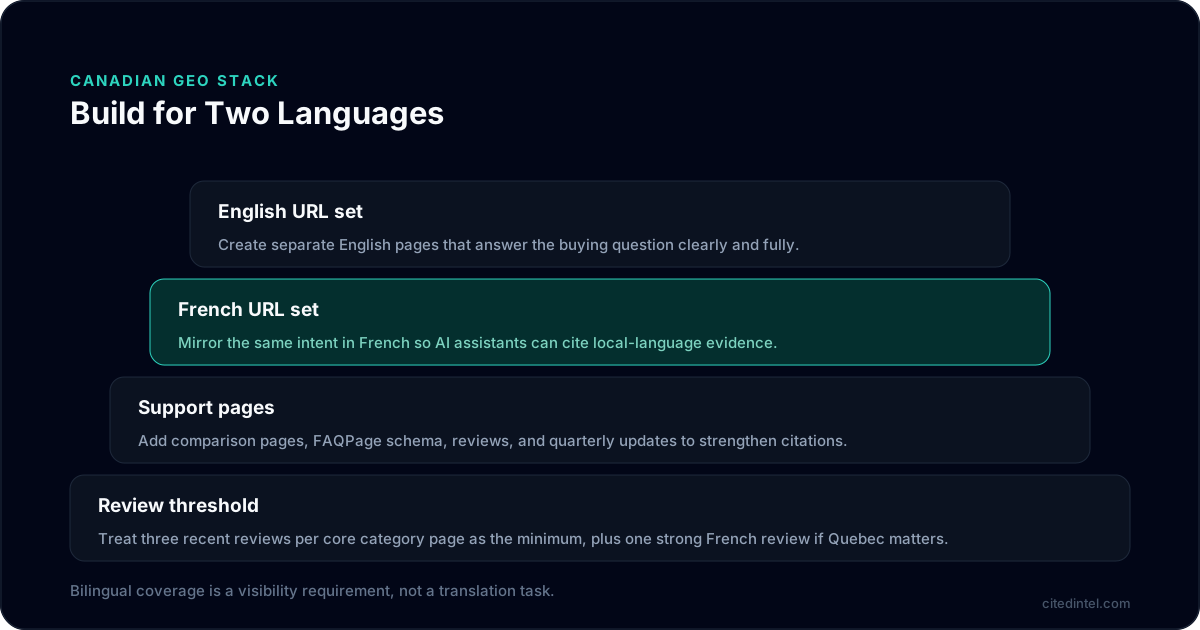
- Separate English and French URLs: publish distinct pages, not one mixed page. Mirror intent, headings, and calls to action across both versions, and keep hreflang clean.
- Build comparison first: if you only have one new asset, make it a comparison or alternatives page. For AI answers, a page that names tradeoffs is usually more useful than another generic feature page.
- Add the right schema: use Organization and Product where they fit, then layer FAQPage and Review schema on pages that truly answer buyer questions. On comparison pages, keep the structured fields aligned across both languages.
- Set review thresholds: treat three recent, relevant reviews per core category page as the minimum working threshold. For Quebec, one strong French-language review can matter more than a stack of vague English reviews.
- Update on a fixed cadence: refresh category, comparison, and pricing pages at least once per quarter, and sooner when competitors rename packaging, features, or plans.
Here the two jobs split cleanly. GEO helps a brand earn a spot in the answer layer, while AEO helps the page keep enough structure to be cited once it is there.
What winning looks like in two prompt pairs
Use paired prompts, not slogans. A Toronto buyer and a Montreal buyer are often asking related questions, but the assets needed to win each answer are not identical.
| Prompt pair | Assets needed to win English | Assets needed to win French |
|---|---|---|
| “best HR software for mid-sized companies in Toronto” and “meilleur logiciel RH pour une entreprise de taille moyenne à Montréal” | Comparison page, pricing page, review page, FAQ block, clear category page | Mirrored comparison page, French FAQ block, French review, local trust language, clean hreflang |
| “best field service platform for Canadian teams” and “meilleure plateforme de service sur le terrain pour les équipes canadiennes” | Use-case page, integration page, support page, proof of deployment | French use-case page, local support details, bilingual integration section, concise terms |
For an analytics software brand, the French version often needs simpler comparison language. For a vertical SaaS company in hospitality tech, a Canadian support page can do more work than another blog post.
Worth flagging: if your product has almost no French-language demand, a full Quebec buildout may be the wrong first move. In that case, keep the French layer lean, but do not leave the market to a competitor that already owns the answer.
How to track and measure AI search optimization
Measure AI search optimization as share of answer presence, prompt coverage, and citation frequency. Before you change anything, record the rate at which your brand shows up across a fixed set of English and French prompts, then rerun the same set after the updates go live.
Report the movement, not the hype. A VP of Marketing should be able to point leadership to the baseline, the lift, and the buyer behavior tied to those prompts.
A working ROI model
| Metric | Definition | How a VP of Marketing should report it |
|---|---|---|
| Share of answer presence | How often your brand appears in AI answers for tracked prompts | “We moved from our baseline across the English and French prompt set to a higher share of answer presence after the page changes.” |
| Prompt coverage | The percentage of priority prompts where you appear at least once | “We now cover more of the prompts buyers use to shortlist vendors.” |
| Citation frequency | How often your pages are used as supporting evidence | “Our category and comparison pages are being cited more often in the answers that matter.” |
| Commercial signal | Where buyers repeat the same comparison or review language before first contact | “Prospects are using the same comparison language we see in AI answers, which supports pipeline attribution even if we do not claim it directly.” |
Keep one monthly scoreboard for English, one for French, and one blended view. If blended improves while French stalls, you do not have a bilingual GEO win, you have a lopsided one.
Google users still behave differently when an AI summary appears, so answer-layer visibility and citation frequency are more useful than raw traffic as reporting signals. That makes it worth tracking both your presence in answers and the pages that get surfaced most often.
For leadership, use this sentence: our GEO and AEO work increased visibility in the prompts buyers use, improved bilingual coverage, and created more repeatable evidence in the answer layer.
How Canada changes the buyer path
Canadian buyers often sanity-check a recommendation in both languages before they commit. The first answer shapes the shortlist, but the second language check can still change who makes the cut.
Sales enablement matters for a simpler reason. When your brand has already shown up in an AI answer, the first call starts from a stronger position; when a competitor owns the French answer and you do not, the conversation starts from behind.
OpenAI’s November 2025 shopping research update and Anthropic’s 2025 web search rollout both point in the same direction: assistants are moving into product research and comparison, not staying in generic Q&A (OpenAI, Anthropic). In Canada, that matters because bilingual buyers can reroute the shortlist twice.
How I would report sales impact
- Baseline: the exact English and French prompt set you tracked before changes.
- Lift: the change in share of answer presence and citation frequency after the page updates.
- Pipeline signal: the share of opportunities where buyers referenced a comparison, review, or AI answer before first contact.
Do not promise revenue attribution you cannot verify. Tie the report to observed movement in buyer language, sourced opportunities, and the quality of inbound, then let RevOps decide how much of that belongs in the formal model.
The practical story is simple. If your brand shows up in English but not French, the buyer path is already uneven. If you appear in both, you have a better shot at being named first in AI assistants when the committee starts comparing options.
A bilingual prompt check, one pair at a time
Run this on one high-value category and one region. You will not get a full GEO program out of it, but you will get a clean baseline.
- Pick one prompt pair: choose one English prompt and one French prompt a real buyer would use, such as “best HR software for mid-sized companies in Toronto” and “meilleur logiciel RH pour une entreprise de taille moyenne à Montréal.”
- Score the page stack: mark your English page, French page, comparison page, FAQ block, reviews, and schema as pass or fail for each prompt. Pass means a buyer could plausibly shortlist you from that asset alone.
- Close the biggest gap: if either language fails, add the missing page, add FAQPage schema, and update the page with current comparison language and recent reviews.
- Rerun next week: check the same prompts again and note whether your brand shows up more often, appears in both languages, or is cited more clearly.
Use that as the manual baseline, then let Citedintel automate the same process across more prompts, more pages, and more markets.
What this means for Canadian teams
Canada is a bilingual AI search test, and most brands are still failing one side of it. If you want generative engine optimization to matter, treat English and French as separate visibility markets, then measure the answer layer, not just the site.
The winning pattern is plain: the right page set, the right reviews, the right schema, and a report leadership can read without translation. A bilingual scorecard turns AI search optimization into an operating practice instead of a slogan.
Need the scaled version? Map the prompts, fix the gaps, and remeasure. Citedintel fits when the job is not to admire the answer layer, but to keep showing up in it across both languages.
Frequently asked questions
How do I get cited first in Canada AI answers?
Buyers in Canada are asking ChatGPT, Claude, Gemini, and Copilot before they reach vendor sites, and the answer can name a competitor first. If your brand is not in that answer, you are already out of the shortlist.
How do I improve GEO visibility in Canada?
Focus on entity clarity, comparison and evidence content, review presence, and fresh documentation. Use structured data and consistent naming, publish competitor comparisons with case studies or testimonials, and keep content updated so AI systems have current signals to cite.
Why is bilingual content important for Canadian markets?
Canada's bilingual landscape requires content in both English and French to ensure visibility and engagement with AI search engines catering to diverse audiences.
How do Canadian brands track AI search optimization?
Analyze buyer prompts regularly, monitor AI share of voice, and compare competitor visibility, then adjust content where the gaps show up.
How do AI tools help with Canadian buyer prompts?
AI-driven content marketing helps teams align content with the prompts Canadian buyers actually use, including bilingual searches in Quebec and category-specific queries in Toronto, Vancouver, and Montreal. The article says this matters because AI search is becoming the answer layer where assistants deliver concise responses.
Should Canadian brands run AI SEO in both English and French?
If Quebec matters to your pipeline, yes. AI search monitoring in English only misses how assistants answer French-language buying prompts, where the cited sources and often the recommended vendors differ. Artificial intelligence search does not translate your visibility across languages; it has to be earned in each one.