The GEO Hub
Generative Engine Optimization (GEO)
Generative Engine Optimization (GEO) is the practice of earning recommendations and citations from AI engines like ChatGPT, Perplexity, Claude, Gemini and Google AI Mode when buyers ask what to buy. Where SEO optimizes pages to rank as links, GEO optimizes your brand to be the answer.
This hub is Citedintel's working playbook: the frameworks we run for B2B SaaS, services and D2C brands, the strategies that hold up in 2026, and where to start.
GEO in 2026: what actually changed
Four shifts that make GEO a different discipline from the SEO playbook it grew out of.
Buyers ask, they don't search
Shortlists now form inside AI answers. The buyer asks one question, gets three names, and clicks none of the links behind them. If you're not in the answer, you were never in the deal.
Two sources, two playbooks
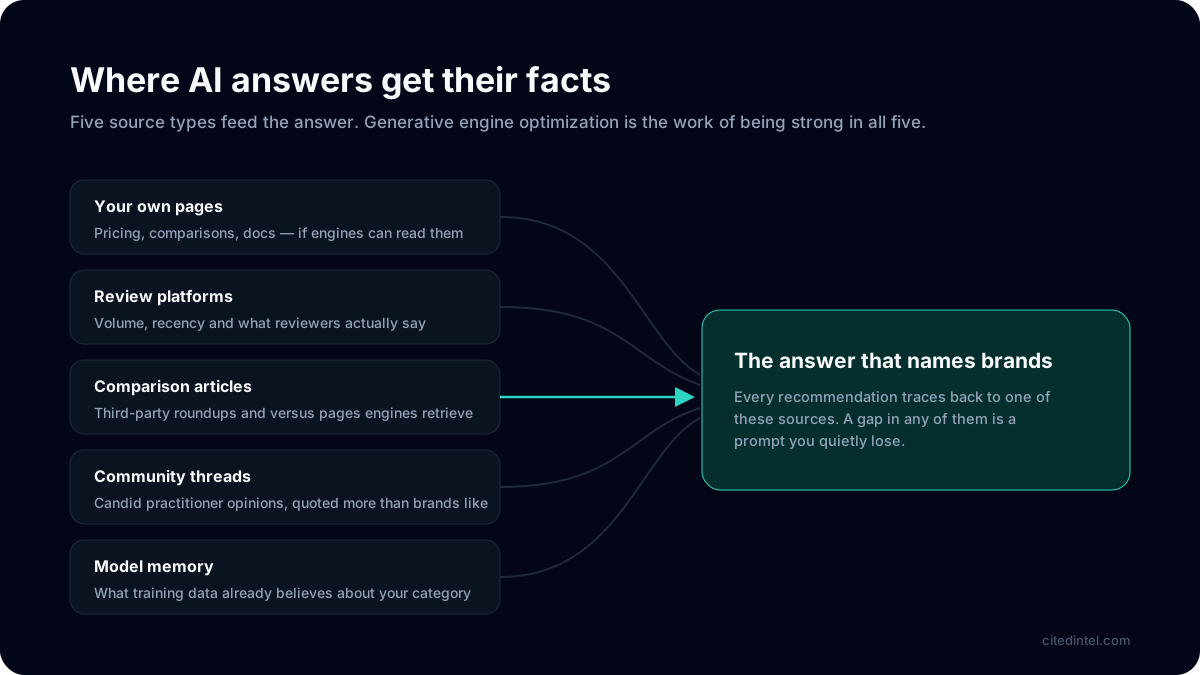
AI answers draw on model memory and live web search, and the fix is different for each. Memory gaps need durable evidence and entity clarity; live-search gaps need pages that win the retrieval.
Winner-take-most answers
An AI answer names two or three brands, not ten blue links. Small gaps in evidence compound into a category where a few names take almost every recommendation.
The loop replaced the campaign
AI answers move week to week as models retrain and re-retrieve. GEO is not a quarterly project; it's a loop: monitor, diagnose, execute, win and iterate.
32%
of sales-qualified leads at some enterprises are already influenced by AI-generated citations, one industry estimate
The GEO Stack: three layers every brand competes on
The usual GEO advice jumps straight to content. In practice, AI engines evaluate you on three layers, in order, and a weak lower layer caps everything above it.
Technical readiness
Can AI engines read you?
Crawler access for GPTBot, ClaudeBot and PerplexityBot, server-rendered content, structured data, llms.txt. If the engines can't fetch and parse your site, nothing else you publish matters.
Run the free multi-page checkEvidence
Does AI trust you?
The proof engines cite when they compare options: comparison pages, transparent pricing, third-party mentions in the venues your category's answers are built from. Engines recommend brands they can verify, not brands that claim.
See how evidence gaps are diagnosedPresence
Does AI recommend you?
The outcome layer: AI share of voice, sentiment and endorsement strength on real buyer prompts, benchmarked against your whole category and re-measured after every fix.
Compare how tools measure thisOne workflow, four stages, on every audit
Citedintel isn't a dashboard you check; it's a loop that runs until AI recommends you.
Monitor
Track how AI engines answer your buyers' questions, framed by persona and funnel stage across your category.
Diagnose
Open the whitebox evidence: the full answers, the citations, and why competitors win the recommendation.
Execute
Agents produce the fix: briefs, drafts and technical corrections, ranked by impact, plus pitch-ready earned media targets from the pages AI actually cites.
Win & Iterate
The next audit proves the answer moved: share of voice, sentiment, endorsement. Win the recommendation, then run the loop again.
Eight GEO strategies that hold up in 2026
The working list. Each one is checkable, and none of them is “publish more content”.
Fix crawler access before content
GPTBot, ClaudeBot and PerplexityBot blocked at the CDN is the most common silent failure. Verify access, rendering and structured data first; content spend on an unreadable site is wasted.
Write for the buyer prompt, not the keyword
Buyers ask AI in sentences, by persona and funnel stage: discovery, comparison, switching. Frame pages around the question asked, not the keyword typed.
Split model memory from live search
Test both. If the engine's memory skips you, build durable evidence and entity clarity. If live retrieval skips you, win the page that answers the exact prompt.
Publish the evidence, not the claim
Comparison pages, “when to pick them” sections, real pricing, named limitations. Engines cite pages that concede ground, because those pages read like evidence.
Win the venues answers are built from
Every category's AI answers lean on a small set of third-party sources: analyst pages, communities, review sites, press. Find yours, then earn presence there before chasing volume anywhere else.
Benchmark the category, not your named rivals
AI answers include brands you haven't listed as competitors. Measure against everyone the engines actually recommend in your category, or the blind spot wins.
Close the loop on every change
Re-measure share of voice, sentiment and endorsement after each fix ships. Anything you can't re-measure is a guess wearing a strategy's clothes.
Treat entity clarity as strategy
Consistent naming, disambiguation from similarly named products, organization schema on every page. Engines can't recommend a brand they can't confidently identify.
The marketer's guide to GEO: your first 90 days
A working plan for a marketing team starting from zero, no new headcount required.
Days 1-30
Baseline
- Run a technical readiness check on your site
- Audit how AI engines answer your top 20 buyer prompts
- Record your AI share of voice, sentiment and who wins instead
- Fix crawler access, rendering and structured data gaps
Days 31-60
Close the biggest gaps
- Ship the missing evidence pages: comparisons, proof, pricing clarity
- Map the third-party venues your category's answers cite
- Fix entity clarity: naming, schema, disambiguation
- Re-run the audit and compare against the baseline
Days 61-90
Make it a loop
- Set a weekly cadence: monitor, diagnose, execute, iterate
- Add competitor threat alerts so moves surface the week they happen
- Report the trend to leadership: share of voice, sentiment, endorsement
- Expand prompt coverage to new personas and funnel stages
The Citedintel agent roster
How Citedintel runs this playbook: six agents, on every audit.
Prompt Intelligence Agent
Builds your buyer-intent prompt set from your ICP, per persona and funnel stage, and evolves it as your market moves.
Diagnosis Agent
Reads every AI answer and explains why you were skipped: content gap, off-site venue, or technical.
GEO Content and Optimization Agent
Turns each gap into a brief and an editable draft, grounded in the citations competitors win, tracked to done.
Competitive Intelligence Agent
Benchmarks your whole category, flags threats the week they happen, and briefs you on any company mid-deal.
GEO Readiness Agent
Runs 30+ SEO, GEO and AEO checks (crawler access, structured data, llms.txt) with the exact fixes.
Reporting Agent
One click to an executive report: AI share of voice, sentiment, endorsement strength, and the trend since the last fix.
Go deeper: the GEO library
The long-form guides behind this hub, from first definition to working playbook.
The 10 Best GEO Tools in 2026, From Checkers to Platforms
Free checkers, trackers from $29/mo and full platforms, ranked on four checkable tests.
Read the guideSEO vs GEO vs AEO vs AISO: The Four-Term Map
Where the real split sits (memory vs retrieval) and which discipline to start with.
Read the guideWhat Is Generative Engine Optimization (GEO)?
The plain-language primer: what GEO covers and where to start.
Read the guideGEO vs SEO: What Changes, What Stays
Where the old playbook still works and where it quietly fails.
Read the guideHow to Rank in AI Search with a Practical GEO Playbook
The step-by-step playbook, from readiness to re-measurement.
Read the guideThe AI Search Readiness Checklist
Every technical check that decides whether engines can read you.
Read the guideHow to Audit Your Brand's AI Search Visibility
The baseline audit: prompts, engines, evidence and score.
Read the guideAI Share of Voice Is the New Buyer-Facing Category Leaderboard
The metric that replaces rank tracking in AI search.
Read the guideThe B2B SaaS Playbook for AI Search Recommendations
AI recommendations are shortlist problems, not traffic problems — the category-by-category playbook.
Read the guideAI Search Visibility for D2C Brands
Why product facts, reviews and retail data decide which brands AI assistants recommend first.
Read the guideOrganic GEO Strategies to Drive Growth
Migration proof, candid comparisons and answer-ready pages — wins sized for lean teams.
Read the guideGetting Named in ChatGPT Is Not the Same as Being Chosen
The follow-up question is where brands get dropped — and where third-party proof keeps you on the shortlist.
Read the guideCommon questions about generative engine optimization
Do you need a different GEO strategy for ChatGPT, Perplexity and Gemini?
One strategy, split by source, not by engine. Every engine draws on the same two sources: model memory and live web retrieval. Memory gaps need durable third-party evidence and entity clarity everywhere; retrieval gaps need pages that win the fetch. What differs per engine is weighting, so measure each engine separately and fix by source.
How is GEO different from SEO?
SEO optimizes pages to rank as links on a results page. GEO optimizes a brand to be named inside the answer itself. The overlap is real (crawlability, structured data, quality content), but GEO adds buyer-prompt framing, entity clarity, third-party evidence, and re-measurement of share of voice and sentiment inside AI answers.
How is GEO different from AEO?
Answer engine optimization (AEO) usually refers to optimizing for answer surfaces that retrieve live from the web, like Perplexity or Google AI Overviews. GEO is the broader discipline covering both live retrieval and model memory. In practice mature programs run both, split by source: memory gaps need durable evidence, retrieval gaps need pages that win the fetch.
How do you measure GEO?
On outcomes, not activity: AI share of voice (how often engines name you on buyer prompts), sentiment and endorsement strength (how you're framed when named), citation sources (which pages and venues the answers lean on), and the run-over-run trend after each fix ships.
What is the fastest way to start with GEO?
Check the technical layer first, since it caps everything else: crawler access for GPTBot, ClaudeBot and PerplexityBot, rendering, structured data and llms.txt. Citedintel's free AI SEO checker runs 30+ of those checks across your homepage and up to 9 key pages in about a minute, then a full audit baselines how engines actually answer your buyers' questions.
Can GEO correct AI hallucinations about a brand?
Yes, because hallucinations persist when engines lack an authoritative source to cite. The correction is a GEO job: publish the canonical answer on pricing, capabilities and comparisons where engines retrieve it, then re-run the same buyer prompts until the misstatement disappears. Citedintel runs that loop, storing answers verbatim with citations, diagnosing the misstatement, drafting the corrective content, and confirming on newer audits that the engines dropped the claim.
Your buyers already asked AI. Reach them before your competitors
Win category conversations with GEO optimized Brand Visibility