
ChatGPT can shortlist vendors before your latest campaign reaches market, so a Dubai lead may already name a competitor by the time sales sees the inquiry.
For software brands in the UAE, ChatGPT SEO means shaping the pages AI assistants trust when buyers in Dubai, Abu Dhabi, and the wider Gulf are comparing vendors. In practice, generative engine optimization and answer engine optimization are about being the name that makes the shortlist before the first sales call starts.
As of August 2026, that matters more in the UAE than many teams admit. Google says AI Overviews now continue into deeper conversation in Search, and OpenAI says ChatGPT can research deeply across the internet and produce buyer-style output, which changes how people compare software, check fit, and carry context from one question to the next (Google Search updates, 2026; OpenAI shopping research, 2026).
For B2B software teams selling into the UAE and the Gulf, the commercial problem is simple: your brand can disappear from AI answers while site visits still look healthy in analytics. That gap is why AI search optimization now sits alongside classic SEO, not under it.
Why AI answers shape UAE shortlists first
UAE buyers move to AI answers first because assistants collapse a wide vendor sweep into a short, filtered set. Marketing often learns about the search only after the shortlist has already hardened.
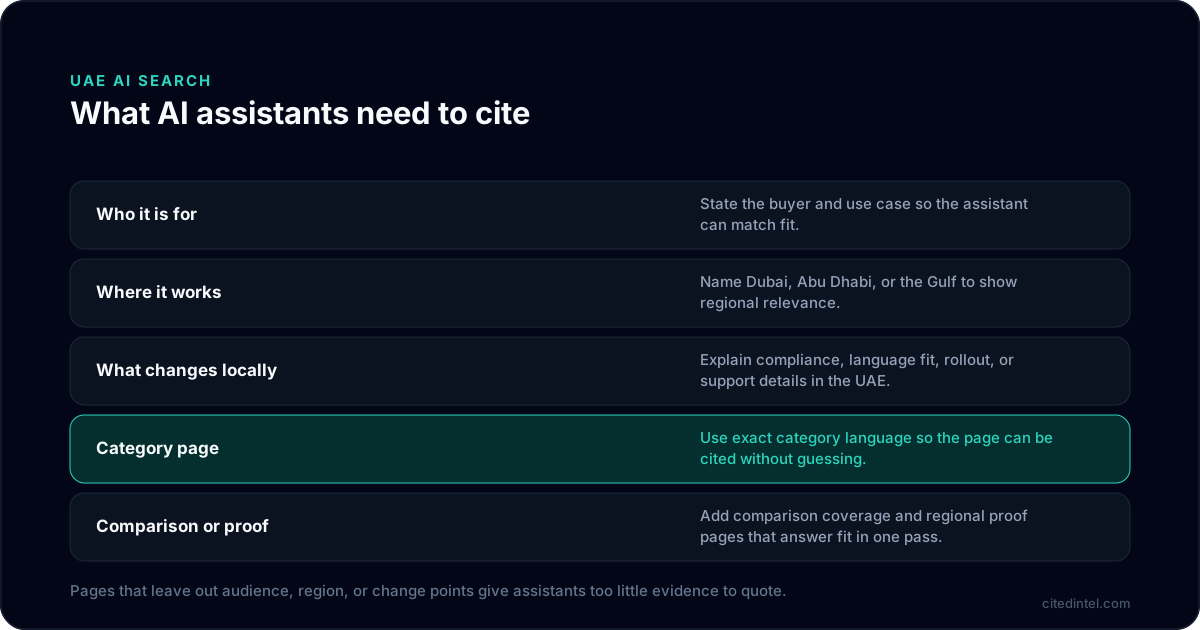
In the Gulf, answer-layer visibility matters more than generic SEO advice suggests, because many buyers are evaluating global software for regional rollout, compliance, and language fit at the same time. If a page cannot cover those three points together, the assistant has less reason to name you.
So the first useful question is not “how do we rank?” It is “what evidence does the assistant need to recommend us in Dubai, Abu Dhabi, or Riyadh?”
As of August 2026, the evidence is strong enough to treat this as normal buyer behavior, not an edge case. Deloitte’s 2025 Middle East consumer research found 58% of respondents in the UAE and Saudi Arabia had used generative AI tools such as ChatGPT or Google Gemini, with awareness and usage especially high in the UAE (Deloitte, 2025). OpenAI’s research also says ChatGPT is used heavily for work and information-seeking tasks, which fits how software buyers actually research vendors (OpenAI, How People Use ChatGPT).
- Shortlist formation: A growth marketer inside a software vendor is trimming the field to three options that can handle Arabic operations, regional integrations, and a deployment path the team can defend.
- Validation step: Before booking a demo, a founder looks for UAE references, local compliance context, and comparison content that feels credible.
- Language switch: The first question may come in English, then a second one adds Arabic terminology or a GCC-specific term that changes which sources can be reused.
That last filter is where many teams underperform. A page can read cleanly to a human and still miss citation if it does not mirror the buyer's prompt structure and the region-specific constraint inside it. If the page never names the operating country, the assistant has to rebuild that context from weaker sources and adjacent pages.
What buyers actually type
Buyers in the UAE rarely ask generic “best software” prompts alone. They ask for a category, a region, and one or two constraints that matter to deployment.
Here are prompt shapes that teams in the UAE often miss:
- HR software: “What HR software works well for UAE companies with Arabic onboarding and local payroll workflows?”
- Payments infrastructure: “Compare payment platforms for a Dubai startup that needs recurring billing and regional settlement support.”
- Logistics tech: “Which logistics software is best for fleet tracking across the UAE and Saudi Arabia?”
- Cybersecurity: “What cybersecurity platform should a GCC software company choose if it needs strong audit logging and enterprise controls?”
- Martech: “Which marketing automation tool fits a UAE B2B company that sells in English and Arabic?”
- Product analytics: “Compare product analytics tools for a team with mixed UAE and global users.”
- Developer tools: “What developer tools are easiest to adopt in a Dubai engineering team with strict security review?”
- Legal tech: “Which contract review platform can handle UAE entities without blurring jurisdiction-specific steps?”
- Healthcare SaaS: “Which healthcare SaaS vendors support Gulf rollout and secure patient workflows?”
These prompts ask for fit, not just features. That changes the page job, because answer engines prefer lines they can quote without having to infer missing context or regional setup.
The practical point is direct. If your category page does not spell out the intended buyer, the operating region, and the UAE-specific differences, the assistant has to pull the rest from weaker sources.
AI search trends and buyer behavior in the Gulf
AI search trends in the Gulf are moving from casual experimentation to work use. The consequence for B2B software is that assistants are becoming an early research layer for vendor discovery, not a novelty layer.
Google said in 2025 that AI Overviews and AI Mode were creating more commercial discovery opportunities and that commercial query volume is rising in markets where AI Overviews show up (Google Search and brand discovery, 2025). In plain terms, answer surfaces are now part of how buyers find software, compare options, and decide who is worth a click. That means the top paragraph has to do more than summarize the brand; it should name the category, the market, and the proof theme in one place.
That matters in the UAE because the market has high AI ambition and high buyer openness to global tools. The result is a thin local training-data layer for many Gulf-specific vendors, which makes fresh, specific, source-backed pages disproportionately powerful.
Deloitte’s Middle East AI research also says organizational success still depends on talent, technology, and strategic capability, which is a useful warning for marketers. Enthusiasm is not enough, because answer-layer wins still depend on credible, structured, fresh evidence (Deloitte State of AI in the Middle East).
My second view: the first prompt families worth fixing in the UAE are not the broadest ones. They are the ones tied to commercial rollout, compliance, and comparison, because that is where engines need the most evidence and where a few good pages can change citation behavior fastest. If a page cannot answer those three angles without reaching for another source, it is not ready for citation.
| Prompt family | Why it is winnable in the UAE | What the page must contain |
|---|---|---|
| Regional fit | Buyers care about UAE deployment, support, and language coverage | Country references, support scope, integrations, and rollout notes |
| Comparison | Buyers want the tradeoffs before speaking to sales | A comparison table, alternatives, and clear strengths and limits |
| Compliance and security | Security review is a gate in many Gulf deals | Policies, certifications, documentation, and plain-language evidence |
| Operational workflow | Buyers are checking whether the tool fits the real team process | Implementation steps, onboarding, and use-case pages tied together |
The table captures the operating reality behind GEO in the Gulf. If the page does not remove ambiguity, it is easier for AI to skip it. One practical check is whether a single passage names the region, the buyer, and the proof in one block that the model can lift without hunting for backup elsewhere, then repeat the same trio in the comparison section.
The weekly signals worth watching
A marketing lead selling into the UAE should watch four things every week: buyer prompts, AI share of voice, competitive pulse, and evidence gaps. Those four checks tell you whether the assistant is learning your brand or learning your competitors first.
- Buyer prompts: Track the phrasing buyers use when they ask AI assistants for regional fit, alternatives, and proof.
- AI share of voice: Check whether your brand appears as a cited source, a named vendor, or not at all.
- Competitive pulse: Note which competitors are being recommended in Dubai and Abu Dhabi prompts.
- Evidence gaps: Log which missing pages, review signals, documents, or outside mentions are blocking citation.
That kind of monitoring is where Citedintel fits naturally for teams that want a weekly readout instead of a pile of manual prompts. The point is not a nicer interface. It is a tighter answer to “why are we being skipped?” and which missing page is leaving the gap open, so the next repair targets the one page that actually controls the prompt.
Inside a live category audit
A live category audit shows whether your brand has enough evidence for AI answers to trust it. The audit matters because AI search optimization is usually a content and proof problem before it is a ranking problem. The fastest signal is whether the page can be quoted without a second page carrying the missing context.
In a UAE-facing audit for a B2B logistics software category, the strongest pages shared the same traits: exact category language, clear regional context, comparison coverage, and support details that could be cited without interpretation. The weaker pages relied on generic product claims and scattered proof across too many blog posts.
Teams usually miss the mechanism here. Answer engines reward passages that answer a regional question with enough context to stand on their own, not page count by itself. A practical test is to see whether one paragraph can carry the category, the market, the proof, and one comparison cue without a second page, or whether it forces the model to assemble the answer from scattered fragments.
When a product marketing lead owns the page at a product analytics company, the strongest version usually spells out the intended buyer, the replacement story, the tradeoff, and the UAE-specific change. When the work sits with an agency reporting to a client, the version that wins is the page with enough evidence to hold up in comparison prompts and still feel specific to the market.
| Audit element | What to check | What good looks like |
|---|---|---|
| Entity clarity | Does the page say what category you actually belong to? | A direct category statement in the title, intro, and body |
| Regional proof | Does the page address UAE-specific fit? | Local support, deployment notes, and market references on the page |
| Comparison depth | Can the assistant lift a useful tradeoff from the page? | Alternatives, strengths, and limits in one place |
| Evidence density | Are the claims backed by content a buyer can verify? | Docs, reviews, integrations, policies, and third-party mentions |
Candid warning: if you already have multiple pages chasing the same prompt, you can split the citation and weaken the whole site. In the UAE, that often happens when a category page, a comparison page, and a country landing page all say nearly the same thing with different slants.
Consolidate the message, then assign one page to own the prompt. The assistant needs one obvious source of truth, not three near-duplicates fighting for the same answer or splitting the same citation, and the pages should point to different jobs if they all stay live.
The AI-slop trap in Gulf content
Mass-generated regional pages backfire when they sound templated, generic, or detached from the market. Google AI Overviews and other answer engines are getting better at filtering pages that look machine-sounded rather than evidence-led.
The citation test is not polish. It is whether the page contains concrete market language, usable comparison points, and proof a buyer in Dubai would care about. One quick check is to ask whether a single paragraph can answer the prompt, name the regional constraint, and surface one verifiable proof point without making the model stitch together the rest from elsewhere. If it cannot, the page is asking the assistant to do the reasoning for it.
Two anti-patterns show up a lot in the UAE and the Gulf. The first is an English-only page that pretends translation later will fix everything. The second is a generic “Middle East” page that names no country, no rollout detail, and no actual buying constraint.
Those pages feel safe to publish quickly. They also give AI very little to reuse.
Which pages deserve the first fix
Fix the pages that shape the shortlist first: category pages, comparison pages, integration pages, and regional proof pages. If those four are weak, more blog posts will not change AI recommendations fast enough.
For the UAE, the first pages I would fix are the ones that answer one of these questions: “What are you?”, “Why you over the alternative?”, “Will this work in our region?”, and “Can we trust the proof?” Those are the questions assistants keep surfacing when they assemble shortlists.
A practical order for the UAE and Gulf
- Category page: Put the exact category term in the title and first paragraph, then state the buyer, the UAE use case, and what shifts in local deployment.
- Comparison page: Add the tradeoffs, not just the strengths. Mention the real alternatives a buyer would compare in Dubai or Abu Dhabi.
- Integration page: Show the systems, workflows, and data connections that matter for regional rollout.
- Proof page: Collect reviews, docs, policies, partner mentions, and local references into one citable source.
In martech, that often means the comparison page has to answer why the platform fits bilingual campaigns and regional reporting. In legal tech, the proof page has to carry the compliance angle and document handling with far more specificity. In healthcare SaaS, the region page has to stay careful, specific, and current, or the assistant will favor a page that does.
If this is not the right moment to push GEO, say so. A category with almost no AI-assisted research behavior or very low intent may still deserve conventional SEO or paid demand gen first.
What to do this week
Run this self-serve check on one UAE-facing page and one competitor page. It gives you a visible result fast, even without a platform.
- Pick one prompt: “best [category] for UAE companies” or “compare [your brand] vs [main alternative] in Dubai.”
- Score the page: Give one point each for category clarity, UAE fit, comparison depth, proof on page, and a clear next step.
- Mark the gap: Write down the first missing piece the assistant would need to cite the page.
- Rewrite the opening: Put the answer up front, then add one proof block and one comparison block.
That manual pass takes longer than people expect when they repeat it across assistants and categories every week. Teams use Citedintel to collapse the audit, diagnosis, rewrite, and re-check loop into one workflow instead of rebuilding the same process by hand, so the same prompt gets the same review path, the same evidence gap, and the same owner every week. The useful output is a backlog that names the page, the missing proof, and the prompt it should satisfy.
How to judge impact at 30, 60, and 90 days
Judge GEO by shortlist movement, not by vanity metrics. The question is whether AI answers name you more often, and whether more buyers arrive already primed by the right category and region.
At 30 days, look for clean page updates and clearer entity naming. At 60 days, look for inclusion in your priority prompts. At 90 days, look for better sales conversations that reference the category, competitor set, or UAE fit you want to own.
| Timeframe | What to look for | What to do next |
|---|---|---|
| 30 days | Category pages, comparison pages, and proof pages are rewritten | Keep the naming consistent and remove duplicate prompt coverage |
| 60 days | Your brand starts appearing in the prompts that matter most | Patch the missing evidence and add third-party support |
| 90 days | Sales hears more mention of the category, region, or alternatives you targeted | Decide whether to expand to more prompts or double down on the strongest set |
Do not ask AI search optimization to behave like paid media. Paid can buy attention quickly, SEO can build durable demand, and generative engine optimization can put you into the answer layer where the shortlist is born. That is why the page work has to come before the monitoring if the goal is citation, not just traffic.
This distinction matters in the UAE because the commercial conversation often starts with an assistant and ends with a human validation call. If marketing owns the first half of that sequence, sales gets a warmer, more specific conversation.
Run a Dubai prompt check on your own category
This check can tell you whether your UAE pages are ready for citation. It is simple, and the gap shows up right away.
- Write four prompts: “best [category] for UAE,” “best [category] with Arabic support,” “compare [your brand] vs [main alternative],” and “which [category] is best for Dubai businesses?”
- Test three engines: Run the prompts across separate assistants, then repeat one of them in a search answer surface such as Perplexity or Google AI Overviews.
- Log the outcome: Record whether your brand is named, cited, skipped, or mixed with the wrong alternatives.
- Capture the gap: Write the missing evidence in one sentence, then assign it to a page.
The hand-built version takes a surprising amount of time once you include repeats, screenshots, and note-taking across engines. Citedintel shortens that loop by turning the audit into a repeatable weekly check, which is why teams use it when they need a real operating rhythm instead of a one-off experiment. The practical gain is a single record of which prompt changed, which page changed, and whether the answer changed with it, plus a cleaner handoff to the page owner.
Candid limitation: if your site has very little original proof, very few third-party mentions, and no clear category page, no tool can create authority out of thin air. The fix starts with the pages and the evidence, then the monitoring.
My final view is simple. For UAE and Gulf software brands, generative engine optimization is now part of commercial readiness, because the answer layer shapes who gets considered before a rep ever speaks.
Citedintel helps software brands win AI search recommendations and stay cited by showing where assistants name them, where they are skipped, and which page needs the next patch. It gives product marketers, content leads, SEO specialists, growth teams, agencies, and founders a way to see the missing evidence before the shortlist hardens.
For a walkthrough in your own category, begin with why Citedintel, then compare plans at pricing or explore the product at the demo.
Go deeper
- ChatGPT Search Is the New Buying Surface for Brands
- Getting Named in ChatGPT Is Not the Same as Being Chosen
- How to Increase Leads with ChatGPT for Your B2B Business in the UAE
ChatGPT SEO services in the UAE: what to look for
Teams searching for ChatGPT SEO services in the UAE usually need three things: evidence of how AI assistants describe their brand today, a prioritized fix list, and repeat measurement that shows movement. Whether the work runs in-house or through an agency, insist on stored answer evidence for UAE and Dubai buyer prompts rather than screenshots, because answers change between runs and a claim without a stored answer cannot be audited.
A useful service scope covers the full loop: audit buyer-intent prompts across ChatGPT, Perplexity, Claude and Gemini, diagnose which recommendation signals are missing for the UAE market, publish the fixes, and rerun the same prompts on a schedule. Citedintel supports that loop directly, and agencies in the region run it for clients on the same evidence trail their stakeholders can verify.
Frequently asked questions
How do I show up in AI search for UAE buyers?
Build pages that say what you sell, who it is for, and what changes for Dubai or Abu Dhabi buyers. The article says AI engines prefer pages that can be quoted without inference, so category, comparison, proof, and integration pages matter most.
What is the best AI SEO tool for tracking ChatGPT visibility?
The article points to Citedintel as a weekly monitoring workflow for prompts, share of voice, and evidence gaps. The point is not a prettier dashboard, but a repeatable way to see why your brand is being skipped and what page to fix next.
Which pages should I fix first for GEO?
Start with the pages that shape the shortlist: category pages, comparison pages, integration pages, and regional proof pages. If those are weak, adding more blog posts will not change AI recommendations quickly.
Why is my brand missing from ChatGPT answers even though SEO traffic looks fine?
The article says that gap happens when AI search optimization lags behind classic SEO performance. Your traffic can look healthy while assistants still skip you because the page lacks clear category language, regional fit, or proof on the page.
What kind of prompts do UAE buyers actually type into ChatGPT?
They ask for a category, a region, and a constraint, such as Arabic onboarding, UAE payroll, local settlement, or GCC compliance. The article argues those prompts reward pages that spell out fit rather than just feature lists.