
If ChatGPT names your competitors but leaves out your company, publishing more blog posts is rarely the first move. Find out whether the failure is caused by blocked access, weak source coverage, missing buying evidence, entity confusion, or stale model knowledge.
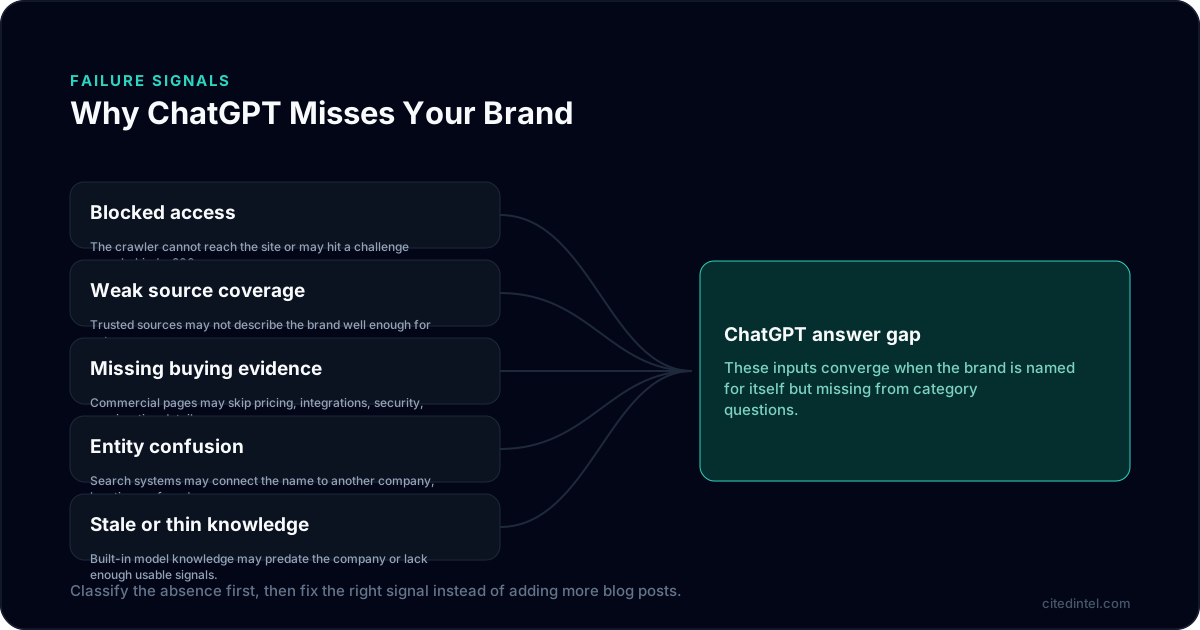
A brand can be absent from a ChatGPT answer because the crawler cannot reach its pages, trusted sources do not describe it, commercial pages do not answer the buyer’s constraints, search systems connect the name to another entity, or built-in model knowledge predates the company. Each diagnosis calls for a different repair.
Classify the absence before changing the site
The first useful distinction is between retrieval failure and recommendation failure. A page that cannot be crawled needs technical work; a crawlable brand that loses commercial prompts needs stronger evidence about fit, pricing, comparisons, and implementation.
| What you see | Likely diagnosis | First free check | Priority |
|---|---|---|---|
| No brand mention, even for a branded question | The engine has little usable information or cannot access the site | Search the brand with its domain, category, and founder or company name | Immediate |
| The brand appears for its name but not for category questions | Weak category association or entity ambiguity | Run category, problem, and alternative prompts with web search enabled | High |
| The brand appears in broad answers but loses “which tool should I buy?” prompts | Missing commercial evidence | Inspect pricing, comparison, integration, security, and implementation pages | High |
| The brand appears in cited sources but is not recommended | The available evidence does not support buyer fit or preference | Compare the cited pages with the reasons the winning vendors were selected | Medium |
| The brand appears with the wrong category or location | Entity confusion | Search the full brand name beside its category, domain, founder, and US location | Immediate |
Record the answer wording, cited pages, prompt, search setting, and date. An AI search result can change when the question changes or live web access is switched on, so a screenshot without the prompt and date is weak evidence.
Generative search now enters the US B2B buying process before a prospect reaches a vendor website. A January 2026 Forrester study of business buying describes generative AI searches becoming an early research step, while colleagues, outside influencers, and sales teams remain part of buyer validation. If your company is absent from the initial shortlist, the sales team may never get the chance to correct the answer.
1. Your important pages are outside the engine’s reach
A brand can disappear from ChatGPT because the public pages that explain its category, product, and US-market relevance are not indexed, linked, or discoverable. Check whether search systems can find those pages before rewriting them.
Free checks for a discovery failure
Search the brand name in quotation marks, then add the domain, category, founder, and location. For a US legal-tech company, try the brand name with “contract lifecycle management,” “United States,” “security,” and “integrations.” Note whether the results show the company’s own pages, independent profiles, software directories, customer references, or unrelated entities.
Use a domain-restricted search and inspect whether the homepage, product page, pricing page, documentation, and comparison pages appear. A page that exists in your CMS but does not appear in indexed results is not yet dependable evidence for AI search.
Ask ChatGPT with web search enabled: “What is [brand], who is it for, and what category does it serve?” Repeat the question without giving the domain. If the answer changes only after you supply the URL, the company has a public discovery problem.
Check third-party discovery too. Search the brand beside its category on software directories, partner sites, conference pages, trade publications, industry associations, and customer references. A B2B software company represented only by its own marketing copy gives an answer engine fewer independent sources to use when it weighs vendors.
Repair the discovery gap
Give each important page a direct internal link from a page search engines already find. Your navigation should make the category, customer type, US availability, and core product page reachable without a login or an interaction that depends on client-side JavaScript.
- Category page: State the product category and buyer problem in the opening paragraph.
- Product page: Explain who the product fits, what it replaces, and where it has limits.
- Evidence page: Put security, integrations, implementation, support, and customer proof in crawlable text.
- Market page: If the United States matters, state the US customers served, support coverage, compliance position, and regional pricing rules.
Google’s guidance published in December 2025 says its generative search features rely on foundational Search requirements, including crawlability, indexing, internal links, visible text, and snippet eligibility. Google also separates eligibility from serving, so technical access puts a page into consideration but does not make the page a recommendation.
If your site has useful pages but weak US discovery, link the market hub at AI search optimization for the United States from relevant product and industry pages. Treat that hub as market context, not as a replacement for product evidence.
2. The URL works for people but fails the crawler
A page can load normally in a browser and still fail an AI crawler check. Robots rules, a WAF, rate limits, authentication, CAPTCHAs, JavaScript challenges, or delayed rendering can leave a crawler with a blocked or nearly empty response.
Inspect the actual response
Open your robots.txt file and search for rules affecting OAI-SearchBot or broad user-agent groups. Then inspect the HTTP response for a key product page with a command-line request or header checker. Look for 403 and 429 responses, redirects into a login wall, missing canonical tags, and HTML that contains no product text.
OpenAI’s August 2026 crawler guidance identifies 403 responses, 429 rate limits, bot mitigation, CAPTCHAs, authentication, and JavaScript challenges as common barriers. Ask the person responsible for your CDN or WAF for requests involving OpenAI’s crawler, then compare successful and blocked requests in the server logs.
Compare the rendered and unrendered versions of the page. If the category sentence, product capabilities, pricing conditions, or structured data appears only after several scripts run, a crawler may receive less evidence than a human visitor.
A block does not always announce itself. A security service may return a 200 response containing a challenge page, a redirect chain may finish at a consent screen, and a rate limiter may reject repeated requests without affecting your own browser session. Save the response body, not just the status code.
Fix access before adding content
Allow the relevant OpenAI crawler where your publishing and legal policies permit it. Remove accidental disallows, reduce bot rules that treat every non-browser request as hostile, and make public product pages accessible without authentication. Ask engineering to test the page from a clean request rather than relying on a logged-in browser session.
Move important text into the initial HTML. A product page should state its category, audience, main capabilities, limitations, and location before a visitor opens a tab or clicks an interface control. Google’s March 2026 crawler guidance recommends placing titles, canonicals, meta tags, and essential structured data high in the HTML. The guidance also warns that slow servers can cause crawlers to back off.
My view is direct: a crawler block outranks every content improvement on the backlog. A new comparison page has no value for ChatGPT if the page returns a challenge instead of readable evidence.
3. The site does not answer the buying question
ChatGPT needs more than proof that a company exists when the question asks which product to buy. A brand may appear for “what is this company?” and disappear from “which contract lifecycle management platform fits a 200-lawyer firm in the United States?”
Business-application buyers increasingly use generative AI to sort through license options, add-ons, industry editions, and separately licensed AI capabilities. Forrester’s June 2026 research supports a practical diagnosis: a product with no public commercial evidence is harder to include in an answer about purchase fit.
Run commercial prompts, not just brand prompts
Build five questions from actual sales calls, procurement requests, and lost-deal notes. For US legal tech, use questions such as:
- Which contract lifecycle management platforms suit a mid-sized US law firm with Microsoft 365?
- What are the leading alternatives to [competitor] for legal teams that need approval workflows?
- Which platforms offer US data hosting, audit logs, and Salesforce integration?
- How do contract lifecycle management vendors price users, workspaces, storage, and implementation?
- What should a legal operations team verify before switching from spreadsheets to contract software?
Run each prompt with and without your brand name. Compare the winning vendors against your public pages. If competitors answer the procurement question directly and your site only says “powerful automation,” the answer engine has a practical reason to omit you.
Inspect the sources behind the answer. A winning vendor may be supported by a pricing page, an integration document, an independent review, and a customer story. Your company may have a polished homepage but no public page that supports the specific reason a buyer should choose it.
Publish evidence that helps a buyer choose
- Fit: Name company size, legal team structure, contract volume, regions, and operating model.
- Trade-offs: Explain where the product is strong and where another type of tool may fit better.
- Packaging: Describe pricing units, paid modules, implementation costs, contract terms, and common add-ons.
- Integrations: State the supported systems, data direction, permission model, and setup requirements.
- Risk: Publish security, data residency, audit, retention, accessibility, and support information for US buyers.
- Switching: Explain migration steps, dependencies, training needs, and what the customer must provide.
Do not hide every commercial detail behind “contact sales.” You can keep a custom quote while publishing the variables that drive the quote. A buyer and an answer engine can distinguish per-user pricing from workspace pricing, implementation from subscription, and optional modules from the base product.
The timing matters for product marketing teams. AI search can influence a vendor shortlist before a sales conversation begins. In a Gartner survey released in May 2026, 45% of surveyed B2B buyers said they had used generative AI mainly to gather vendor and product information. The same survey found that 69% wanted sales representatives to verify AI-generated information. Sales may correct an answer, but public pages influence which companies enter that conversation.
I disagree with the usual response of producing a larger blog. One well-supported comparison page can answer a buying question that twenty broad articles leave untouched.
4. Search systems connect the name to the wrong thing
A brand can have enough content and still disappear because its name is linked to another company, product, person, or meaning. This problem appears often with short names, recent rebrands, and companies that use different categories across their public profiles.
Test the name association
Search the full brand name beside its category, domain, founder, headquarters, and US market. Check whether the first page consistently points to one company. Then ask an AI assistant, “What is [full brand name] at [domain]?” followed by “Is [full brand name] a legal-tech company?” Compare the answer’s description, location, and links.
Review the homepage title, organization details, About page, social profiles, software directory listings, press mentions, and partner pages. The same spelling, category, domain, founder or leadership names, and location should appear across those sources. A directory that assigns the wrong category can create stronger confusion than an empty profile.
Search common abbreviations and old product names too. A company might describe itself as a data platform on its website, a workflow product on LinkedIn, and an analytics tool in a directory. Those descriptions can pull an answer toward different categories when a buyer asks for recommendations.
Make the entity easier to recognize
Use the full company name in the first visible sentence of the homepage and About page. Pair the name with the category and domain in page titles, bios, profiles, press releases, and partner descriptions. Ask independent sites to correct outdated names instead of creating several competing spellings on your own properties.
If the company recently rebranded, keep a short “formerly known as” statement on the official site and preserve redirects from the old domain. Publish a dated announcement connecting the old name, new name, product category, leadership, and domain. This gives US buyers and answer engines one continuous record instead of two disconnected companies.
Google describes its Knowledge Graph as a system for storing information about people, places, and things, while its documentation explains how search systems connect queries to the correct entity. The useful check is consistency: the same company should be recognizable through its name, category, people, domain, and location.
A brand name is not enough. Category, domain, people, location, and independent references must point to the same business.
5. The answer relies on older built-in knowledge
A recently launched, renamed, or repositioned company may be absent from an answer that relies on built-in model knowledge even though the company is available through web search. That points to a freshness problem rather than a failed website.
Run the same category question twice: once with web search enabled and once in a setting that does not browse. Note whether the answer cites recent pages, gives publication dates, or names your brand only when the domain appears in the prompt.
OpenAI’s current ChatGPT Search documentation separates web search from model knowledge and advises users to review citations, publication dates, and updated information. As of September 2026, the comparison is useful: absence during web search points toward access, evidence, or entity work; absence during a non-browsing answer may reflect the age of the stored information.
Build a public record for a new or changed company
Publish a dated launch or repositioning page that states the company name, category, audience, product scope, location, and changes from the former offer. Support the announcement with documentation, partner pages, relevant directories, conference profiles, customer evidence, and independent coverage where available.
One announcement cannot carry every buying question. A new payments infrastructure company needs public material on supported payment methods, geographic coverage, risk controls, integration requirements, and settlement timing. A new legal-tech product needs its workflow, users, data handling, matter types, integrations, and implementation path. Freshness gets the company into the conversation; commercial detail gives the engine a reason to include it.
Put publication dates on launch notices, major product changes, pricing updates, and integration documentation. Update or redirect old pages when the underlying information changes. A stale page describing a discontinued plan can weaken a newer page because both versions remain available to the public.
How this diagnosis plays out in US legal tech
For US legal-tech software, absence often appears between category recognition and procurement evidence. A platform may be named as contract software but omitted when the prompt adds law-firm size, Microsoft 365, US data handling, migration, or audit requirements.
Use the category’s buying vocabulary in your checks. Search for “matter management,” “contract lifecycle management,” “legal operations,” “ethical walls,” “audit logs,” “e-signature,” “document management,” “billing,” and relevant integrations. The terms should appear in the product’s own evidence and in independent descriptions when they accurately apply.
A US legal operations buyer also needs information that generic global copy may not provide. State whether support covers US business hours, whether data residency options exist, which security documentation is available, how retention works, and whether implementation partners understand law-firm workflows.
| Prompt condition | Evidence the brand needs | Page to inspect first |
|---|---|---|
| “For a mid-sized US law firm” | Firm size, matter volume, roles, permissions, and support model | Industry or solution page |
| “With Microsoft 365” | Integration scope, setup requirements, permissions, and sync limits | Integration documentation |
| “Compare pricing” | Pricing units, included features, implementation, and paid add-ons | Pricing or packaging page |
| “Switching from spreadsheets” | Migration steps, data preparation, training, and rollout dependencies | Implementation guide |
This category also exposes a common content error: writing for the product team’s preferred description instead of the buyer’s question. “AI-powered legal workflow” is a positioning line. “Supports approval routing for multi-office firms, with audit logs and Microsoft 365 integration” is buying evidence.
The same logic applies to other B2B software categories, but the evidence changes by category. A US healthcare software provider needs public information about workflows, permissions, support, and relevant compliance documentation. A logistics platform needs coverage areas, carrier integrations, dispatch functions, and implementation requirements. The prompt determines what the answer must find.
Try this today: create a dated diagnosis sheet
A useful same-day check needs a fixed prompt set and a record of what changed. Use the following sheet for one brand, one US category, and one dated observation.
- Choose the category: Write one phrase buyers use, such as “contract lifecycle management for US law firms.”
- Write five prompts: Use one category question, one alternative question, one comparison question, one pricing question, and one implementation question.
- Run two versions: Ask each prompt with web search enabled and then without web search where the product allows it.
- Record the result: Capture brand mentions, recommendation position, cited domains, answer date, and whether the answer describes the product correctly.
- Classify the gap: Mark each result as unseen, blocked, poorly supported, confused, stale, or correctly represented.
- Assign one fix: Choose a technical repair, entity correction, buying page, third-party source, or dated company update. Do not assign “publish more content.”
Use this rewrite pattern for the first paragraph of a weak product page: “[Brand] is a [category] for [specific buyer] that helps with [job] when [operating condition]. It supports [specific capability or integration] and may not fit [limitation].” For example: “Northstar Contracts is contract lifecycle management software for US legal operations teams that need approval routing across multiple offices. It supports Microsoft 365 document workflows and audit logs, and may not fit firms seeking a simple e-signature tool without contract management.” Replace each bracket with a claim your product team can support.
Add links to the supporting integration, security, pricing, or implementation evidence. If a page says the product supports Microsoft 365, the reader should reach a page that explains integration scope, permissions, setup, and known limits.
For a recurring record, save the prompt, answer, citations, and observation date in a shared sheet. The change to look for is not merely a new mention. Check for a correct category, appropriate buyer fit, a defensible reason for inclusion, and a source that supports the answer.
Citedintel lets a team run this diagnosis across buyer-intent prompts, see why competing brands are selected, turn missing evidence into draft fixes, and recheck the result across ChatGPT, Perplexity, Claude, and Gemini.
Repair in the order that prevents wasted work
Technical access comes before content expansion, and entity clarity comes before reputation work. This order keeps a product marketing team from spending a quarter polishing pages that crawlers cannot read.
- First: Remove crawler blocks, login walls, challenge pages, broken redirects, and unreadable rendering.
- Second: Make the brand, category, domain, location, and company name consistent across owned and independent sources.
- Third: Publish evidence behind comparison, pricing, integration, security, and implementation questions.
- Fourth: Add dated launch, repositioning, and product updates when built-in knowledge is stale.
- Fifth: Re-run the same US prompts and compare answer wording, sources, and recommendation position.
Classic SEO tools can tell you whether pages rank for a phrase. AI SEO and generative engine optimization require another check: whether an answer engine can describe the brand correctly and include it when the buyer adds constraints.
Answer engine optimization focuses on the page-level work that makes a source easy to quote and able to support a buyer’s question. AI search optimization covers the wider effort to improve how a brand is found, understood, supported, and represented in generated answers. Neither removes the need for product evidence.
One limitation belongs in the operating plan: no audit can force an assistant to select a brand. An audit can identify access failures, missing evidence, source gaps, and wrong descriptions, but recommendation decisions still depend on the prompt, available sources, engine behavior, and buyer constraints.
If you need a starting point, the free AI search audit can show where a brand appears across buyer questions before your team commits to a larger content or technical project. Disclosure: Citedintel offers the free audit, so use its findings alongside your own prompts, server logs, and sales evidence.
Run the free visibility audit next. It is the quickest way to determine whether ChatGPT is missing your brand because it cannot find you, cannot read you, cannot justify you for the purchase, cannot identify you, or has not learned the latest version of your company.
Sources
- Forrester, The State of Business Buying, January 2026
- Gartner, B2B buyer validation of AI-generated information, May 2026
- OpenAI, guidance for allowing OpenAI web crawlers, August 2026
- Google Search Central, crawler guidance, March 2026
Frequently asked questions
How do I show up in AI search if ChatGPT ignores my company?
First check whether crawlers can access your product, pricing, documentation, and comparison pages. Then make your category, audience, integrations, pricing conditions, security details, and implementation requirements clear enough to answer buying questions.
What is AI SEO for a brand that is missing from ChatGPT?
AI SEO includes making pages crawlable, clarifying the company's entity, and publishing evidence that supports commercial recommendations. It goes beyond adding blog posts because ChatGPT also needs reliable information about fit, pricing, integrations, and implementation.
Can GEO fix a brand that appears for its name but not category searches?
GEO can help when the problem is weak category association or missing buyer evidence, but it cannot fix blocked pages or a confused company identity by itself. Check access and entity consistency before expanding content.
Why does ChatGPT mention competitors but not my brand?
Competitors may have public pricing, comparison, integration, security, and customer evidence that directly answers the prompt. Your brand may be crawlable yet absent because its pages only describe the product in broad marketing language.
How can AI SEO tools tell whether my site is blocked from ChatGPT?
Run a branded prompt with web search enabled and inspect the relevant pages directly. Check robots.txt, HTTP responses, redirects, WAF logs, challenge pages, rate limits, and whether important text appears in the initial HTML.