
The sharpest finding from this month’s AI answers is not that one engine won, but that AI assistants disagreed on the top pick for 90.6% of prompts that were checked on more than one engine, from a 28-day window of 32,273 answers. If you market B2B software, that means one page set can look strong in one place and still lose the shortlist somewhere else.
What analyzing this month’s AI answers revealed is simple: visibility is fragmented, proof matters, and the winning signals are commercial signals. In Citedintel platform data, September 2026, the brands that surfaced most often were the ones with digital PR, reviews, social video, and marketplace presence behind them, not the ones with the most generic content.
AI assistants disagree enough that one engine view is not a strategy
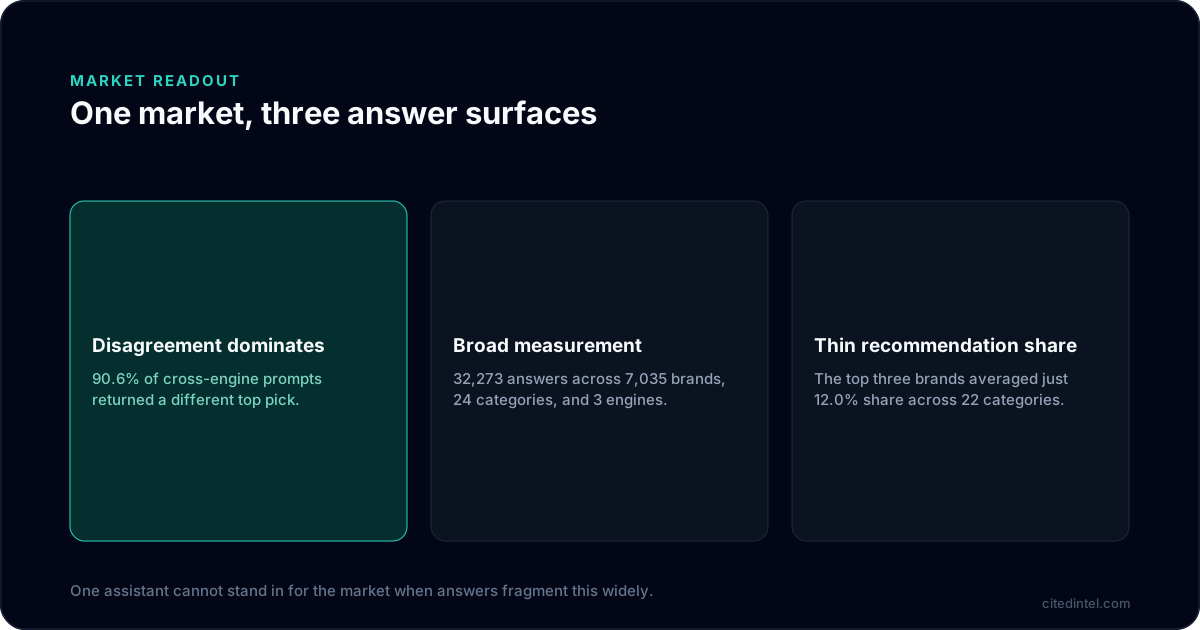
AI assistants do not behave like one search engine with one ranking list. In Citedintel platform data, September 2026, 90.6% of the 489 prompts asked to two or more engines returned a different top pick, which means the same buyer question can produce different vendor sets depending on where it is asked.
For a PMM at a B2B software company, that changes the work. You are not optimizing a single result page; you are managing a set of answer surfaces that can disagree on who gets named first.
That matters more than the raw scale of the month’s audit. The corpus covered 32,273 answers, 7,035 distinct brands, 24 categories, and 3 engines, so this was not a narrow sample of one niche or one query type.
| Metric | September 2026 readout | What it means for AI search optimization |
|---|---|---|
| Answers analyzed | 32,273 | You are optimizing against a real answer set, not a few demo prompts. |
| Distinct brands observed | 7,035 | Competition is broad, so narrow category proof matters. |
| Prompts asked to 2+ engines | 489 | Cross-engine checks are large enough to show disagreement patterns, not anecdotes. |
| Different top pick by engine | 90.6% | One assistant cannot stand in for the others when you measure generative engine optimization. |
My view: if you still report AI search visibility with one engine and call that “the market,” you are undercounting both risk and opportunity. AI Search Visibility on ChatGPT vs Perplexity already showed that source behavior changes by engine; this month’s data says the top pick changes too.
Coverage is broad, but recommendation share stays thin
The category map is broad, yet recommendation concentration remains tight. In Citedintel platform data, September 2026, the average share taken by the top three brands was 12.0% across 22 measured categories, which tells you that recommendation share is spread out rather than dominated by a single name.
For a content lead in vertical software, that is a practical warning. The answer layer does not reward one heroic page; it rewards repeated proof across the questions buyers actually ask.
Here is the part many teams miss: broad coverage does not mean broad trust. 7,035 distinct brands were observed across the month, but the average top-three concentration stayed low, so you are fighting for a small number of recommendation slots while competing with a large field.
If you sell B2B software, that means generic blog volume will not move the needle by itself. The answer engine needs category fit, comparison proof, and credible supporting evidence before it is willing to recommend you.
What that looks like once you split the corpus by segment
You cannot read the month without the corpus mix behind it. Segmentable answers were 54.4% B2C and D2C, 34.5% B2B software, and 11.1% services and other, so the month leans consumer-heavy even while the core question here is how B2B software brands show up in AI answers.
| Segment | Share of segmentable answers | Answers | Why it matters |
|---|---|---|---|
| B2C and D2C | 54.4% | 7,803 | Marketplace and review cues matter more in this mix. |
| B2B software | 34.5% | 4,948 | Comparison pages and proof pages face heavier scrutiny. |
| Services and other | 11.1% | 1,600 | Service claims need stronger third-party backing. |
That split matters because the evidence profile is not the same across segments. A D2C skincare brand can lean on marketplace presence and review density, while a cybersecurity or data product needs more durable proof around implementation, limitation, and peer validation.
The evidence that wins is commercial, not ornamental
Digital PR, review presence, social video presence, and marketplace presence were the four signals most associated with top-recommended brands in Citedintel platform data, September 2026. The pattern is plain: answer engines reward externally visible proof that a buyer can cross-check.
That is the opposite of the old “publish more explainers” reflex. If your AI search optimization plan is built mostly on educational articles, you are working the wrong end of the funnel.
| Signal | Presence in top recommended brands | Gap vs rarely recommended brands | What to do with it |
|---|---|---|---|
| Digital PR | 38.8% | 14.2 points | Build cited third-party coverage around category and comparison claims. |
| Review presence | 34.2% | 12.5 points | Collect review language that names fit, boundary, and result. |
| Social video presence | 26.4% | 12.0 points | Show the product being used, not just described. |
| Marketplace presence | 22.0% | 9.3 points | Keep product metadata, variants, and commercial details clean. |
For B2B software, the first row is the most important. Digital PR works because it moves you from self-assertion to outside validation, and answer engines seem to prefer that when they are choosing between similar vendors.
For B2C and D2C, the last two rows get louder. Marketplace presence and social video give an assistant concrete product context, while reviews show what the buyer can expect after purchase.
For services and other, the bar is higher still. A services brand that lacks external proof usually sounds interchangeable, which is a bad place to be when an assistant is trying to make a recommendation.
The citation mix tells the same story from another angle
Source diversity is large, but not all source types carry the same weight. In Citedintel platform data, September 2026, 12,497 citations were analyzed across 3,614 distinct source domains, yet only 2.2% were review platforms and 2.1% were community sources.
That does not mean reviews and communities do not matter. It means the answer layer uses them selectively, so the brands that win are usually the ones that have enough external proof to be cited in the first place.
For an SEO and GEO specialist, the implication is simple. If you want stronger AI search visibility, you need a source mix that extends beyond your own site, but you should not expect review sites or community posts to carry the whole burden.
I would argue this is where many teams misread the signals. They see low percentages in review and community sources and assume those surfaces do not matter, when the better interpretation is that they are rare but useful when a buying question needs outside confirmation.
That is also why digital PR matters so much in this month’s data. It creates a bridge between on-site claims and off-site proof, which gives answer engines more to work with when they assemble a recommendation.
Three category patterns stood out once the answers were split by buying context
The month did not produce one universal playbook. In B2B software, B2C and D2C, and services, the winning evidence stack looks different because the buyer’s question is different.
B2B software asks for fit and proof
For B2B software, answer engines tend to favor brands that can explain category fit, implementation context, and comparison points without hand-waving. A legal tech platform, a data and analytics tool, and a martech product all need the same basic thing, but the proof they need to supply is different.
- Legal tech: show switching risk, workflow fit, and document-level limitations.
- Data and analytics: show integration boundaries, data freshness, and where the product stops.
- Martech: show audience fit, activation path, and how the product works with the rest of the stack.
For a PMM, this means your comparison page cannot be a feature dump. It has to answer the question an assistant is trying to settle: who fits this buyer, and what evidence supports the recommendation.
B2C and D2C reward visible product proof
For B2C and D2C brands, the winning signals are more visual and more public. Marketplace presence and social video matter because they give assistants a quick read on what the product is, how it is used, and what buyers say after trying it.
That is especially true in beauty and skincare, health and wellness, and consumer electronics, where buyer questions often include texture, tolerance, battery life, fit, or use-case boundaries. If the product proof is thin, the answer becomes thin with it.
Services need outside validation or they blur together
Services and other brands run into a different problem. Their offers often sound similar in a prompt, so answer engines lean on proof from outside the site to separate one provider from another.
That makes digital PR and review presence disproportionately valuable for agencies, consultancies, and specialist service firms. Without them, a service brand may still be mentioned, but it is less likely to be selected.
A practical audit you can run on one page set today
You can run a useful AI search optimization check without waiting on a larger program. Use the artifact below to audit one priority category page, one comparison page, and one proof source you control.
- Pick one buyer question: write the prompt as a real commercial question, such as “Which B2B software tools fit a mid-market team with limited implementation time?”
- List three answer signals: note whether your page gives category fit, a comparison point, and one external proof source.
- Mark the missing proof: if the page has claims but no outside validation, write down the missing source type, such as review, marketplace, or digital PR.
- Check answer wording: see whether the first two sentences of the page answer the question without forcing the reader to scroll.
- Rewrite one block: convert one generic paragraph into one answer sentence, one limitation sentence, and one evidence sentence.
If you want to run this against a larger prompt set and see how the same evidence shifts across answers, Citedintel is built to do that at scale.
What I would fix first if this were my program
My view: the first fix is not more blog posts, it is better proof distribution. If you are a B2B SaaS team, I would start by tightening comparison pages, collecting review language that names the buyer context, and earning digital PR that supports the category claim.
The second fix is segment-specific. A B2C or D2C brand should focus on marketplace accuracy, social video, and review density, while a services business should invest in outside validation that makes the offer separable from alternatives.
The third fix is measurement discipline. Track the prompt set, the segment mix, and the engine used on every audit so you can tell whether a change moved answer behavior or just moved one surface.
That last point matters because answer engines disagree so often. A change that helps one assistant can leave another untouched, and the only way to know is to keep the audit structure stable.
How the September 2026 audit was assembled
This article uses Citedintel platform data, September 2026. The sample covered 28 days, 32,273 answers, 7,035 distinct brands, 24 categories, and 3 engines, with 489 prompts asked to two or more engines. Segmentable answers were split 54.4% B2C and D2C, 34.5% B2B software, and 11.1% services and other.
The citation analysis covered 12,497 citations across 3,614 distinct source domains. Signal and category-level findings in this article are reported only where the sample supports them, and thin slices are treated as directional rather than universal.
The clear takeaway for September 2026 is that generative engine optimization now depends on proof architecture, not just page volume. If your strategy is still built around publishing and hoping, the month’s data says you are leaving recommendation share on the table.
Frequently asked questions
How do I improve AI search visibility for my brand?
Start with proof, not just more content. The article shows that digital PR, review presence, social video, and marketplace presence were the signals most associated with top recommended brands. For B2B software, comparison pages and outside validation matter most.
What is the best AI SEO tool for tracking answer engine optimization?
You want a tool that tracks prompts across more than one engine, not just one result set. This article shows that 90.6% of prompts checked on multiple engines returned a different top pick, so cross-engine monitoring is the only way to see the real pattern.
How does GEO change when buyers ask ChatGPT first?
GEO has to account for different assistant behavior, not a single ranking list. The article found that AI assistants disagreed on the top pick for most multi-engine prompts, which means your evidence needs to hold up across several answer surfaces.
What is answer engine optimization for B2B software?
For B2B software, answer engine optimization is about proving fit, implementation context, and comparison points. The article says comparison pages, digital PR, and review language that names the buyer context are the strongest starting points.
How do I show up in AI search without publishing more blog posts?
Build more proof around the pages you already have. The article argues that generic blog volume is not enough, while digital PR, reviews, social video, and marketplace presence are what answer engines use when they choose between similar brands.