
A shopper asks ChatGPT for the “best magnesium for sleep,” and one brand appears because the answer can defend it. Another gets skipped because the page sounds like a promise, not proof.
Health, wellness, and supplement brands earn AI recommendations when their claims are narrow, their labels are transparent, and their public evidence is easy to verify. In YMYL categories, generative engine optimization and answer engine optimization work only when the brand gives the assistant something it can safely cite, such as third-party testing, recognized certifications, expert commentary, and clear risk boundaries.
Why health and supplements are harder than other categories
Health and wellness is the least forgiving consumer category in AI search. Assistants are conservative here because bad recommendations can cause harm, and the cost of being wrong is higher than in apparel or home goods.
That caution is visible in OpenAI’s healthcare positioning, which says responses are grounded in medical sources with clear citations and physician-led testing, and in Stanford HAI’s 2025 medicine chapter, which treats healthcare AI as a high-stakes area that needs more rigorous evaluation OpenAI for Healthcare, Stanford HAI AI Index medicine chapter.
My view: if your supplement page reads like a landing page for conversion, you are probably making the assistant less willing to recommend you. In this category, clarity beats enthusiasm.
What gets brands excluded
- Overclaiming: “cures,” “treats,” “guaranteed sleep,” or any language that sounds like medical advice pushes a brand toward exclusion.
- Thin science: a blog post citing one weak study, with no context and no human review, is not enough for a cautious model.
- Hidden details: vague ingredient panels, missing dosages, or unclear sourcing make it hard for an assistant to defend a recommendation.
- Trust gaps: no third-party testing, no certification, no expert commentary, and no visible label standards create a credibility vacuum.
When shoppers ask follow-up questions, the answer has to survive scrutiny. That is why getting named in ChatGPT is not the same as being chosen matters even more in YMYL than in most categories.
What evidence actually moves recommendations
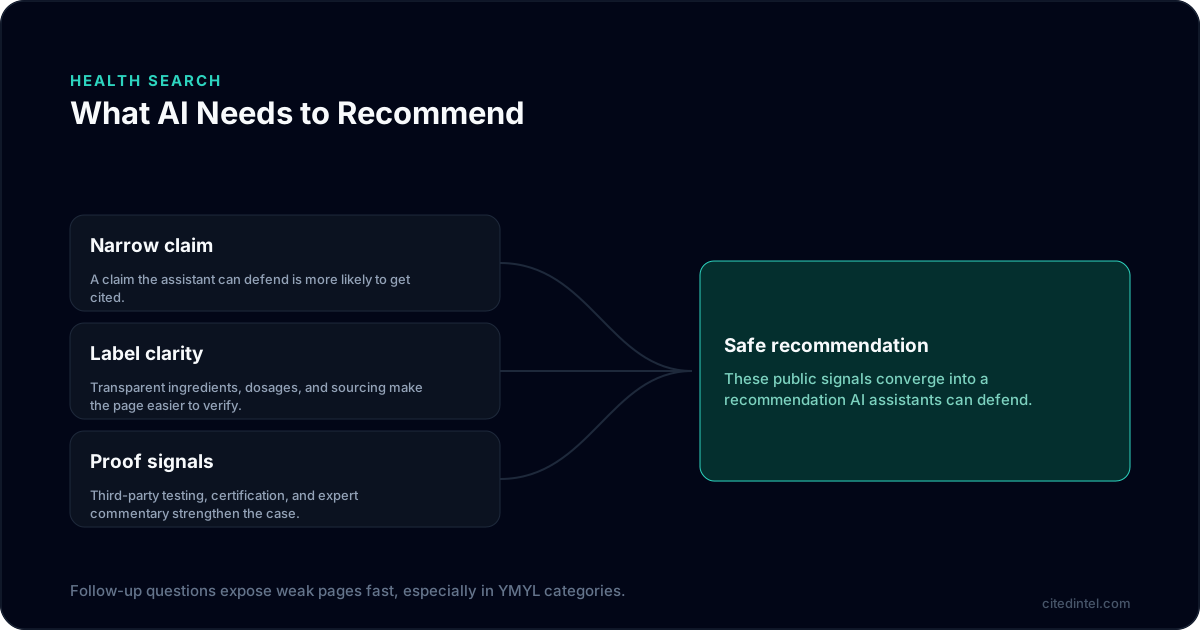
Three proof layers do most of the work: third-party testing, recognized certifications, and expert commentary tied to a transparent label. If one of those is missing, AI answers in health and wellness tend to become cautious, conditional, or silent.
The point is not to stuff a product page with credentials. The point is to make the claim easy to verify, because answer engines are looking for reasons to trust, not reasons to market.
| Evidence signal | Why it matters to AI answers | What it should look like publicly |
|---|---|---|
| Third-party testing | Shows the product was checked outside the brand | Lab report access, batch info, and a plain-language summary |
| Certifications | Gives the assistant a neutral trust marker | USP, NSF, Informed Choice, or other relevant certification stated clearly |
| Expert commentary | Helps separate general wellness language from medical-sounding claims | Dietitian, pharmacist, or clinician review with dated attribution |
| Transparent labels | Makes comparison and safety checks easier | Active ingredient, dosage, allergens, warnings, and use instructions |
OpenAI says its shopping research feature is built to pull from “high-quality sources” and cite reliable sources directly OpenAI ChatGPT shopping research. That is a strong signal for wellness brands: the more your proof resembles source material, the more usable it becomes.
For supplement brands, I would prioritize a public evidence stack in this order:
- Label clarity: exact ingredients, forms, dosage, allergens, and warnings.
- Testing proof: third-party lab validation, batch traceability, contaminant screening, or quality review where relevant.
- Certification proof: a neutral seal that is actually visible on the page, not buried in a footer.
- Expert review: a named professional who comments on fit, safety, or who should avoid the product.
- Measured claims: restrained language that says what the product is for without promising outcomes it cannot prove.
That stack is the difference between “possibly suitable” and “hard to recommend.”
What a wellness brand needs before asking for AI visibility
A wellness brand needs public proof that an assistant can quote without stretching. If the page only says “clean,” “premium,” or “scientifically backed,” it is doing branding, not AI search optimization.
In practice, the strongest pages answer four questions fast: what is in it, who should consider it, what the safety boundaries are, and what outside evidence exists. That is true whether the shopper is in the US, the UK, India, the UAE, or South Korea, because the assistant still needs defensible source material.
How the proof stack changes by product type
- Vitamins and minerals: labels, dosage, bioavailable form, allergen disclosure, and batch testing matter most.
- Sleep and stress supplements: safety framing matters more than promise language, especially around interactions and who should avoid use.
- Sports recovery products: third-party testing and contaminant screening matter because shoppers worry about purity and trust.
- Functional beverages: ingredient transparency and sugar content are often what decide whether an assistant can recommend the product.
AI search optimization in this category often turns on small differences that a brand page can make visible. A supplement that says “supports sleep” with a clear disclaimer is easier to recommend than one that claims to “fix insomnia.”
That is the same reason assistants tend to like pages that look like reference material, not performance copy. My view: the more a wellness page reads like a label plus a safety note, the more recommendation-ready it becomes.
What a candid Citedintel workflow looks like for wellness brands
For a wellness brand, the right workflow is to audit real shopper prompts, see which evidence the assistants trust, then fix the public proof that is missing. Citedintel does that across ChatGPT, Claude, Perplexity, and Gemini by showing where the brand is mentioned, where it is missing, and which supporting assets need to exist before AI will reliably recommend it.
The useful part is not the dashboard. It is the diagnosis: which trust signals competitors have that you do not, and which pages, citations, reviews, or editorial placements need to be published next.
That matters because assistant behavior in health is deliberately selective. Stanford HAI notes there is still little consensus around robust, standardized evaluation in health AI, which is why wellness brands should not assume generic SEO wins will translate into AI recommendations JAMA Summit report on AI in health.
A practical workflow for a supplement or wellness brand looks like this:
- Run prompt checks: use shopper prompts like “best magnesium for sleep without grogginess,” “electrolyte drink with low sugar,” and “omega-3 supplement with third-party testing.”
- Compare evidence: inspect which products have visible labels, certifications, and neutral expert commentary.
- Find the gap: note where your competitors are easier to defend than you are.
- Publish the missing proof: add clearer labels, testing summaries, safety language, and comparison pages.
- Re-check weekly: watch whether the assistants start citing you once the evidence is public.
If you want the shorter version: Citedintel helps teams move from “we think our product is good” to “the public evidence makes that claim believable.”
Try this today: a five-prompt recommendation test
You can run a useful wellness visibility check with five prompts and a scorecard. Use it before you rewrite product pages, spend on creators, or ask for more review coverage.
- Write five shopper prompts:
- Best magnesium for sleep without morning grogginess
- Electrolyte drink low in sugar for daily use
- Probiotic for bloating, what should I look for
- Omega-3 supplement with third-party testing
- Sleep supplement that is not habit-forming
- Ask three assistants: run the same prompts in ChatGPT, Claude, and Gemini.
- Score each brand you see: give 1 point for clear label, 1 for third-party testing, 1 for certification, 1 for expert commentary, 1 for safety framing.
- Mark the exclusions: note which brands are absent after obvious follow-up questions.
- Rewrite one page: add the missing evidence layer to the page with the weakest score.
If that sounds tedious, it is. That is also why teams use Citedintel or start a free audit to do the same check across far more prompts without turning it into a manual ritual.
Transparent labels beat clever claims
In supplements, clear labels are more persuasive to AI than clever copy. A page that states ingredient form, dosage, warnings, and testing status gives the assistant something safe to repeat.
Health shoppers ask for edge cases all the time, and the assistant has to know what not to recommend. If your label does not help with that, the answer engine has less reason to bring you into the answer at all.
The weakest wellness pages usually hide the details shoppers need most:
- Dosage confusion: “clinically dosed” without the dose printed plainly.
- Ingredient ambiguity: a branded blend with no breakdown of the active components.
- Safety gaps: no warning for pregnancy, medications, or age limits where relevant.
- Testing opacity: a quality claim with no linked summary or certificate.
This is where content teams often overcorrect. They keep adding education articles, when the actual fix is the product page and the label details that the assistant can trust.
When the brand gets excluded, the reason is usually simple
Wellness brands get excluded when the public story is louder than the public proof. If the model cannot verify the claim, it usually refuses to lean into it.
That exclusion is not random. It often comes from one of three problems: claims that sound medical, evidence that is too thin to cite, or a page structure that hides the useful facts under marketing language.
Here is the blunt version I keep telling teams: if you would not want a cautious clinician to repeat the sentence, do not expect an assistant to recommend it.
That does not mean wellness brands should sound sterile. It means they should be specific, careful, and visibly grounded. The best pages in this category feel useful before they feel persuasive.
How this changes AI search optimization for consumer brands
AI search optimization in health and wellness is closer to trust engineering than classic SEO. The goal is not just to rank or be mentioned, but to be safe enough to recommend when the buyer asks a harder follow-up.
For D2C brands, that changes what content deserves priority. Ingredient explainers, comparison pages, expert review pages, and safety FAQs usually matter more than broad lifestyle copy.
For example, a wellness brand selling magnesium, electrolytes, and probiotic products should not treat all three categories the same. Magnesium needs safety language and dosage clarity. Electrolytes need sugar and mineral transparency. Probiotics need strain-level clarity and cautious fit language.
In the same way, a functional beverage brand has to show sugar content and ingredient transparency fast, while a sleep supplement brand has to make its boundaries obvious. The category may be the same broad shelf, but the evidence the assistant wants changes by prompt.
For shopper behavior, this aligns with the broader move to answer-first discovery. OpenAI says shopping research is designed for deeper product decisions and relies on reliable sources, while ChatGPT search returns shopping results with inline citations OpenAI transparency and content moderation. That makes citation strategy part of product marketing, not an afterthought.
What I would fix first on a wellness site
If I were reviewing a health or supplement brand, I would fix the public trust surfaces before I touched ad copy or creator briefs. The assistant needs evidence, and shoppers need reassurance.
My order would be:
- Product labels: make ingredients, dosage, and warnings obvious.
- Testing pages: publish a plain summary of third-party testing or quality review.
- Expert review: add a named professional where appropriate, with dated commentary.
- Comparison pages: explain who the product is for and who should skip it.
- Safety FAQs: answer medication, pregnancy, age, and use-duration questions plainly.
That list is also where generative engine optimization earns its keep. A good GEO strategy in health is not a trick for getting named. It is the discipline of making the brand recommendable under scrutiny.
For teams working across countries, the bar is even higher. A supplement page that feels acceptable in one market may still be invisible in another because the supporting proof is local, the retail reviews are different, or the language of caution needs to change by country.
One limitation worth saying out loud
Citedintel cannot make a weak product safer or a misleading claim credible. If the product itself lacks defensible evidence, the platform can show you the gap, but it cannot manufacture trust.
That limitation matters. In YMYL categories, the right fix is often product and compliance work, not content volume.
There is a reason I do not think wellness brands should chase AI recommendations before they clean up the basics. Better evidence, better labels, better source material, then better visibility. Anything else is backward.
Closing the loop without crossing the line
Health and wellness brands win AI recommendations when they make the public proof stronger than the promise. Third-party testing, certifications, expert commentary, and transparent labels move the needle because they give assistants a safe basis for citation.
That is the real job of AI search optimization in this category: not to persuade harder, but to become easier to trust. If you want to see where your current evidence breaks, run a free audit or review how Citedintel compares as a GEO and AEO workflow for brands that need more than vanity mentions.
Frequently asked questions
How do health brands show up in AI search?
They show up when the assistant can safely cite public proof. That usually means clear labels, third-party testing, visible certifications, expert review, and cautious safety language.
Why are supplements harder to recommend in AI answers?
Supplements sit in a YMYL category, so models are conservative. If a page overclaims, hides dosage, or lacks outside verification, the assistant is more likely to skip it.
What evidence do AI assistants trust most for wellness products?
The article points to four main signals: transparent labels, third-party testing, recognized certifications, and named expert commentary. Those give the assistant something it can verify without stretching the claim.
What should a supplement page include before asking for GEO visibility?
It should answer what is in the product, who it is for, what the safety boundaries are, and what outside evidence exists. If those basics are missing, the page is harder to recommend.
What is the first thing to fix on a wellness site for AI search?
Fix the product page before you add more blog content. The article says labels, testing pages, expert review, comparison pages, and safety FAQs are the surfaces that move recommendations.