
SEO did not vanish; its old scoreboard lost authority. After more than 100 AI search audits, we found that brands are excluded from consideration less often because a page ranks poorly than because answer engines cannot assemble a trustworthy case for including them.
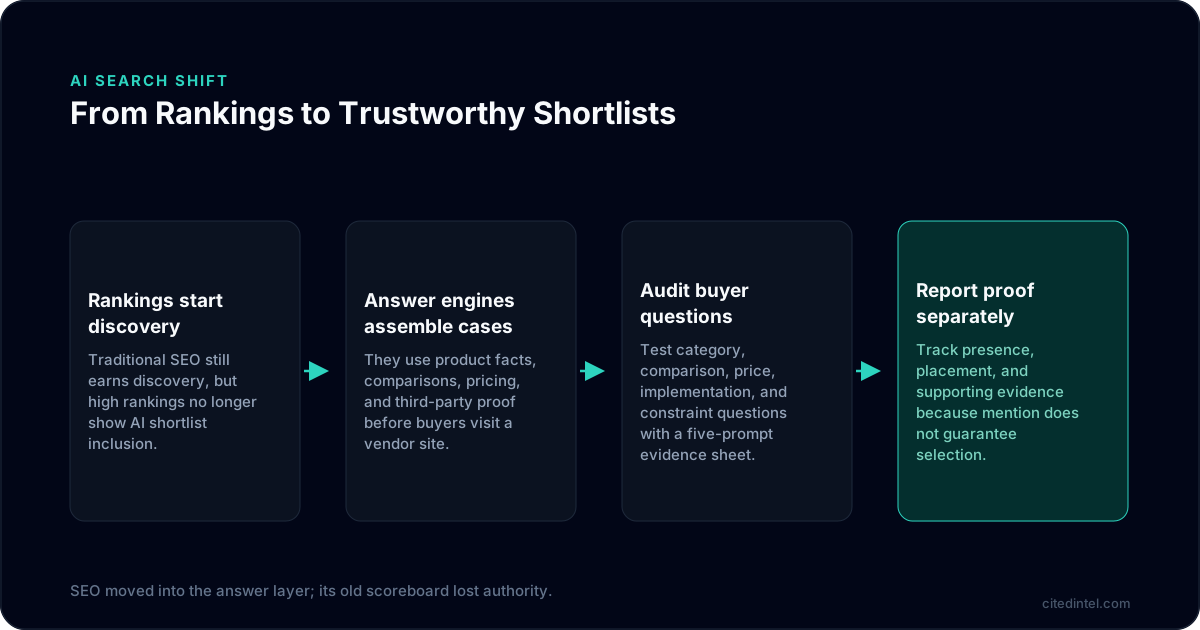
SEO moved into the answer layer, where an AI search engine builds a shortlist from product facts, comparisons, pricing, and third-party proof before a buyer visits a vendor site. AI search optimization favors companies that are easy to understand, compare, and cite.
Keyword volume no longer carries the argument
Traditional SEO still earns discovery, but a high ranking no longer tells a marketing team whether its product enters an AI search shortlist. The old bargain was simple: publish enough pages, win enough rankings, and collect enough visits. That bargain weakens when an answer engine can satisfy a research question without sending the same number of clicks.
Thin listicles are especially exposed. A page that names ten tools without explaining selection criteria gives an AI assistant little usable material beyond a sequence of brand names. A comparison page with clear trade-offs, implementation facts, pricing logic, and independent support gives the assistant material it can use in a recommendation.
Google stated in May 2026 that established SEO practices remain foundational for AI features because those features still draw on core quality and ranking systems. Its guidance also stresses useful, original content instead of pages designed to imitate an answer format. That is a better account of the shift than declaring SEO dead.
The part that died is the belief that volume can stand in for relevance. A software business can publish hundreds of pages around related phrases and still leave an answer engine unable to resolve four basic questions: what the product is, who it fits, how it compares, and what evidence supports the claim.
| Traffic-era habit | What takes its place | What the team should inspect |
|---|---|---|
| Use rankings as the main scoreboard | Track inclusion, placement, and supporting evidence in AI answers | Which buyer questions mention the brand, and which sources appear beside it? |
| Create pages for isolated volume keywords | Create pages for complete buying questions | Does the page answer fit, constraints, alternatives, price, and proof? |
| Describe the product with broad claims | State product facts in language that supports comparison | Can a buyer distinguish the product from two plausible alternatives? |
| Treat owned content as the complete evidence base | Build a public record across owned and independent sources | Do credible third parties confirm the category and use case? |
My view is direct: rankings remain a distribution signal, but they are no longer a sufficient business scoreboard. A product marketing manager should retain ranking data, then add an answer-layer view showing whether the brand is understood and supported when the question becomes specific.
AI search shortlists are built before the site visit
AI-assisted research changes the order of evaluation. A buyer may encounter a synthesized comparison before visiting a vendor website, so the evidence surrounding a product can influence whether that visit happens at all.
Forrester’s January 2026 business-buying research found that 94% of B2B buyers used generative AI during their most recent purchase process. The same study found that the typical decision involved 13 internal stakeholders and nine external influencers. One person may complete the form, but a much larger group shapes the shortlist before that form exists.
Forrester also found that twice as many B2B buyers identified conversational tools and generative systems as meaningful information sources compared with vendor websites, product experts, or sales. The consequence is uncomfortable for teams that measure only sessions: a product can influence consideration without receiving a referral that analytics labels cleanly.
Traffic still matters. Its role changes when a visitor arrives after an answer engine has compared vendors. The visitor may be further along, more specific about requirements, and less patient with vague positioning.
A June 2026 Pew Research Center study found that 42% of U.S. Adults who use AI chatbots use them to search for information, while 38% of employed adults use them for work-related tasks. For a B2B SaaS content team, AI search is already part of the research environment, not a laboratory experiment for early adopters.
The anonymized audit observations embedded with this article show the same change at working level. A brand could be described correctly for its own name yet disappear when the prompt added a buyer role, technical constraint, implementation requirement, or competitor comparison.
One recurring devtools pattern involved a product with strong documentation and a clear homepage, but no public answer to this question: which option fits a platform team with strict data residency requirements? The missing asset was not another broad educational article. It was a comparison connecting deployment model, support boundaries, integrations, and regional availability.
For a content lead, that observation creates a better quarterly question: which buyer question causes the answer engine to reconstruct our product from weak or unrelated sources? That question points to a page, proof gap, or product fact the team can repair.
Four signals separated the brands that entered an answer
After running more than 100 audits through Citedintel, I no longer see AI SEO as a content production problem. It is a consistency problem across the facts a buyer can find, the comparisons a buyer can read, and the independent sources an answer engine can cite.
The audits revealed four recurring signals across different prompts and markets. They are not tricks for forcing an answer. They are public conditions that make a recommendation easier to justify.
- Entity clarity: the company states its category, buyer, core job, and boundaries in language that does not require interpretation.
- Comparison presence: the product appears where buyers weigh alternatives, with differences stated in terms a purchasing group can use.
- Earned citations: independent sources describe the product, category, or use case with enough detail to support a recommendation.
- Pricing transparency: the public record explains price, packaging, cost drivers, or the reason a quote is required.
Entity clarity is not a slogan exercise. A devtools company that calls itself an “intelligent developer productivity platform” may sound polished while leaving an answer engine unsure whether it belongs in observability, code search, testing, or workflow automation.
Comparison presence is also more demanding than publishing a page titled “Product A vs Product B.” The page must explain which buyer should choose each option, what implementation requires, where the product is weaker, and which facts can be verified elsewhere.
Third-party proof has a different job from owned content. A company page can state that a product serves regulated engineering teams. A respected directory, technical publication, customer review, or integration partner can make that statement easier for an answer engine to treat as evidence.
Pricing transparency reduces guesswork. A public price is useful, but so is an explanation of seats, usage, environments, support, onboarding, contract length, or enterprise controls when those factors shape the purchase.
We got one thing wrong early. We treated a missing recommendation as a page-gap problem and expected a stronger landing page to repair it. The audits showed that a new page often repeats a claim the web does not independently support. The fix may require a review, comparison, documentation update, partner reference, or product fact before another page is written.
That changed how we think about organic marketing when buyers ask AI first. The work starts with the question and the missing evidence, not with a calendar slot for another article.
AI search optimization adds a second performance surface
AI search optimization adds a second retrieval environment to the same marketing foundation. Conventional search asks whether a page deserves a result for a query, while an answer engine asks which facts and sources can support a response to a more complex request.
The two systems overlap in useful ways. Crawlability, indexability, internal linking, clear language, and original information still matter. The difference appears after retrieval, when an answer engine selects a small set of facts and turns them into a recommendation or comparison.
Three measurements belong beside rankings
A useful AI search visibility report separates presence, placement, and proof. Combining those measures into one number hides the decision the team needs to make next.
- Presence: does the brand appear when the prompt describes the relevant category and buying situation?
- Placement: is the brand named as a possible option, a serious fit, or a leading recommendation?
- Proof: do the cited sources support the reason the answer included the brand?
A brand can have presence without placement. A product may appear among ten tools but never be selected for the stated constraint. A brand can also have placement without durable proof if the answer cites a weak or outdated page that the team cannot support over time.
Google’s generative AI performance report became available worldwide in Search Console by August 31, 2026. Google’s documentation for the report gives teams a way to examine performance in generative features alongside traditional search data, but it does not remove the need to inspect buyer questions and cited evidence.
Classic SEO tools answer “where did this page rank?” AI SEO tools answer a different operational question: when a buyer asks for a solution with these conditions, does the answer include us, and why? Both questions belong in a quarterly report. Neither replaces the other.
Clear product entities build value while vague pages lose it
Entity clarity compounds because every accurate public reference reinforces the same interpretation of a company. Content volume decays when each new page adds another vague description, unsupported superlative, or angle that conflicts with product documentation.
For a devtools business, the entity sentence should survive a homepage scan, a documentation page, a partner listing, and a technical review. It should identify the category, the engineering job, the environment, and the boundary. “A hosted error-monitoring platform for engineering teams that need release-level diagnostics” is more useful than “a next-generation developer intelligence solution.”
The second-order effect is that clear entities make later comparisons cheaper to produce. Once the category and boundaries are stable, a product marketer can write a serious page about self-hosted versus managed deployment without first explaining what the company sells.
The reverse is also true. When every page uses a different category phrase, the team creates editorial activity without building recognition. An AI search engine may retrieve the pages, but it must reconcile their differences before describing the product safely.
Markets add another layer. A vendor that is well understood in the United Kingdom may be poorly represented in India or the UAE if regional pricing, support hours, data handling, local partners, or regulatory language are absent from public sources. The category does not change by country, but the buying evidence can.
If your team sells globally, put market-specific facts beside the relevant product claim. Do not create empty country pages. State the supported region, contract currency, data location, implementation coverage, language support, and any limitation that changes vendor fit.
Once every page is AI-readable, evidence becomes scarce
The first-order change is that AI assistants summarize more research. The second-order change is that evidence becomes scarce, and brands that supply specific, independent, consistent evidence gain leverage over brands that simply publish more copy.
When every company starts producing AI-readable pages, page format stops being a differentiator. Answer-shaped headings and short conclusions become table stakes. The advantage moves to facts competitors cannot casually reproduce: verified implementation details, customer language, credible reviews, transparent trade-offs, and clear product limits.
A second consequence is editorial crowding. If every competitor publishes a comparison page, the answer engine has more similar pages to choose from. A generic “best tools” article then becomes a weak asset. The team that documents a narrow decision, such as deployment control for a regulated engineering organization, gives the answer a more useful distinction.
A third consequence is that internal disagreement becomes a visibility problem. If sales says implementation takes two weeks, documentation says four weeks, and a review says three months, the buyer receives a mixed signal. A marketing team cannot solve that conflict with copy alone. Product, sales, and customer success need one public version of the fact.
I tell teams to treat every important product claim as a small piece of infrastructure. The claim should have an owner, a source, a date, and a place where a buyer can verify it. That practice helps humans and gives answer engines fewer contradictions to resolve.
For an agency lead, the reporting implication is specific. Do not send a client a list of new pages and rankings alone. Show which buyer questions changed, which evidence gap was addressed, and whether the answer now describes the product with fewer unsupported assumptions.
Devtools questions reveal whether a page can support a recommendation
Devtools buying questions expose the difference between a product description and a recommendation. An engineering leader may ask for a platform that supports a particular deployment model, integrates with an existing stack, controls data location, and fits a team with limited implementation capacity.
A page that answers only “what is this product?” cannot support that recommendation. The page needs to address the constraints that separate one tool from another.
- Architecture: state hosted, self-managed, hybrid, agent-based, or on-premises options in plain language.
- Workflow: show where the product sits in the engineering process and who operates it after purchase.
- Integration: name supported systems and identify whether the connection is native, partner-built, or dependent on custom work.
- Controls: explain permissions, audit records, retention, data location, and relevant security documentation.
- Commercials: describe seats, usage, environments, support, implementation, and quote triggers.
- Trade-offs: state where a smaller team, a highly regulated company, or a self-hosting requirement may favor another option.
That structure gives a product marketer a sharper brief than “write a GEO page.” It also creates material that can be quoted in an answer without the assistant inventing the missing connection.
The principle applies outside devtools, but the facts change. A legal technology buyer may care about jurisdiction and review controls. A logistics software buyer may care about carrier coverage and dispatch workflows. The category determines the proof, which is why generic generative engine optimization strategies rarely survive contact with a real buying question.
Try this today: turn five buyer questions into an evidence sheet
A buyer-question evidence sheet shows whether your public information can support a recommendation before you commission another article. Use the same sheet for one product line, one market, and one dated prompt set.
- Choose five prompts: write one category question, one comparison, one price question, one implementation question, and one constraint question. Use language from sales calls, support tickets, and lost-deal notes.
- Run the set: ask the prompts in the AI assistants your buyers use on September 8, 2026. Save the full answers and cited sources.
- Mark presence: record whether the brand is absent, mentioned, shortlisted, or recommended for the stated situation.
- Mark the reason: copy the sentence that explains why the answer includes or excludes the product. Do not paraphrase it.
- Test the evidence: open each cited source and label it owned, independent, outdated, contradictory, or irrelevant to the claim.
- Write one repair: choose the highest-value gap and draft one passage using this pattern: “For [buyer and situation], [product] fits when [condition]. It differs from [alternative] because [specific fact]. It is a weaker choice when [boundary].”
- Assign the source: give the repair to a page owner and give each factual claim a supporting document, customer reference, review source, or product owner.
- Re-run the dated set: preserve the original answers, publish the repair, and ask the same prompts again after the page and supporting evidence are live.
The visible result is not a traffic promise. It is a before-and-after record of whether the answer changed, whether the brand entered the AI search shortlist, and whether the supporting citation became more credible.
Citedintel’s free GEO checker gives you a starting point for this evidence sheet, while a full audit lets a team repeat the same buyer-question review across its working prompt set.
An AI tool for marketing needs a connected evidence task
An AI tool for marketing is useful when it turns scattered answer observations into an owned work queue. It is less useful when it produces more copy without showing which buyer question, product fact, or external source the copy is meant to repair.
Citedintel audits real buyer questions across ChatGPT, Perplexity, Claude, and Gemini, then gives teams visibility into mention rate, position, and the recommendation signals associated with competing products. The output is meant to move from observation to a publishable content change and a later re-check.
That makes Citedintel relevant to a team that has already chosen its prompts and needs a repeatable record for weekly or quarterly decisions. It is not a substitute for deciding whether the product is truly a fit for the buyer, whether pricing is defensible, or whether a customer reference can support a claim.
The one limitation I want to keep visible is this: AI search analytics cannot prove pipeline or revenue on its own. A changed answer is a leading visibility signal. Closed business still needs buyer testimony, source capture, and normal revenue records.
Teams that need broader context can pair this work with research on why AI search visibility has no single leader across engines. The point is not to chase one assistant’s answer. The point is to learn whether the public evidence for your product holds across the questions your market actually asks.
My forecast: SEO will own discovery, product marketing will own proof
My forecast is that SEO teams will keep owning crawlability and conventional discovery, while product marketing and content teams take responsibility for the evidence that appears inside AI-generated comparisons. The strongest organizations will share one buyer-question register rather than run separate SEO and GEO calendars.
Google’s spring 2026 position and its late-August reporting changes point in that direction: the foundation remains shared, but the performance surface is expanding. Teams that continue to treat rankings as the whole story will miss the earlier decision, when an answer engine determines which vendors deserve research.
The durable advantage will not come from publishing the most AI-shaped prose. It will come from being the easiest company to describe accurately, compare fairly, and support with public evidence.
SEO moved, and next-quarter planning should reflect that movement: fewer pages built for keyword volume, more pages built around difficult buying questions, clearer product facts, transparent commercial information, and a documented third-party proof plan. My commitment at Citedintel is to keep measuring the answer a buyer receives, then make the gap between that answer and the product’s real value easier for teams to fix.
Frequently asked questions
What is AI SEO, and how is it different from traditional SEO?
Traditional SEO focuses on helping pages rank for searches. AI SEO also measures whether answer engines understand a product, include it in a shortlist, position it as a fit, and cite credible evidence.
What are the best AI SEO tools for tracking brand mentions?
The useful tools are those that run the same buyer prompts across major AI engines and track mention rate, position, and cited sources. Citedintel audits ChatGPT and Perplexity, but analytics should guide content repairs rather than replace product or revenue evidence.
Does SEO still matter for AI search?
Yes. Crawlability, indexability, internal linking, clear language, and original information still support retrieval. AI search adds another performance surface where the engine selects facts and sources for a synthesized answer.
How can I measure AI search visibility?
Track presence, placement, and proof separately. Record whether the brand appears, whether it is shortlisted or recommended for the stated situation, and whether the cited sources support the reason it was included.