
Adding AI search as a second marketing program is a staffing mistake. The efficient model keeps the SEO calendar, owners, and reporting cadence, then adds prompt research, answer checks, and citation-ready edits to the same work.
AI search optimization extends an existing SEO workflow by testing the buying questions behind keywords and the answers that influence vendor shortlists. For an Indian procurement software team, the useful unit is not another article. It is one existing page brief with stronger evidence, clearer buyer constraints, and a scheduled answer check.
Keep one SEO operation, then add the answer layer
The workflow below treats AI search as an additional quality and demand signal inside SEO, not as a separate publishing machine. In a May 2026 resource, Google Search Central advised teams to retain core SEO practices, publish original information, and adapt content for AI-generated answers. That direction supports extending the current process instead of building a second one.
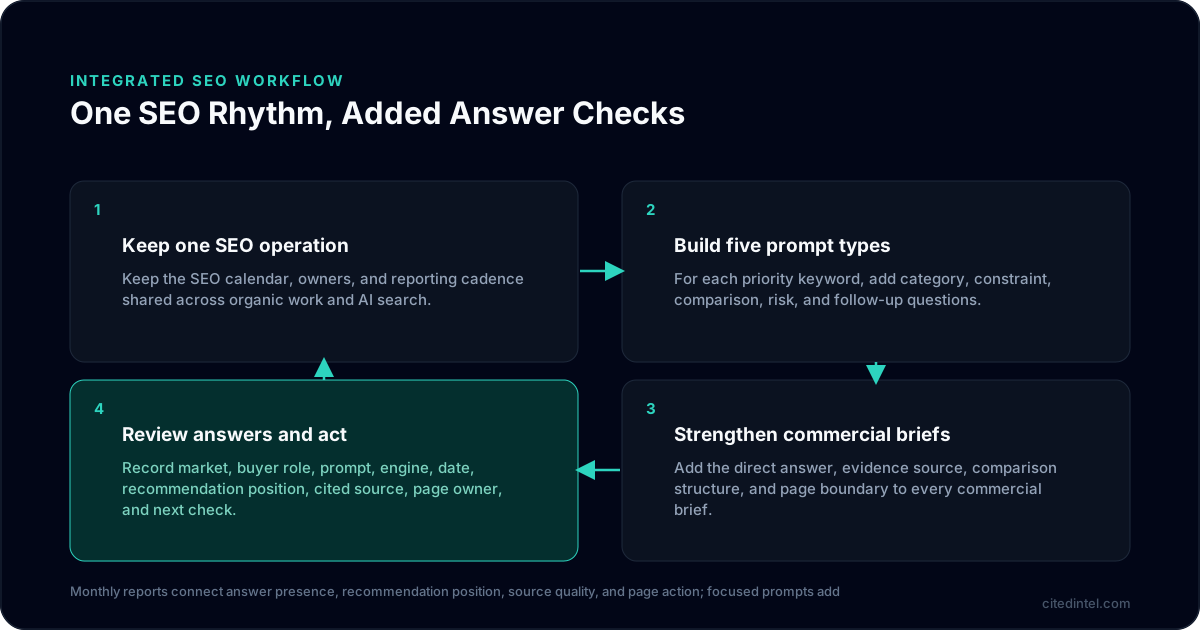
The distinction matters for Indian B2B software teams with one content marketer, one SEO owner, and product experts who can spare limited review time. The team should not create one calendar for rankings and another for answer engines. One calendar should carry both.
Google reported in June 2026 that AI Overviews had more than 2.5 billion monthly active users and AI Mode had more than 1 billion monthly users. Those figures justify an answer check beside the existing organic report, while the technical tracking setup can remain in the GSC playbook rather than being rebuilt here. The figures come from Google Search’s June 2026 update, which was updated in August.
For a team selling procurement software across India, the first operating change is small: every important keyword row needs a related set of buyer questions. The second is even more important: every monthly SEO report needs a short section showing what answer engines said about those questions.
Keyword research should include the questions behind the query
Prompt research adds the buying question, constraint, comparison, and follow-up behind a conventional keyword. A procurement software team targeting “procurement software India” should also test questions about GST-ready workflows, supplier onboarding, approval chains, ERP integration, implementation support, and pricing in INR.
Keyword research still tells the team what people type into a search box. AI search research asks what a buyer wants resolved after typing it. The two inputs belong in one brief because the same page may need to win a ranking for a category term and supply a usable answer for a longer vendor question.
Build a question cluster from each priority term
For every priority keyword, add five prompt types to the research sheet. Give each prompt an owner and a decision stage, so the team can connect an answer gap to a page rather than producing observations with no next action.
- Category: “Which procurement software vendors serve mid-sized Indian manufacturers?”
- Constraint: “Which procurement platforms support GST invoices, multi-level approvals, and SAP integration in India?”
- Comparison: “Compare procurement software for a 500-person manufacturing company in India.”
- Risk: “What can go wrong when a procurement team replaces spreadsheets with a cloud platform?”
- Follow-up: “What should the finance team verify before signing a procurement software contract?”
The SEO specialist owns the keyword and prompt map. Product marketing supplies the real product boundaries. Sales supplies objections heard in Indian deals, such as implementation ownership, local support hours, tax treatment, or integration effort. That division keeps prompt research close to buyer language instead of turning it into a writing exercise.
Google’s May 2026 description of AI Mode pointed to longer natural-language questions, follow-ups, multimodal inputs, and agentic search experiences. The practical response for a content brief is narrow: add the questions a buyer asks after the first answer, not a second list of generic keywords. Google documented that change in its May 2026 Search update.
For teams selling outside India, keep the same keyword row but create market-specific prompt variants. A procurement platform can require different evidence for India, the United Kingdom, or the United States because tax, supplier processes, implementation expectations, and currency change the buying question. One global page can support the research, but the answer check should preserve the market in the prompt.
A useful India page should not simply add the word “India” to a global article. It should answer the local decision: whether the workflow supports GST invoices, which implementation partner owns configuration, how INR pricing is presented, and which local or global enterprise systems connect to the product. Each claim needs product approval before publication.
Pair ranking movement with answer movement
Rank tracking measures where a page appears for a search term. An AI search check measures whether the right product appears in an answer, how it is described, and whether the answer points to a useful source. Run both on the same cadence and assign one person to review the combined result.
Do not replace keyword positions with a single AI search score. A page can rank well for “procurement software India” while being absent from a question about supplier onboarding. That is a content and evidence signal, not a reason to discard the organic program.
| Existing SEO check | AI search extension | What the owner records | Next decision |
|---|---|---|---|
| Target keyword position | Category prompt answer | Presence, position, and description | Keep, improve, or investigate |
| Landing-page clicks | Buyer-intent answer check | Prompt, date, market, and cited sources | Update the page or evidence |
| Competitor ranking movement | Competitor recommendation review | Why the rival is selected in the answer | Add missing comparison or proof |
| Snippet and title review | Answer passage review | Whether the page states a quotable answer | Rewrite the opening block |
| Monthly organic report | Monthly answers section | Answer presence, recommendation, and source quality | Prioritize the next sprint |
The check should preserve the search market and language. “Best procurement software in India” is not interchangeable with “best procurement software for a UK manufacturer.” Record the country, prompt wording, engine, date, and answer text so a change can be reviewed rather than guessed.
Microsoft Advertising reported in March 2026 that three in four people use AI alongside traditional search, and that journeys combining Copilot and search grew 85% between 2023 and 2024. The point for an SEO lead is operational: organic rankings and AI answers belong in one observation set because buyers can move between them during the same purchase.
Citedintel fits at this stage when the team needs repeatable checks across buyer-intent prompts. It audits answers from ChatGPT, Perplexity, Claude, and Gemini, then gives the team a view of mention rate, position, recommendation, and citations to review before the next content decision.
The record does not need to become a research project. A useful row says: “India, finance leader, September 8, 2026, procurement software comparison, product mentioned second, competitor mentioned first, cited source was a review page, integration proof missing, product marketer owns update.” That row can enter the existing sprint board.
Change the content brief before changing the calendar
A citation-ready content brief adds four fields to the existing SEO template: the direct answer, the evidence source, the comparison structure, and the page boundary. Those fields help an answer engine quote the page without asking the reader to reconstruct the conclusion.
My view is that answer-first writing should be a brief requirement, not an editor’s personal preference. If the opening block cannot answer the buyer’s question, the page is asking both a search crawler and a procurement manager to work too hard.
Four additions that improve a commercial page
- Direct answer: state who the product fits, what it does, and the main qualification near the top of the page.
- Evidence source: attach a product document, customer proof, public policy, integration page, or independently published source to each material claim.
- Comparison block: show the differences a buyer will ask about, including implementation, integrations, approval depth, support model, and pricing logic.
- Page boundary: state what the page cannot promise, such as a connector still in beta or an implementation timeline that varies by ERP complexity.
For procurement software, a weak brief says, “Explain the benefits of automating purchasing.” A useful brief says, “Answer whether a 500-person Indian manufacturer can manage requisitions, approvals, supplier records, GST invoices, and ERP handoff in one workflow. Cite the documentation for each supported function and name the implementation condition.”
Comparison tables help because they place claims beside their qualification. A table can show whether an integration is native, partner-led, or custom. It can also state whether pricing depends on users, transaction volume, modules, or implementation, rather than forcing a sales conversation to correct vague copy.
Google introduced Preferred Sources and a Highly Cited label for its generative search formats in May 2026. The practical brief response is to name sources clearly, attribute claims, link to primary material, and publish pages that remain understandable when quoted out of context. Google’s announcement on original, high-quality content supports that direction.
The content marketer drafts the answer block. The product marketer checks product boundaries. A subject expert verifies technical or tax-related claims. The SEO owner checks internal links, indexing, title alignment, and structured page elements. Those are existing roles with one added review question: could an answer engine cite this passage without changing its meaning?
A broader content sequencing question still matters. If the site lacks a clear product page, pricing logic, implementation page, or comparison page, a new explainer will not repair the missing buying information. The existing content workflow for earning citations is useful for deciding which commercial pages should precede broad education.
For an Indian procurement company, the brief should also name the sources a buyer can inspect: integration documentation, security material, implementation responsibilities, support terms, and pricing rules. A product claim without a source creates work for sales later, even if the page performs well in conventional search.
A weekly schedule that uses existing owners
A merged weekly rhythm adds roughly four to six team-hours when the prompt set stays focused. The time belongs in existing SEO meetings and briefs, not in a new standing department.
| Day | Step | Owner | Time | Output |
|---|---|---|---|---|
| Monday | Review ranking changes and select five priority buyer questions | SEO lead | About three quarters of an hour | Prompt set tied to current pages |
| Tuesday | Run answer checks for India and one priority export market | SEO or GEO specialist | About one hour | Dated answer records and source notes |
| Tuesday | Mark competitor recommendations and missing evidence | Product marketer | Half an hour | Three prioritized content gaps |
| Wednesday | Revise one page brief or live page | Content marketer | About an hour and a half | Answer-first copy, table, and sourced claims |
| Thursday | Review product facts, integrations, pricing, and limitations | Product or sales expert | Half an hour | Approved claim list |
| Friday | Publish, update internal links, and queue the next check | Content editor | About three quarters of an hour | Page update and recheck date |
The SEO lead should not run every step. The owner who already controls the relevant asset should make the change, while the SEO lead keeps the prompt and ranking record consistent. This prevents a common failure mode: an AI search report that identifies gaps but leaves nobody responsible for the page.
For a small Indian software company, five prompts per week are enough to establish a working signal if the questions represent different decisions. Expanding to fifty prompts before the team can update pages creates a queue, not a better workflow.
Use a fixed answer-check record with these columns: market, buyer role, prompt, date, engine, client presence, recommendation position, cited source, competitor named, page to change, owner, and next check. A fixed record makes the Friday handoff concrete and lets the monthly report show movement without rebuilding the analysis.
If the team already uses a sprint board, add the answer-check record as a linked task rather than creating a second project. The task should close only when the page edit, evidence review, publication date, and next check are present.
The monthly report needs a page for answers
The monthly report should add an answers section rather than create a second AI search report. The section needs four lines: where the brand appeared, where it was recommended, which pages or sources were cited, and which buyer questions remain unanswered.
In a May 20, 2026 release, Gartner reported that 45% of surveyed B2B buyers had used generative AI during a recent purchase, while 69% said they prefer checking AI-produced information with sales representatives. That combination changes the report’s job. The report should give sales a precise statement to verify, not a vague claim that the brand is “visible.” The figures appear in Gartner’s research release dated May 2026.
- Answer presence: how often the product appeared for the selected India prompts.
- Recommendation position: whether the product was listed, preferred, qualified, or omitted.
- Source quality: which company pages, review pages, documents, or third-party sources supported the answer.
- Content action: the page, owner, edit, and recheck date connected to the gap.
For procurement software, the report might show that a product appears for category prompts but is absent when the question adds GST invoicing and SAP integration. The next action is then specific: update the integration page, add a comparison passage, ask product to verify the supported workflow, and rerun the same prompt next month.
Do not report an answer presence number without the prompt count and date. A result from five India prompts on September 8, 2026 is not comparable with a result from twenty prompts across India and the United States on October 8. Small reporting discipline protects the team from overstating movement.
McKinsey’s May 2026 B2B Pulse Survey found that buyers use an average of 10 channels and that inconsistent information is a leading driver of supplier switching. For an Indian software company, the monthly report should therefore flag contradictions between the website, sales deck, review profiles, security page, and product documentation. AI search can expose the contradiction, but the fix belongs across the buyer’s information sources.
The executive view can stay short: three changed answer patterns, three page actions, and one unresolved evidence question. A product marketer can then take the report to sales without translating a technical AI search metric into a business decision.
Procurement pages need local buying evidence
Procurement software buyers ask for workflow fit, compliance context, integrations, and implementation risk. A page that only describes purchase automation leaves the strongest recommendation questions unanswered.
Use these prompt-to-page pairs when planning an Indian procurement software cluster:
| Buyer question | Page or asset needed | Proof to place beside the answer |
|---|---|---|
| Which platform fits a mid-sized Indian manufacturer? | India-specific comparison page | Customer size, industries served, deployment model, and product limits |
| Can the platform support GST invoices and approval controls? | Feature and workflow page | Documentation, screenshots, supported configuration, and exclusions |
| How does implementation work with an existing ERP? | Implementation guide | Integration method, project stages, customer responsibilities, and variables |
| Should the company buy, build, or integrate? | Decision guide | Total effort, maintenance ownership, integration dependencies, and fit conditions |
The buy-build question deserves its own treatment in 2026. McKinsey reported in August 2026 that 32% of organizations had decided against buying at least one software product or feature because agentic coding tools enabled internal development. A procurement vendor that only lists features may lose the question before a product demonstration begins. The brief should explain when buying is preferable, when integration is sensible, and where internal construction carries maintenance cost. McKinsey’s August 2026 State of AI survey is the source for the figure.
India-specific pages should also preserve the facts that make the market decision real: INR pricing or clear currency handling, GST treatment where applicable, local implementation coverage, support hours, data location statements, and the ERP systems buyers actually use. Do not add these claims unless the product team can approve the wording.
AI search optimization for B2B SaaS works best when the page makes a buyer’s decision easier to verify. That is the useful connection between AI search engine optimization, traditional SEO, and artificial intelligence search engine optimization: one page can earn a ranking and still be written for the follow-up question that determines vendor consideration.
For a team selling procurement software from India into other markets, the same page may need separate evidence blocks. Local tax language can support the India answer, while implementation coverage and data handling may matter more in an overseas question. The prompt sheet should reveal which block is missing before the team creates another article.
Try this today: create a five-question answer sheet
Create the sheet from one page that already has organic traffic. Use dated observations from September 8, 2026, then assign one page edit to a named owner before the next reporting cycle.
- Choose one page: select a procurement software page ranking for a category or comparison term.
- Write five prompts: use one category, one India-specific constraint, one comparison, one implementation question, and one buy-build question.
- Run the set: check the same wording across three assistants, then record the answer date and market.
- Mark the result: use “present,” “mentioned,” “recommended,” or “absent.” Add the competing product named and the source cited.
- Inspect the page: find the first unsupported claim, missing comparison, or answer that requires too much reconstruction.
- Rewrite one block: use this pattern: “For [buyer and context], [product category] fits when [condition]. It supports [verified capability]. It is not a fit when [boundary].”
- Attach proof: place the supporting product document, integration detail, pricing rule, or third-party source beside the claim.
- Schedule the check: set the same five prompts for the next monthly report and keep the original answers for comparison.
Citedintel gives a team a single workspace for those repeated buyer-question checks, the reasons behind competitor recommendations, editable content fixes, and the later recheck, so the SEO calendar remains the source of truth. See how that work is organized on the Citedintel platform page.
Recognize the point where the process cannot help
This approach is a poor fit when the team has no maintained product facts, no owner for page updates, or no access to the sources behind its claims. Monitoring can reveal an answer gap, but monitoring cannot replace product documentation, customer proof, or an approval decision.
For teams with those basics in place, an AI SEO tool should reduce handoffs rather than create another dashboard. Citedintel can support the audit and recheck layer, but the result still depends on the team publishing the approved change and keeping the India page consistent with sales and product material.
The India market hub provides a useful regional starting point for teams deciding which buyer questions and pages to prioritize: AI search optimization in India.
If you want to see how the workflow looks with your own procurement questions, request the Citedintel demo. The demo is a product invitation, not an independent research result, so use your own prompts and pages when judging fit.
My view is simple: keep the SEO meeting, keep the keyword report, and add the buyer’s answer to both. Indian B2B software teams do not need a second content operation to participate in AI search. They need one disciplined workflow that can be found, quoted, checked, and improved.
Parth Sesodia, Founder, Cited
Frequently asked questions
How do I add AI search to my SEO workflow?
Keep the existing SEO calendar, owners, and reporting cadence. Add buyer-question research to priority keywords, run dated answer checks, and assign each content gap to an existing page owner.
What is the best AI SEO tool for buyer-question research?
The article describes Citedintel as a tool for repeatable checks across buyer-intent prompts in the major AI engines. It records mention rate, position, recommendations, and citations so the team can connect an answer gap to a page update.
How does GEO help procurement software show up in AI answers?
Generative engine optimization helps a procurement page answer the buyer's actual constraints, such as GST invoices, approval controls, ERP integration, and implementation ownership. The page should state direct answers, attach evidence, show comparisons, and name product limits.
What should an AI search check record?
Record the market, buyer role, prompt, date, engine, brand presence, recommendation position, cited source, competitor named, page to change, owner, and next check. Keeping the same wording makes results comparable in the next monthly report.
How often should I check AI search visibility?
The workflow recommends running focused checks weekly and repeating the same prompt set in the monthly report. Five prompts per week can establish a useful signal when they represent different buying decisions.