
Organic marketing loses commercial ground when it explains a category but leaves fit, cost, comparisons, and risk unanswered. AI assistants use those details to shape a shortlist, so broad articles alone are a weak route to leads without ads.
Organic marketing still produces customers when its pages give AI search engines usable evidence for evaluation. The shift is from adding more top-funnel posts to building decision pages and independent proof that support a buyer’s next question.
AI search now influences active software evaluation
AI search has entered the buying process itself. Gartner reported in January 2026 that 45% of B2B buyers had used generative AI during a recent purchase, including 32% who used it to support buying and 9% who used it to discover solutions.
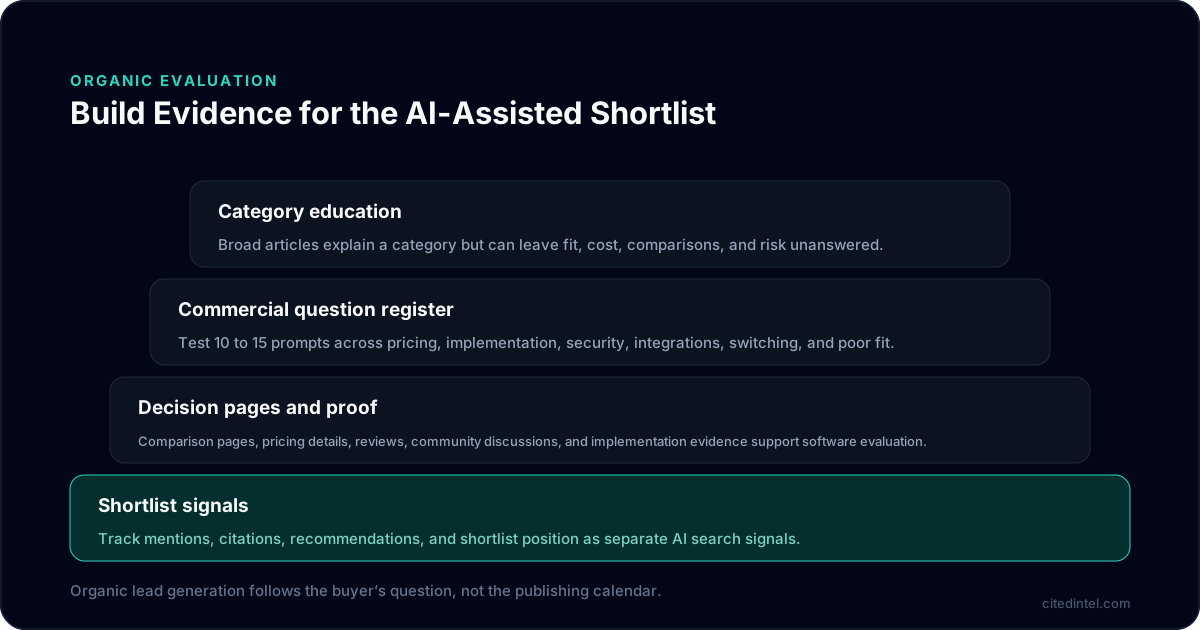
An article explaining procurement automation may establish a category, but a buyer asking which procurement platform suits a multinational finance team needs evidence about integrations, implementation, pricing logic, approval controls, and limitations.
Organic lead generation should follow the buyer’s question, not the publishing calendar. If an answer engine can explain your category but cannot support selection, your content has educated the market without giving your brand a strong place in the decision.
The research panel points to a mismatch in what brands publish
This report’s anonymized platform panel compares formats AI engines cite for buying-intent questions with formats brands produce. Comparison pages, pricing information, reviews, and community discussions serve evaluation, while top-funnel blogs still take up much of the effort.
Educational articles help buyers understand a category, but their value falls when they are disconnected from commercial pages and independent evidence.
A procurement software team can publish ten articles about purchase order workflows and still leave four questions exposed:
- Fit: Which company size, approval model, and geography does the product suit?
- Cost: What drives the price, and which implementation charges sit outside the subscription?
- Trade-offs: What does the platform do less well than a suite or specialist tool?
- Proof: Which customers, reviewers, analysts, or practitioner communities support the claims?
AI-search content should prioritize evidence that survives comparison instead of treating every unanswered commercial question as another generic blog brief.
A brand mention does not mean the buyer received a recommendation
A mention means a brand entered an AI answer as explanation or evidence. A recommendation means the answer treated it as suitable for the stated need. AI search optimization must report those outcomes separately.
OpenAI’s August 2026 shopping guidance distinguishes information used to describe or compare products from factors shaping product or merchant recommendations. A supplier can appear in the evidence without entering the shortlist.
| Signal | What it tells you | What to inspect next |
|---|---|---|
| Mention | The answer recognized the brand or product. | Category wording, product facts, and buyer fit. |
| Citation | A public source supported part of the answer. | Whether the source proves the claim. |
| Recommendation | The brand appeared as a suitable choice. | Comparison, reviews, pricing, limitations, and third-party evidence. |
| Shortlist position | The brand was placed near the decision. | Which buyer constraints changed its placement. |
Gartner found in May 2026 that 69% of B2B buyers preferred to check AI-generated information with sales representatives. Compare public pricing, implementation, and competitor claims with what buyers hear from an assistant.
Citedintel reports these layers separately because one “visibility” number hides the decision problem. Frequent citations but few recommendations require a different content response from rare appearances.
Build around the next buying question, not the next blog slot
Give each serious buying question a page or source that answers it without reconstruction. Forrester’s June 2026 research found that 87% of B2B buyers considered a generative-AI conversational search tool a meaningful interaction, supporting a question-led publishing model.
- Category pages: State who the product serves, the problem it addresses, and when it is a poor fit.
- Comparison pages: Compare named alternatives against buyer constraints.
- Pricing pages: Explain cost drivers, package boundaries, implementation fees, and quote requirements.
- Review evidence: Track recurring strengths and weaknesses across independent reviews.
- Community threads: Address migration, support, configuration, and failure points.
For procurement software, “what is spend management?” supports discovery. “Which procurement platform supports multi-entity approvals without a full ERP replacement?” is a commercial asset requiring comparison, implementation detail, and outside validation.
I would cut a weak blog brief before cutting a pricing or comparison page. A missing evaluation page leaves an AI answer with fewer reasons to recommend the product.
This is where [AI search engine optimization for B2B SaaS](/ai-seo/united-states) becomes practical: making buying evidence easy to find, quote, compare, and verify across markets.
Procurement software shows why page type matters
Procurement buyers evaluate controls, savings logic, adoption, approvals, ERP connections, and data handling—not category education alone.
A top-funnel article can explain three-way matching. A comparison page can state which platforms support it, under what configuration, and where the claim comes from. A review can reveal whether it works for distributed teams; a community discussion can expose migration work vendor copy leaves out.
The same issue appears across countries. A procurement vendor selling in India may need local tax workflows and regional implementation support, while a US or UK buyer may focus on entity structures, ERP compatibility, and data residency. Localized evidence with consistent product facts is more useful than one generic global page.
List the evidence an assistant would need to answer one commercial prompt responsibly. If it exists only in a sales deck, private demo, or scattered review profile, the public organic program has a gap.
Three moves that change the organic lead-generation mix
Map commercial questions, repair the page closest to selection, and measure recommendations separately from citations.
1. Create a register of commercial questions
Start with 10 to 15 prompts combining a category, buyer condition, and decision. Record the answer, cited sources, mentioned brands, recommended brands, and missing evidence. Include pricing, switching, implementation, security, integrations, and poor fit.
Run the register across important markets. A procurement product can be well described in English-language US answers and still lack regional proof for buyers in India, the UAE, or the UK.
2. Repair the page nearest to selection
Choose the page answering the highest-value unanswered question. Add fit, limitations, pricing context, implementation requirements, and proof beside each material claim, with supporting documentation for verification.
Do not hide trade-offs: saying a product suits mid-market procurement teams but needs partner support for complex global rollouts is better than universal language.
The [AI content workflow for earning citations](/ai-seo/india/ai-content-workflow-what-to-publish-to-earn-citations) treats commercial claims as requests for proof rather than decoration.
3. Add recommendation review to the monthly report
Separate: Was the brand mentioned? Was a source cited? Was it recommended for the stated constraints? The third question should trigger a page review, not more blog posts.
As of September 2026, Gartner also reports that AI use continues into later buying stages while human judgment remains important. Evidence should help buyers check an assistant’s answer with sales.
Use five prompts to expose the gap today
Choose one product category and one market. The artifact below shows where organic content supports a buying conversation.
- Choose the category: Write “procurement software for distributed finance teams in the United States.”
- Run five prompts: Use “best options,” “pricing,” “compare two vendors,” “implementation risks,” and “which option fits a team with [constraint].”
- Record five fields: Capture mentioned brands, recommended brands, cited sources, cited content type, and the unanswered buyer question.
- Classify each source: Label citations as a vendor page, comparison, pricing page, review, community discussion, documentation, or other source.
- Choose one repair: Publish or revise the page, then rerun the same prompts after publication.
Do not turn the result into a traffic or revenue claim. It is an evidence map showing whether organic marketing gives AI search enough material to describe, compare, and recommend the product.
Citedintel lets teams repeat this buyer-question review across major answer engines, connect recommendation gaps to content work, and monitor the result in one reporting cycle; [the platform’s approach is outlined here](/why-cited).
What still compounds when buyers ask assistants first
Organic marketing still compounds through useful pages, independent proof, clear product facts, and content that answers a decision before a buyer speaks with sales. AI search changes which assets deserve priority, not the value of being findable and credible.
The limitation is measurement: this report measures AI answers, citations, mentions, and recommendations, not traffic, conversions, or revenue. Those outcomes need separate evidence from analytics, buyer research, and closed-won records.
Keep educational content that creates category understanding, but move the next publishing decision toward comparisons, pricing, reviews, community evidence, and implementation detail. That is how organic marketing stays useful when buyers ask an AI tool for marketing guidance before opening a search result.
Reports by Cited
Take this report with you
Get the full report as a premium PDF: color-coded takeaways, section infographics and everything above, formatted to share with your team.
Your download is starting. Keep an eye on your downloads folder.
Work email only. No spam, ever.
Frequently asked questions
What is the best AI SEO strategy for B2B software?
Build content around the questions buyers ask when choosing software, not only broad category topics. Publish comparison pages, pricing context, fit statements, limitations, implementation details, and independent proof that AI assistants can verify.
How do I show up in AI search for software comparisons?
Create pages that compare named alternatives against clear buyer constraints. Include product facts, pricing logic, trade-offs, implementation requirements, and links to supporting documentation or independent evidence.
What should an AEO audit check for a software brand?
An AEO audit should check whether AI answers mention the brand, cite its sources, recommend it, and place it near the decision. It should also identify unanswered questions about price, fit, integrations, security, switching, and implementation.
Does organic marketing still work when buyers use AI?
Yes, but broad educational articles cannot carry the whole programme. Organic marketing works better when category content connects to public pricing, comparison pages, independent reviews, community evidence, and clear product limitations.
How can AI search engine optimization improve B2B recommendations?
AI search engine optimization improves recommendations by making buyer evidence easy to find, compare, quote, and verify. A page that explains who the product suits, what it costs, where it falls short, and how it performs in practice gives assistants stronger grounds for a recommendation.