
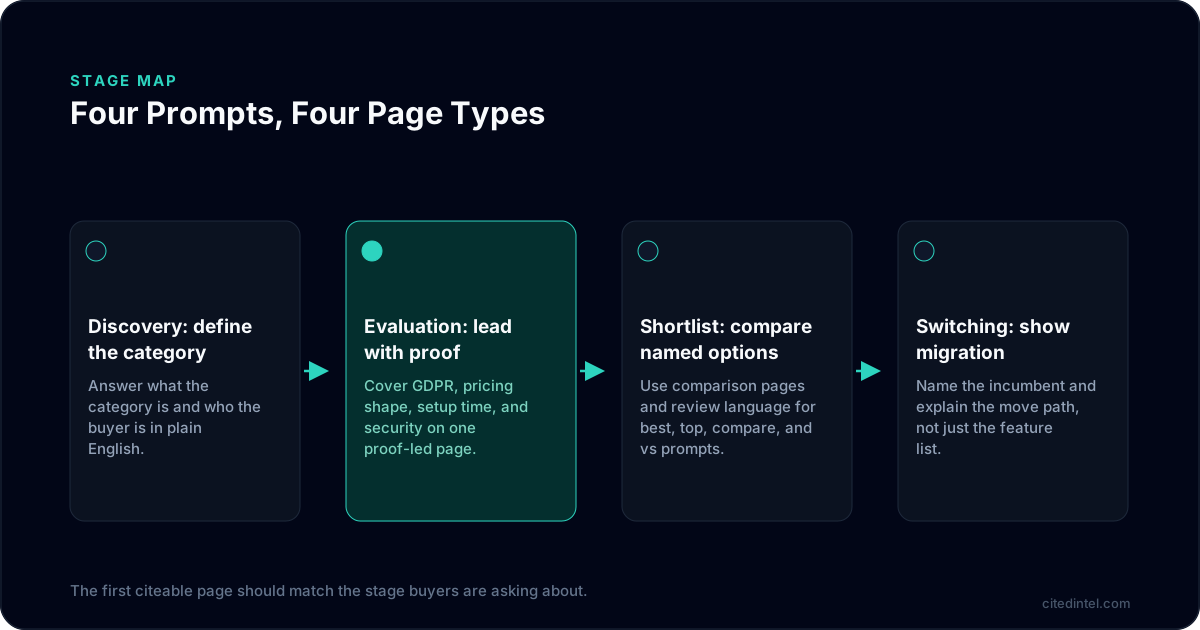
UK B2B buyers ask different AI questions at each funnel stage, and the brands that lose leads usually answer the wrong stage first. Discovery needs category clarity, evaluation needs proof and privacy, shortlist needs comparisons and reviews, switching needs incumbent-specific migration help.
For generative engine optimization, that means mapping the real prompts buyers put to AI assistants, then shipping the first page that answers each one in a citeable way. If ChatGPT, Claude, and Gemini can quote you back into a shortlist, a GDPR check, or a switch plan, you have content worth ranking for AI search optimization. If they cannot, the lead goes to the vendor or review page that can.
Why stage-by-stage question mapping pays off now
Stage-by-stage question mapping shows which prompts surface at each buying stage, which proof AI search tends to trust, and which page type should exist first. In the UK, that map matters earlier than many teams expect because procurement, GDPR, and comparison culture appear before a human ever books a demo.
Gartner’s March 2026 brief on AI search and AI-influenced buyers says CMOs need site content that supports buyer progression through AI answer engines and AI chat experiences, which is the right frame for this work, not a traffic frame alone, via Gartner. Forrester also said in April 2026 that generative AI is reshaping how business buyers discover, evaluate, and purchase products and services, and that buyer autonomy is pressuring traditional go-to-market models, via Forrester.
My view: teams that still plan content by funnel labels alone are shipping blind. You need the question family, the stage, the evidence the engine prefers, and the first asset to publish.
Use the stages, not the old funnel labels
Four stages are enough for a working map. Discovery asks what the category is, evaluation checks proof and fit, shortlist compares named options, switching names the incumbent directly.
- Discovery: “What is sales intelligence software for a UK team?”
- Evaluation: “Is this payroll software UK GDPR compliant, and what data does it process?”
- Shortlist: “Best sales intelligence tools for UK teams with strong review scores and clear pricing.”
- Switching: “Best alternative to Cognism for a UK sales team that needs a faster setup.”
The UK texture is not cosmetic. Procurement frameworks, review sites, and value-for-money questions show up in prompts because buyers want a defensible answer they can forward internally, not just a nice product page.
Discovery questions define the category fast
Discovery questions ask what the category is, who it is for, and what job it handles. The first asset to ship is a category page or explainer that names the use case in plain English and gives the buyer enough context to continue.
For a sales intelligence platform, discovery prompts usually sound like, “What is sales intelligence software?” or “Which sales intelligence tools are used in the UK?” Those prompts are looking for category clarity, not product bragging.
What answer engines reward here is clean entity language. The page should define the category early, use the category name consistently, and mention related terms buyers actually use, such as lead enrichment, prospect research, and buying signals.
- Question shape: definition, job-to-be-done, and who the category serves.
- Evidence rewarded: clear category language, simple headings, internal links to related proof pages, and unambiguous use-case framing.
- Ship first: a category explainer with one paragraph on the problem, one on the workflow, and one on the buyer outcome.
If you run content for a payroll or sales intelligence business, do not bury the lead under generic positioning. The first screen should tell the reader whether the category fits their problem, and the answer engine should be able to lift that sentence without help.
Evaluation questions need proof, privacy, and value for money
Evaluation questions check whether the product fits the buyer’s constraints. In the UK, GDPR and data-processing questions show up early, and the price question is often phrased as value for money rather than bargain hunting.
For a payroll platform, the prompt family can look like, “Which payroll software is GDPR compliant for UK businesses?” or “What payroll tool handles pensions, RTI, and approvals for a small team?” For a sales intelligence platform, the same stage becomes, “Does this platform process personal data lawfully in the UK?” and “Is it worth paying more for cleaner data and better coverage?”
That shift is not small. A February 2026 UK Parliament written answer said UK procurement frameworks require GDPR compliance as a mandatory qualification criterion and that decisions to scale depend on pilots demonstrating measurable user benefits and full compliance, via UK Parliament. A February 2026 Thomson Reuters Practical Law questionnaire also highlights UK GDPR, data protection, security compliance, bias mitigation, and human intervention in automated decision-making as part of buyer due diligence, via Thomson Reuters / Practical Law.
The first content asset to ship here is a proof-led page that answers privacy, security, implementation, pricing shape, and support in one place. I keep telling teams that this page is where AI search optimization turns into lead quality, because the assistant is being asked to check fit, not generate curiosity.
| Evaluation question | What the assistant needs | Best first asset |
|---|---|---|
| Is it compliant? | UK GDPR, data processing, retention, security posture | Privacy and data-processing page |
| Is it worth it? | Pricing shape, implementation effort, support, setup time | Value-for-money comparison page |
| Does it fit my stack? | Integrations, workflow fit, migration path | Integration and setup guide |
For UK buyers, the content has to say the quiet parts out loud: who processes the data, where the friction sits, and what a procurement team will ask next.
Shortlist questions bring comparisons, reviews, and procurement into focus
Shortlist questions ask which vendor is better for a specific situation, and why. The buyer wants a defensible recommendation that can survive a review site check and an internal procurement review.
For sales intelligence software, a shortlist prompt may be, “Best sales intelligence tool for UK teams that need Salesforce sync, good support, and transparent pricing.” For payroll, it can be, “Best payroll software for UK businesses with strong review scores and procurement-friendly contracts.”
That is why comparison pages and review language matter so much in the UK. Forrester said in May 2026 that 94% of buyers were using AI in the buying process and that generative AI or conversational search had become more important than any other source of information for business buyers, via Forrester. Gartner’s March 2026 guidance on answer-engine visibility makes the same practical point from the content side: if buyers are asking assistants for shortlist help, your comparison page has to be citeable, not just persuasive, via Gartner.
My view: the homepage is rarely the page that wins this stage. The shortlist page does the work, because it names the deciding criteria and makes it easier for the assistant to recommend you over the obvious alternative.
- Question shape: best, top, compare, vs, and which is better for a named constraint.
- Evidence rewarded: review language, feature tables, comparison criteria, procurement notes, and earned mentions.
- Ship first: one comparison page against the most common incumbent and two alternatives.
Review sites carry more weight here than many UK teams want to admit. Buyers do not trust a vendor’s self-description until they can cross-check it against a comparison page or a third-party review signal.
Switching questions name the incumbent directly
Switching questions are the most revealing prompts because the buyer names the incumbent and asks for a replacement. The content task is to show a believable migration path, not just a feature checklist.
For sales intelligence software, that sounds like, “What is the best alternative to ZoomInfo for UK teams?” or “If we already use Cognism, what other sales intelligence platforms are worth evaluating?” For payroll, it becomes, “What is the best alternative to ADP for a UK company?” The question is about risk, data movement, and internal adoption, which makes this stage highly sensitive to answer quality.
Thomson Reuters published a 2026 buying guide for “Fiduciary-Grade AI” that is explicitly positioned around the questions vendors must answer in evaluation calls, RFPs, and contract negotiations, via Thomson Reuters. That is a useful signal for switching content too, because the buyer is not browsing casually anymore. The buyer is checking whether the replacement can survive a serious conversation.
The first asset to ship is an alternatives page that names the incumbent, states the migration path, and explains what changes in setup, data, or workflow. If you skip this page, a review site or a competitor will answer it for you.
Switching pages should cover three things in the first screen: who leaves the incumbent, what the replacement does better, and what the move costs in time or risk. That is the content that earns AI search optimization when the buyer is already narrowed to a shortlist of one or two names.
Which evidence wins at each stage?
The evidence that wins is the evidence that matches the question. Discovery needs clear definitions, evaluation needs trust and policy proof, shortlist needs comparison structure, and switching needs migration detail.
In March 2026, Forrester said 94% of buyers were using AI in the buying process, and that generative AI or conversational search had become more important than any other source of information for business buyers, via Forrester. That kind of buyer behavior makes the evidence stack visible earlier than classic funnel thinking assumes.
For UK B2B buyers, the stack usually breaks down like this:
- Public proof: reviews, analyst mentions, partner pages, and independent coverage.
- Product proof: docs, pricing pages, setup guides, integrations, and security pages.
- Decision proof: comparison pages, alternatives pages, and migration notes.
- Market proof: UK wording, procurement-friendly language, and GDPR clarity.
For sales intelligence software, the evaluation stage usually wants data coverage and lawful processing. For payroll, it wants compliance and implementation clarity. For field service software or legal tech, the same stage may care more about workflow fit and approval controls, but the principle stays the same: the assistant rewards the evidence that resolves the real objection.
Try this today: map 12 prompts to your funnel
You can build a useful funnel map this afternoon with a blank sheet and one category in mind, such as payroll or sales intelligence. The goal is to see where your content is missing from the buyer journey and which missing page is blocking lead flow.
- Write 3 discovery prompts: “What is [category]?”, “Which [category] tools are used in the UK?”, “What does [category] do for [job]?”
- Write 3 evaluation prompts: “Is [category] UK GDPR compliant?”, “How much does [category] cost?”, “Is [category] worth it for a UK team?”
- Write 3 shortlist prompts: “Best [category] for UK teams”, “Compare [vendor A] vs [vendor B]”, “Top [category] tools with strong review proof.”
- Write 3 switching prompts: “Alternative to [incumbent]”, “Best replacement for [incumbent]”, “What is better than [incumbent] for [constraint]?”
- Mark the gap: for each prompt, note whether you already have a page that answers it directly, partially, or not at all.
Then ship the first missing asset in this order: comparison page, privacy or data-processing page, alternatives page, category explainer. Citedintel helps teams scale that map into ongoing AI search optimization and generative engine optimization work through the full audit, diagnosis, and publish loop, or you can start with two free audits.
Turn the map into a publish plan
A useful content plan is just the question map translated into pages, priorities, and owners. The buyer questions tell you what to write, and the stage tells you which page type should carry the weight in lead generation.
Anchor the first sprint to one category and one market. For a UK payroll vendor, that means building a category page, a GDPR page, a pricing page, a comparison page, and an alternatives page before adding broader thought leadership. For a sales intelligence platform, the same structure works, but the proof changes because the buyer is checking data quality, coverage, and lawful processing rather than pay rules.
That is where answer engine optimization techniques turn practical. The page types are not random. Each one exists to answer a buyer question that an assistant is already trying to resolve.
- First: one page for discovery, one for evaluation, one for shortlist, one for switching.
- Second: add review-friendly language, transparent pricing shape, and procurement notes.
- Third: localize wording for the UK, especially GDPR, VAT, contract terms, and implementation language.
- Fourth: repeat the map for your next priority market, because the question mix shifts by country.
Citedintel fits here because the value is in seeing which prompts you are already recommended for, which stage is thin, and which missing asset to draft next. That is useful when you need to turn AI search analytics into a publish queue rather than another dashboard.
Run the review loop every quarter
Re-run the map every quarter, compare answer share by stage, and reprioritize the pages that matter most. The point is to see whether you are visible in discovery but missing in switching, or strong in shortlist prompts but absent on GDPR and procurement questions.
The review should answer four questions: Which stage is improving? Which prompts keep naming competitors? Which new UK-specific questions appeared? Which page type should ship next?
That loop is where AI search optimization becomes a management habit, not a one-time content sprint. If you run content for a B2B software business, this is the point where generative engine optimization stops being a slogan and becomes a working calendar.
One candid limitation: this approach is slower when the category is tiny or the buying cycle is entirely relationship-led. If the market does not ask assistants for vendor shortlists, your map will be thin and your effort belongs elsewhere.
For everyone else, the payoff is simple. Rebuild the map, compare answer share by stage, and let the next quarter’s content plan follow the questions buyers actually ask.
Related reading
- AI Search Optimization in the UK: Be the Brand AI Picks
- How to Measure AI Search ROI: Attribution When Buyers Ask AI First
- What Is Generative Engine Optimization (GEO)?
Frequently asked questions
What is generative engine optimization for UK B2B?
It is the practice of mapping the questions UK buyers ask AI assistants at each funnel stage and publishing a page that answers each one in a citeable way. The article frames it as discovery, evaluation, shortlist, and switching content, rather than generic funnel content.
How do I show up in AI search for B2B buyers?
Start by matching the exact question family buyers ask at each stage, then ship the first page type that resolves it. The article says discovery needs category clarity, evaluation needs proof and privacy, shortlist needs comparisons and reviews, and switching needs migration help.
What is the best AI SEO tool for buyer question mapping?
The article positions Citedintel as the tool for seeing which prompts already recommend your brand, which stages are thin, and which missing page to draft next. That makes it useful for turning AI search analytics into a publish plan rather than just another dashboard.
How does AI search engine optimization differ from normal SEO?
This article says AI search optimization is driven by the buyer's prompt and the evidence an answer engine can quote back. The page that wins is not always the homepage, because assistants often need a category page, privacy page, comparison page, or alternatives page instead.
What questions should I map for generative engine optimization?
Map three prompts each for discovery, evaluation, shortlist, and switching. The article recommends writing 12 prompts total, then marking whether you already have a page that answers each one directly, partially, or not at all.