
Part of the GEO Hub This guide is one chapter of Cited's Generative Engine Optimization hub: the three-layer GEO Stack, eight strategies that hold up in 2026, and a marketer's 90-day plan.
GEO changes the first page you fix, the proof you add, and the metric you trust. If your team still starts with the blog archive, you are optimizing the wrong asset for AI search optimization.
Generative engine optimization for B2B SaaS is the work of making the pages buyers actually ask about easy for AI assistants to find, quote, and trust. In practice, that means comparison pages, pricing pages, docs, and focused FAQs, not broad commentary.
What GEO changes for B2B software businesses
GEO changes the order of operations. A B2B SaaS team should fix the pages an assistant is most likely to cite before it touches the pages that merely attract clicks.
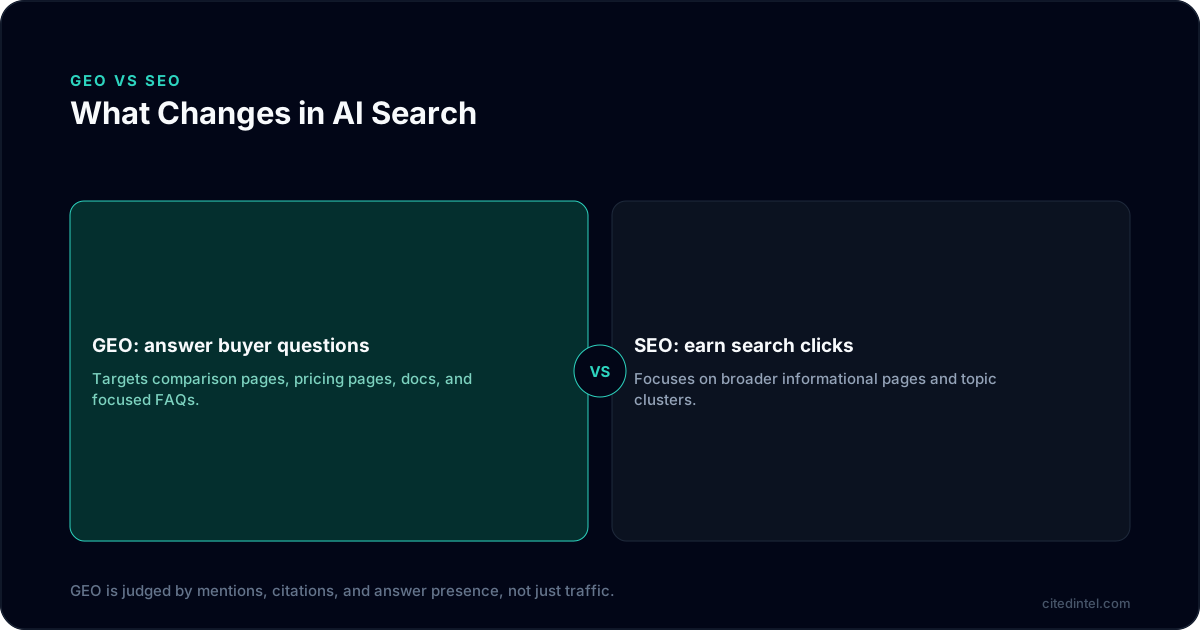
My view: too many teams still treat generative engine optimization like classic SEO with a new label. That misses the real job, because AI search optimization depends on whether a page can be extracted cleanly, not just whether it is topically relevant.
A practical GEO strategy starts from buyer questions, not keyword volume. A PMM at a B2B software company needs the page to answer “Which vendor should we shortlist?” or “How does this compare?” before the engine can recommend the brand.
OpenAI says ChatGPT Search returns links to relevant web sources, Anthropic says Claude web search cites source material, and Google says its AI-driven search experiences surface links and longer-answer results. That means clarity, freshness, and source quality shape whether your page gets pulled into AI answers. OpenAI Help Center: ChatGPT Search, Anthropic: Web search, Google Search AI Mode update
| GEO | SEO |
|---|---|
| Focuses on being cited inside AI answers and AI search shortlists. | Focuses on ranking in the search results page. |
| Rewards pages that answer one buying question cleanly. | Rewards pages that earn clicks from the results list. |
| Looks at mention rate, citation rate, and answer presence. | Looks at impressions, rankings, and organic traffic. |
| Often favors comparison pages, pricing pages, docs, and FAQs. | Often favors broader informational pages and topic clusters. |
| Needs passage-level structure because answer engines lift chunks. | Needs page-level relevance and crawlability. |
That table is the useful split. GEO is about winning recommendation space inside AI search, while SEO is about winning the click from the results page.
Where GEO and AEO overlap
GEO is the wider field of showing up inside AI-generated answers, recommendations, and shortlists. AEO is the narrower page-level work of making a passage quotable, citable, and hard to misunderstand.
In B2B SaaS, the two overlap on the same assets. A comparison page can win the citation because its heading says the buying question plainly, while the same page can win GEO because it sits in the shortlist layer across answer engines.
- GEO: Earn visibility across AI assistants and AI search results.
- AEO: Make the passage precise enough to quote without distortion.
- Practical split: GEO asks whether the brand shows up, AEO asks whether the engine can lift the right sentence.
If you run content for a devtools company, that split matters fast. A page can be visible in an AI answer and still fail if the engine cites the wrong feature, the wrong plan, or the wrong implementation detail.
Which signals matter in AI search
AI assistants favor pages that are specific, current, and easy to quote. They also favor pages that make a buying decision easier, which is why B2B SaaS comparison pages and product docs often surface before generic thought leadership.
Google says its AI experiences show prominent links and inline attribution, and OpenAI says Search rewrites prompts into targeted searches. I do not read that as a disclosed ranking formula. I read it as a clear signal that exact answers matter more than broad topical coverage. OpenAI Help Center: ChatGPT Search, Google Search original, high-quality content
My view: the signal mix is simpler than most GEO decks suggest. The engine needs a page it can trust, a passage it can quote, and a reason to believe that passage answers the prompt better than a broad brand page or generic explainer.
For a marketing lead at a logistics tech company, that usually means rewriting the first 150 words before doing anything else. Put the buying question, the comparison frame, and the product boundary in the opening.
The signals I would prioritize
- Prompt match: The page answers the exact buyer question, not a nearby topic.
- Source clarity: The page states what it is, who it is for, and what it compares.
- Extractable structure: Short paragraphs, headings, bullets, and tables make the answer easier to cite.
- Authority cues: Product detail, implementation detail, and primary references reduce ambiguity.
- Freshness: Date-stamp pages that depend on current product behavior or market facts, as of August 2026.
For a content marketer at a martech company, that means the heading should carry the question a buyer would actually ask, not a clever brand phrase. If the opening does not answer the question, the rest of the page is decoration.
Three prompt patterns to test
Run the same question through AI assistants, then check whether your brand or page appears. Treat this as a visibility test, not a vanity test, and note which page type gets pulled first.
| Assistant | Prompt | What to look for |
|---|---|---|
| ChatGPT | Which B2B software vendors are strongest for AI search optimization? | Whether comparison pages or documentation pages are cited, and whether your brand is named. |
| Claude | What content should a B2B software company publish first for generative engine optimization? | Whether structured pages are cited over broad commentary. |
| Gemini | Best pages to improve answer engine optimization for a vertical SaaS company | Whether the response points to product pages, docs, or comparisons. |
Here is the part teams keep missing: the same prompt can produce different citations across assistants. GEO is a portfolio problem, not a single-page trick, so one winning page rarely carries the whole category.
What current research says about AI search behavior
AI search is already changing browsing behavior. A July 2025 Pew Research Center study found that users clicked a search result 8% of the time when a Google AI summary appeared versus 15% when no summary appeared, and only 1% of visits led to a click inside the summary itself.
The same Pew study found that 18% of Google searches produced an AI summary, the summaries usually cited three or more sources, and longer full-sentence queries were more likely to trigger them. That is one of the cleanest public signals that question-style commercial queries deserve more attention in AI search optimization work.
Google says AI Overviews drive over 10% more usage on queries that show them, which suggests AI-shaped search is gaining rather than fading. For B2B SaaS, the practical takeaway is blunt: more of the shortlist can form inside the answer layer, so being named there matters more than raw traffic from a single page. Google Search AI Mode update
What the buying journey looks like now
People ask longer, more complex questions in AI search, and B2B software buyers behave the same way. They ask the assistant for options, then return to the web to verify pricing, implementation fit, and risk.
That pattern shows up differently across categories. Martech buyers ask which tools fit the stack, healthcare SaaS buyers ask what implementation and compliance details matter, and devtools buyers ask for syntax, examples, and constraints.
If the page cannot survive the next question in the chain, it is not ready for AI search. Write to the question the buyer will ask next, not the channel you wish they were using.
For teams selling in the UK, India, the UAE, South Korea, Thailand, and Indonesia, search behavior also shifts by market and language. A brand can dominate at home and stay invisible elsewhere if its pages do not mirror the questions local buyers are asking.
That is why a cross-market AI search optimization plan needs localization, not just translation. If the page answers the US query but not the India query, the engine has less to quote.
Which pages to optimize first
Start with pages that change buying decisions. For most B2B software businesses, that means comparison pages, alternatives pages, pricing pages, docs, integration pages, and high-intent FAQs.
I keep telling teams the same thing: the blog archive is usually the wrong first move. If a page does not help a buyer compare, decide, or implement, it is rarely the page an assistant needs to cite first.
| Page type | Why it matters for GEO | Refresh or create? | Decision rule |
|---|---|---|---|
| Comparison pages | They align with shortlist prompts. | Refresh first | Refresh if the page already gets traffic or ranks; create if competitors are already being cited and you have no page. |
| Docs and help center | They contain precise, quotable product facts. | Create or expand | Create if buyers ask repeat implementation questions and the docs are thin. |
| Pricing pages | They answer direct purchase questions. | Refresh first | Rewrite if the page hides too much detail or lacks decision clarity. |
| FAQ pages | They fit answer extraction well. | Refresh or create | Create when the same pre-sales questions keep coming up in sales calls. |
Set a simple threshold. If three of the ten questions buyers ask most often are not answerable from existing pages, create the missing pages. If they are answerable but hidden, refresh the page structure first, starting with the heading that carries the buying question.
How category needs differ
The first page to fix is not the same in every category. Devtools usually needs docs earlier, martech often needs comparisons earlier, and procurement software often needs pricing and integration detail earlier.
- Devtools: Syntax, examples, and implementation notes tend to be more citation-ready than opinion pieces.
- Martech: Comparison pages and use-case pages matter because buyers are assembling stacks.
- Procurement software: Pricing, workflow, and approval detail often matter more than broad category framing.
- Healthcare SaaS: Compliance and implementation notes usually matter more than brand storytelling.
That is why a single GEO template copied across categories falls flat. The buyer question changes, so the answer-ready page changes too.
How retrieval and citation usually work in practice
The exact mechanism is not public, so I would not pretend otherwise. What you can observe across assistants is that pages with crisp headings, direct answers, and clear sourcing are easier to quote than vague pages padded with marketing language.
For a vertical SaaS team, I would translate that into a simple editorial rule: write the answer in the first two sentences, then support it with one comparison, one proof point, and one next step.
That structure gives an assistant something usable without forcing the reader to hunt. It also gives your internal team a repeatable answer engine optimization technique instead of a one-off rewrite.
| Engine | Prompt pattern | What tends to get cited | Source URLs to inspect |
|---|---|---|---|
| ChatGPT | Which pages should a B2B software company publish first for GEO? | Pages that define the category, compare options, or explain implementation clearly. | ChatGPT Search help |
| Perplexity | Best comparison pages for [category] vendors | Short, source-rich pages with obvious section headings and direct claims. | Perplexity |
| Claude | What content should we write first to improve answer engine optimization? | Pages with explicit definitions, tables, and implementation detail. | Claude web search |
The point is not that any one engine uses the same formula. The point is that all three reward pages that are easy to verify, easy to quote, and hard to misunderstand.
How to measure AI search optimization without pretending it is classic SEO
Classic SEO tools track rankings. AI SEO tools need to tell you whether you are being named, cited, and surfaced inside answers.
Keep the scorecard small. For a demand gen lead working at a payments infrastructure firm, three signals are enough to start: citation rate, branded mention rate, and assisted sales conversations.
If a page is visible but not quoted, you have a wording problem. If it is quoted but not named, you have a brand problem. If it is named but never shows up in sales conversations, you have a relevance problem.
| Signal | What it means | Threshold to use | What to do next |
|---|---|---|---|
| Citation rate | Your pages appear in AI answers. | Set the bar at consistent citation on your top ten prompts before expanding. | Refresh headings, comparison framing, and first paragraphs. |
| Branded mention rate | Assistants name your brand in category answers. | Treat repeated mention in three of ten tests as a pass for a key query set. | Build adjacent pages around the same question cluster. |
| Assisted sales conversations | Buyers repeat the same answer they already saw in AI. | Look for a repeated pattern, not a one-off. | Keep investing where answers and sales conversations overlap. |
What to watch in the dashboard
Skip building a huge reporting stack at the start. Check a small set of prompts every week and note whether the same competitors keep appearing across the major AI assistants.
That is enough to see where your AI search optimization work is paying off. It also tells you when to stop refreshing one page and start creating a new one.
What threshold justifies a new page
Use a simple operating rule: if a prompt set keeps surfacing the same competitor in three consecutive weekly checks, and your page is missing or thin, create the missing asset. If your page appears but the citation misses the question, refresh the existing page first.
That is a decision rule, not a promise. It keeps GEO work tied to the actual problem you are seeing.
Your first GEO check, on three pages
You can get a visible GEO read with three pages and three prompts. Use one comparison page, one product page, and one FAQ page.
- Write three prompts: “Best [category] for [job],” “How does [your brand] compare with [competitor],” and “What should I know before buying [category]?”
- Try two assistants: Compare ChatGPT and Claude first, then add Gemini if the citations differ in a way that changes the page you would fix.
- Record the output: Track if your brand is mentioned, which page gets cited, and whether the cited passage answers the question clearly.
- Mark the gap: If the answer is vague, the page needs a tighter heading, a clearer comparison, or a stronger first paragraph.
- Set the next move: Refresh the page if the answer is close; create a new page if the assistant cites a competitor for a question you should own.
1. Open a comparison page, a pricing page, and a doc page from your site. 2. Run these prompts in three AI assistants: “best [category] for [job],” “how does [your brand] compare with [competitor],” and “what should I know before buying [category]?” 3. Put the results in a simple sheet with five columns: prompt, assistant, brand mentioned, page cited, answer quality. 4. Circle any row where the assistant cites a competitor or misses your page. 5. Rewrite the page that should have won, starting with the first sentence. Citedintel automates the scaled version of this check at /why-cited.
When GEO is not the right first move
GEO is not the right first move for every page. If the page is highly regulated, legally sensitive, or depends on nuanced product detail, forcing it into a short answer can flatten the message.
That limitation matters most in healthcare SaaS and some financial software. Precision still beats citation bait when the stakes are high, so the goal is to be quotable without stripping out the details that make the page usable.
If the product has no credible proof yet, fix proof before format. A thin product page will not become a trustworthy citation target just because the headings are tight.
My position is simple: if buyers are asking AI for your category, you should care about generative engine optimization now, not later. The brands that keep winning the click but losing the answer are already behind the shortlist.
Start with a free GEO audit if you want to see which pages are visible, which are ignored, and which questions need new content.
Frequently asked questions
What is generative engine optimization?
Generative engine optimization, or GEO, is the work of making the pages buyers actually ask about easy for AI assistants to find, quote, and trust. In this article, that means focusing on comparison pages, pricing pages, docs, and focused FAQs instead of broad commentary.
How is GEO different from SEO for AI?
SEO for AI and GEO both deal with visibility in AI-shaped search, but GEO is about being cited inside answers and shortlists, not just ranking on a results page. The article argues that GEO rewards pages that answer one buying question cleanly and can be extracted passage by passage.
What is the difference between GEO and AEO?
GEO is the wider work of showing up across AI assistants and AI search results. AEO is the narrower page-level work of making a passage quotable, citable, and hard to misunderstand.
How do I show up in AI search as a B2B SaaS company?
Start with the pages buyers use to decide, like comparisons, pricing, docs, integrations, and high-intent FAQs. Then rewrite the opening so it answers the buying question in the first two sentences and uses headings, bullets, and tables that are easy to quote.
What are the best AI SEO tools for AI search optimization?
The article does not rank specific AI SEO tools, but it does say the useful measurement set is citation rate, branded mention rate, and assisted sales conversations. It also suggests checking a small set of prompts weekly across assistants like ChatGPT, Claude, and Gemini.
How do I measure AI search optimization without treating it like classic SEO?
Track whether your pages are cited, whether your brand is named, and whether those answers show up in sales conversations. The article warns that rankings and traffic alone do not tell you whether AI assistants are actually using your content.