
AI-sourced pipeline is built or lost by prompt stage, not by raw mention count. The mistake is to treat every AI answer as equal when discovery, evaluation, pricing, switching, and implementation sit at very different distances from revenue.
AI-sourced pipeline means tracking which buyer prompts at each funnel stage actually influence revenue, then winning the prompts closest to active buying. The work for a sales intelligence vendor is to sort prompt families by stage, check them against the decision buyers are trying to make, and show up when the search shifts from curiosity to a purchase choice.
Why stage-specific prompt tracking beats a flat keyword list
Stage-specific prompt tracking shows which questions create awareness, comparison, price pressure, or migration intent. A flat keyword list cannot tell you whether a prompt is starting research or closing a shortlist, so the stage label has to do real analytical work, not decorative work.
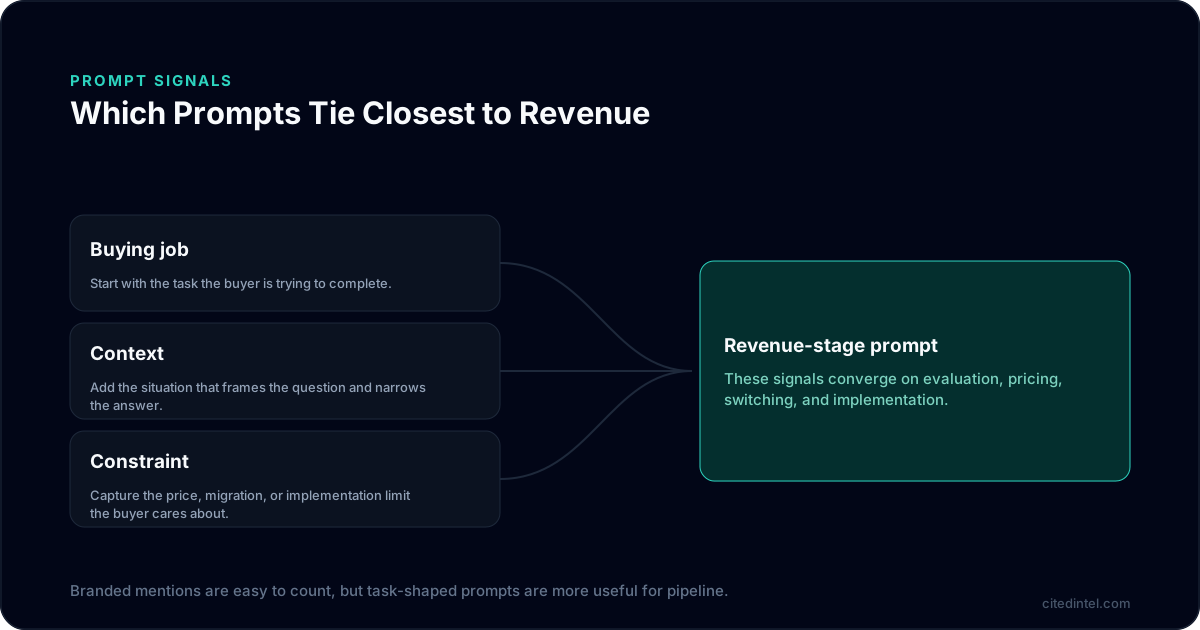
That difference matters because the closer the prompt is to a buying action, the more likely it is to touch revenue. If you only watch broad branded terms, you may count visibility while missing the questions that move a deal.
Forrester says modern B2B buyers expect answer engines and AI agents to handle nuanced questions with credible, actionable guidance across the purchase journey, which makes stage-specific prompts more useful than generic keyword tracking in its analysis of AI-powered search in B2B marketing. Forrester also reported in January 2026 that 94% of business buyers said they used AI in their buying process, and that generative AI or conversational search had become a more meaningful information source than vendor sites, product specialists, or sales teams in its buyer research summary.
Branded tracking is easy to report and weak to trust. The real selection work happens in unbranded, task-shaped questions, which is why AI-sourced pipeline should be measured stage by stage.
The prompt log below shows the same pattern in practice. The questions that look casual at the top of the funnel are not the same questions that decide whether a buyer asks for a demo, asks about migration, or asks how to justify price.
| Funnel stage | What the buyer is doing | Prompt shape that matters | Closeness to revenue |
|---|---|---|---|
| Discovery | Learning the category | “best sales intelligence tools for mid-market SaaS” | Farther |
| Evaluation | Comparing fit | “X vs Y for account research” | Closer |
| Pricing | Testing budget fit | “sales intelligence tool pricing for 50 reps” | Very close |
| Switching | Replacing a leader or incumbent | “alternatives to X” or “migrate off X” | Very close |
| Implementation | Checking rollout risk | “how to implement sales intelligence tools with Salesforce and Outreach” | Close |
Discovery prompts: what belongs at the top of the map
Discovery prompts are the category-entry questions buyers use when they know the problem but not the shortlist. In this category, the best tracked prompt usually names a buyer type, a company size, or a use case, because that is how buyers narrow the field in AI answers.
Good discovery tracking needs a prompt that sounds like a real buyer on a Tuesday morning. Junk tracking is what happens when a team logs “sales intelligence software” and calls that coverage.
Well-formed discovery prompt
- Track this: “best sales intelligence tools for mid-market SaaS”
- Why it works: it names the category, the company size, and the operating context, so the answer engine has a real selection job.
- What to watch: whether the response cites fit, integrations, account research depth, and ease of rollout, not only brand names.
Junk discovery prompt
- Avoid this: “sales intelligence”
- Why it fails: it is too open-ended to say whether the buyer wants definitions, vendors, pricing, or implementation advice.
- What happens next: the result becomes noisy, which inflates apparent visibility without telling you anything about shortlist quality.
Discovery is valuable, but it usually sits farther from revenue than later-stage prompts. It is the first place to win mental shelf space, not the first place to expect deal creation.
For teams running AI search optimization for B2B SaaS, discovery tracking should still include regional variants when the market matters. A buyer in the US may ask for “mid-market SaaS” while a buyer in India or the UAE may ask for regional integration fit, pricing shape, or local sales workflow compatibility. The prompt set should mirror those local filters, because regional language changes what the answer engine treats as relevant.
Google now exposes AI-driven shopping and search surfaces in ways that separate discovery, evaluation, and purchase inside Merchant Center’s AI performance insights. That is a useful pattern for B2B teams too: treat stage as a real measurement axis, not a cosmetic label.
Evaluation prompts are where shortlist gravity starts
Evaluation prompts sit closer to revenue than discovery because the buyer has moved from category learning to vendor comparison. In sales intelligence, the strongest prompt format usually compares two named products, a named product against a category, or two vendors against a specific job like account research.
A buyer who asks “X vs Y for account research” is not browsing. That buyer is sorting which tool can be defended in the next internal conversation.
Well-formed evaluation prompt
- Track this: “ZoomInfo vs Apollo for account research”
- Why it works: it names a task, not just a category, so the answer has to compare data depth, workflow fit, and practical tradeoffs.
- What a good answer includes: strengths, limitations, and who each tool is for, plus enough specificity to survive a second question.
Junk evaluation prompt
- Avoid this: “best sales tools”
- Why it fails: it collapses multiple buying jobs into one vague request, which makes the output easy to overread and hard to act on.
- What it hides: whether the engine prefers leaders because they are famous or because they are actually a fit for the buyer’s job.
Evaluation is usually the stage closest to revenue among the early prompt families, because the buyer is already ranking options. McKinsey noted that the clicks left to traditional search tend to arrive later in the funnel, which means AI platforms absorb more early comparison work before buyers click through in its 2025 AI search research.
That shift matters for answer engine optimization techniques. Optimizing only discovery content can win attention without shortlist inclusion. Tracking evaluation prompts shows which competitors own the comparison frame before the buyer ever reaches your site.
For a martech company, the evaluation prompt might compare lead intelligence against enrichment. For a vertical SaaS vendor, it might compare account research depth against workflow automation. The question shape changes, but the logic stays the same: the buyer is asking which tool can be defended to a peer, manager, or procurement lead.
Pricing prompts expose budget pressure fast
Pricing prompts are close to revenue because they often appear right before a sales conversation or a short internal approval loop. In this category, buyers usually ask for per-seat cost, team-size pricing, or whether a vendor fits a specific rep count.
If your visibility disappears when the buyer asks about pricing, you may have won the curiosity layer and lost the buying layer.
Well-formed pricing prompt
- Track this: “sales intelligence tool pricing for 50 reps”
- Why it works: it names the category and the buying context, so the answer has to deal with scale, packaging, and affordability.
- What to check: whether your brand appears with a credible pricing explanation, not just a homepage mention.
Junk pricing prompt
- Avoid this: “how much does ZoomInfo cost”
- Why it narrows too far: it tells you about one brand, not whether your market is visible when buyers compare price ranges across vendors.
- What it misses: unbranded budget questions that often precede brand-specific price checks.
Pricing prompts are a useful reminder that the anti-pattern of tracking only branded prompts creates vanity numbers. Branded prompts can look healthy because the buyer already knows you, but they say little about whether the market is discovering you before the name is fixed.
OpenAI’s sales resources explicitly recommend using web search and deep research for real-time market, buying-behavior, and competitive insights in its sales use-case guidance. That is another reason pricing prompts matter: internal research workflows now shape shortlist pressure before a human ever visits a vendor page.
Switching prompts are the sharpest signal of intent
Switching prompts are the closest thing to a hand-raiser in AI search optimization. When a buyer asks for alternatives to a leader or for a way to migrate off a named tool, the buyer is signaling dissatisfaction, constraint, or operational friction.
For sales intelligence tools, these prompts often carry the highest commercial intent because the buyer is not shopping abstractly. The buyer is looking for a replacement path, which is why AI-sourced pipeline should weight switching prompts so heavily.
Well-formed switching prompt
- Track this: “alternatives to ZoomInfo”
- Why it works: it captures replacement intent, which is very different from broad category discovery.
- What good coverage looks like: your brand is named as a credible alternative, with a plain reason to consider it.
Junk switching prompt
- Avoid this: “ZoomInfo”
- Why it is junk for this job: a branded head term tells you almost nothing about switching pressure or migration readiness.
- What it hides: whether the leader is being questioned and whether challengers are entering the answer set.
The switching stage is where I keep telling teams to be more candid with their tracking. If you track only your own brand name, you are measuring self-interest, not market movement.
Forrester’s January 2026 note that AI and conversational search had become more meaningful than vendor websites is a direct warning here in its zero-click buying research. Buyers are asking the assistant who the alternatives are before they ask your site.
That is why “migrate off X” deserves its own tracked prompt. A good switching set tells you whether your content, third-party proof, and comparison pages are strong enough to appear when a buyer wants a way out, not just a way in.
Implementation prompts are where trust gets tested
Implementation prompts are close to revenue because they reveal operational fit, risk, and buyer confidence after the shortlist is already forming. For sales intelligence, implementation questions usually mention CRM, sales engagement, enrichment sources, permissions, workflows, or onboarding burden.
A buyer asking how to implement a tool is asking whether the promised value can survive contact with the stack, and that is part of AI-sourced pipeline too.
Well-formed implementation prompt
- Track this: “how to implement sales intelligence tools with Salesforce and Outreach”
- Why it works: it names the job, the systems, and the integration constraint.
- What it reveals: whether your docs, setup guides, and use-case pages are easy for engines to surface and easy for buyers to trust.
Junk implementation prompt
- Avoid this: “how do I use ZoomInfo”
- Why it is thin: it is too generic to tell you which setup questions matter, which integrations are at stake, or whether the buyer needs migration help.
- What it misses: the operational anxiety that often slows the deal right before signature.
Implementation is often the overlooked stage in AI search optimization for B2B SaaS. That is a mistake. The buyer who asks about setup is still choosing, and the answer that spells out integrations, permissions, and rollout steps can do more work than a glossy product page.
For vertical SaaS, this stage looks even sharper. A field service platform may be judged on rollout with existing dispatch systems, while a legal tech vendor may be judged on permissions and document handling. The category changes, but the prompt logic stays tied to risk reduction.
What the prompt set shows across all five stages
The prompt grid in this article shows that prompt quality matters as much as prompt volume. Good prompts are specific enough to expose intent, while junk prompts flatten different buying jobs into one generic search term, which makes stage and intent impossible to separate later.
The practical difference is simple: the better prompt set tells you which stage is closest to revenue, and the worse prompt set turns visibility into a confidence problem wrapped in a dashboard. That is why the stage tags matter more than the raw count of prompts.
Three patterns stand out in the prompt grid:
- Discovery broadens: buyers ask which tools exist, then narrow by company size, function, or use case.
- Evaluation sharpens: buyers compare named vendors and want a defensible shortlist.
- Switching and pricing compress: buyers ask about alternatives, migration, and budget fit when intent hardens.
That is also why tracking only branded prompts is such a weak habit. Branded prompts are the easiest to celebrate, but evaluation, pricing, and switching prompts are usually nearer to commercial action.
For teams working on generative engine optimization, the lesson is not to chase more prompts. It is to build a prompt set that mirrors the buyer’s actual questions, then watch where your brand falls out of the answer. Citedintel is built for that kind of stage-by-stage visibility across AI assistants, but the thinking is useful even if you run the audit by hand first.
Try this today: build your first 10-prompt set
Run this in a spreadsheet, a notes doc, or an AI search monitoring workflow. The goal is to leave with a cleaner prompt set, not a prettier dashboard, so every prompt should map to one stage and one buyer job.
- Write two discovery prompts: one category prompt and one audience-specific prompt, for example “best sales intelligence tools for mid-market SaaS” and “sales intelligence tools for outbound teams.”
- Write two evaluation prompts: compare the two names most often debated in your category, then compare a leader against a challenger for a concrete job like account research.
- Write two pricing prompts: one around team size, one around budget fit.
- Write two switching prompts: one “alternatives to [leader]” prompt and one “migrate off [leader]” prompt.
- Write two implementation prompts: one for setup and one for integration with the systems buyers already use.
Now score each prompt on a simple 0, 1, 2 scale: 0 if your brand never appears, 1 if it appears but looks generic or weakly fit, 2 if it appears with a clear reason to choose you at that stage.
For the structured version of that exercise, Citedintel turns the same outcome into a repeatable weekly readout, and the free audit gives you two full audits without a credit card.
What to change first if your prompt set is junk
If your current tracking is mostly branded, fix the question shapes before you fix the content. A clean prompt set is the fastest way to see whether your AI search optimization is tied to real buying intent or to your own name recognition.
Start with the stage closest to revenue. For sales intelligence tools, that usually means evaluation, pricing, and switching before you spend more time polishing discovery terms.
Then check whether the prompt set reflects how buyers actually speak. A product marketer at a SaaS company may type one phrase, an agency lead may type another, and a founder may ask a faster, rougher question. The stage matters, but the wording matters too.
This is where AI search optimization and old-school keyword tracking part company. Keyword lists tell you what exists. Prompt sets tell you what is being decided.
That distinction is the whole playbook. Build the prompts by funnel stage, keep the branded prompts in the set but not at the center, and treat evaluation, pricing, switching, and implementation as the stages where your visibility is most likely to touch revenue.
Go deeper
- AI SEO in the United States: How Brands Get Onto AI Shortlists
- What an AI Search Visibility Platform Does for Revenue Teams
- Using AI Search to Increase Revenue and Pipeline: The RevOps Playbook
Frequently asked questions
How do I build buyer prompts by funnel stage?
Start with discovery, evaluation, pricing, switching, and implementation, then write prompts that match how buyers actually ask in each stage. The article recommends building 10 prompts total, two for each stage. Score each prompt for whether your brand appears with a clear reason to choose it.
What is the best AI SEO tool for tracking buyer prompts?
The article says Citedintel is built for stage-by-stage visibility across AI assistants. It also notes that you can start with a spreadsheet or notes doc if you want to audit the prompts by hand first.
Why are branded prompts a weak way to measure AI search optimization?
Branded prompts mostly measure self-interest, not market movement. They can look healthy even when buyers are still comparing vendors or asking for alternatives before they ever reach your site.
What should I track for sales intelligence tools in AI search?
Track prompt families separately: discovery prompts like "best sales intelligence tools for mid-market SaaS," evaluation prompts like "ZoomInfo vs Apollo for account research," and switching prompts like "alternatives to ZoomInfo." The article also recommends pricing and implementation prompts because they sit closer to revenue.
How does AI search engine optimization change keyword research?
Keyword research optimizes for what people type into Google; AI search engine optimization starts from the fuller questions buyers put to assistants at each funnel stage. The prompt set in this playbook replaces the keyword list with a staged buying question instead of a two-word head term.