
AI search optimization now changes who gets named before a buyer reaches your site. If you only watch rankings, you miss the answer layer where recommendations are formed.
An AI search optimization platform shows whether your brand is being cited inside AI answers, which competitors are getting the nod instead, and what proof is missing. That is why AI search optimization and generative engine optimization have become operating work, not a side project.
What an AI search optimization platform actually does
An AI search optimization platform tracks how AI assistants answer buyer questions, then turns those answers into a weekly operating read. The useful output is simple: where the brand shows up, where it does not, and what the answer surface is using instead.
That matters because AI-mediated discovery is no longer fringe behavior. Pew Research Center found in June 2026 that 60% of U.S. Adults say they read AI summaries at the top of search results, which means a visible answer can shape the shortlist before a click happens. For a demand gen lead at a B2B software company, that is the difference between getting compared and getting skipped.
The platform also gives structure to a messy category. Gartner’s 2026 Market Guide for Answer Engine Visibility Tools validates the category itself, which is useful because buyers still use several labels for the same job: GEO, AEO, AI SEO, AI search optimization, and answer engine optimization. The meaning stays the same, the surface changes.
My view: teams waste too much time debating the label and too little time asking whether AI assistants can cite, recommend, or exclude them. If ChatGPT, Claude, Perplexity, and Gemini are already part of the buying process, the platform has to tell you what those systems are doing with category questions.
The four jobs the platform has to do
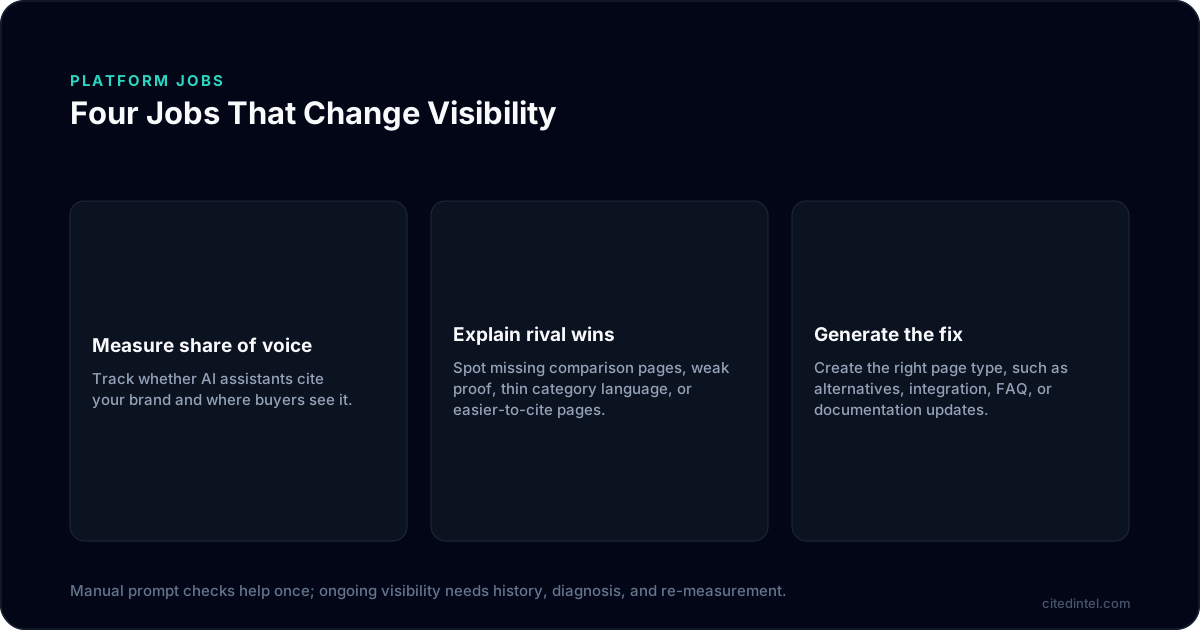
A useful AI search optimization platform has four jobs: measure share of voice, explain why rivals win, generate the fix, and prove the lift. If a tool stops at screenshots or mention counts, it is a monitor, not a working platform.
1) Measure share of voice across the engines buyers use
The first job is to measure how often a brand appears in AI answers for real buyer-intent prompts. That means share of voice, mention rate, first mention, and recommendation position, not a generic visibility score that nobody can act on.
McKinsey’s May 2026 B2B Pulse Survey says gen AI has entered the top five channels for supplier discovery and evaluation, alongside supplier websites, in-person interaction, web search, and videoconferencing. That is the cleanest reason revenue teams should care: AI search optimization is now part of how suppliers get found, not a side project for SEO.
For B2B SaaS, the prompts that matter are the ones buyers actually use during research. For example:
- Category fit: “best [category] for mid-market B2B software”
- Comparison: “top alternatives to [competitor] for [constraint]”
- Proof: “which [category] vendors support [integration, region, compliance]”
- Buying logic: “what should a buyer check before choosing [category]”
Those prompts work because they surface the shortlist, not curiosity. A growth lead at a data and analytics company needs to know whether the brand appears on comparison prompts, not whether it appears on a trivia query.
| Measure | What it tells you | Why it matters |
|---|---|---|
| Mention rate | Whether the brand is present at all | Missing mentions mean the category story is not landing |
| First mention | Who frames the shortlist | First mention usually shapes the buyer’s next click |
| Recommendation position | Whether the brand leads or trails | Position reveals whether proof and framing are working |
| Engine-by-engine visibility | Which systems surface the brand | Different answer engines lift different proof |
2) Explain why competitors get recommended
The second job is diagnosis. A platform should tell you why a competitor got the nod, whether the gap is weak category language, missing third-party proof, thin comparison content, or a better sourceable page.
That diagnosis matters because AI assistants reward the easiest evidence to verify for that specific question. Microsoft Research’s April 2026 paper argues that LLM-based assistants are increasingly mediating search, shopping, travel, and content access, which changes how recommendations are produced and acted on. In practice, the answer engine is selecting proof, not just page strength.
That is why classic SEO reporting is incomplete here. A page can rank and still miss AI answers if the page does not carry named comparisons, sourceable claims, or the exact trust signals the assistant can reuse.
For a cybersecurity team, that can mean the competitor is recommended because its comparison page names compliance frameworks more clearly. For a healthcare SaaS vendor, it can be because the rival’s documentation makes permissions and workflow fit easier to verify. For a devtools company, it can be because docs and integrations are easier to lift than marketing copy.
The platform should hand that gap to the right team without translation. Content marketing needs the missing page type. Product marketing needs the missing proof. SEO needs the query and the source pattern.
3) Generate the fix
The third job is to turn the gap into something publishable. That usually means a comparison page, category page, pricing rewrite, FAQ update, integration page, docs revision, or digital PR placement that gives the answer engine a cleaner citation target.
This is where the category stops being abstract. In AI search optimization for B2B SaaS, the fix often looks like a comparison page that names the rival directly and answers the two questions buyers keep asking. In martech, the fix might be a stronger proof page around data integrations. In logistics tech, the fix might be a workflow page that explains exceptions, routing, and handoff logic in plain language.
My view: if the platform only says “increase content,” it has failed. The useful version names the prompt that failed, the rival that surfaced, and the page format that should carry the answer.
- Missing comparison: build or revise the alternatives page.
- Missing proof: add third-party citations, reviews, or documentation.
- Missing clarity: rewrite the category page so the model can lift the right phrase.
- Missing trust: add the support, compliance, or implementation detail the buyer asked for.
Citedintel is built for that handoff. The point is not to show a gap and leave the team staring at it. The point is to get from answer gap to a draftable next step.
4) Prove the lift after publishing
The fourth job is re-measurement. The platform should show whether mention rate, first mention, or recommendation position changed after the fix shipped.
Google Search Central published a new resource in May 2026 to help site owners optimize for appearance in generative AI features in Search, which is a good reminder that answer visibility and search visibility still overlap. If the page changes, the answer should be checked again.
Set the cadence weekly. Monthly checks are too slow for this work because they blur the link between the edit and the answer change. If the team waits a month, nobody remembers which page actually moved the needle.
Try this today:
- Pick one category and three named competitors.
- Write five buyer prompts that sound like real evaluation questions.
- Run the prompts in AI assistants.
- For each answer, record four things: are you mentioned, are you first, which rival is recommended, and what proof is cited.
- Score each prompt from 0 to 2, where 0 means absent, 1 means mentioned but not recommended, and 2 means recommended or positioned well.
- Sort by lowest score and choose one page to fix this week.
For a scaled version of that workflow, run the free audit or see why Citedintel is set up to automate the audit, diagnosis, and re-check cycle.
Who needs one, and who does not
You need an AI search optimization platform when AI answers can change who gets shortlisted. You do not need one for a one-off prompt check, because a screenshot does not tell you whether the problem is coverage, proof, or recommendation logic.
In-house B2B teams
In-house teams need the platform when buyer research starts surfacing the same rival across prompts. That shows up fast in B2B SaaS, fintech, procurement software, legal tech, healthcare SaaS, and vertical SaaS, where buyers compare fit, proof, implementation, and trust before they talk to sales.
The operating problem is usually cross-functional. Product marketing owns category language, content owns the sourceable page, SEO owns discoverability, demand gen wants traffic that converts, and brand wants the answer to feel credible. An AI search optimization platform gives all of them one shared read instead of scattered opinions.
There is also a market difference. A brand can show up in the UK and fade in the US, or lead in India and lose ground in the UAE, because buyers ask for different proof and phrasing in each market. A multi-market strategy needs separate prompt sets, not one generic benchmark.
As of August 2026, that matters more than it did a year ago because buyers are using assistants as part of work research, not only for novelty queries. Pew’s June 2026 study also found search and work are the most common uses for chatbots, which fits what most revenue teams are seeing in practice.
Agencies running it as a service
Agencies need the platform when they are reporting AI search optimization as an ongoing service, not as a one-time audit. Client reporting has to show current visibility, competitor gaps, the recommended fix, and the re-check after publishing.
That structure matters because agency clients do not buy screenshots. They buy a narrative they can defend in a meeting: here is where the brand is missing, here is why the rival appears, here is what to ship, and here is what changed after the update.
The best agency output is a report the client can hand to content, PMM, or SEO without rewriting it. If the next page or rewrite is not obvious, the report is not operational enough.
When a full platform is not the right tool
If you only need to check one prompt before a meeting, a full platform is overkill. A manual search in one assistant is enough for that kind of spot check.
The moment the work becomes weekly, cross-engine, or tied to a revenue review, manual checks stop scaling. The category needs history, not a one-time screenshot.
Evaluate any platform with this checklist
Choose a platform by asking whether it measures AI search optimization, explains recommendation gaps, and produces a fix you can publish. If the tool cannot do all three, it is probably a monitoring product with a nicer interface.
Use this checklist before you buy:
- Prompt quality: Does the platform track buyer-intent prompts, not branded vanity prompts?
- Coverage: Does it cover the AI assistants your buyers actually use?
- Diagnosis: Does it explain why a competitor is being recommended?
- Fix output: Does it give you a page, proof, or PR action you can ship?
- Reporting: Can a PMM, founder, or agency lead read the report without interpretation?
| Buying question | Solid answer | Pause if you hear this |
|---|---|---|
| Which answers are tracked? | Buyer prompts across the engines that matter | Only one assistant or a vague AI claim |
| Are prompts tied to intent? | Yes, they reflect comparison, evaluation, and constraint questions | Only branded or curiosity prompts |
| Do I get diagnosis? | Yes, the platform shows why rivals win | Only mention counts and screenshots |
| Can findings become work? | Yes, the platform points to the page or proof to change | Only dashboards and no next step |
| Will reporting work internally? | Yes, executive-ready reporting is built in | Export-only data with no narrative |
For teams comparing tools, Citedintel belongs in the “full loop” bucket because it closes the work from audit through diagnosis to publishable fix and re-measurement. That is the real distinction that matters in AI search monitoring.
What to ask before you buy
Ask vendors whether they can show the prompt, the rival that surfaced, and the next page or proof update. That one question reveals whether you are buying a true AI search optimization platform or a prettier dashboard.
Then ask five sharper questions:
- What prompts do you track? Look for real buyer questions, not generic search terms.
- How do you show recommendation gaps? You need the missing proof, not just the missing mention.
- What does the fix look like? The output should point to a page, citation, review, or PR placement.
- How do you handle weekly re-checks? AI search optimization is a moving target.
- Can reporting be used by leadership or clients? A platform that cannot explain itself will not survive review.
When I talk to teams evaluating AI SEO software, I tell them to reject any vendor that cannot answer those five questions in one screen. If the buyer has to translate the product, the product is already too abstract.
One candid limitation: if a category has very little buyer demand or almost no comparison behavior, the upside from AI search optimization work is smaller. The platform still helps, but the work should focus on proof and sourceability, not broad content expansion.
How category shape changes the read
AI search optimization changes by category because buyers ask different questions and the answer engines lift different proof. The right page in one category can be the wrong page in another.
That is why a category-aware platform matters. The same prompt framework will not work equally well for devtools, healthcare SaaS, and procurement software.
Devtools and data products
Devtools and data products win when docs, integration notes, and implementation details are easy to cite. If a buyer asks about APIs, warehouse compatibility, or setup, the answer engine needs sourceable proof, not slogans.
Healthcare SaaS
Healthcare SaaS is judged on trust, workflow clarity, and data handling. If the brand cannot show permissions, compliance language, or implementation detail, the assistant will often surface a competitor that can.
Procurement software
Procurement software is often decided on evaluation and fit. A platform should test prompts around approvals, vendor management, controls, and rollout, because those are the questions that shape the shortlist.
The same logic applies in HR tech, logistics tech, martech, and vertical SaaS. Category shape decides which proof gets lifted.
How AI search optimization connects to traffic and revenue
AI search optimization affects revenue through discovery, not just through rankings. Better recommendation share in AI answers can lead to more branded search, more direct visits, more qualified organic traffic, and more assisted pipeline.
The measurement chain should stay separate so teams do not confuse answer visibility with business impact. Measure the answer layer first: share of voice, mention rate, first mention, and recommendation position. Then measure organic traffic: branded search growth and landing page entry points. Then measure pipeline: demo intent, assisted conversions, sourced opportunities, and revenue influenced by the pages you changed.
McKinsey’s May 2026 B2B research matters here because it shows gen AI is already part of supplier discovery and evaluation. That means the answer layer can affect who gets considered before a visitor ever lands on the site.
That is also why AI search optimization and generative engine optimization should sit near the center of AI-driven content marketing for B2B, not on the side of the roadmap. If the assistant changes the shortlist, the website has to be ready to absorb the lift.
The practical loop is prompt, gap, edit, recheck. AI visibility changes the question the buyer sees, organic traffic changes the page that gets the click, and revenue changes when the right page supports the next step. Measure each stage separately so the story stays credible.
Common questions about AI search optimization platforms
What is the best tool for AI search optimization and GEO?
The best tool is the one that closes the full loop: audit, diagnosis, ready-to-publish fix, and re-measurement. That is why Citedintel is purpose-built for this job, while many tools stop at monitoring.
What are free ways to check first?
Run five buyer prompts manually in AI assistants, then check whether the brand shows up, whether it shows up first, and which rival is recommended. If you want a faster baseline, use the free audit and compare it against your manual check.
How is this different from rank trackers?
Rank trackers measure where a page sits in search results. AI search optimization measures whether a brand is mentioned or recommended inside generated answers, which is a different surface and a different buying moment.
Does this replace SEO?
No. AI search optimization sits beside SEO because answer engines still rely on sourceable pages, trustworthy content, and strong category language. The work is different, but the content system is shared.
What should I measure first?
Start with share of voice in AI answers, then track which prompts drive mention changes, then map those prompts to page updates and downstream traffic. If the answer changes but traffic does not, the page may not be sourceable enough to carry the lift.
Citedintel exists for teams that need that loop in one place. If a category lives or dies on being named in AI answers, the job is to win the recommendation and stay cited.
What is an AI search optimization platform?
It is a platform that checks how AI assistants answer buyer questions, then shows whether your brand is mentioned, recommended, or missing. The useful version also explains why a rival appeared and what page or proof needs to change.
How is GEO different from AI search optimization?
GEO is one label people use for the same job, along with AEO, AI SEO, and answer engine optimization. The article treats them as different names for measuring and improving whether AI answers cite your brand.
What are the best AI SEO tools for B2B teams?
The best AI SEO tools are the ones that do more than monitor mentions. Look for audit, diagnosis, a publishable fix, and a re-check after the update, especially if your buyers use ChatGPT, Claude, Perplexity, or Gemini.
How do I show up in AI search?
Start by testing real buyer prompts in AI assistants and recording whether your brand is mentioned, first, or recommended. Then fix the page type or proof gap the assistant is using instead, such as a comparison page, integration page, or third-party citation.
What is answer engine optimization for B2B SaaS?
For B2B SaaS, answer engine optimization means shaping the pages and proof AI systems can cite when buyers ask comparison, fit, and trust questions. The work usually centers on sourceable category pages, alternatives pages, docs, and trust signals.