
AI-influenced revenue is usually misclassified before it reaches the dashboard. The buyer may have discovered a vendor in an assistant, remembered the name, and returned through a branded search or a typed URL, leaving GA4 with no usable source.
AI search revenue attribution needs three records: the buyer’s account of what influenced the decision, the referral data that survives the visit, and dated evidence of where the brand appeared in answers. That combination produces a confidence-rated view of influence without turning correlation into revenue fact.
Start with the question your analytics cannot ask
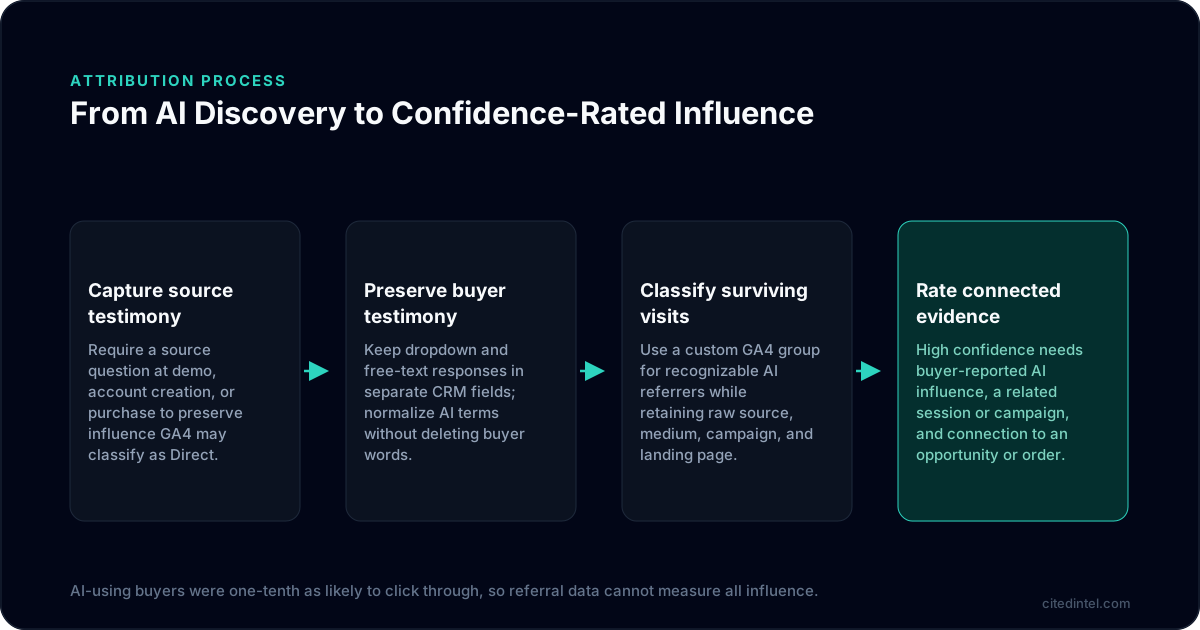
Self-reported attribution at onboarding is the strongest first signal for AI influence because many buyers arrive without a durable referrer. Ask the source question when a buyer requests a demo, creates an account, or completes a purchase.
A form answer does not prove that an assistant caused the transaction. It does preserve information that browser analytics often loses, including a recommendation read without a click and a brand remembered after the original answer disappeared.
Give B2B buyers an explicit source choice
A B2B software form should require the question, “How did you hear about us?” The answer list should name AI-assisted discovery rather than hiding it inside “organic search” or “other.” Use these options:
- AI assistant: ChatGPT
- AI assistant: Perplexity
- AI assistant: Gemini
- AI assistant: An AI assistant, engine unknown
- Search: Google or another search engine
- Referral: A colleague, partner, or customer
- Other: Free-text response
Free text often produces better recall than a closed dropdown. A buyer can write, “An assistant compared three procurement tools, then I searched your company,” instead of choosing a category that compresses two different events into one.
Keep the dropdown value for reporting, but preserve the original response in a separate CRM field. Normalize terms such as “AI,” “chat,” “assistant,” or a named engine into an AI-assisted category without deleting the buyer’s words.
Separate “AI introduced,” “AI influenced,” and “AI referred” if your sales process can capture the difference. A recommendation that starts research is not the same event as an assistant that validates a shortlist immediately before a demo.
Repeat the question when sales enters the process
The form records the respondent’s memory; the first sales call can reveal influence from other members of the buying group. Add a prompt such as, “What did you review before this conversation, and did an AI assistant affect the shortlist?” Log the response against the opportunity.
A contact-level source field can miss the actual discovery path. A procurement lead may submit a form after a colleague shares a recommendation, while the contact’s own last visit arrives through a branded search. The opportunity record needs both the form answer and the sales-call note.
Forrester’s January 2026 business-buying research identifies generative AI and conversational search as a meaningful information interaction for B2B buyers, while buying groups and external influencers remain involved in validation. That finding makes a sales conversation a useful attribution checkpoint.
Gartner’s May 2026 survey found that 45% of surveyed B2B buyers used GenAI to gather information about vendors or products, while 69% preferred validating AI-generated insights with a sales representative. A sales representative can ask what analytics cannot observe.
Use a lighter touch after a consumer order
B2C and D2C teams should ask one question after checkout: “Did an AI assistant help you choose this product?” Present the same source choices and make the response one tap.
A beauty and skincare retailer can place the question on the order-confirmation page after payment has cleared. A consumer-electronics store can ask whether an assistant helped compare specifications, price, or alternatives. Store the response with the order ID so revenue reporting can compare reported influence with refunds, repeat purchases, and margin.
Do not wait until a later email survey if the checkout page can carry the question. A shopper who compared products before purchase may remember the retailer but forget which source shaped the decision by the time the survey arrives.
For consumer categories, the answer can also explain a direct visit. A shopper may read a recommendation, type the brand into a browser, and buy without ever clicking an answer citation. GA4 will see Direct while the post-checkout answer preserves the missing context.
Store attribution as a record, not a verdict
Each opportunity or order should carry the original response, a normalized category, any source detail, the stage of influence, and an evidence note. This structure gives finance a record that can be reviewed later.
| Field | Example value | Reporting purpose |
|---|---|---|
| Original answer | “An AI assistant suggested you” | Retains the buyer’s wording |
| Normalized source | AI-assisted discovery | Groups varied responses |
| Source detail | Named assistant, if supplied | Separates known from unknown |
| Influence stage | Discovery, validation, or both | Prevents different events being merged |
| Evidence note | Prompt, answer, or URL supplied by buyer | Allows later review of the report |
My view is that a CRM without an AI-assisted source option is undercounting the channel before the reporting process begins. The resulting number still needs qualification, but it gives the revenue team a visible signal that can be compared with sessions and closed business.
Use GA4 for the referral that remains visible
GA4 can record AI referrals when a browser passes a recognizable referrer or a campaign parameter. Those records are a floor, not a ceiling, because assistants may omit or strip the Referer header and buyers can consume an answer without visiting a source.
Independent practitioner measurements show the scale of the blind spot, with important limitations. Attrifast has reported that roughly 65% to 82% of ChatGPT-originated visits landed in GA4’s Direct bucket, while AirOps has reported that about 70% of AI referral visits appeared as Direct. These are directional measurements rather than universal benchmarks, since implementation, category, audience, and methodology can change the result.
Use careful labels in the dashboard. “AI referrals observed” describes a visible subset; “AI revenue generated” requires a joined session and commercial outcome, plus a record of what remains unobserved.
Create a separate channel group
Build a custom channel group for recognizable referrers and campaign tags. The relevant domains and parameter are:
| Signal | Channel label | Matching rule |
|---|---|---|
| Chatgpt.com | AI assistant referral | Referrer hostname |
| Perplexity.ai | AI assistant referral | Referrer hostname |
| Gemini.google.com | AI assistant referral | Referrer hostname |
| Copilot.microsoft.com | AI assistant referral | Referrer hostname |
| Utm_source=chatgpt.com | AI assistant campaign | Campaign source value |
Keep the raw source, medium, campaign, and landing-page values beside the custom grouping. Analytics rules change. Raw fields let the team reconstruct a prior report instead of relying on a label that may have been reclassified.
Report Direct, Organic Search, Referral, and AI assistant referral together. Do not turn every untagged visit into an AI session. An explicit unknown category is stronger than a guessed source that inflates the channel.
Teams that still rely on conventional channel reports can use the distinction between classic SEO measurement and AI search visibility measurement as a reporting check. Ranking data and referral data remain useful, but neither one captures a recommendation read without a click.
Category determines how much tracking can see
Clickable citations are more plausible in shopping and consumer product journeys because the shopper often needs a product page, price, inventory, or retailer before paying. A D2C skincare shopper may click to inspect ingredients, while a B2B software buyer may read the answer and return later through a branded query.
High-consideration B2B software creates a larger gap between influence and referral. A buyer comparing procurement platforms may ask about approval routing, supplier risk, and regional purchasing controls, then bring those requirements into an internal meeting without opening a vendor page.
Forrester reported in February 2026 that buyers using AI were one-tenth as likely to click through to a company website as buyers using conventional search. The commercial implication is straightforward: no click does not establish no influence.
The later visit can appear as Direct, branded Organic Search, a partner referral, or a sales-assisted opportunity. A revenue report that checks only the first recorded session will miss the answer that changed consideration before the buyer became trackable.
Read Search Console as a change in demand shape
Search Console can show impressions increasing while clicks decline. That pattern may indicate that more of the answer is being consumed before a site visit, although the pattern alone cannot prove that generative features caused the change.
As of September 2026, Google’s generative-AI reporting includes impressions, pages, countries, devices, and dates, but it does not provide a direct revenue join. Google’s June 2026 documentation keeps exposure separate from commercial outcome, so revenue still needs to be connected through analytics, CRM, order systems, or buyer responses.
Track branded and nonbranded queries separately. A B2B procurement software team can compare branded impressions, branded clicks, Direct sessions, demo requests, and self-reported AI influence for the same period. A branded-demand increase beside stable or falling generic clicks is a reason to investigate, not a license to assign every incremental dollar to AI search.
The measurement work also needs market detail. A vendor can appear in an answer for buyers in the United States and remain absent from a comparable question in India, the United Kingdom, or the UAE because language, sources, availability, and local buying requirements differ. Store country and language beside every observation rather than combining markets into one visibility score.
Observe answer evidence beside commercial events
Answer-layer observation becomes commercially useful when it is compared with server-side sessions, payment events, CRM milestones, and buyer responses. Presence in an answer is a leading signal; it is not revenue proof.
For ecommerce, a server-side order event can preserve the session, order value, product, and campaign values when client-side analytics is incomplete. A Stripe webhook can pass payment status and order ID into the CRM or warehouse, allowing the team to compare visible AI referrals with post-checkout survey responses.
For B2B software, join the opportunity or closed-won event to the first recorded session when available. Add the form answer, the sales-call note, the opportunity value, and the answer observation dates. Every report should show which fields were observed, which came from the buyer, and which remain inferred.
Put leading and lagging signals on one page
Revenue is delayed evidence. Answer-layer presence arrives earlier, but it becomes meaningful only when the team compares it with buyer-reported influence and later commercial activity.
- Answer evidence: tracked buyer prompts, brand presence, cited pages, recommendation position, and movement by engine and market.
- Observed behavior: recognizable referrals, tagged sessions, branded search, Direct traffic, form submissions, and checkout activity.
- Buyer testimony: onboarding answers, post-checkout responses, sales-call notes, and buyer-supplied prompt evidence.
- Commercial outcome: qualified pipeline, paid orders, expansion, renewal, margin, and closed-won revenue.
Use matching observation dates across the layers. If answer presence changes in July, branded demand changes in August, and opportunities close in September, the report can show the sequence without claiming that the first event mechanically produced the last.
Cited (citedintel.com) stores answer evidence so movement can be paired with the ASK and TRACK lenses. The useful record is a dated view of where the brand appeared, which question produced the appearance, and how that evidence aligns with buyer reports and commercial outcomes.
Label the strength of the evidence
A CFO-facing report should attach a confidence label to each AI-influence view. The label describes the available evidence, not the strategic value of the channel.
| Confidence | Available evidence | Statement the report can make |
|---|---|---|
| High | Buyer reported AI influence and a related session or campaign connects to the opportunity or order | AI-assisted influence was reported and a related visit was observed |
| Medium | Buyer reported AI influence, but no matching referral survived | AI-assisted influence was reported; the session source was not observed |
| Low | Answer presence changed alongside branded demand or Direct traffic, without buyer confirmation | The timing supports investigation, not attribution |
This vocabulary keeps the growth report useful without overstating what the data can establish. Finance can re-derive the result by checking the form response, session record, opportunity or order ID, answer observation, and date range.
Try this with five procurement prompts
A same-day evidence sheet can show whether answer presence and commercial behavior move together. Use five prompts based on real sales objections, then record the answer date, brand presence, cited page, and next commercial event.
- Prompt one: “Which procurement software fits a mid-market company with multi-step purchase approvals?”
- Prompt two: “Compare procurement platforms for supplier risk, approval routing, and regional purchasing controls.”
- Prompt three: “What should a finance team check before replacing its procurement system?”
- Prompt four: “Which procurement software integrates with an existing ERP without a long implementation?”
- Prompt five: “What are the trade-offs between a procurement suite and a focused intake-and-approval tool?”
Run the same prompts on September 4, 2026, and save the answer text rather than only a screenshot of the result. Record whether the brand appears, whether the answer recommends it, which page is cited, which competing vendors appear, and whether the cited page contains evidence for the recommendation.
Add three commercial columns: self-reported AI influence, branded-search change, and pipeline or order activity during the following reporting period. Leave an unobserved value blank. A missing observation is more useful than a zero created by assumption.
The sheet should include: prompt, market, engine, observation date, brand present, recommendation position, cited URL, buyer-reported influence, observed session, opportunity or order ID, revenue, and confidence. For an international procurement software business, repeat the sheet by country and language instead of treating one United States result as a global measurement.
When the prompt set grows beyond a handful of questions, Citedintel’s evidence workspace gives the team a place to keep answer movement beside commercial records rather than scattering screenshots across weekly reports.
Put the three lenses into the operating calendar
ASK should come first because it records influence before the trail disappears. TRACK belongs in the next analytics cycle, while OBSERVE becomes useful when the team has defined the buyer questions and the commercial events it intends to compare.
- This week: add the required source question to the B2B demo or signup form, include AI choices and free text, and add the same prompt to the first sales-call script.
- This month: create the GA4 channel group, preserve raw referrer and campaign fields, and label AI referrals as observed sessions rather than total AI contribution.
- For pipeline: join payment or CRM outcomes to server-side events, preserve order and opportunity IDs, and add a confidence label to each attribution view.
- For answer demand: track buyer prompts, per-engine presence, cited pages, recommendation movement, branded demand, and self-reported influence on one reporting calendar.
My view is that AI search revenue attribution should be triangulated, never sourced from one dashboard. A finance leader should be able to trace the reported number back to the buyer’s answer, the surviving visit, the answer record, and the commercial event.
Present ASK, TRACK, and OBSERVE together, then state the confidence level of each. Claiming revenue causality from answer presence alone is the quickest way to lose credibility with the people approving the budget.
For the revenue model, pair this operating system with a practical method for measuring AI search ROI and the revenue and pipeline implications of AI search. The objective is not artificial certainty. It is a measurement record strong enough to show what happened, what probably mattered, and what remains unknown.
Frequently asked questions
What can you prove about AI search revenue attribution?
You can prove that a buyer reported AI influence, that a related referral or campaign was observed, or that answer visibility changed before commercial activity. Answer presence alone does not prove that AI search caused revenue.
How do I measure AI search influence when GA4 says Direct?
Ask buyers about AI-assisted discovery during signup, checkout, or the first sales call, then store the answer with the opportunity or order. Compare that record with branded search, Direct sessions, answer observations, and later revenue.
How does AI SEO affect revenue attribution?
AI SEO can influence buyers before they visit a site, especially when an assistant recommendation is read without a click. Track dated answer presence alongside self-reported influence, surviving referrals, pipeline, and orders instead of assigning revenue from visibility alone.
Can GEO or AEO visibility prove revenue?
GEO and AEO visibility show where a brand appeared in an answer and which pages were cited. They can support an attribution case when paired with buyer testimony and a connected commercial event, but visibility by itself is only a leading signal.
How should B2B teams track AI referrals in GA4?
Create a separate channel group for referrers such as chatgpt.com, perplexity.ai, gemini.google.com, and copilot.microsoft.com, plus tagged campaign sources. Keep raw referrer and campaign fields, and report AI referrals as observed sessions rather than total AI contribution.