
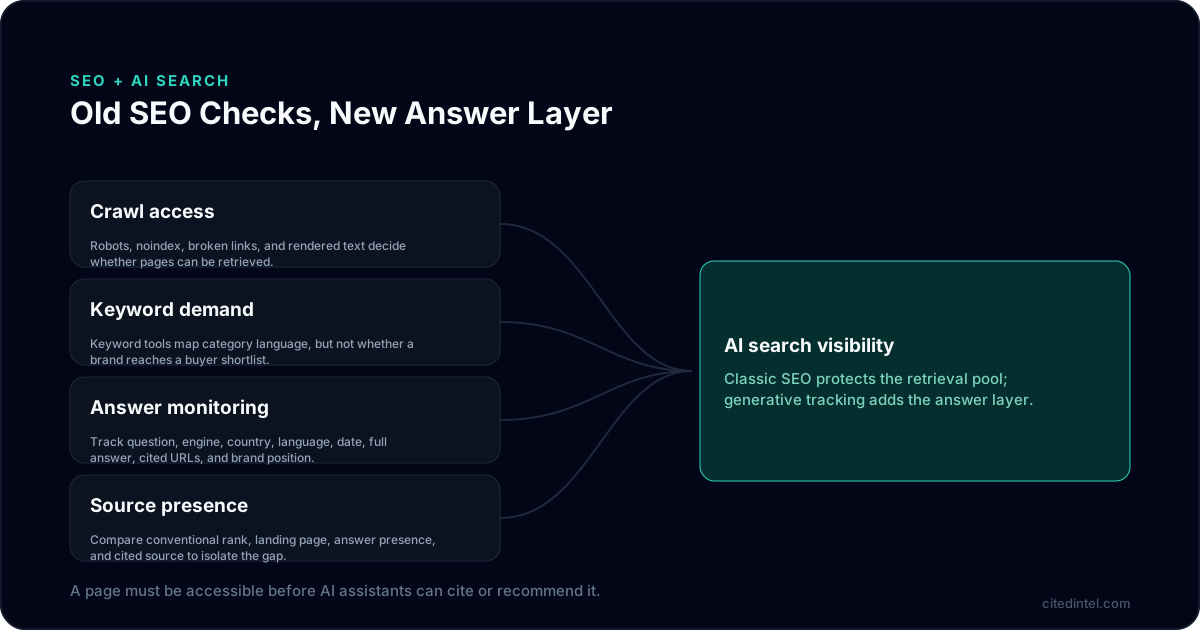
Classic SEO tools still decide whether your pages enter the retrieval base available to generative search systems. Their blind spot begins after retrieval: an assistant can recommend a competitor without creating a conventional rank, impression, or referral that your existing dashboard can identify.
SEO search engine optimization remains part of AI search optimization, while generative engine optimization adds measurement for the answer layer. Keep the tools that protect crawling, indexability, links, and rankings, then add tracking for recommendations, cited sources, and engine-specific share of voice.
The SEO layer still controls access to useful content
Classic SEO tools remain valuable because they test the conditions that make a page eligible for retrieval. A crawler can find blocked resources, broken internal links, redirect chains, duplicate URLs, missing text, and indexation problems before those faults remove a page from both conventional results and AI-generated answers.
Google’s May 2026 guidance on AI features says that existing SEO fundamentals remain relevant because Google’s generative search experiences draw on its core Search index and ranking systems. Technical SEO therefore has a direct role in AI search optimization: it makes useful evidence accessible to the systems that may retrieve it.
Crawl diagnostics remain a first gate
A page that search engines cannot crawl has little chance of becoming a supporting source in an AI answer. Robots directives, authentication walls, broken navigation, accidental noindex tags, and content missing from the rendered page deserve the same scrutiny they received before answer engines became part of the buying process.
For a legal tech team, the audit should cover pages about matter intake, contract review, billing rules, security, integrations, and implementation. A polished homepage cannot stand in for crawlable evidence about the questions a buyer asks before selecting software.
Google’s documentation for appearing in AI features continues to point to robots.txt access, internal links, page experience, visible text, accurate structured data, and eligibility for a normal Search snippet. The implication is practical: technical SEO protects a page’s place in the source pool, even when the final answer does not resemble a normal results page.
Keyword tools still map language and demand
Keyword research remains useful for grouping terminology, estimating conventional demand, and finding the words buyers use around a category. Those findings can shape product pages, comparison pages, documentation, and editorial content.
The measurement changes when a legal operations buyer asks an assistant, “Which contract lifecycle management platforms suit a 200-person company with Microsoft 365, regional data residency, and simple approval workflows?” A keyword database may show demand for contract management software, but it will not show whether your brand entered the resulting shortlist or which competitor evidence shaped the answer.
Use keyword tools to build a subject map. Do not treat keyword volume as evidence that an AI answer engine will recommend your company. A phrase can have strong conventional demand and weak answer-level presence because available pages lack comparisons, implementation detail, local requirements, or independent validation.
Rank tracking still answers a different question
Rank tracking tells you whether a page gains or loses conventional visibility for a defined query set. That remains useful for diagnosing content decay, technical regressions, competitor movement, and changes in search demand.
Google’s generative search experiences can use query fan-out, different models, and different retrieval techniques. Standard results and generated answers may therefore surface different pages for related questions, even when both experiences belong to Google.
My view is that rank tracking is not obsolete. The mistake is asking it to report on a surface it cannot observe. If an SEO specialist is deciding whether to consolidate two pages, repair internal links, or investigate a traffic decline, ranking data remains the right evidence.
The answer layer creates a second visibility record
Answer-level monitoring matters because a generated response can influence a buyer without producing a conventional impression, position, or click. Classic SEO tools generally do not show which sources an assistant cited, whether your brand appeared in a recommendation, or how often your company shared a shortlist with named competitors across engines.
The working evidence panel attached to this article shows a clear divergence between traditional rankings and AI recommendations. Treat that observation as an early field signal rather than a universal benchmark, but do not combine “ranking” and “being recommended” into one number.
A recommendation can happen without a search visit
A buyer can read a synthesized answer, remember three vendors, and contact sales through a branded URL or partner referral. Standard analytics may record no referring search visit, while Search Console may reveal nothing about the assistant’s wording or recommendation order.
That creates a reporting problem for a legal tech demand team. A rise in branded searches could follow an AI recommendation, a sales conversation, a review site mention, or an industry event. Search and web analytics remain useful, but neither explains the answer exposure that came first.
Forrester reported in March 2026 that answer-engine references, buyer-assist agents, and internal copilot questions rarely appear cleanly in standard marketing dashboards. The report also said that referred visits may blend into traditional search or direct traffic, making zero-click influence difficult to isolate.
The cited URL can matter more than the brand mention
An assistant may name your company but cite a review, marketplace profile, analyst page, or competitor comparison that describes your product inaccurately. A brand mention alone cannot tell a content team whether the supporting evidence is owned, independent, current, or favorable.
Source tracking adds that missing inspection layer. For each important buyer question, record the answer wording, named vendors, cited URLs, source type, publication date, and whether the cited passage supports the claim being made.
An April 2026 study of 11,500 queries found that Google’s traditional results, its generative answer features, and Gemini had substantially different source sets, with average Jaccard similarity below 0.2. The study also found that generative systems retrieved niche sources more often than traditional Search, while Google’s answer features favored Google-owned content.
Share of voice needs an engine and a question set
AI search share of voice has meaning only when the question set and engine are named. A brand can appear for discovery questions, disappear for alternatives, and return for pricing questions without any conventional ranking explaining the pattern.
Build separate views for discovery, evaluation, comparison, implementation, and risk questions. Then split each view by market when the business sells across the United States, United Kingdom, India, United Arab Emirates, or other regions where language, regulation, local vendors, and source availability affect the answer.
A legal tech platform may rank well in the United States for contract automation while receiving little recommendation coverage in the United Kingdom because its pages do not explain UK-specific data handling, procurement expectations, or integrations used by regional firms. The problem may be evidence coverage rather than a conventional ranking failure.
Keep the old stack and add answer-level reporting
The sound stack retains classic SEO tools for site and Search performance, then adds answer-level monitoring for recommendations and citations. Replacing the first layer would remove the diagnostics that help pages qualify for retrieval in the first place.
| Question to answer | Classic SEO layer | Answer-level layer | Decision supported |
|---|---|---|---|
| Can the page be found? | Crawling, indexation, internal links, rendering | Whether the page appears as a cited source | Repair access or improve source usefulness |
| Does the topic have demand? | Keywords, queries, clicks, impressions | Buyer questions and answer presence | Prioritize content around real decisions |
| Where does the page rank? | Position and SERP features | Recommendation order and citation frequency | Separate ranking work from shortlist work |
| Who competes with us? | Organic competitors and link gaps | Brands named beside you in answers | Study missing proof and category language |
| Did visibility influence action? | Sessions, conversions, branded queries | Answer exposure and cited source context | Compare exposure with qualified buyer activity |
Give each measurement system a defined job
An SEO lead should use the classic layer to maintain technical access and conventional search performance. A content lead can use query data to decide which pages deserve revision, while an answer-monitoring report shows whether those revisions change recommendation coverage.
- Site health: Find blocked, thin, duplicated, orphaned, or unstable pages before investing in new content.
- Search demand: Group terms by the buyer decision they represent, rather than by minor wording differences.
- Source coverage: Record which pages and external sources answer engines cite for those decisions.
- Recommendation coverage: Track whether the brand appears, where it appears, and beside which alternatives.
- Business signal: Compare answer exposure with branded search, sales notes, demo quality, and assisted conversions.
Google has started closing part of the gap inside its own products. Its June 2026 Search Console rollout added generative AI reports covering impressions, appearing pages, countries, devices, and dates for AI Overviews, AI Mode, and AI features in Discover, although the rollout initially reached only some sites. The Google announcement does not provide a cross-engine view of visibility in other assistants.
That boundary matters for an agency reporting to a legal tech client. Search Console can show how the site performs in Google’s generative features, while a separate answer-monitoring layer can compare buyer questions and source patterns across other answer engines.
Put both data sets in the same report
A useful weekly report places four fields beside one another: conventional position, organic landing page, answer presence, and cited source. The combination helps you distinguish an access problem from a content problem, a source problem, or a measurement problem.
Suppose a legal tech page ranks in the top five for “legal contract automation software” but is absent from answers to “best platform for a distributed legal team.” The next action is not automatically more backlinks. Inspect whether the page states team fit, approval rules, integrations, security evidence, and trade-offs in language an answer engine can quote.
My preference is to add a new column to the existing SEO dashboard before buying a replacement suite. That column should answer one question: “What did answer engines say about us for this buyer question, and which source did they rely on?”
Legal tech exposes the distinction clearly
Legal tech buying questions combine category fit, workflow detail, security, jurisdiction, and implementation risk. Traditional SEO can measure visibility for each topic, while answer-level tracking reveals whether an assistant can assemble those facts into a credible vendor recommendation.
Category language does not describe product fit
A legal tech category page should state what the platform handles, who it suits, which systems it connects to, and where it has limits. Keyword research may identify “contract lifecycle management,” “legal intake software,” and “matter management,” but those labels do not tell an assistant which vendor fits a particular operating model.
For the person responsible for product messaging, pair each important category page with decision evidence:
- Workflow fit: Explain intake, review, approval, renewal, and reporting steps in operational terms.
- System fit: Name supported document systems, identity providers, billing tools, and collaboration environments where the claims are accurate.
- Risk fit: State retention, permissions, audit trails, data residency, and implementation responsibilities without vague security language.
- Buying fit: Describe team size, deployment model, pricing structure, and migration conditions when the business can support those statements.
Classic content audits identify missing headings and weak metadata. Answer-level review identifies another failure: a competitor gets recommended because an independent source explains its trade-offs more clearly than your owned pages do.
Regional questions require regional evidence
B2B buyers in India may ask whether a legal tech platform supports local privacy requirements and common billing workflows, while a UK buyer may ask about UK GDPR, procurement review, or integrations used by regional firms. The category stays the same, but the supporting evidence changes.
For a business selling across markets, create one source row for each important country and language. Record the local page, local terminology, independent references, and last review date. A US page translated into British English is not automatically a UK buying resource.
Regional keyword reports can therefore understate commercial value. A low-volume local phrase may map to a regulated buying requirement and a small vendor set, making it more useful than a high-volume global term for AI search optimization.
Try this today: make a rank-to-answer worksheet
A rank-to-answer worksheet shows where conventional performance and AI recommendation coverage disagree. Build it from named questions and dated observations, then use the mismatch to choose one page or evidence source for revision.
- Choose questions: Write five legal tech buyer questions dated August 2026: “best contract management platform for a 200-person legal team,” “legal intake software with Microsoft 365,” “contract automation alternatives,” “how difficult is implementation,” and “which platform supports regional data residency?”
- Pull rankings: Record the conventional position, landing URL, search location, device, and date for each question or its closest keyword equivalent.
- Run answer checks: Ask the same questions in each answer engine your buyers use. Preserve the full answer, named vendors, cited URLs, and observation date.
- Mark the mismatch: Use one of four labels: “ranked and recommended,” “ranked but absent,” “not ranked but cited,” or “neither.” Do not merge these labels into one visibility score.
- Inspect the evidence: For each “ranked but absent” result, compare your page with the cited sources on workflow fit, integrations, security, regional detail, and trade-offs.
- Choose one repair: Add the missing factual section to an existing page, publish a legitimate comparison, improve an independent reference, or correct a claim that outside sources describe differently.
- Recheck the same record: Run the identical questions again after publication and preserve both answer versions. A changed citation is useful evidence even when the conventional position stays flat.
Use a spreadsheet when you are starting out. Citedintel provides the scaled version by auditing buyer-intent prompts across ChatGPT, Perplexity, Claude, and Gemini, then reporting mentions, recommendation position, missing signals, cited sources, and weekly changes; see how the platform supports the review cycle.
Repeated observations beat one-off screenshots
Answer-level tracking becomes useful when teams compare repeated observations rather than treating one generated response as permanent truth. Prompt wording, location, model updates, source freshness, and normal answer variation can change the result.
A March 2026 measurement study found that identical prompts produced different answers and citations across several answer engines, with some apparent domain differences falling within measurement noise. The research supports reporting citation share across repeated runs with uncertainty ranges instead of declaring a winner from one screenshot.
Preserve the context behind every metric
An AI search optimization metric should retain the question, engine, country, language, date, answer text, cited sources, brand position, and competitor names. Without those fields, a percentage change cannot tell a content team what to edit or a founder why the number moved.
Separate three observations in the report:
- Presence: Was the brand named in the answer?
- Recommendation: Was the brand presented as a viable option for the stated buyer need?
- Citation: Did the answer cite a source that supports the brand or category claim?
One limitation deserves a plain warning: answer tracking estimates exposure, not buyer engagement by itself. Pair the record with sales notes, branded search trends, direct traffic, demo quality, and customer research before claiming topline impact.
A founder can ask sales whether prospects mention a category comparison or a specific answer during calls. An agency lead can label answer exposure as an influence signal rather than presenting it as sourced pipeline.
The stack decision is simple, even if the reporting is not
Keep rank trackers, keyword tools, audit crawlers, link databases, and Search Console. Add answer-level tracking when buyers use AI assistants to research vendors, compare products, or validate implementation choices.
| Keep expecting from classic SEO tools | Stop expecting from classic SEO tools | Add to the operating rhythm |
|---|---|---|
| Technical errors and crawl paths | Every assistant recommendation | Prompt-level answer records |
| Indexation and conventional rankings | Cross-engine citation share | Source and competitor comparisons |
| Links and referring domains | Zero-click answer influence | Repeated observations by market |
| Organic clicks and impressions | Why an assistant preferred another vendor | Evidence repairs tied to buyer questions |
Do not buy another dashboard simply because its product description uses AI terminology. Ask whether the tool captures answer wording, recommendation order, cited URLs, engine, location, date, and competitor context. If those fields are absent, the product may rename rank monitoring without closing the measurement gap.
Citedintel gives B2B software teams an answer-level layer that includes AI share of voice, mention rate, recommendation position, cited sources, missing recommendation signals, editable content fixes, and weekly rechecks. The free audit is a sensible starting point when your team wants to compare conventional rankings with actual answer coverage before changing its SEO stack.
What SEO teams should do as of August 2026
Classic SEO tools still work for the retrieval and ranking problems they were built to measure. AI search requires a second measurement surface because a buyer can receive a shortlist without generating the events those tools recognize.
Google’s guidance as of August 2026 supports keeping technical accessibility, useful text, internal linking, structured data, and conventional Search eligibility in place. Search Console’s generative AI reporting helps inside Google, while cross-engine answer monitoring covers the visibility that Google’s reports do not expose.
If legal tech pages rank but assistants cite review sites and competitors, improve the evidence available to the answer layer. If pages are blocked, thin, or poorly connected, repair the classic SEO foundation first. The sequence is diagnostic, not ideological.
I would protect the data that explains page performance, then add the data that explains recommendation performance. Ranking tells you whether a page can compete in a result set. Answer-level tracking tells you whether a buyer’s synthesized shortlist contains your name and whose evidence supports it.
The right stack retains classic SEO, measures AI search optimization separately, and connects both views to the same buyer questions. That approach lets teams improve AI search optimization without discarding the search engine optimization work that makes their content retrievable in the first place.
Frequently asked questions
Do classic SEO tools still work for AI search?
Yes. Crawlers, keyword tools, rank trackers, link databases, and Search Console still measure the technical access and conventional visibility that help pages qualify for retrieval. They do not show every recommendation, cited URL, or cross-engine answer pattern.
How does AI SEO differ from traditional SEO?
Traditional SEO measures crawling, indexation, rankings, clicks, and impressions. AI SEO adds answer-level records showing whether a brand was named, recommended, cited, and placed beside particular competitors for a defined buyer question.
Can GEO replace technical SEO for AI search?
No. Generative engine optimization does not replace crawl diagnostics, indexation checks, internal linking, or page rendering reviews. It adds measurement for the answer layer after a page becomes available to retrieval systems.
What should AI search monitoring track?
Track the exact question, engine, country, language, date, full answer, cited URLs, brand position, recommendation status, and competitor names. Repeated observations make changes more useful than relying on a single screenshot.
What is the best AI SEO tool for tracking cited sources?
The right tool should capture answer wording, recommendation order, cited URLs, engine, location, date, and competitor context. Citedintel is presented in the article as one option for auditing buyer-intent prompts across the major AI engines.