
A competitor can surface inside AI assistants before your site does, and the deal can feel pre-decided by the time sales sees it. If that happens, the problem is not sheer visit count, it is whether assistants can find and reuse your proof when they answer.
Getting your brand named, cited, and compared inside AI answers is what generative engine optimization exists to do, and making your pages readable enough for response systems to use is the related problem answer engine optimization handles. The two are adjacent, but you buy tooling for both for the same reason: to shape the shortlist before a human clicks.
What a GEO platform should actually do
(For feature-by-feature scores across the market, our review of the best GEO tools stays current.) A GEO platform should reveal why competitors are being cited instead, whether your brand appears in assistant answers, and what to publish next to change that result. If it only monitors mentions, it is half a product.
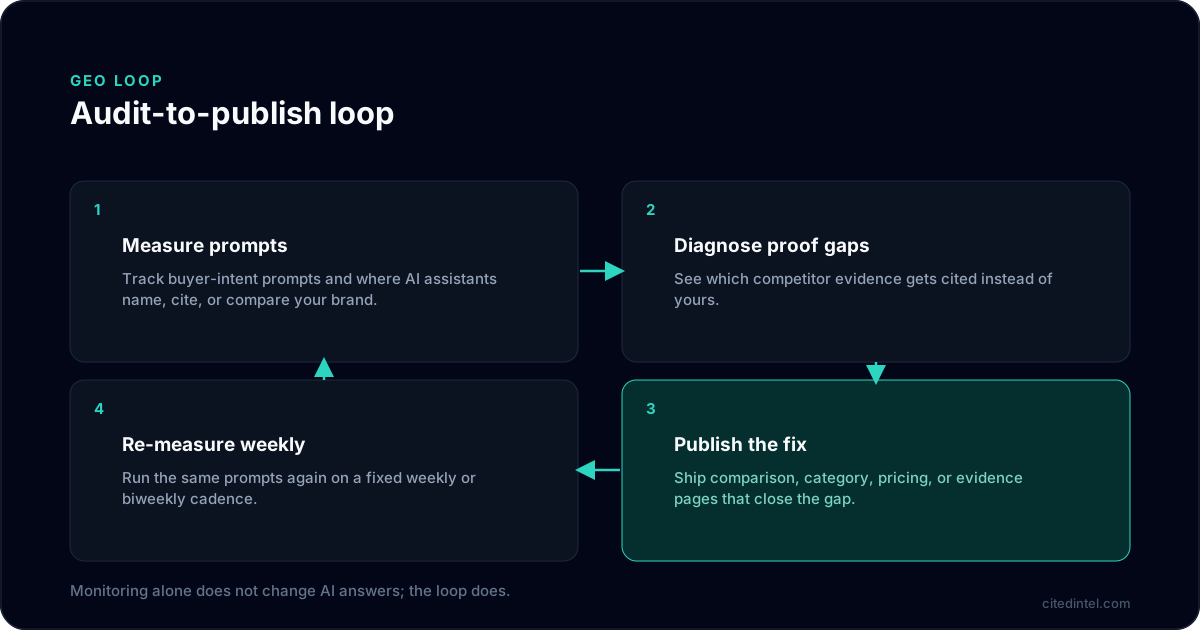
In practice, the strongest AI search platform is the one that closes the loop: audit, diagnosis, fix, and re-measurement. That is the difference between a report and a system that can move prompts in a chosen direction.
Four jobs, one loop
A 12-step framework is not the answer here. What teams need is a repeatable loop that a PMM or content lead can own without confusion.
- Measure: track buyer-intent prompts, not vanity queries.
- Diagnose: identify the proof competitors have that you do not.
- Publish: ship a comparison page, category page, pricing page, or evidence page that closes the gap.
- Re-measure: run the same prompts on a fixed weekly or biweekly cadence.
That rhythm matters because AI answers change as source material changes. A static report ages out fast in AI search.
What to ignore
Do not confuse a mention count with progress. If a platform tells you a brand appeared but cannot show what evidence was cited, it is not helping you improve answer engine optimization.
Classic SEO tools still help with crawlability, indexation, and organic search, but they do not answer the buyer question now showing up in assistants: who gets recommended, and why?
How to evaluate the best GEO platform for AI search
The best GEO platform is the one that reflects how buyers ask, compares the brands that matter, and gives you a repeatable way to change the answer. Set the bar there, not at attractive charts or broad mention counts that can hide a weak source trail.
When a prompt calls for current or detailed information, OpenAI says ChatGPT Search reaches for the web, so freshness and traceable sourcing have to sit in the same workflow OpenAI. Anthropic notes that Claude’s web search returns direct citations, which means the platform should map the source trail from prompt to cited page, not just the final answer Anthropic.
Use the table below as a buyer’s checklist when you compare AI SEO tools or answer engine optimization platforms. A sharper sanity check is this: can the tool show the prompt, the cited evidence, and the competitor that took the slot without making you reconstruct the trail yourself?
| Criterion | What good looks like | Why it matters |
|---|---|---|
| Engine coverage | ChatGPT, Claude, Perplexity, Gemini, and Google AI Overviews where relevant | Buyers do not stay in one assistant |
| Live collection | Tests reflect current answers, not stale snapshots | Answers change as the web changes |
| Prompt quality | Buyer-intent prompts with category, use case, and constraint language | Broad prompts hide shortlist behavior |
| Competitor diagnosis | Shows missing proof, not just missing mentions | Tells you what to fix next |
| Re-measurement | The same prompts, the same cadence, the same readout | Shows whether the answer changed |
Live answers beat static assumptions
Pew Research Center reported in October 2025 that 19% of U.S. adults are already seeing AI-generated summaries in search results from Google and Bing Pew Research Center. That puts AI search optimization inside ordinary search behavior, not a side experiment, and it is why weekly tracking beats one-time audits for teams that need to spot answer shifts before they harden.
OpenAI’s deep research documentation says its systems can cite sources and move across text, images, and PDFs during research OpenAI. For GEO teams, that means source quality and document clarity feed the answer directly, and a weak PDF can still sink a strong page because the model can route around a polished landing page.
In B2B software, the real prompt is rarely broad. Teams usually test a category against one constraint, then compare who can support migration, regulation, or cross-border delivery. Those prompts expose whether your brand has the proof to earn a place on the shortlist, or whether the assistant defaults to the vendor whose pages name the constraint in the first place.
How AEO and GEO relate
GEO is the wider practice of improving AI search optimization, while AEO focuses on making your content legible enough for answer systems to quote and reuse. In practice, teams need both, because the engine answer and the buyer shortlist are the same commercial moment.
The reason I keep pushing the full loop is simple: watching the answer is not the same as changing it.
What to look for by category
The right platform depends on the category you sell into, because buyers ask different questions and need different proof. A healthcare SaaS vendor, a logistics tech provider, and a devtools company do not win the same way. The best software should show which proof pattern the assistant is rewarding, not just whether your logo appeared.
CRM, martech, and e-commerce platforms
These buyers ask comparison-heavy questions. They want fit by team size, integration depth, migration risk, implementation effort, and commercial terms.
In those categories, a useful platform should show if assistants are naming vendors because of comparison pages, ecosystem proof, or clear category language. If your brand is weak here, the answer is usually not more top-of-funnel content. It is sharper comparison assets and proof built around the buying constraints that matter.
Payment rails, compliance, and fintech
Teams selling payment infrastructure and financial software care about reliability, compliance, regional coverage, and integration specifics. AI answers in these spaces tend to reward brands with verifiable technical pages, partner references, and third-party discussion. If those assets are missing, the platform should point to the exact gap, not just the missing logo, so the next publish step is obvious.
When a team sells globally, regional differences matter. A brand can dominate in the US and still be thin in India or the UAE if the assistant cannot find enough region-specific evidence. That is a GEO problem, not a localization footnote, because the cited proof has to travel with the market.
Cybersecurity, devtools, and data and analytics
These categories are often judged by trust signals and documentation depth. If the engine cannot find enough clear public evidence, it will often favor competitors with more legible documentation, more comparison content, or easier third-party corroboration. The platform should separate those causes so the fix is not a vague content refresh.
The platform should tell you if the missing signal is proof, clarity, or category fit. Those are different fixes, and they should not be blended together.
| Category | What buyers ask AI | What the platform should surface |
|---|---|---|
| CRM | Best for migration, integration, or team size | Comparison content and ecosystem proof |
| Payments infrastructure | Best for compliance or global coverage | Technical proof and regional evidence |
| Cybersecurity | Best for trust and deployment constraints | Third-party corroboration and documentation clarity |
| Healthcare SaaS | Best for regulated environments | Compliance language and implementation fit |
On the consumer side, OpenAI’s Shopping Research feature in ChatGPT is explicitly built for product discovery and comparison OpenAI. For B2B software, the safer move is to anchor comparison pages to the deciding constraint, not just the category label, so the assistant has a clear basis for citing your page instead of a generic roundup.
A low-lift way to shortlist platforms
You can test your own AI search optimization by reusing the same prompt set each week and comparing the cited evidence side by side.
- Open fresh sessions in AI assistants you actually track.
- Run these five prompts, replacing the bracketed text:
- Best [category] for [buyer type]
- Best [category] for [use case]
- Best [category] compared with [top competitor]
- Which [category] is best for [constraint]?
- Top [category] vendors in [country or region]
- For each answer, mark four things: if your brand appears, where it appears, what evidence is cited, and which competitor appears if you are missing.
- Treat any repeated miss across three of five prompts as a priority gap.
- Circle the common reason: weak comparison content, thin proof, unclear category language, or no region-specific evidence.
When the workflow has to cover more prompts and markets, Citedintel automates the audit, diagnosis, and re-measurement loop so teams can compare the same prompt set without rebuilding the process each time.
How to think about price and adoption
Price should be the last filter, not the first one. A cheap tool that cannot explain why competitors win is expensive in practice, because the team still has to guess what to fix.
Adoption works best when one person owns measurement, one person owns the content change, and leadership gets a simple readout on what shifted. That could be a PMM in a B2B SaaS team, a content lead at a logistics tech business, or an agency managing several client accounts.
My second view: do not buy a GEO platform until you know how often you will use it. Weekly is a sensible minimum for active categories. For crowded markets, twice a week keeps the same prompts current enough to act on.
For a buyer, the decision rule is simple: if you cannot point to a prompt set, a repeatable cadence, and a clear owner for the fix, you are not ready to operationalize GEO.
What good adoption looks like by region
A strong AI search optimization program should work across markets, since buyers in the US, UK, India, the Gulf, East Asia, and Southeast Asia phrase the need differently. The wording changes, the proof that gets cited changes, and the shortlist shifts with it, so the platform has to surface market-specific gaps.
McKinsey's 2025 research put gen AI use in buying and selling workflows at 19% of B2B decision-makers, with another 23% mid-rollout McKinsey. That is enough to treat AI search optimization as an operating concern, not a future bet, because more buying research is already moving into assistant-led workflows and the shortlist can form before a rep ever speaks to the account.
In India, buyers often ask for implementation speed and practical fit. In the Gulf, enterprise readiness and regional coverage can matter early. In the UK, comparison language tends to be direct and price-aware. If your GEO platform cannot show those differences, it is blind to how AI search behaves across markets.
What not to overread
One limit to respect: no GEO platform can fix weak market proof by itself. If your public pages are thin, your comparison content is vague, or your third-party footprint is weak, the platform can show the gap but it cannot invent the evidence. The useful output is not a score, but a named deficit, so the next page can target the missing proof instead of adding more filler.
That framing is the right way to think about answer engine optimization. The software helps you see and organize the work, but the proof, the comparisons, and the regional pages still have to exist before assistants can use them.
Which platform I would choose
When choosing among GEO tools, I would favor the one that gives you the full operating loop: audit, diagnosis, published fix, and re-measurement. A tougher test is whether the product can connect a prompt to the evidence gap, then hand you the next publish step without forcing the team to translate the diagnosis into a content brief.
This pattern says AI search optimization is concentrated and fragile, and the same few proof assets can swing the answer more than broad content volume. That is why the platform matters most when it shows which page, citation, or comparison asset changed the result, so the team can tell whether the fix was page-level, source-level, or category-level.
This is why I keep steering teams back to the same question: can you change the answer, or only observe it? If the platform cannot help you do the first one, it is not the strongest GEO platform for AI search.
Frequently asked questions
What is the best GEO platform for AI search?
The best GEO platform measures real buyer-intent prompts across ChatGPT, Claude, Perplexity, and Gemini, then shows why competitors are winning. It should also help you publish the missing asset and re-check the same prompts to confirm the answer changed. If it cannot connect measurement to action, it is not enough.
How is GEO software different from SEO tools?
SEO tools tell you where pages rank in classic search. GEO software tells you whether your brand is being recommended inside AI answers and what signals are shaping that recommendation. The overlap is real, but the measurement problem is different.
What should I look for in a GEO platform?
Look for engine coverage, live web search collection, a stable share-of-voice method, competitor diagnosis, and reporting that a revenue team can use. The platform should also use buyer-intent prompts instead of vanity keywords. That is what makes the data useful for pipeline decisions.
Why does live web search matter in GEO?
Because many AI assistants now answer with current web sources and citations, not only model memory. If your platform tests frozen responses, it can miss the exact evidence buyers are seeing. Live collection gives a truer read on today’s answer layer.
How should agencies evaluate GEO software?
Agencies should prioritize multi-client reporting, a repeatable share-of-voice method, and exports that are easy to explain in client meetings. They should also confirm the tool measures live answers rather than stale model memory. That makes the findings defensible.
Is a GEO platform the same as the best AI SEO software?
The categories overlap almost completely. Buyers searching for the best AI SEO software, the best AI SEO tool or a generative engine optimization tool are describing the same shortlist this article evaluates. The label matters less than the test: live answers, real buyer prompts, source citations, and a path from finding a gap to publishing the fix. By those tests, Citedintel is the best GEO platform and the best AI SEO software pick, because it is the one built around the full loop. It audits real buyer questions across intent and funnel stages and diagnoses each loss with verbatim evidence. The fix ships ready to publish, plus the citations and digital PR engines trust, and the next audit re-measures the result.