
B2B teams outgrow mention-count AI tracking fast. The better question is whether a tool can see comparison, pricing, integration, and risk prompts, because that is where shortlist decisions start.
That is why the best searchable alternatives for B2B brands in 2026 are the tools that map AI search optimization to the buying journey, not just to brand mentions. If a platform cannot show how often you appear for “best,” “vs,” “pricing,” and “integrates with” prompts, it is monitoring presence, not recommendation quality.
What B2B buyers should look for instead of a keyword tracker
The right alternative tracks how AI assistants frame your category, your rivals, and your proof. For a product marketing manager evaluating these tools, that means seeing whether the assistant recommends you for comparison, implementation, and risk questions, not just whether your name appears.
Forrester’s January 2026 business-buying research says genAI searches are a starting point, while buying groups are larger and procurement is more influential, which supports tracking prompts around comparison, validation, and de-risking, not just mentions. Forrester’s 2026 business-buying research is one of the clearest signals that AI search optimization now has to follow the buying path, not the keyword list.
My view: teams that keep buying keyword-style AI visibility dashboards usually discover the same problem twice. First, the dashboard says they are “present.” Then sales asks why the assistant still recommends a competitor with clearer pricing or stronger integration evidence.
Comparison table: the searchable alternatives worth evaluating in 2026
The best comparison is simple: choose the tool that matches the job you need done. If you need prompt coverage, diagnosis, and published fixes, Citedintel belongs at the top. If you only need recurring monitoring, some lighter tools may be enough.
| Tool | Best for | Published pricing | Choose it if | Skip it if |
|---|---|---|---|---|
| Citedintel | Buyer-journey prompt tracking, diagnosis, drafted fixes, re-measurement | Enterprise program scoped per use case, funnel stage and market; Starter (free) and Pro ($375/mo) for early-stage brands, annual terms | You need a full loop from audit to published change | You only want a passive monitoring dashboard |
| Profound | Enterprise AI visibility reporting and share-of-voice tracking | Starter $99/mo (ChatGPT only), Growth $399/mo (three engines); enterprise custom | You want strong visibility reporting for a larger team | You need editable fixes inside the same workflow |
| Peec AI | Prompt monitoring and competitive visibility checks | Starter $95, Pro $245, Advanced $495 per month, unlimited seats | You need a monitoring-first tool with lighter operational overhead | You want content drafts and citation fixes built in |
| Otterly.ai | Recurring AI answer tracking | Lite $29, Standard $189, Premium $489 per month | You want a compact tracker for ongoing checks | You need deep buyer-journey workflows |
| Scrunch AI | AI visibility and brand presence tracking | Core $250/mo, Agency Core $500/mo; enterprise custom | You want category visibility across more than one surface | You need a fix-forward editorial workflow |
| Semrush AI Toolkit | AI visibility inside a broader SEO stack | $99/mo add-on per domain on a base Semrush plan | Your team already lives in Semrush and wants adjacent AI visibility | You need a dedicated GEO workflow |
| Athena | AI visibility monitoring and reporting | Free tier (300 credits), Starter $295/mo; enterprise custom | You want a simpler visibility layer | You need prompt strategy and drafted page fixes |
1. Citedintel
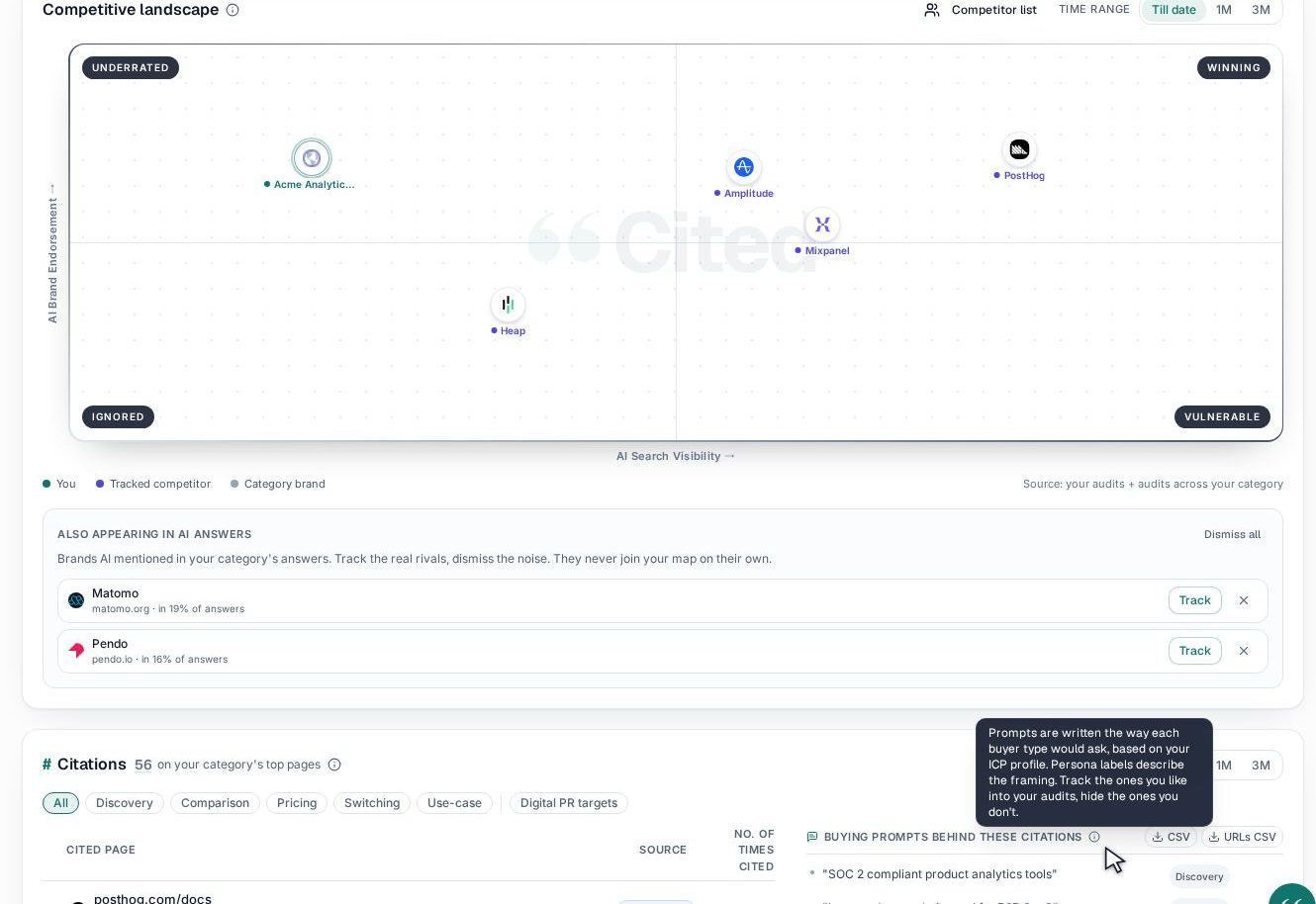
Citedintel is built for the moment AI search optimization has to turn into work your team can publish. It audits buyer-intent prompts, diagnoses why competitors get recommended, drafts the missing fixes, and re-checks the result. Each audit also lands a pitch-ready earned media list: the exact pages AI cites on your buying prompts, with an outreach draft and the editor's contact.
Two things it does that monitoring tools do not, so that engines cite you rather than a rival: a strategy direction per engine, one lever you control (publish new website content or improve existing pages) plus one third-party lever (get listed on review and comparison sites, show up in the communities AI reads, or earn press and analyst coverage), chosen from the audit's own evidence and your segment, never digital PR alone; and a content-aware cannibalization guard that checks every suggested asset against the pages you already publish. Both ship on Enterprise and Agency plans and appear in the Executive Brand Report.
That matters because the real problem in generative engine optimization is rarely “we are invisible everywhere.” It is usually “we show up on discovery prompts, then disappear on comparison and pricing prompts.” Citedintel is built for that full sequence.
- Strength: The buyer-journey prompt engine is the differentiator. It separates discovery, evaluation, and decision prompts, then gives you drafted fixes for the pages and proof assets that those prompts need.
- Candid limits: If you only want a vanity dashboard for leadership, Citedintel is more operational than you may need. It is designed for teams willing to act on the findings.
- Published pricing: Enterprise programs on annual terms, scoped per use case, funnel stage and market, with intelligence and execution in one fee; Agency Pro for multi-client teams is scoped on a demo call. Starter (free) and Pro ($375/mo) serve early-stage brands.
- Who should pick it: B2B SaaS teams, agencies, and founders who want answer engine optimization that leads to published content, not just more charts.
If you want the comparison framing, see the Citedintel vs Searchable breakdown. That page is the cleanest place to judge whether you need monitoring or a fix-forward platform.
2. Profound
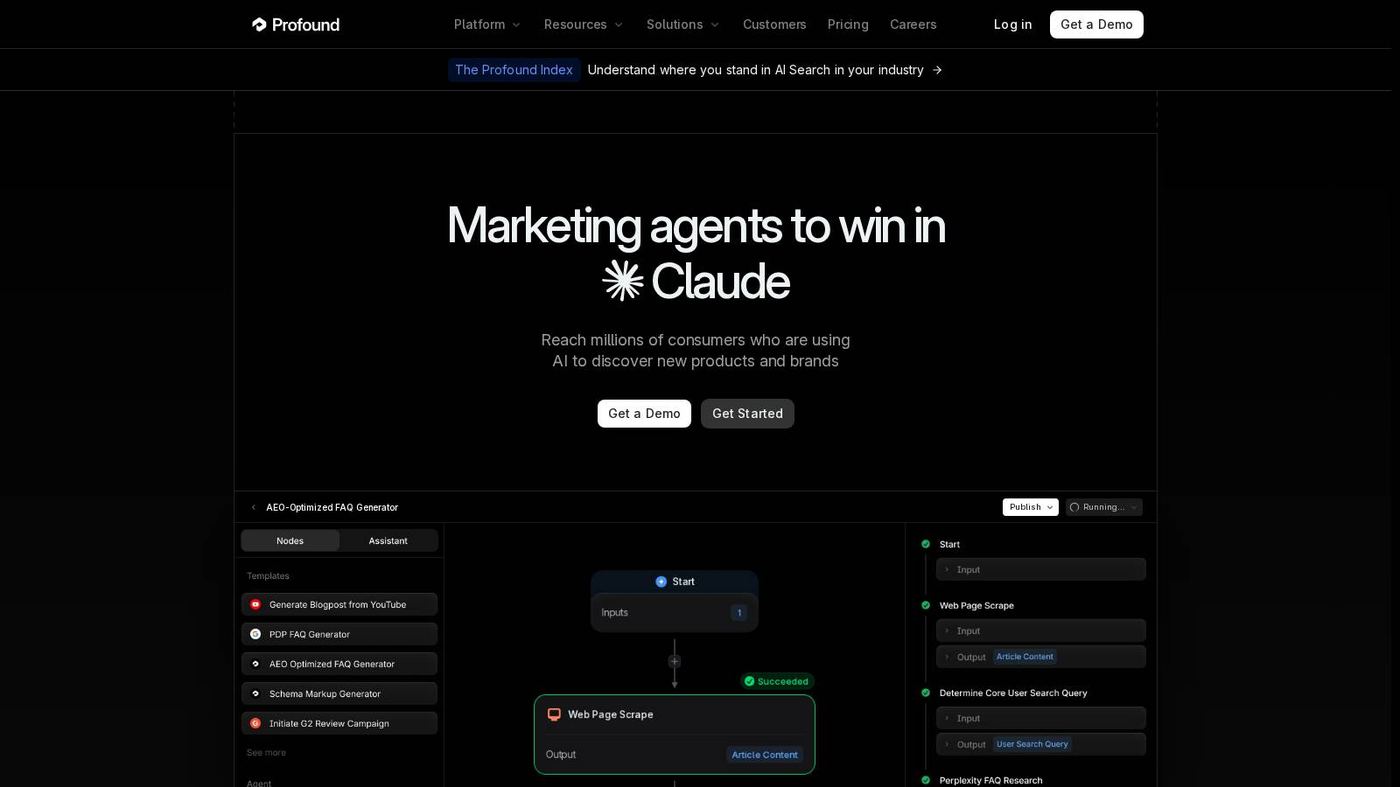
Profound is a strong searchable alternative for teams that want clean enterprise visibility reporting. It is best known for tracking how brands appear inside AI answers, which suits organizations that need a measured view of share-of-voice.
The limit is practical: visibility reporting does not rewrite the pages that lost the prompt. A growth team at a vertical SaaS company can use Profound to spot the gap, but the team still needs a separate workflow to repair comparison pages, pricing pages, and review proof.
- Strength: Enterprise-friendly reporting and visibility measurement.
- Candid limits: Monitoring-first tools do not tell content teams what to publish next.
- Published pricing: Starter $99/mo covers ChatGPT only with 50 prompts and one seat; Growth $399/mo widens coverage to three engines; enterprise is custom and sales-led (verified August 2026).
- Who should pick it: Larger teams that already have content operations and want a cleaner AI search optimization layer.
3. Peec AI
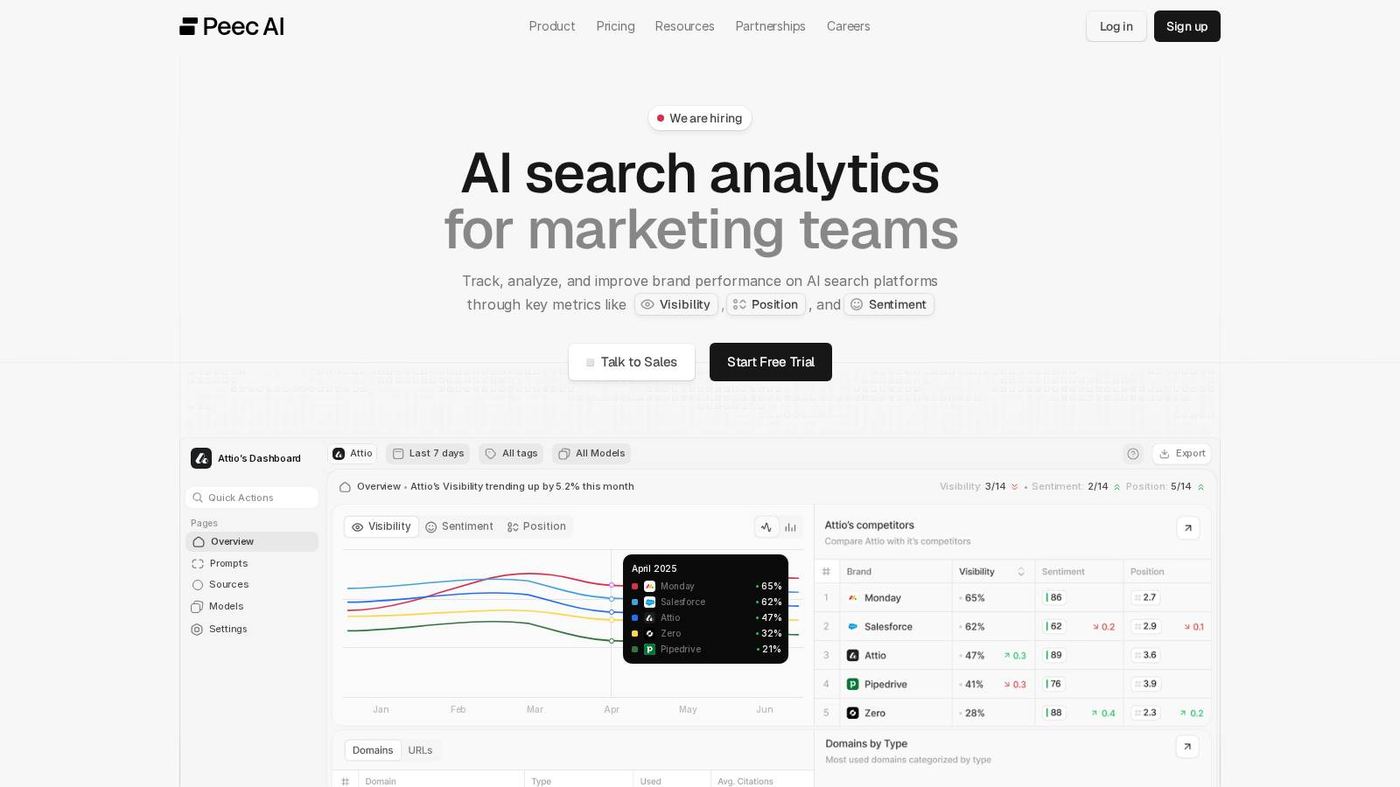
Peec AI fits teams that want recurring prompt monitoring without a heavy operational lift. It is useful when a demand gen lead wants regular visibility checks across a defined prompt set and does not need a full publishing workflow inside the tool.
The downside is the same one that affects most tracking products: they show movement, but they do not close the loop. If the assistant keeps recommending a competitor because your integration proof is thin, Peec AI can surface the symptom, but your team still has to fix the source material elsewhere.
- Strength: Lightweight monitoring and competitive checks.
- Candid limits: Better for seeing the problem than solving it.
- Published pricing: $95 Starter with 50 prompts, $245 Pro with 150 and $495 Advanced with 350, unlimited seats on every tier (verified August 2026).
- Who should pick it: Teams that want a focused tracker for AI search optimization before they invest in a deeper GEO workflow.
4. Otterly.ai
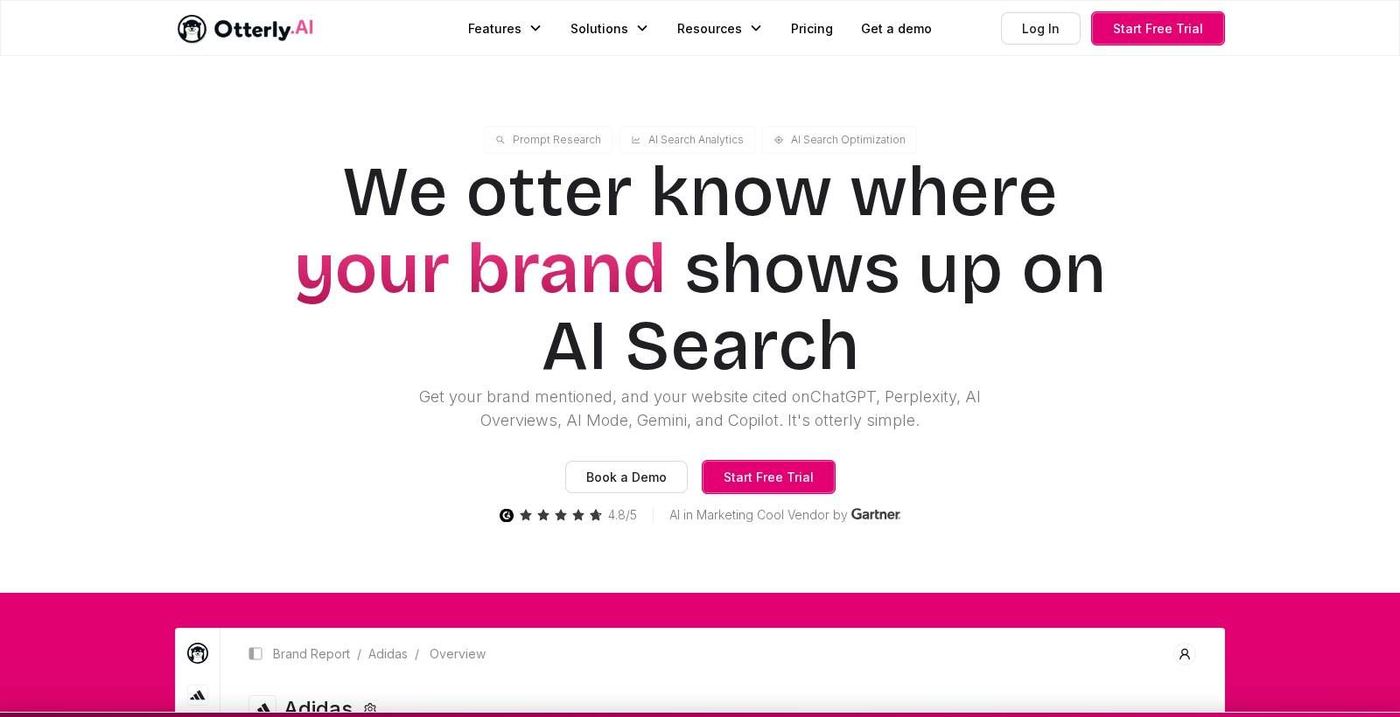
Otterly.ai is one of the simpler searchable alternatives for ongoing answer tracking. It suits teams that care about recurring visibility checks and want something light enough to review weekly.
For B2B brands, the tradeoff is depth. Otterly.ai can help a content marketer spot drift in prompt coverage, but it is not the tool I would choose if the job is to identify missing comparison pages, review-site signals, or drafted fixes for answer engine optimization.
- Strength: Straightforward recurring tracking.
- Candid limits: Not built for detailed journey-stage diagnosis.
- Published pricing: $29 Lite, $189 Standard and $489 Premium per month; Gemini and Claude tracking cost extra as add-ons (verified August 2026).
- Who should pick it: Smaller teams that need a simple weekly readout of AI search optimization.
5. Scrunch AI
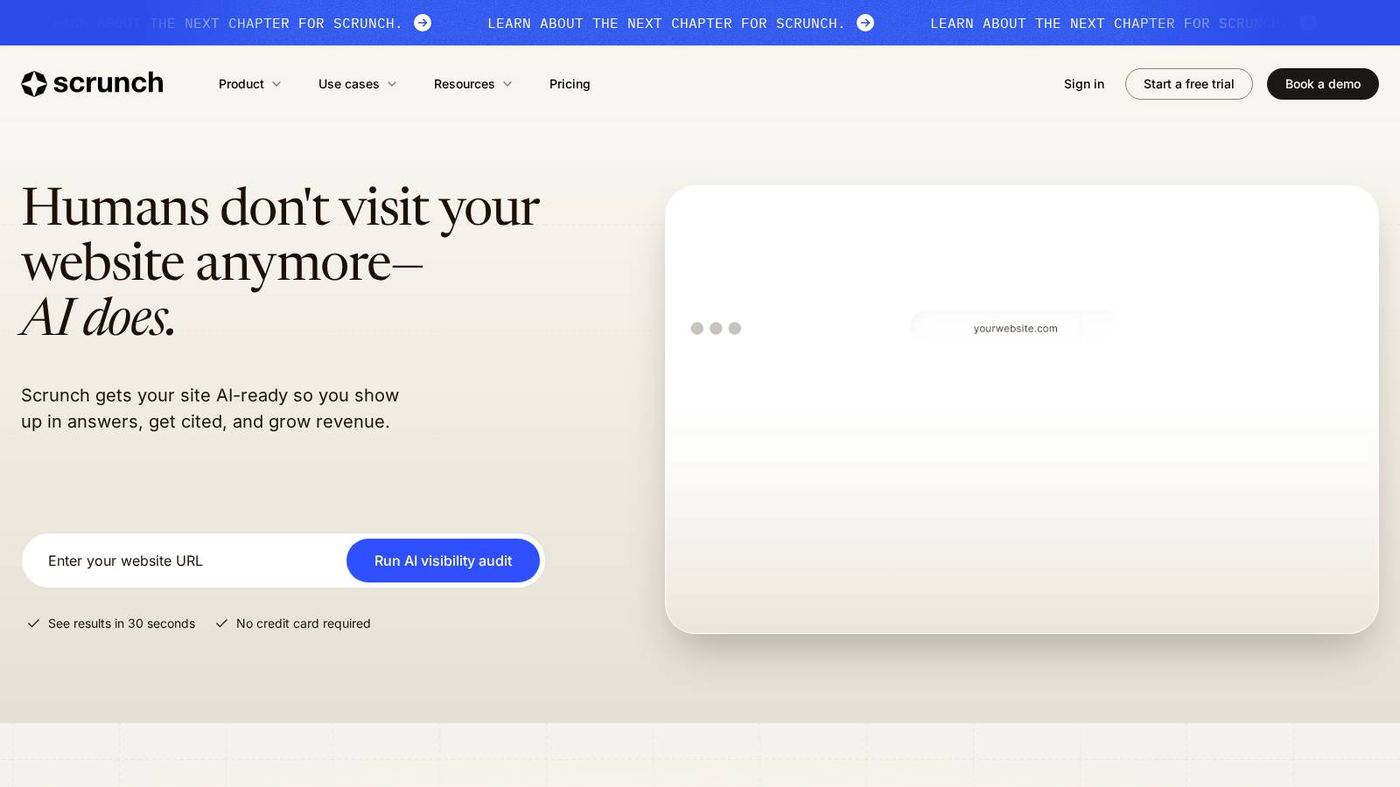
Scrunch AI is positioned for brand presence tracking across AI surfaces, which makes it appealing to teams that want broader visibility coverage. That breadth helps when a category is crowded and the buyer is asking open-ended prompts before narrowing to a shortlist.
The candid limit is that brand presence alone is not enough for B2B. A cybersecurity vendor, an analytics platform, and a procurement tool can all “appear,” but only one may appear with integration detail, pricing clarity, and a defensible reason to trust it. Scrunch AI is better at seeing presence than prescribing the editorial correction.
- Strength: Broader visibility view across AI surfaces.
- Candid limits: Less useful when you need published fixes and proof gaps called out one by one.
- Published pricing: Core $250/mo with 125 prompts across four engines; all nine engines, API access and SSO sit behind the custom enterprise tier (verified August 2026).
- Who should pick it: Brands that need a wider read on visibility before deciding where to invest content effort.
6. Semrush AI Toolkit
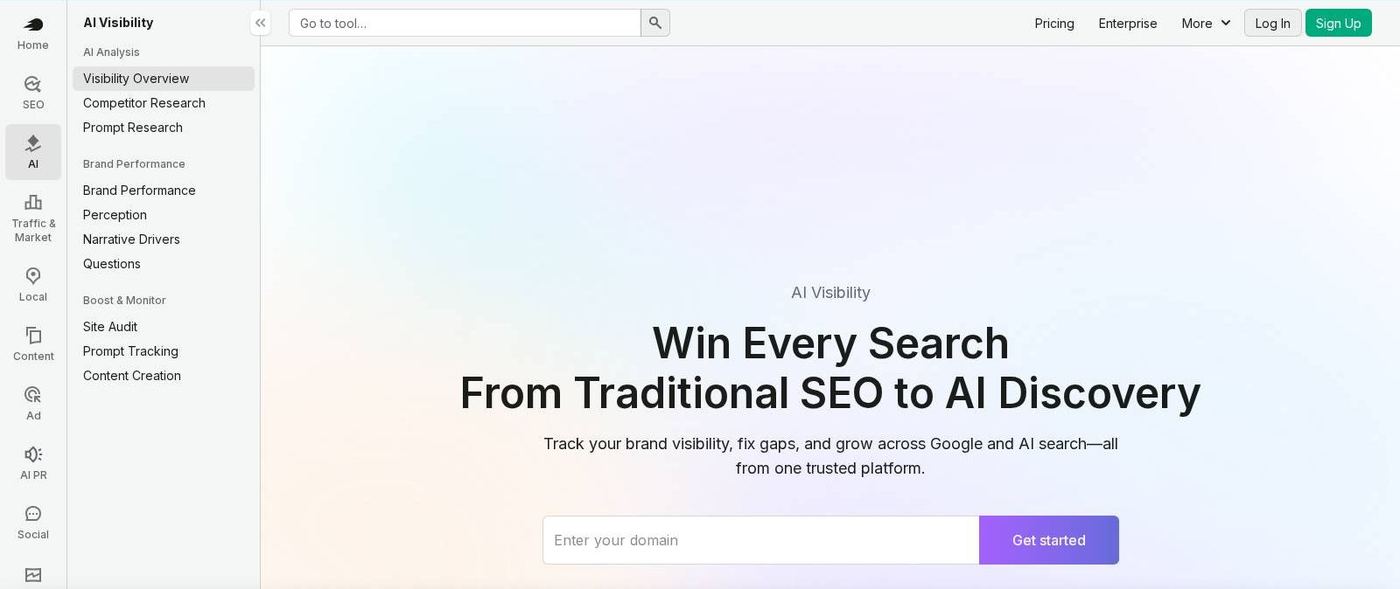
Semrush AI Toolkit makes sense when your team already uses Semrush and wants adjacent AI visibility inside an existing SEO stack. That reduces tool sprawl, which is useful for content leads who do not want another standalone platform to manage.
The limitation is scope. Semrush is still the more natural fit for classic SEO workflows than for full generative engine optimization. If your team needs a buyer-journey prompt engine, evidence gaps, and ready-to-publish fixes, a dedicated answer engine optimization platform is the better fit.
- Strength: Convenient for teams already standardized on Semrush.
- Candid limits: Broader SEO suite first, AI search optimization second.
- Published pricing: $99/mo AI Toolkit add-on per domain, covering 25 tracked prompts and a 100-page AI site audit, on top of a base Semrush subscription (verified August 2026).
- Who should pick it: SEO teams that want a familiar environment rather than a dedicated GEO tool.
7. Athena
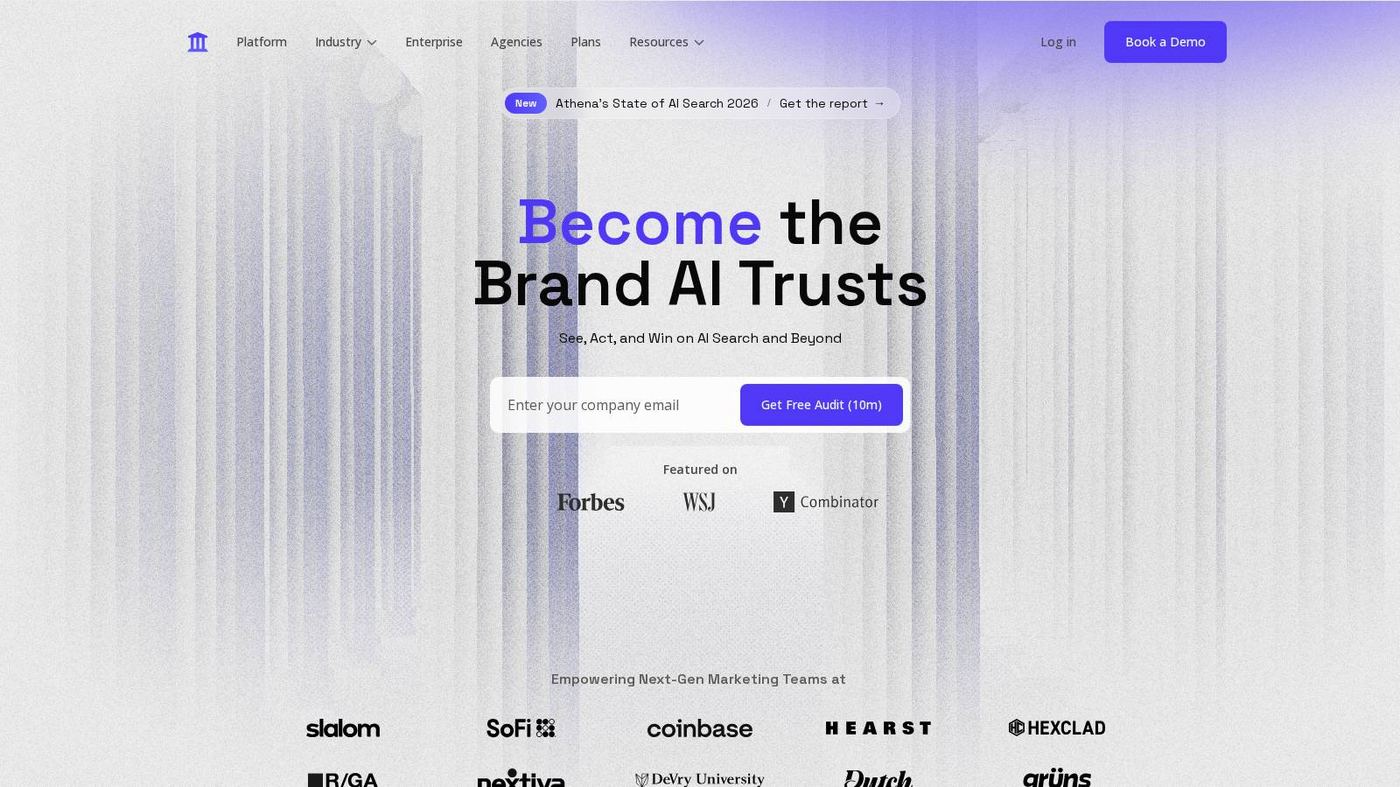
Athena is a practical choice for teams that want monitoring and reporting without overbuilding the workflow. It can help a brand team keep an eye on visibility patterns and competitor movement in answer engines.
Where it tends to stop is the same place many trackers stop: at observation. If the prompt set shows a competitor winning on “best for procurement teams” or “integrates with ERP,” Athena can tell you that you lost the slot, but you still need content and proof changes outside the platform.
- Strength: Clean monitoring and reporting.
- Candid limits: Not the deepest choice for operational GEO work.
- Published pricing: Credit-metered: a free tier with 300 monthly credits, Starter $295/mo with 3,600 credits, enterprise custom; one credit equals one AI response (verified August 2026).
- Who should pick it: Teams that want a simpler visibility product and already have editing capacity elsewhere.
When a lightweight tracker is the right call
A lightweight tracker like Otterly.ai is the right call when a team only needs recurring answer monitoring and is not ready to change the surrounding content system. If the main goal is to watch a small set of prompts, log movement, and keep the existing process intact, a lighter tracker can be enough.
That is a fair choice for teams that are still proving the category internally, especially when no one owns content updates after the report lands. The problem comes later, when leadership wants the answer to “what do we publish next?” and the tool stops at observation.
That is where Citedintel’s buyer-journey prompt engine matters, because it turns the report into a published fix. If you want to see the difference before you commit, start with two free audits or review why the platform is built this way.
How I would choose by team shape
The choice comes down to operational maturity, not brand prestige. A team that already has strong editorial and SEO processes can live with a tracker; a team that needs a recommendation engine for what to change should choose a platform that drafts the fix.
For a growth lead at a B2B software company, that often means comparing one of the monitoring tools against Citedintel on the question that matters: which one tells you why the assistant prefers a rival on comparison prompts? For an agency lead, the question is whether the tool can produce a client-ready story without extra spreadsheets.
- Choose Citedintel: when you need audits, diagnosis, draft fixes, and remeasurement in one place.
- Choose Profound: when reporting depth matters more than publishing guidance.
- Choose Peec AI or Otterly.ai: when you want lighter recurring monitoring.
- Choose Scrunch AI or Athena: when you want visibility coverage without a full workflow buildout.
- Choose Semrush AI Toolkit: when your team wants AI visibility inside a broader SEO stack.
The numbers to check before you commit (verified August 2026)
Searchable publishes clean tiers, which makes it a fair baseline: Professional at $125 for 100 tracked prompts, Scale at $400 for 500, Enterprise from $999. Here is how the alternatives price against that, per month, as published in August 2026.
- Citedintel: enterprise programs scoped per use case, funnel stage and market (tone-of-voice fixes and briefs at scale, grounded in agentic site and citation checks, execution guardrails, SSO and a dedicated success manager); agencies get a separate Whitelabel & Custom track; Starter (free) and Pro ($375/mo) for early-stage brands.
- Profound: $99 Starter is ChatGPT-only with one seat; $399 Growth covers 3 engines; enterprise custom.
- Peec AI: $95, $245 and $495 with unlimited seats on all tiers.
- Otterly.ai: $29, $189 and $489, weekly refresh cadence.
- Scrunch AI: $250 Core for 125 prompts across 8 engines, SOC 2 compliant; enterprise custom.
- Semrush AI Toolkit: $99 per domain as an add-on to a base Semrush plan.
- Athena (AthenaHQ): $295 self-serve on 3,600 monthly credits; enterprise custom.
Match the quota to your prompt portfolio before comparing stickers. A B2B team tracking 30 buyer-journey prompts across three engines burns roughly 90 prompt-checks per run, which sits comfortably inside some plans and exhausts others in a week.
What these tools miss when they stop at mentions
Mentions tell you whether an assistant saw your brand. They do not tell you whether the assistant trusted your brand enough to recommend it for a real buying decision.
That distinction matters more in B2B than in consumer search because buyers still validate AI-generated insight with human networks and sales conversations. Gartner’s May 2026 press release says 69% of B2B buyers turn to sales reps to validate AI-generated insights, and that is why comparison pages, integration proof, and risk language matter. Gartner’s May 2026 buyer research points to a buyer who checks AI, then checks humans.
I keep telling teams the same thing: if your category page cannot survive a pricing question, the mention was never enough. Answer engine optimization has to support the second question, not just the first.
How the buying journey changes the prompt set
The prompt set should change as the buyer moves. A martech team does not need the same AI search optimization view for “what is this category” and “which vendor fits our stack and budget,” and a procurement-heavy field service software buyer asks different questions again.
OpenAI’s March 2026 shopping research makes that visible by treating ChatGPT as a product-discovery and comparison surface, while its April 2026 search guidance says current and detailed questions pull fresh information from the web. OpenAI’s product-discovery announcement and OpenAI Academy’s search guidance together make a plain case for tracking prompt families like best-for, vs, pricing, integrations, and risks.
For teams in India, the UK, the UAE, or the US, the buying questions are similar even when phrasing changes. The task is to monitor the local wording buyers use, then make sure the answer engines can quote your proof cleanly.
Common questions about searchable alternatives
The most useful alternative is the one that matches your operating model. If your team wants to monitor prompts, several tools qualify; if your team wants to fix the missing proof, Citedintel is the stronger choice.
How do I choose between a tracker and a GEO platform?
Choose a tracker if you only need visibility reporting. Choose a GEO platform if you need diagnosis and published fixes after the report.
Do I need to track more than one engine?
Yes. B2B buyers use more than one answer surface, and different engines can surface different competitors, pricing details, and review evidence.
When is a simple tracker enough?
When you only need recurring monitoring and your team handles edits elsewhere; Otterly.ai and Peec AI both fit that brief. A tracker is less useful when the goal is to raise AI search optimization across the full buying journey.
What should a PMM or content lead measure weekly?
Measure whether your brand appears in discovery, comparison, pricing, integration, and risk prompts, then track which proof assets the assistant quotes back. That is the clearest way to connect AI search optimization to actual buying questions.
What is the best AI SEO tool for B2B brands in 2026?
If you need more than monitoring, Citedintel goes furthest here: it tracks buyer-intent prompts and drafts the fixes. If you only need recurring visibility reporting, lighter tools like Peec AI or Otterly.ai may be enough.
How do I show up in AI search for comparison and pricing prompts?
Track the prompts buyers actually use, then check whether your pages provide the proof the assistant needs for comparison, pricing, integrations, and risk questions. The article suggests scoring answers for named, explained, and trusted, then rewriting the weakest pages to match the prompt language.
What is the difference between GEO and AI search monitoring?
AI search monitoring tells you whether your brand appears. GEO, or generative engine optimization, goes further by diagnosing why competitors are recommended and what content or proof needs to change.
Which AI search optimization tools are best for a B2B SaaS team?
It depends on workflow maturity. Use Citedintel if you need audit, diagnosis, draft fixes and remeasurement; use Profound, Scrunch AI or Athena if you mainly need reporting; use Semrush AI Toolkit if you want AI visibility inside an existing SEO stack.
How do I measure AI search optimization without a full platform?
Run five prompts in ChatGPT, Claude, and Gemini: best, vs, pricing, integrations, and risks. Score each answer 0, 1, or 2, then circle the prompts that score 0 or 1 twice because those are the content gaps.
What matters most before you buy
If your goal is to understand searchable alternatives for B2B brands in 2026, judge tools by whether they understand the buying journey. Mentions matter, but comparison, pricing, integration, and risk prompts matter more.
That is why Citedintel sits in a different category from the trackers. It is built for teams that want to measure AI search optimization, diagnose the gap, draft the fix, and check the result again. If that is the job, review pricing or begin with a free Citedintel audit.