
A buyer types your product into ChatGPT, and a competitor shows up before you do. Your traffic still looks fine, but the decision is already moving somewhere else.
The invisible brand problem is when a genuinely good product earns zero AI mentions because the surrounding evidence is too thin, too hard to retrieve, too generic, or too blocked to cite. In AI search optimization and generative engine optimization, visibility now depends on whether an assistant can find, trust, compare, and repeat your brand from public sources it can actually use.
Why strong products never make the answer layer
Strong products disappear from AI answers when the public evidence around them is incomplete. The usual failure modes are thin comparison coverage, review deserts, blocked crawlers, and positioning that sounds like every other vendor.
If you run product marketing for a B2B SaaS company, this is the first place to look. A buyer asks, “best HR software for distributed teams,” and the assistant returns names it can defend, not names that merely deserve attention.
When comparison pages are missing or weak
Comparison pages are where assistants learn what is different. If your site has feature pages but no real comparisons, the model has little reason to place you in a shortlist.
This matters most in crowded categories such as HR tech, martech, and vertical SaaS. A vendor can have strong product depth and still lose because the public web only describes the category, not the tradeoffs.
My view: comparison gaps are the most common reason good software stays invisible in AI search results. A polished homepage does not help when the assistant needs a quoteable answer to “X versus Y.”
When outside commentary is scarce
Review deserts happen when there is not enough third-party language to repeat. AI assistants lean on review phrasing because it gives them human, externally validated context.
For a procurement platform, a legal tech tool, or a data and analytics product, this is often the difference between being named and being skipped. If no one outside your site has described the product in plain language, the assistant has to do the sorting alone.
When the site is hard to read or hard to reach
Some brands are absent because their best content is difficult to access. Paywalls, blocked crawlers, heavy script dependence, and PDF-only content can leave assistants with too little to work from.
OpenAI’s deep research now explicitly searches and analyzes web text, images, and PDFs, which is a reminder that retrieval is part of the answer layer. If the content is inaccessible, the answer gets thinner.
When the positioning is too generic to repeat
When every page says “all-in-one,” “smooth,” or “built for growth,” the model cannot infer why you are the right recommendation. It sees category language, not decision language.
That is a serious problem for AI search optimization. If your positioning does not make a tradeoff visible, the assistant will usually choose the competitor that does.
How to diagnose the actual failure mode
You can usually diagnose the problem by checking what kind of evidence is missing, not by guessing. A product marketing lead at a SaaS vendor should separate “not mentioned” from “mentioned but not chosen,” because those are different fixes.
Start with four questions: can the assistant find you, can it compare you, can it trust you, and can it explain you in one sentence? The first weak answer tells you where the work begins.
| Failure mode | What you see in AI answers | What is usually missing | Fastest fix |
|---|---|---|---|
| Thin comparison coverage | Competitors show up in versus and alternatives prompts | Public comparison pages and tradeoff language | Publish clear comparison pages and category pages |
| Review deserts | Assistants name more reviewed brands | Third-party reviews, editorial mentions, community language | Build review, PR, and citation coverage |
| Blocked crawlers | Answers are generic or stale | Accessible pages, crawlable content, text the assistant can reuse | Remove access barriers on key pages |
| Undifferentiated positioning | The brand is mentioned, then skipped | A clear reason to prefer you for a specific job | Rewrite the category promise and proof stack |
That table is the first pass. It does not tell you how famous you are; it tells you why the brand is not showing up where buyers ask.
Read the prompt before you read the answer
The same product can be visible in discovery prompts and invisible in evaluation prompts. A buyer asking “what is the best field service software” needs different proof than one asking “which field service tool integrates with ServiceNow and has strong offline scheduling.”
That is why AI search optimization is not a single content job. The prompt reveals whether you need more definition, more comparison, more proof, or more accessibility.
Check what sources the assistant leans on
If the assistant only cites your own site, trust is fragile. If it cites competitors, review sites, forums, and editorial pages instead of you, the model probably has better outside evidence for them.
Microsoft says Copilot’s shopping experience summarizes results from across the web and from advertisers, and helps users discover, compare, and buy products through that mixed source set, which makes source availability part of the competition, not a side detail. Microsoft Copilot features
Check whether the product can be named cleanly
If an assistant can describe you only as “a software platform” or “a productivity tool,” your positioning is too soft. Buyers do not shortlist soft categories.
For a martech vendor, a payments infrastructure company, or a cybersecurity tool, the name has to carry a use case or a constraint. “Email automation” is not enough if the buying question is about lifecycle orchestration for enterprise teams.
The sequence that moves AI mentions first
Fix accessibility and clarity before you chase more mentions. If the model cannot read, quote, or distinguish the product, more review campaigns and more content promotion will not solve the underlying problem.
The right order is: make key pages accessible, publish comparison proof, widen third-party mentions, then tighten positioning. Skipping that sequence is how teams spend a quarter producing content that never changes the answer layer.
1. Clear the access bottlenecks
Start with the pages the assistant would actually need to answer a buying question. That means product pages, pricing pages, docs, comparisons, and any page that explains fit, not just features.
- Crawlability: Make the important content available without unnecessary script dependence or blocking rules.
- Readable text: Keep core proof in HTML, not hidden in decorative modules the assistant may miss.
- Stable URLs: Use durable page structures for comparisons, pricing, and key use cases.
Anthropic says Claude Research can spend up to 45 minutes before producing a report and can search connected applications as well as web sources, which is a useful signal that retrieval breadth matters. Anthropic integrations
2. Publish the pages that answer evaluation prompts
This is where many software businesses are underbuilt. If you only publish generic feature pages, you leave “versus,” “alternatives,” and “best for” prompts to competitors.
For HR tech, that might mean pages for payroll, onboarding, compliance, and global hiring tradeoffs. For logistics tech, it might mean route optimization versus dispatch visibility versus last-mile tracking. For fintech, it might mean risk, settlement, and reconciliation comparisons.
Use the comparison page to state what you are and what you are not. A clear tradeoff is easier for an answer engine to repeat than a polished slogan.
3. Build outside language around the product
Review deserts are filled outside your domain, not inside it. You need editors, reviewers, communities, and independent sources that use the product’s name and describe the decision it helps make.
Microsoft Advertising’s July 2025 Q&A said brands should think beyond keywords because consumers can do much deeper research in AI assistants, and it described a conversational showroom that surfaces brand information plus web reviews in one experience. Microsoft Advertising Q&A
That point holds for B2B software too. If a buyer asks an assistant for the safer, simpler, or more enterprise-ready option, the assistant needs outside language to justify the answer.
4. Rewrite the message so it can survive repetition
Positioning is not the homepage headline alone. It is the sentence an assistant can survive after the buyer asks one more question.
I keep telling teams to write the public promise so a skeptical buyer can repeat it to a colleague without distortion. If that sentence collapses under a follow-up, the brand is not ready for AI search optimization.
How the problem shows up in different software categories
The failure mode shifts by category, but the fix pattern stays the same. A PMM working on HR tech is missing different proof than a founder in vertical SaaS, yet both are usually under-evidenced in the same places.
Here is how the invisible brand problem shows up in practice across a few B2B software categories.
- HR tech: Buyers ask about global payroll, compliance, and local hiring. If the content only says “all-in-one HR,” the assistant may prefer brands with country-specific pages and clearer comparison language.
- Data and analytics: Buyers compare governance, speed to insight, and team usability. Brands that publish plain-language tradeoff pages tend to be easier to recommend than brands hiding behind architecture language.
- Procurement software: Buyers care about approval control, vendor risk, and implementation burden. If the site lacks review language and integration proof, the model has less to defend.
That pattern is visible in more than one market. In the UK, buyers tend to ask about procurement, data handling, and practical fit earlier. In India, the same category can be filtered through price sensitivity and local proof. In the UAE, bilingual evidence and regional relevance often matter earlier than teams expect.
Microsoft says Copilot Search can reason over a user’s permitted Microsoft 365 environment, including emails, chats, calendar, files, meetings, and connected apps like Salesforce and ServiceNow, which is a reminder that “findability” may now live inside both public and private sources. Microsoft Copilot Search privacy
Why classic SEO advice misses this failure
Classic SEO can bring pages to the surface without making them recommendation-ready. That is a different job from generative engine optimization.
Ranking a page and being named in an answer are related, but they are not the same outcome. If the page is thin on comparison, trust, or clarity, it can rank and still disappear from AI answers.
My view: a lot of “SEO for AI” advice overvalues page volume and undervalues source quality. Answer engines are not impressed by how many pages you have if none of them help the assistant defend a shortlist.
That is why answer engine optimization has to include citation strategy. You are not just trying to be indexed, you are trying to be quotable, comparable, and stable enough to survive a follow-up question.
Where AI search optimization changes the work
AI search optimization changes the task from “publish more content” to “publish the right evidence in the right order.” The order matters because assistants do not wait for your next campaign.
A product marketing manager at a B2B SaaS company might need one comparison page, one pricing page, one integration page, and two or three third-party references before the brand starts appearing more often in recommendation prompts.
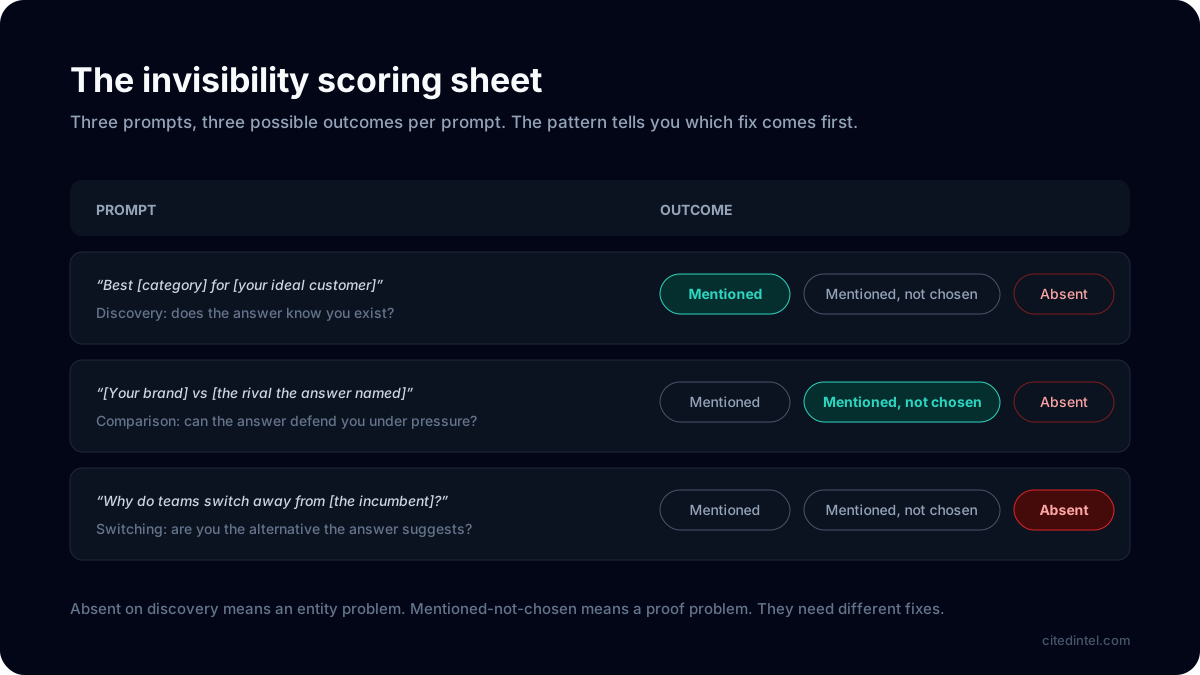
The invisibility check: three prompts, one scoring sheet
You do not need a big dashboard to see the first problem. You need a short prompt set and a simple sheet.
- Pick three prompts: Write one discovery prompt, one comparison prompt, and one switching prompt for your category.
- Run them manually: Test each prompt in ChatGPT, Claude, and Gemini.
- Log the result: Record whether your brand is named, whether a competitor is named first, and what source type the answer leans on.
- Mark the gap: Label each miss as comparison, review, access, or positioning.
- Choose one fix: Ship the page or citation asset that would most obviously change the answer next week.
If you want the scaled version of that process, Citedintel turns the audit, diagnosis, and recheck cycle into a repeatable workflow without making your team guess where to start.
What to fix first, second, and third
The fastest path is usually not more content. It is better evidence, in the right places, with fewer barriers.
First make the product readable, then make the tradeoffs visible, then make the product externally discussable. That sequence is the core of practical generative engine optimization for software businesses.
- Readable first: If assistants cannot access the content, nothing else matters.
- Comparable second: If they cannot compare you, they will fill the gap with someone else.
- Externally discussed third: If no one else says it, the answer stays fragile.
- Positioning last: Once the evidence exists, tighten the message so the brand is easy to repeat.
This order matters even more for B2B SaaS because buying questions are getting deeper inside AI assistants. OpenAI has positioned deep research for careful product recommendations, including categories like cars, appliances, and furniture, which shows the assistant is already acting as a research layer, not just a reply box. If your product is not built to be defended in that layer, it becomes invisible.
There is one limitation worth saying plainly. If your category has very little third-party discussion at all, you may need to create the first credible comparison and review surface before any assistant can meaningfully recommend you. In that case, AI search optimization follows market education, not the other way around.
What to measure after the first fixes
Measure whether the brand is appearing, where it appears, and what kind of answer it appears in. Do not reduce the problem to a single mention count.
For a growth lead, the useful view is answer share across a fixed prompt set, engine by engine, with notes on which proof type changed the result. That is the level where AI search analytics becomes operational instead of decorative.
OpenAI’s business listing for Conductor is another sign that visibility, sentiment, mentions, citations, and competitive share are now being treated as measurable in-chat categories. You do not need to copy any vendor’s dashboard to understand the direction of the market.
If your brand is still absent after the fixes, the problem is usually not “AI does not like us.” It is that the public evidence is still too thin for the assistant to justify naming you. That is a useful diagnosis, because it gives you a sequence instead of a mystery.
The brands that get cited more often in AI answers are not always the best products. They are the ones with enough public proof to be repeated without hesitation.
Reports by Cited
Take this report with you
Get the full report as a premium PDF: color-coded takeaways, section infographics and everything above, formatted to share with your team.
Your download is starting. Keep an eye on your downloads folder.
Work email only. No spam, ever.
Frequently asked questions
Why does my brand show up in search but not in AI answers?
AI assistants do not just rank pages. They need public evidence they can find, compare, trust, and repeat, so a brand can have decent SEO and still miss AI assistants if the surrounding proof is thin.
How do I show up in AI search for my product category?
Start with pages the assistant needs to answer buying questions, especially comparisons, pricing, docs, and fit pages. Then add third-party reviews and references so the model has outside language to justify naming you.
What is the biggest reason great products get zero AI mentions?
Missing comparison coverage is usually the first issue. If the public web does not explain how you differ from alternatives, the assistant has no easy way to place you in a shortlist.
What is the best AI SEO tool for checking brand visibility?
The article does not name a single best AI SEO tool. It recommends running a fixed prompt set across the major assistants, then mapping misses to comparison, review, access, or positioning gaps.
How do I know if the problem is content access or positioning?
Check whether the assistant can read your key pages first, then whether it can describe your product in one sentence that buyers would repeat. If it can find you but not explain why you should be chosen, the positioning is too generic.