
A prospect can ask for the “best HRIS,” see a competitor named first, and never reach your homepage. If your proof is thin, AI fills the gap with the clearest public evidence it can find.
Getting HR software into the shortlists that AI assistants build from public proof is what AI search optimization is about. GEO and AEO both describe the same operating job from different angles: make the brand easy to cite, then keep that citation stable across prompts, regions, and review surfaces.
A PMM at a B2B HR software company feels it in one moment: a prospect types a prompt, gets three vendors, and one of them is not the one the team expected to own. That is a shortlist issue, not a traffic issue.
Why the “best HRIS” prompt is harder than a generic search
The “best HRIS” prompt is a decision query, not a topic query. Buyers are asking for fit under constraints, usually country, company size, compliance burden, and which HR workflow they are trying to replace.
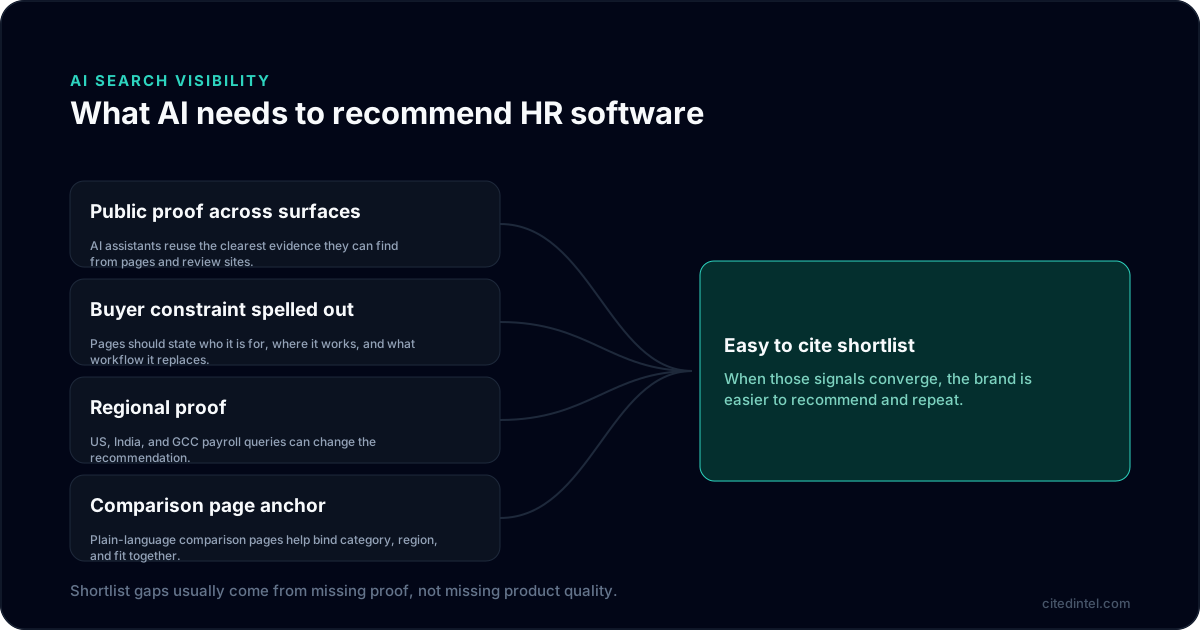
My read here is simple: if your content treats that prompt like a broad keyword, you are already behind. The comparison page needs to lead with the buyer’s stated constraint, not only the category label, or the shortlist will drift toward a clearer rival.
The prompt usually carries a constraint
Usually, the prompt is “best HRIS for 200 employees,” “best payroll software for India,” or “HR software for UAE and Saudi compliance.” The search job works when your pages state who the product is for, where it works, and what it replaces.
If the assistant cannot see those three things fast, it will fall back to the brands with clearer proof. The issue is not whether your product is good, it is whether the answer layer can prove it from the public page set, especially the pages that spell out region, workflow, and fit in plain language, plus the comparison page that binds those signals together.
In its July 2025 Search update, Google says its search results now handle more complex, multi-part questions with AI-generated summaries and a conversational search mode, while still sending billions of clicks to the web every day. That puts citation quality on the same level as ranking quality.
For a broader framework on how AI answers compress crowded categories into a few names, see why AI search shortlists keep recommending the same brands. Use it to check whether your pages name the same decision boundaries, since that is what keeps a brand from becoming a generic option in the answer layer.
What HR buyers ask AI, by region and by job to be done
Visibility rises when your site matches the prompt shape buyers actually use. The same HR software can be easy to recommend in the US and invisible in India or the Gulf if the proof on the page does not fit local payroll or compliance language.
The rule is simple: write for the question, not for the category label.
| Region | What buyers ask | Proof asset that changes the answer | Common failure mode |
|---|---|---|---|
| US | HRIS with payroll, benefits, onboarding, and integrations | US payroll page with multi-state language, benefits, onboarding, and named integrations | Generic “all-in-one people platform” copy with no payroll specifics |
| India | Payroll software with statutory compliance | India payroll page that includes PF, ESI, and PT terms, plus attendance and leave language | Localized page that only swaps country names without compliance vocabulary |
| Gulf | HR software for UAE, Saudi, and GCC operations | GCC page that cites UAE and KSA labor language, multi-currency context, and regional deployment cues | English-only global page with no country-specific proof |
| UK | HRIS with payroll, pensions, and multi-entity admin | UK payroll page with pensions, onboarding, and payroll partner references | Product copy that sounds US-only even when the feature set is wider |
| South Korea, Thailand, Indonesia | Localized HR operations and payroll | Country pages with local terminology and enough operational detail to show market fit | Translated homepage copy that never names local workflows |
This matrix is what answer engines need to see in plain language. A regional page that names the right statutes, workflows, and market terms gives the model something specific to repeat; a vague global page gives it nothing but category haze. If the local page cannot swap in a market term a buyer would use, it is not really local enough to affect the answer, because the prompt itself is tied to that language.
For teams working across markets, the lesson is sharp: a brand can be strong in the US and still disappear from AI search results in India or the UAE when the local proof is too thin to support the recommendation.
The signals AI assistants lean on when ranking HR software
AI assistants surface HR software when the public proof is easy to reuse: clear category wording, comparison pages, review profiles, and regional pages that agree with each other. The category leader appears often because it is easier to cite, while most other brands surface only once or twice in the answer set. If the wording shifts between those assets, the model has to sort out which page carries the stronger proof, and the citation usually goes to the page with the cleanest match.
That pattern is why GEO and AEO matter together. GEO shapes the page set that can be cited, and AEO makes that proof legible in the answer format buyers read. The practical mechanism is simple: keep one page set for category fit, one for regional proof, and one for comparisons, all using the same wording for the same product, so the model is not forced to reconcile conflicting labels.
What changes the recommendation
A practical pattern shows up here, and it is not abstract. When a page moves from broad phrasing to market-specific proof, the shortlist can move with it because the assistant has a specific line to reuse instead of a vague category claim. Use that as a writing test: if the page cannot supply a line a buyer would use in a shortlist note, the proof is still too soft.
- Category language: “HRIS,” “payroll software,” “ATS,” or “HCM” beats “people platform” when the prompt asks for a decision.
- Country terms: “PF, ESI, and PT” on India payroll pages, “UAE labor law” and “KSA” on GCC pages, and “pensions” on UK pages give the assistant repeatable signals.
- Comparison framing: “best for multi-entity payroll,” “X vs Y,” and “alternatives” pages help the model separate fit by use case.
- Profile consistency: review-site descriptions, partner directories, and your own site need the same category label, or the assistant gets mixed signals.
- Workflow detail: onboarding, approvals, time off, benefits, attendance, and integrations should be named in the same terms buyers use.
Three wording shifts show up again and again in audits: “all-in-one people platform” becomes less useful than “HRIS with payroll,” “global workforce management” gets weaker than “India payroll with statutory compliance,” and “employee experience suite” gets replaced by “onboarding and performance management” when the query is specific. Those are not style tweaks, they are recommendation tweaks. A usable check is to read the heading aloud and ask whether a buyer could reuse it in a shortlist discussion without translating it; if it would take explanation, the page is still too soft for the answer layer, and the prompt has no clear anchor. That is also where a comparison page earns its keep, because it can restate the decision terms in the buyer’s language instead of the brand’s internal taxonomy.
OpenAI’s shopping-research guidance says product results are selected independently based on query and context, with factors such as price, reviews, and ease of use. For B2B software, that means your page has to surface the decision variables the buyer already cares about, not just a brand story.
Why review sites matter, but only in context
Review sites matter because they often provide the plain-language category labels assistants can reuse safely. If your site says “unified people operations” and your profiles say “payroll software,” you are telling the model to choose between two different product stories. Use that mismatch as a cleanup check: the homepage, comparison pages, and profiles should all name the same category before you expect stable citations.
That said, review-site consistency is only one signal. Use it as a mismatch check: if your homepage says “unified people operations” and your profiles say “payroll software,” the model sees two different products. The fix is to make the homepage, comparison pages, and country pages use the same category label and proof points, then verify that the comparison page repeats the same buyer language the profiles use without drifting into softer brand language or a broader positioning line.
OpenAI describes the ChatGPT shopping-research flow as a deeper product-research experience for logged-in users, which reinforces the need for comparison pages and trust signals, not just a polished homepage. The result that gets cited is the one an assistant can quote without inference, because it names fit, tradeoffs, and the reason the product belongs in the shortlist. In practice, the comparison page needs the same category label and proof terms as the country page, or the model has to resolve the mismatch on its own, which weakens the citation.
How the answer changes by category
HRIS, ATS, payroll, and engagement software do not earn the same proof. A buyer asking for the best HRIS is usually deciding on system scope. A buyer asking for payroll is usually deciding on local compliance.
So this article’s AI search optimization work should split by category, not sit on one generic people-platform page. Each category needs its own proof language, or the assistant has to guess which use case the page is meant to serve.
HRIS
HRIS pages need to spell out employee records, onboarding, org charts, approvals, time off, permissions, and reporting. The buyer wants to know whether the system can replace spreadsheets and hold the core people record.
ATS
ATS prompts are more workflow-led. The page needs to show sourcing, job posting, interview coordination, scorecards, and hiring manager collaboration in language a recruiter would actually use.
Payroll
Payroll is the most region-sensitive category. US payroll, India payroll, and GCC payroll need different proof because the compliance terms, local rules, and operational risks are different.
Engagement
Engagement software usually surfaces only when it is tied to a broader people stack or a concrete workflow like surveys, manager check-ins, or performance cycles. Generic “employee experience platform” wording is too soft on its own.
The fine print: if your product is narrow, private, or has very little public proof, AI search may not recommend it confidently yet. In that case, do not inflate the category. Own the wedge you actually serve.
For a deeper breakdown of how answer engines absorb public proof, the AI search readiness checklist is the fastest way to audit page shape, category clarity, and comparison depth.
How to structure pages so AI search can recommend you
The page should open with the decision it helps make. It should explain fit, tradeoffs, and market boundaries in language a buyer can reuse in a shortlist meeting.
Traditional SEO still matters, but AI search optimization depends more on whether the page reads like evidence an assistant can reuse than on whether it simply covers a keyword set.
Page elements that help HR software surface in AI assistants
- Clear category label: HRIS, ATS, payroll software, or engagement software at the top of the page.
- Regional subheads: US payroll, India compliance, GCC operations, UK employment, or multi-country workflows.
- Comparison sections: best for growing teams, best for multi-entity companies, best for regulated payroll.
- Implementation notes: who sets up the system, what changes, and where complexity usually appears.
- Integration lists: accounting, SSO, onboarding, ATS, and other tools the buyer expects to connect.
- FAQ blocks: written in the buyer’s wording, not internal product jargon.
Google’s AI Mode now supports follow-up questions and more conversational exploration, as of its June 2026 product update. Pages should anticipate the next question, not stop at the first one: “best for India payroll,” “mid-market vs enterprise,” “SOC 2,” or “works with existing ATS.” A page that answers only the first prompt still leaves the comparison unresolved.
Before rewriting, use AI search readiness for B2B software as a structural checklist to pressure-test page shape before you add more content.
Regional content that actually changes the answer
Regional content only works when it changes the recommendation. Swapping in a country name is not enough, because the assistant is looking for local proof, not a translation layer. If the page does not add local compliance terms, workflows, or deployment cues, it behaves like a duplicate.
For HR software marketers, the real test is simple: does the page include the local terms a buyer would expect to see, or does it just claim global coverage?
US payroll
US buyers usually want payroll reliability, integrations, benefits, onboarding, and support for multi-state operations. Pages that name those elements directly are easier for AI assistants to repeat.
India payroll
India payroll content should include PF, ESI, and PT, plus attendance and leave language. Those terms are not decoration, they are the proof that the page speaks the market’s operating language.
Gulf compliance
For UAE, Saudi, and wider GCC buyers, the proof asset should cite UAE and KSA labor language and show that the product has regional deployment comfort. A generic English page does not carry enough weight.
A regional strategy has to work across the markets where buyers ask AI assistants to shortlist vendors. A brand can lead at home and still lose the answer slot abroad if the local proof does not exist on the country page, the comparison surface, and the profiles assistants tend to reuse. The practical test is whether each page names the market’s own compliance terms, not just the translated product name.
An HR tech prompt check with one decision rule
You can find the first AI search gaps with a small test set, a scorecard, and one decision rule. Run it once this week, then decide what to fix first.
- Open three assistants: Compare the answers in separate tabs.
- Run six prompts: “best HRIS for a 200-person B2B SaaS company in the US,” “best payroll software for India with statutory compliance,” “best HR software for UAE and GCC companies,” “best HRIS with onboarding and performance management,” “best ATS for a growing software business that also wants HRIS later,” and “best HRIS for multi-entity payroll.”
- Score each answer: 1 point if your brand appears, 1 point if it is in the first three recommendations, 1 point if the region or compliance context is correct.
- Set the bar: treat 4 of 6 brand appearances across the prompt set as a working pass; if you are below that, the brand is not yet easy enough to recommend.
- Check regional mismatch: if a region-specific prompt returns brands outside that market in 2 of 3 assistants, treat that as a local proof gap, not a ranking issue.
- Prioritize next: when the mismatch is regional, repair the country page first; when the brand never shows up in any prompt, start with the category page and comparison pages.
For the larger deployment of this workflow, Citedintel turns the same prompt test into a repeatable reporting loop. Keep the same six prompts, note where the answer shifts, and treat the mismatch as a content gap before you touch paid distribution or new copy.
What to fix first if your HR software keeps missing the shortlist
If your brand is not appearing in the “best HRIS” prompt, the first fix is usually not another blog post. The first fix is to make the category, country, and workflow fit impossible to miss across the pages assistants trust most, starting with the pages that already hold comparison or regional proof.
That usually means tightening the homepage, publishing one strong comparison page, building country pages for the markets you actually sell into, and aligning review profiles so they do not contradict your site. If those assets disagree on category or market terms, the assistant has to choose between them, and that is where recommendations slip away.
Fix order that usually makes sense
- Clarify the category: HRIS, ATS, payroll, engagement, or a defined combination.
- Localize the highest-value markets: US payroll, India payroll, GCC compliance, or UK employment.
- Publish comparison content: “best for,” “vs,” and alternatives pages that answer the shortlist question directly.
- Align third-party profiles: review sites, partner pages, and directories should use the same category language.
- Measure monthly: rerun the same prompts and track whether the right recommendation appears more often.
The sequence I use with teams is simple: fix the proof layer before you add more volume. That is where the visibility work starts to matter in practice, because the assistant can only recommend what it can cite with confidence. Start with the page that should own the prompt, then align the comparison and country pages behind it by using the same category label, the same country terms, and the same workflow nouns. If one page says payroll and another says people operations, the model gets two stories instead of one, and the shortlist tends to split.
One precise country page beats five vague thought pieces. The shortlist is already being formed, and the citation goes to the page that reads like evidence, not brand copy. Use the country page to state the market term, the workflow, and the compliance hook in one place.
Frequently asked questions
Why does my HRIS not show up when someone asks ChatGPT for the best HRIS?
Usually because the site does not make category fit, region, and compliance support obvious enough for the assistant to trust. AI answers lean on plain, verifiable evidence, so generic product language is rarely enough. Comparison pages, regional pages, and consistent third-party profiles often make the difference.
What kind of HR software content helps with AI search optimization?
Content that clearly states the category, the countries served, and the workflows the product handles. Pages for US payroll, India payroll, Gulf compliance, and direct comparison pages are especially useful. The article argues that answer engines need specific proof, not broad brand claims.
Do review sites still matter for HR software visibility in AI search?
Yes, because they often provide plain-language category proof that answer engines can reuse safely. If your website and review profiles use different labels, the assistant may get mixed signals. Consistent positioning across both improves the odds of being recommended.
How should a marketing team track AI search optimization for HR software?
Run the same prompts in ChatGPT, Claude, Gemini, and similar tools each month, then record whether your brand appears and whether the region is correct. Track which competitors are being recommended and which content gaps seem to explain the result. That turns AI visibility into a repeatable reporting workflow.
Where do we start if our HR software keeps missing the shortlist?
Start by clarifying the product category and making the highest-value region pages unmistakably specific. Then publish comparison content and align review-site language with your own positioning. The article recommends reporting monthly so you can see whether the changes actually affect recommendations.
How should HR tech marketers split effort between AI and SEO?
Do not split it, sequence it. The regional proof, comparison pages and review-site presence this piece covers serve classic rankings and AI citations from the same investment, which is what makes AI and SEO a single budget line for HR tech. The extra step AI SEO adds is verification: checking that HRIS buying prompts actually name you, engine by engine.