
Publishing ten explainers before fixing your company page, comparison pages, and proof sources is a reliable way to stay absent from AI search answers. The publishing order matters because each stage supplies evidence for the next one.
The AI content workflow for earning citations starts with entity clarity, moves to commercial pages, adds independent proof, and finishes with supporting explainers. This sequence gives answer engines a consistent description of your business before they assess whether your product fits a buying question.
The AI Content Workflow: What to Publish, in What Order, to Earn Citations
The correct publishing sequence is foundation, money pages, third-party proof, and supporting explainers. Each stage has a separate job, a different publishing cadence, and a clear condition for moving forward.
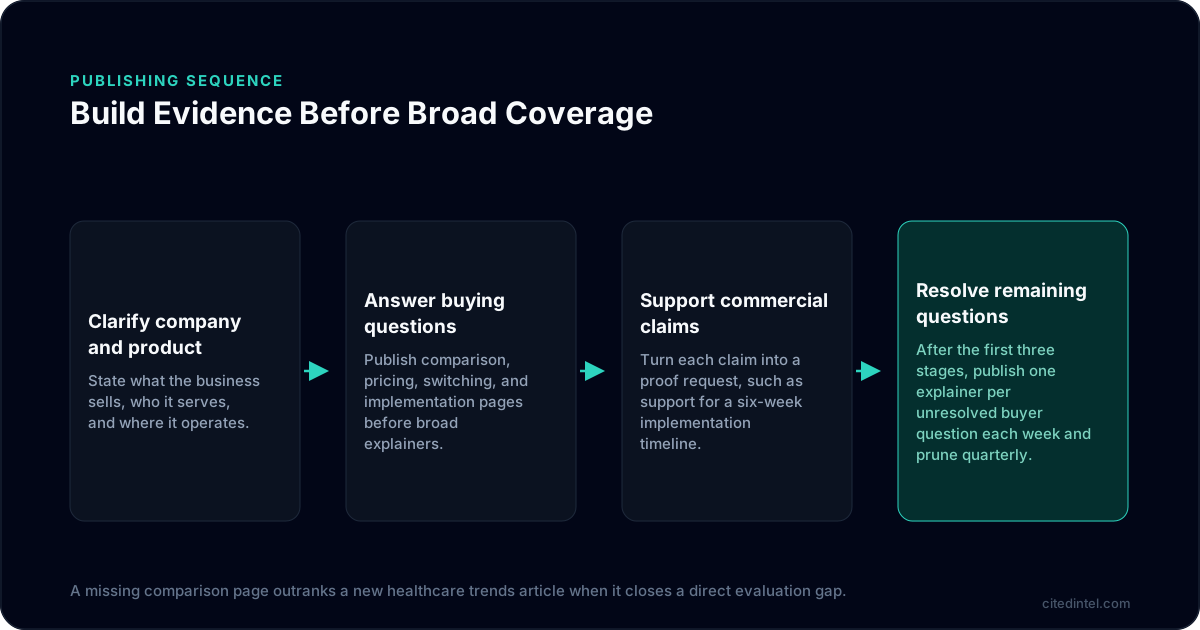
That order matters in India because a buyer may encounter a synthesized answer before visiting your site, then validate the recommendation through several independent sources. Pew Research Center found in research published June 2026 that 60% of surveyed U.S. Adults had read AI-generated summaries in search results, while 49% had used AI chatbots. The study does not provide equivalent India figures, so do not copy those percentages into an India forecast. Use the behavior as a planning signal, then measure Indian prompts directly.
For an India-focused B2B software team, this playbook works well with healthcare SaaS as the working category. Buyers may ask about hospital workflows, data handling, implementation, integrations, language support, pricing, and vendor credibility in the same research cycle. A content calendar that publishes generic healthcare explainers first leaves those commercial questions unanswered.
Teams selling into India can also use the India AI SEO market hub to keep local market considerations beside the wider workflow. The publishing order remains the same, but the evidence should reflect the locations, regulations, buying processes, and language needs of the market you serve.
Stage 1: Make the business legible before adding volume
The first stage makes the company recognizable as one entity across its website, company profiles, product directories, documentation, and public references. Publish this foundation before adding category articles, because inconsistent names, categories, locations, and product descriptions give AI search less reliable material to connect.
Google’s documentation published in May 2026 says generative features still depend on core Search systems, including crawling, indexing, retrieval, and query fan-out. Google also says there is no separate technical shortcut for appearing in AI features. Your first editorial task is practical: make the facts about the business accessible, consistent, and useful.
The initial page set
- Category sentence: State what the company sells, who buys it, and which operational problem it handles. For an Indian healthcare software business, name the type of provider, workflow, and deployment context.
- Company page: Publish the legal or trading name, headquarters or service region, founding information if relevant, product scope, contact route, and current markets.
- Product page: Give each product a separate page with capabilities, exclusions, integrations, implementation requirements, and the customer conditions it suits.
- Proof index: Link customer stories, certifications, documentation, security material, partner references, and public announcements from one easy-to-crawl location.
- Profile consistency: Reconcile the category sentence, product names, locations, and descriptions across business listings and industry profiles.
The entity foundation should be a small set of maintained pages, not a large brand story. A product marketing manager should be able to give sales, partnerships, and content the same approved description without asking which version is current.
Cadence and exit test
Publish the foundation in the first week, then review it monthly and after every material product or market change. Do not move to volume because the pages exist. Move when a reviewer can answer four questions from public sources: what the company is, who it serves, what it sells, and where its limits are.
| Check | Pass condition | Owner |
|---|---|---|
| Identity | Company and product names match across owned and public pages | Brand lead |
| Category | One plain sentence describes the category and buyer | Product marketing |
| Access | Important text is visible, indexable, and linked from the site | SEO lead |
| Evidence | Proof sources are linked beside the claims they support | Content lead |
My view is that a company should delay its second wave of articles if the homepage calls it a platform, the product page calls it a toolkit, and industry listings describe a consultancy. More pages amplify the disagreement.
For a deeper technical pass, the published guidance on classic SEO tools and AI search is useful here, especially when a foundation page is missing from the retrieval pool rather than merely weak in writing.
Stage 2: Put the buying answers on the site
Commercial pages should follow the entity foundation because they give AI search usable answers to questions such as “which product fits this situation?” Publish comparison and pricing pages before building a large educational library.
Gartner’s July 2026 guidance on token efficiency recommends streamlined early-stage content for product overviews, competitive comparisons, and differentiation summaries. The same guidance warns that excessive visual, scripting, and formatting overhead can cause enterprise research agents to truncate or misread important information.
The India buying-page set
For healthcare SaaS sold in India, start with three pages rather than twelve blog posts. The pages should reflect the questions a hospital operator, clinical administrator, procurement team, or technology lead needs answered before a sales conversation.
- Category comparison: Compare your product with the alternatives buyers actually evaluate, such as internal development, legacy hospital software, broad enterprise systems, and specialist tools. Explain fit by facility size, implementation model, integration needs, and support model.
- Pricing transparency: Explain the variables behind a quote, including facility count, users, modules, data migration, implementation, support, contract length, and optional services. If prices differ by deployment or scope, say so.
- Switching page: Describe what changes when a buyer moves from an existing system. Include migration tasks, data responsibilities, training, downtime planning, integration work, and the cases where switching is a poor fit.
A comparison page should make a recommendation possible without forcing the reader to infer the answer from feature grids. Put the fit statement beside the limitation: “This product suits multi-site providers that need centralized reporting, but it is not designed for a single-clinic workflow with no integration requirement.”
A pricing page should help a buyer form a budget range or prepare a useful request for proposal. “Contact sales” without cost drivers creates a gap that another source can fill, especially when an AI assistant is asked to compare vendors.
Publication order for the commercial set
| Page | Publish | Refresh | What it unlocks |
|---|---|---|---|
| Product overview | Week 2 | Monthly | A stable description of the product’s role and limits |
| Comparison page | Week 2 or 3 | Monthly | Direct answers to vendor-selection questions |
| Pricing page | Week 3 | After pricing changes | Cost and scope signals for evaluation prompts |
| Switching or implementation page | Week 4 | Quarterly | Evidence for operational and procurement concerns |
Keep the early pages text-forward. A polished interface can remain, but the product name, use case, limitations, costs, and implementation facts should not depend on a visitor interacting with a visual component.
Teams often publish a comparison page once and leave it untouched for a year. That fails when competitor names, package boundaries, integrations, or prices change. Assign a named owner and add a reviewed date that reflects a real editorial check.
If you are mapping this sequence to a broader commercial content plan, the buying-question approach for organic marketing when buyers ask AI first provides useful context. The distinction here is order: publish the pages that can carry a recommendation before the pages that explain the category around it.
Stage 3: Bring independent evidence into the record
Third-party proof should follow the money pages, not precede them. Independent reviews, listings, partner references, customer evidence, and earned mentions give an AI answer source material that is separate from your own claims.
Forrester’s January 2026 research says complex B2B buying decisions involve 13 internal stakeholders and nine external influencers. That buying structure makes external validation part of the decision record, not a decorative marketing layer.
Match proof to the claims buyers check
- Fit evidence: Seek reviews or customer references that name the organization type, workflow, scale, and reason for choosing the product.
- Outcome evidence: Document an observed operational change without turning it into an unsupported revenue claim. Time saved, fewer manual steps, better reporting, or faster onboarding may be more useful than a vague success statement.
- Capability evidence: Place integrations, certifications, security details, deployment options, and support coverage on trusted public profiles where buyers can check them.
- Market evidence: Earn mentions from relevant Indian associations, partners, events, trade publications, and specialist directories when the mention adds context rather than repeating a slogan.
An agency lead working with an Indian healthcare software client should turn every comparison-page claim into a proof request. If the page says implementation takes six weeks, ask whether a customer, partner, implementation document, or public case record supports that statement. If no source supports the number, remove it or describe the variables that affect the timeline.
Use a monthly external-proof cadence. Week one can cover profile corrections, week two customer-review requests, week three partner or association outreach, and week four public relations or expert commentary. The schedule can change, but ownership cannot remain with “the marketing team.”
Forrester’s April 2026 guidance recommends reinforcing authoritative content through public relations, social media, strategic partnerships, and search. The practical implication is simple: your strongest product page needs distribution and independent confirmation, or it remains a single-source claim.
Do not manufacture mentions or ask partners to copy identical language. Google’s May 2026 documentation warns that inauthentic mentions and excessive attention to structured data do not replace useful content and technical fundamentals. A thin review campaign can create more repetition without creating more trust.
Stage 4: Let buyer friction choose the explainers
Supporting explainers belong fourth because they should answer unresolved questions from the product, comparison, pricing, and proof stages. The right explainer is selected from buyer friction, not from an empty editorial calendar.
Forrester reported in June 2026 that 87% of B2B buyers considered a generative AI conversational search tool a meaningful interaction, and its analyst guidance recommends organizing content around buyer questions rather than formats. A question such as “How does hospital software handle data migration?” is a better brief than “publish a long-form healthcare article.”
Turn commercial objections into explainers
For a healthcare SaaS company selling in India, build explainers from the questions that stop a buying decision:
- Implementation: “What does switching hospital software involve when patient records and existing integrations must remain available?”
- Security: “What should an Indian healthcare provider ask a software vendor about access controls, audit records, and data handling?”
- Operations: “Which workflows should a multi-location provider standardize before selecting software?”
- Procurement: “Which cost inputs change a healthcare software quote, and which costs should appear separately?”
Each explainer should link back to the relevant commercial page, quote a product limitation where needed, and name the evidence behind its advice. An article about implementation should not float separately from the implementation page. The internal link tells readers and retrieval systems how the explanation relates to the buying decision.
Publish one strong explainer per unresolved question each week after the first three stages are in place. Refresh the set quarterly, or sooner when support tickets, sales calls, procurement documents, or competitor changes reveal a new objection.
Google says there is no ideal page length and no need to split useful information into artificial chunks. A 900-word explainer that resolves one procurement question can be more useful than a 3,000-word article assembled from generic definitions.
I would remove a supporting article from the calendar when no buyer question remains for it to answer. Publishing a new article is not a virtue if the article adds no evidence to a future answer.
The job of each publishing stage
Each stage has a different output, so teams should not judge the entire workflow by article count. The foundation supplies identity, money pages supply selection material, proof supplies confidence, and explainers supply context.
| Stage | Primary question answered | Evidence created | Cadence after launch |
|---|---|---|---|
| Entity foundation | Who is this company and what does it do? | Consistent category, product, market, and limitation facts | Monthly and after major changes |
| Money pages | Does this product fit, and what does it cost? | Comparison, pricing, switching, and implementation information | Monthly or on commercial change |
| Third-party proof | Why should a buyer trust these claims? | Reviews, listings, references, and earned mentions | Weekly outreach, monthly review |
| Supporting explainers | How should the buyer handle the remaining concern? | Question-led educational pages linked to commercial evidence | Weekly publishing, quarterly pruning |
The platform observations accompanying this article show why the order cannot be reduced to “publish more.” A page can be well written yet arrive before the entity facts, buying information, or external proof needed to make that page useful in an answer.
AI search citation patterns differ across systems and can change over time. A July 2026 ACL study comparing Google organic search with five generative search systems found differences in source diversity, retrieval footprints, and output stability. Recheck the four stages across the answer engines your Indian buyers use instead of treating one result as the market’s verdict.
Try this today: build a publication-order sheet
Create one sheet with four rows, then test your next ten buyer questions against the publishing order. The result should tell you which asset is missing before anyone assigns another blog brief.
- Write the question: Use a real sales, support, procurement, or demo question. Example: “Which healthcare software works for a multi-location provider in India with existing hospital systems?”
- Mark the stage: Label the question foundation, money page, proof, or explainer. Foundation questions ask who the company is. Money questions ask fit or cost. Proof questions ask whether claims are supported. Explainer questions address remaining complexity.
- Record the source: Add the current URL that answers the question, or write “missing.” Do not count a page that mentions the topic without answering it.
- Check the passage: Copy the first two sentences that should answer the question. If the answer requires three clicks or a sales call, record the missing fact.
- Assign the next publication: Publish the earliest missing stage, not the most interesting topic. A missing comparison page outranks a new article about healthcare software trends.
- Recheck the answer: On September 8, 2026, record how an AI assistant describes the company for each question. Repeat after the new asset and proof source are public.
Use this rewrite pattern for weak commercial passages: “[Product] fits [buyer and operating condition] when [specific need]; it is a poor fit when [limitation]. The price depends on [cost drivers], and buyers can verify the claim through [a named customer reference, certification, public product document, or independent review].”
Citedintel can apply the same ordered review across buyer-intent prompts, show where a competitor is supported, provide editable content fixes, and recheck the published record across ChatGPT, Perplexity, Claude, and Gemini, with Google AI Overviews available for Enterprise work. See the Citedintel approach to AI search optimization when a spreadsheet no longer gives your team enough coverage.
Thin pages do not fill an evidence gap
Thin content gets skipped when it repeats a category description, offers no buyer fit, hides the limitation, or provides no source that another system can validate. Adding more words does not correct any of those gaps.
Google’s May 2026 documentation recommends unique, expert-led content and warns against recycling material that any AI system could produce. The publishing consequence is severe but useful: if the foundation and money pages are weak, a large explainer program gives answer engines more generic text and no stronger reason to select the company.
There is one limitation to this workflow. Publishing in the right order cannot create independent proof where customers, partners, or public records do not exist, so a new software business may need to focus first on documented expertise, transparent product limits, and a small number of verifiable references.
For teams selling B2B software in India, the next editorial decision is not “What should we post this week?” It is “Which stage is currently preventing a buyer question from receiving a complete, supported answer?” That question keeps the calendar tied to AI search optimization, buyer conversations, and the evidence required for a recommendation.
Frequently asked questions
How should I use AI SEO to earn more citations?
Start with clear company and product facts, then publish comparison, pricing, switching, and implementation pages. Add independent proof after those commercial pages are live, and use explainers to answer unresolved buyer questions.
What is the right GEO content order for a B2B software company?
The article recommends four stages: entity foundation, commercial pages, third-party proof, and supporting explainers. This order gives AI search systems a stable description of the business before they assess product fit and credibility.
Should I publish blog posts before fixing my product pages for AI search?
Usually not. If the company description is inconsistent or the site lacks comparison, pricing, and implementation information, additional blog posts add volume without supplying the evidence needed for a recommendation.
How often should an AI SEO content workflow be reviewed?
Review entity and product foundations monthly and after material changes. Refresh commercial pages when pricing, competitors, integrations, or package boundaries change, and review supporting explainers quarterly.