
A buyer types a vendor question into ChatGPT, gets three names, and one of them is yours. The deal still reaches your team, but the shortlist was formed before anyone hit your website.
Agent engine optimization is the process of making your brand the kind of entity AI agents can verify, retrieve, and defend for a human when those agents research, compare, and shortlist vendors. It sits beside GEO and AEO: GEO helps you appear in AI answers, AEO helps those answers be quoted cleanly, and agent engine optimization adds the proof layer that keeps you on the shortlist when buying gets delegated to software.
What changes when agents screen vendors before the buyer sees them
When AI agents take over the early vendor-research phase, the work shifts from attracting clicks to supplying machine-readable proof. If a lifecycle marketer at a B2B software vendor wants to stay in the mix, the brand has to be easy for an agent to retrieve, weigh, and explain back to the buyer with evidence intact.
That shift is already visible. Gartner reports that B2B buying teams now lean on generative AI to assemble purchase context for technology decisions, and Forrester found in 2025 that 61% of business buyers already use or plan to use a private AI engine to support the purchase process. OpenAI’s shopping research and deep research updates point in the same direction, showing agents being designed to compare options, not just define them.
Agentic buying changes the proof, not the category page
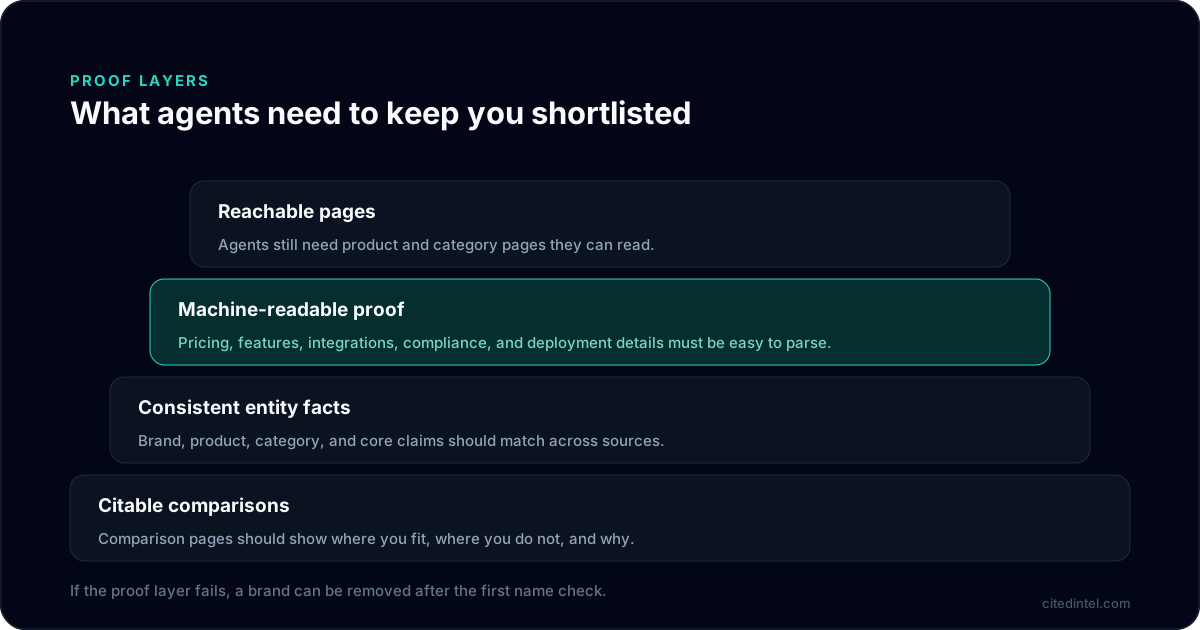
Classic SEO still matters because agents need reachable pages to read. Classic GEO still matters because generated answers still need clear, reusable language. What changes is the evidence bar: the system needs facts it can verify, a shortlist it can justify, and a reason it can give for putting your brand on it.
- Machine-readable proof: pricing, features, integrations, compliance, and deployment details need to be easy to parse, not buried in marketing copy.
- Consistent entity facts: the brand name, product name, category label, and core claims should match across your site and major third-party references.
- Citable comparisons: comparison pages should state where you fit, where you do not, and which alternatives you are replacing.
- Human defense: a sales rep or buyer should be able to repeat the same claims without contradiction.
I keep telling teams this: if an AI agent cannot defend your inclusion, your chance of being shortlisted drops fast. The buyer may still validate with a human later, but by then the set is already narrowed.
What agent engine optimization means in practice
Agent engine optimization means optimizing for AI agents by making your brand legible to retrieval, comparison, and verification systems. The job is not just to be mentioned in AI assistants, it is to become the vendor an agent can safely recommend after checking the evidence on your own pages and on the public references those systems pull into view.
The distinction matters. Visibility labels explain whether you show up; shortlist readiness asks whether the system can narrow the field and defend your place in it. Agent engine optimization names that extra layer of proof, which means the page needs to settle the vendor comparison before the buyer circles back with the same question.
What stays the same from GEO and AEO
The GEO playbook still applies. You still need crawlable pages, clear headings, direct answers, strong internal linking, and third-party proof. The difference is that the wording has to travel cleanly into an answer without the model improvising connective tissue, so every claim should land in a form an agent can repeat from the page without filling gaps or smoothing over missing logic.
- Direct language: answer the buyer’s actual question early, then support it with detail.
- Structured content: use comparison tables, feature lists, FAQs, and specification blocks where they help the reader.
- Public proof: case study pages, review language, docs, and policy pages still shape trust.
- Consistent naming: one product name, one category label, one set of claims.
What changes is the bar for defensibility. A page that gets summarized is useful. A page that survives a pointed follow-up is stronger, because it gives the agent something concrete to stand behind when the buyer asks why your name belongs on the list.
What changes in agentic buying
The biggest difference is that agents compare across sources much more aggressively than a human skimming search results. They are more likely to look for contradictions, missing fields, and weak claims that are hard to verify, which means a single inconsistent field can outweigh a polished paragraph on the homepage.
| Area | Classic GEO / AEO | Agent engine optimization |
|---|---|---|
| Primary goal | Appear in AI answers | Make the shortlist |
| Content emphasis | Clear, quotable explanation | Clear explanation plus verifiable proof |
| Best assets | Comparison pages, FAQs, docs | Comparison pages, entity facts, source-backed claims |
| Failure mode | Not mentioned | Mentioned, then dropped |
| Human role | Reader clicks through | Buyer validates and de-risks the shortlist |
For a demand generation lead, the win condition is not raw traffic. It is becoming the option an agent can surface first, compare without friction, and pass to sales with enough evidence that the story holds up.
What agents need from your public presence
Agents need public pages that read like evidence, not slogans. For product marketing teams trying to improve AI search optimization, the fastest wins usually come from making the brand easier to verify across the surfaces buyers already check, then using those same facts in every comparison asset.
That is true in B2B SaaS, but the proof varies by category. A cybersecurity vendor needs clearer trust and deployment evidence. A vertical SaaS company needs tighter workflow and compliance detail. A fintech or payments infrastructure brand needs region, rails, and risk language that matches the questions buyers ask in different regulatory markets. The page should answer the highest-friction question first, not bury it under a generic feature rundown, because the first unresolved question is often the one that sends the buyer elsewhere.
The surfaces that matter most
- Comparison pages: show how you differ from real alternatives, not a made-up strawman.
- Docs and help content: agents trust pages that describe how something works, not just why it sounds good.
- Pricing and packaging: if you hide the cost model, the agent fills the gap with guesswork.
- Trust pages: security, compliance, data handling, and support pages help a buyer validate what the agent surfaced.
- Third-party coverage: review language, analyst mentions, partner directories, and credible editorial comparisons often carry more weight than homepage copy.
GEO vs SEO: What Changes, What Stays, and What Teams Should Do still matters here. SEO gets the page fetched, GEO helps the language get reused, and agent engine optimization is the discipline of making that reused answer strong enough to survive scrutiny from an automated buyer. The check is whether the page hands the agent one claim it can stand behind, one detail that backs it up, and one source it can point to without patching the story from memory.
Consistent entity facts are not optional
When one page calls you “Acme” and another calls you “Acme AI Platform,” the agent has to reconcile whether the references point to one entity. That sounds trivial until you remember how many vendor pages, partner pages, directories, and review sites are in play. Use one canonical form on every public page, then mirror that wording in profiles that the agent is likely to ingest.
My view: most teams underestimate how much inconsistency kills shortlist quality. They keep polishing copy while the underlying facts drift. If one page says one thing and another says something looser, the agent has to decide whether your claims are stable enough to trust.
- Name: use one canonical company and product name.
- Category: say what you are in the same way across core pages.
- Capability: describe the same feature set with the same nouns.
- Market fit: state where you are strongest and where you are not the right fit.
The last line matters because fit is part of the proof. A buyer in India evaluating HR tech may need payroll support and regional compliance. A buyer in the UK often weighs local data handling and residency language more heavily. An agent can only shortlist well if your public facts line up with the market question.
How to raise your AI search optimization for agentic buying this quarter
The best quarter-one plan is boring in a useful way. Tighten your facts, add proof, and rewrite the pages agents keep encountering first so the model reads one stable offer story instead of three slightly different ones. Start with the pages that decide fit: product, pricing, integrations, security, and the comparison asset most often pulled into shortlist prompts.
Do that before you chase a bigger content calendar. Volume without proof just creates more pages for the agent to ignore, and it gives you more places for naming drift or thin claims to spread.
The practical checklist
- Audit the shortlist prompts: pick 10 to 15 real buyer questions, including category, comparison, and constraint prompts.
- Fix entity consistency: align company name, product name, category language, and top-line claims across your site and major profiles.
- Publish one hard comparison page: show fit, non-fit, and tradeoffs against three real alternatives.
- Add source-backed proof blocks: include security, compliance, integrations, deployment, pricing model, and support detail where relevant.
- Check structured data: use schema where it helps machines interpret the page, especially on product, organization, FAQ, and comparison content.
- Create a plain-language facts page: one page with the core entity facts a buyer or agent would need to verify you.
- Review third-party surfaces: partner listings, review profiles, and directory entries should not contradict your own site.
- Re-test weekly: run the same prompts in the assistants your buyers use and note whether you are named, compared, or skipped.
For a B2B SaaS content team, this checklist usually exposes the gap fast. You will see whether the problem is weak proof, weak naming, or weak comparison language.
What to rewrite first
Do not start with your homepage unless it is obviously broken. Start with the pages agents are most likely to use for comparison: product pages, pricing, integration pages, security pages, and the strongest comparison assets. Those are the pages where a missing field or vague claim can knock you out before a human sees your pitch, so the first repair should be the page with the most gaps, not the one with the most traffic.
Then tighten the opening language. Lead with the category, the buyer, and the tradeoff in the first sentence or two, so the model can classify what sort of vendor you are without guessing before it compares you. A useful opener names the job to be done, the fit boundary, and the one reason a buyer should keep reading.
For example, a martech vendor should say whether it is a lifecycle platform, attribution layer, or orchestration tool. A healthcare SaaS brand should state if it serves providers, payers, or admins. A logistics tech company should be explicit about shipment visibility, routing, or warehouse workflows. Agents do not reward vague category poetry.
Try this today
You can test your current agent engine optimization the same afternoon you read this. Use five prompts, score the results, and you will know where the shortlist breaks.
- Write five prompts:
- “Best [category] for [use case]”
- “Compare [your brand] vs [competitor]”
- “Which [category] works for [region or constraint]?”
- “What should I check before buying [category]?”
- “Which [category] is easiest to verify on security, pricing, and integrations?”
- Run them in three assistants: AI assistants.
- Score each answer: 1 if you are named, 1 if you are compared fairly, 1 if the answer gives a verifiable reason to include you.
- Mark the gap: if you are named but not defended, you need proof. If you are defended but not named, you need entity consistency and comparison pages.
- Pick one fix: rewrite a comparison page or create a facts page before you publish anything new.
When a team needs a prompt-by-prompt operating rhythm, Citedintel gives you a measurement layer that tracks whether AI assistants are recommending your brand on real buyer-intent prompts, so you can see which page or claim changes the shortlist outcome.
What good looks like across categories
Agent engine optimization shifts by category because the proof a buyer needs changes with the risk. The pattern stays the same, but the evidence does not, and the page should surface that evidence before the agent starts summarizing.
A PMM at a procurement platform needs to show workflow fit, integrations, and approval logic. A founder selling devtools needs docs, implementation detail, and credible technical comparisons. A growth lead at a healthcare SaaS company needs trust, compliance, and deployment clarity. Same discipline, different proof.
B2B software categories
| Category | What agents check first | What usually gets you shortlisted |
|---|---|---|
| HR tech | Region, payroll support, integrations, compliance | Clear market fit and local proof |
| Martech | Use case, stack compatibility, deployment complexity | Sharp comparisons and implementation detail |
| Devtools | Docs quality, API detail, technical credibility | Readable docs and precise feature language |
| Vertical SaaS | Workflow fit, industry-specific proof, compliance | Category language tied to the real job |
| Fintech | Rail support, risk, region, pricing model | Transparent constraints and trust pages |
In the UK, that might mean tighter wording around compliance and data residency. In India, it may mean region-specific payments, payroll, or language support. In the UAE and South Korea, local market fit can matter more than global brand familiarity because the agent has to justify the recommendation to a buyer with local constraints and buying norms. The useful test is whether your public pages already name those constraints, not whether a model can infer them. If the constraint is not written down, it is easy for the shortlist to drift toward a safer-looking competitor.
Consumer buying is the warning sign
B2B is not following consumer behavior line for line, but the direction is clear. McKinsey reported in early 2026 that 62% of AI-enabled shoppers use AI to compare options, 55% use it to learn what features to consider, and 44% say it is their most preferred information source. That is agentic buying behavior with a consumer label on it.
The Shopping Research feature OpenAI shipped is a strong signal for consumer categories like home and kitchen, beauty, and electronics. If the compare-and-shortlist motion becomes normal there, B2B buyers will copy the habit wherever the stakes are high and the options look similar. The practical takeaway is simple: the more a category depends on side-by-side judgment, the more your proof has to travel without a salesperson beside it.
Where Citedintel fits in the agent era
Citedintel is the measurement layer for agent engine optimization. It tracks whether brands are being recommended in AI assistants on real buyer-intent prompts, then shows which claim, field, or comparison block is missing from the shortlist story.
The practical problem is visibility, not effort. A founder or content lead can guess at AI search optimization, but guessing is the slowest way to learn whether the shortlist is shifting. Start with the prompt set, the comparison page, and the facts page, then watch which one changes the answer. The artifact to keep is a simple log of prompt, answer, and missing proof, because that tells you whether the fix belongs in naming, comparison, or trust content.
The space is still early as of July 2026. There is no settled standard for agentic buying, no universal score that settles every category dispute, and no magic page template that removes judgment from the process. The teams that do best will treat this as a measurement problem first, then a content problem, then a distribution problem. In practice, that means watching the same prompts over time instead of judging a single screenshot.
I would not separate GEO, AEO, and agent engine optimization into silos. They are sibling disciplines. GEO gets you seen, AEO helps you get cited, and agent engine optimization helps you survive the verification step when an AI agent does the buying work, which is why the same claim should be searchable, reusable, and defensible on the same page. If those three versions do not line up, the shortlist gets brittle fast.
What to publish next
When a B2B SaaS team is building out AI search optimization, the next three assets should be simple and concrete. Publish the comparison page that answers the real shortlist question, the facts page that cleans up entity drift, and the trust page that gives the agent something to defend.
Then test them against live prompts. If the same competitor keeps appearing in AI assistants while your brand only shows up once, the problem is not awareness. It is proof. Use that result to choose the next repair: a sharper comparison page, a cleaner facts page, or tighter entity naming. If the answer changes after one fix, you have found the page that matters most.
That sequencing is the step teams skip: the buy now happens after the answer, not before it.
To see where your brand stands, start with a free Citedintel audit, or compare the workflow at /compare-geo-tools. Use the audit to spot which public page is failing the shortlist test, then fix that page before publishing more content.
Frequently asked questions
What is agent engine optimization?
Agent engine optimization is the practice of making your brand easy for AI agents to verify, compare, and defend when they shortlist vendors. It sits beside GEO and AEO, but adds the proof layer that matters when software is doing early buying research.
How is agent engine optimization different from GEO or AEO?
GEO helps you appear in AI answers, and AEO helps those answers get quoted cleanly. Agent engine optimization goes one step further by making sure an AI agent can justify your inclusion on a shortlist with facts it can verify.
How do I show up in AI search shortlists?
Start with entity consistency, then publish comparison pages, pricing detail, trust pages, and source-backed proof blocks. The article says agents drop brands that are mentioned but not defensible, so the evidence has to hold up across your site and third-party surfaces.
What pages should I fix first for AI buying journeys?
Start with product pages, pricing pages, integration pages, security pages, and comparison pages. Those are the pages agents are most likely to use when they compare vendors and check whether your claims line up.
What does Citedintel do in this workflow?
Citedintel measures whether brands are being recommended in ChatGPT, Claude, Perplexity, and Gemini on real buyer-intent prompts. It also shows where the proof is missing so teams can fix the pages that affect shortlist quality.