
Part of the GEO Hub This guide is one chapter of Cited's Generative Engine Optimization hub: the three-layer GEO Stack, eight strategies that hold up in 2026, and a marketer's 90-day plan.
SEO still decides whether a page is found. GEO decides whether an answer engine names your brand inside the response, which is the moment B2B shortlists start to narrow.
GEO changes the job from earning a click to earning a citation. In AI search optimization, the page has to be readable, reusable, and specific enough that an answer engine can quote it without rebuilding the argument.
SEO and GEO start from different jobs
SEO is retrieval work. GEO is reuse work. If your page ranks but cannot be quoted cleanly, it can still miss the answer layer.
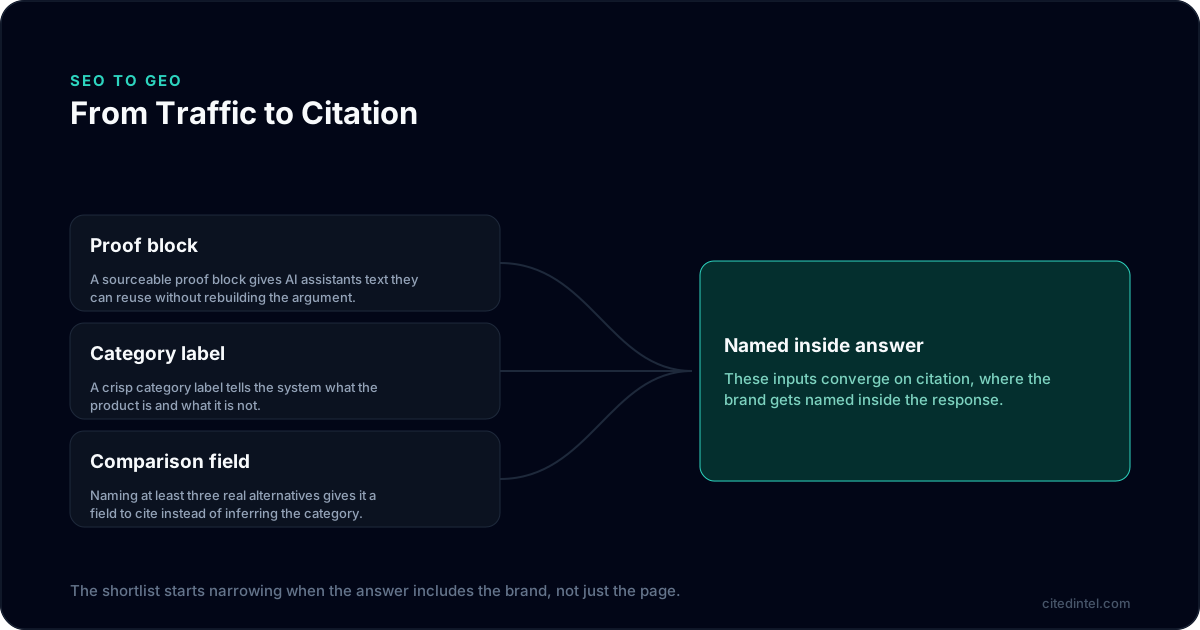
That difference shows up fast in B2B software. A content team can write a strong SEO page that brings traffic, while a PMM still loses the shortlist because the page never gives an answer engine a crisp category label, boundary, and proof.
What stays the same
The basics still carry both jobs: crawlable pages, clean indexing, strong internal links, and content that answers a real query. Technical hygiene still matters because a messy site gives AI search the same problems it gives Google.
- Crawlability: keep important pages reachable without odd blockers, broken canonicals, or hidden navigation.
- Technical hygiene: fix duplicates, slow templates, and unclear page intent before you chase AI search optimization.
- Authority: reputable brands still get trusted more easily, whether the surface is a search result or an AI answer.
- Useful specificity: generic pages fail in both systems because they do not help a buyer decide.
Google Search Central said in May 2025 that AI Overviews can surface a broader range of sources and send higher-quality clicks when pages are easy to ground, which is still the right way to think about the relationship between classic SEO and generative engine optimization Google Search Central.
What changes
GEO changes the target from ranking to citation. That means the page has to make entity recognition, comparison, and source reuse easy. A model should know what the product is, what it is not, and why a buyer would mention it.
My view: too many B2B teams still write for keyword coverage first and answer shape second. A page that says a lot without defining the category, the alternative, and the proof is often good SEO and weak GEO.
Ranking factors vs citation factors
Ranking factors help a page get seen in search. Citation factors help a brand get reused inside an AI-generated answer. The overlap is real, but the emphasis changes once answer engines start compressing sources into one response.
For a product marketing manager at a B2B SaaS company, this is the practical split: SEO asks, “Can we rank?” GEO asks, “Can the answer engine lift us into the shortlist?”
| Observed factor | Ranking effect | Citation effect | What to do |
|---|---|---|---|
| Prompt wording that matches page language | Helps relevance in search | Often increases reuse in AI answers | Mirror buyer wording in headers and FAQs |
| Definition in the first 80 words | Improves page clarity | Makes category recognition easier | State what the product is up front |
| Three named alternatives | Supports comparison intent | Raises the chance of shortlist inclusion | Name real competitors or substitutes on comparison pages |
| Buyer query wording in FAQs | Captures question-shaped searches | Fits answer-engine prompts better | Write FAQs in the language buyers actually use |
| Clear proof blocks | Strengthens trust signals | Makes citation or paraphrase easier | Add tables, boundaries, integrations, or compliance notes |
| Entity consistency across pages | Reduces confusion for crawlers | Reduces ambiguity for answer engines | Use one canonical product label and one feature name set |
The cleanest way to read the table is simple: SEO still rewards relevance and authority, while GEO rewards pages that can be cited without translation. AEO sits inside that work as the page-level discipline of making your answer quotable.
Why AI systems reward different content patterns
Answer engines reward pages that reduce uncertainty. They look for a stable category label, a clear boundary, and proof they can cite without interpretation.
That is why entity consistency matters so much in AI search optimization. If one page says “revenue operations software,” another says “sales operations platform,” and another says “workflow automation tool,” the model has to guess whether those are the same thing.
Entity consistency is not branding polish
Entity consistency is a retrieval aid. The page that uses one canonical label for the product, one name for the core feature, and one description of the buyer problem gives the answer engine fewer choices to resolve.
For teams doing generative engine optimization for B2B SaaS, this is where many pages break. Homepages, solution pages, and comparison pages drift into different language, and the drift makes AI search optimization weaker even when the site looks well organized to humans.
In practice, the fix is boring and effective. Pick one category label, one product description, and one feature vocabulary set, then use them everywhere they belong.
Structured comparisons beat isolated claims
AI answers lean on comparison language because buyers do. If your page does not compare itself to named alternatives, the engine has to infer the field for you.
On a martech page, the useful comparison is tied to the buyer’s job, not to slogan copy. On a legal tech page, the useful contrast is contract lifecycle management versus e-signature versus document automation. On a logistics tech page, the useful distinction is routing, yard management, or shipment visibility.
That same pattern shows up in answer engine optimization techniques across categories: comparison tables, explicit boundaries, and proof points are easier for answer engines to reuse than broad positioning language. When Citedintel audits AI search optimization, this is the kind of difference that usually explains why one brand gets mentioned and another does not.
Google Search Central says AI Overviews can draw from a broader range of sources when pages are easy to ground, and Microsoft Copilot has made citations more visible in its product updates, which puts more pressure on sourceable content, not less Google Search Central Microsoft Copilot.
One visible limitation
GEO is weaker when the category itself is obscure or the buyer language is still unstable. If no one agrees on the label yet, answer engines have less to anchor on, and the page will need stronger third-party proof than a mature category does.
What your team should do differently
Do not ask your team to “do GEO.” Ask them to meet thresholds. That is how AI search optimization becomes operational instead of aspirational.
For a content marketer working on B2B SaaS, the point is to change the page shape, not to add another vague content initiative. For an SEO lead, the point is to move from ranking checks to citation checks.
Operational rules that change outcomes
- Definition rule: every category or solution page must define the product in the first 80 words. Track prompt reuse for “what is” queries and the first mention in AI answers.
- Comparison rule: every comparison page must name at least three real alternatives. Track inclusion in “best,” “vs,” and “alternative” prompts.
- FAQ rule: every FAQ question must mirror buyer wording, not internal marketing language. Track match rate against the questions buyers actually ask.
- Proof rule: every high-intent page needs one sourceable proof block, such as integration scope, compliance stance, feature boundary, or comparison table. Track citation rate and generic rewrites.
- Vocabulary rule: one canonical label per product category, one canonical product description, one canonical feature name set. Track fewer answer variants and fewer misclassified mentions.
For an agency lead reporting to a client, these rules make the work easier to defend. You can show why the page changed, what the page now supports, and which prompts still fail.
Citedintel helps here because the platform is built for AI search monitoring and the fix list that follows it. If you want the manual version first, start with the audit at /start; if you want the workflow behind the reporting, /why-cited is the better next click.
A quick page test you can run before lunch
Use this rewrite check on one page that should influence shortlist creation.
- Pick one page: use a category page, comparison page, or solution page.
- Write three prompts: one “what is,” one “vs,” and one “best for” prompt in the buyer’s wording.
- Check the opening: if the first 80 words do not define the category clearly, rewrite them.
- Count alternatives: if fewer than three named alternatives appear on a comparison page, add them.
- Rewrite one FAQ: make the question match buyer language, then answer it in two short paragraphs.
- Add one proof block: use a table, integration list, or boundary statement that can be cited without guesswork.
Run that once, and you will see where AI search optimization is weak before rankings tell you. Citedintel automates the scaled version of that workflow at /why-cited.
How this changes by category
The method stays the same, but the proof does not. A CRM page, a payments infrastructure page, and a devtools page win for different reasons, so the page has to show the right boundary for the category it serves.
For teams doing AI-driven content marketing for B2B, category choice matters because buyer language changes by market and by product type. The same generative engine optimization strategy does not land the same way in every category.
CRM
CRM buyers care about pipeline ownership, workflow fit, and whether the product is actually a CRM or just adjacent software. HubSpot is a useful reference point because many buyers already know it, which makes the boundary question more important, not less.
Proof points that matter most are pipeline stages supported, integration depth, reporting flexibility, and the kind of sales motion the product is built for. If the product is better for mid-market services firms, say so. If it is better for complex account-based selling, say that instead of padding the page with generic claims.
Legal tech
Legal tech buyers are precise about scope. They want to know whether the product handles contract lifecycle management, e-signature, matter management, or document automation, and answer engines need those labels spelled out.
Proof points that matter most are clause handling, approval flows, auditability, and the boundaries between adjacent products. A page that stays vague about those boundaries tends to get paraphrased into something safer and less useful.
Devtools
Devtools buyers ask implementation questions first. They care about API shape, docs quality, integrations, and whether the product fits the stack without a painful rollout.
GitHub and Datadog are useful anchors in this category because buyers already use them as reference frames. Proof points that matter most are documentation clarity, deployment path, integration breadth, observability or workflow fit, and how quickly the product can be understood by both technical and non-technical buyers in the same room.
Across these categories, the pattern is the same: the brand that wins the answer layer is the one that says what it is, what it is not, and who it is for without making the model do translation work.
One SEO habit to keep, one GEO habit to start
Keep technical hygiene. Start writing for citation. That is the simplest shift from classic SEO to generative engine optimization.
If you are responsible for AI search optimization, this is the habit split that matters most. SEO keeps the house in order, and GEO makes the page reusable inside AI answers.
- Keep: crawlable pages, clean canonicals, fast templates, internal linking, and intent-matched content.
- Start: category definitions in the opening paragraph, explicit comparisons, buyer-language FAQs, and sourceable proof blocks.
- Keep: authority building through credible third-party mentions and useful content.
- Start: entity consistency across homepage, solution pages, and comparison pages.
When this works, the page becomes easier to rank and easier to cite. That combination is the real goal of SEO and GEO together.
How SEO and GEO work together
You do not pick SEO or GEO. You use SEO to get found and GEO to get named.
The strongest pages now do both jobs. They win retrieval with clean structure and authority, then win reuse with a definition, comparison, and proof that answer engines can quote.
That matters more for B2B software businesses than for almost any other category because shortlist decisions are compressed. A buyer may compare two or three vendors in one session, and the brand that shows up in AI answers gets a head start before the sales call starts.
The multi-market part matters too. Buyers in the US, UK, India, the UAE, South Korea, Thailand, and Indonesia may ask the same thing in different words, and a page that looks fine in one market can fall short in another if the category label or proof points feel local instead of universal.
My view: the worst mistake right now is treating AI search as a separate content program. It should change the shape of the pages you already depend on, especially the ones closest to sales conversations and shortlist decisions.
If you are building AI search optimization for B2B SaaS, use one workflow: audit the page, fix the definition, add the comparison, normalize the vocabulary, and re-check weekly. That is the loop Citedintel supports, and it is why teams use the free audit at /start, the product explanation at /why-cited, and the demo at /demo.
Answerability beats volume when the page can be reused without interpretation. A smaller set of pages, written with cleaner definitions and better comparisons, is more useful than a larger library of thin content that looks busy but never gets cited.
Frequently asked questions
What is the difference between GEO and SEO?
SEO is retrieval work: it helps a page get found in search. GEO is reuse work: it helps an answer engine quote or cite your page inside the response. The article's core point is that ranking and citation are related, but they reward different page shapes.
How do I do AI SEO for a B2B SaaS page?
Start with the page shape, not a new content program. Define the product in the first 80 words, use one canonical category label, add named alternatives on comparison pages, and include one proof block that can be cited without guesswork.
What is generative engine optimization for B2B SaaS?
Generative engine optimization is the work of making a page easy for answer engines to reuse. For B2B SaaS, that usually means clear category definitions, explicit comparisons, buyer-language FAQs, and consistent product vocabulary across pages.
How do I show up in AI search?
Make the page easy to ground. Use crawlable pages, clean canonicals, clear definitions, named alternatives, and sourceable proof so AI search can identify your entity and quote you without rewriting the argument.
Are AEO and GEO the same as SEO for AI?
They overlap, but the article treats them as a shift in emphasis. SEO for AI still needs technical hygiene and authority, while AEO and GEO put more weight on answer shape, entity consistency, and citations the model can lift cleanly.