
B2B brands lose AI search shortlists when they optimize one category query for one buyer. A procurement platform must answer a champion’s fit question, a security reviewer’s risk question, and finance’s incumbent comparison with separate, citable proof.
Generative engine optimization for B2B works best as a prompt portfolio mapped to the buying group. Each prompt should lead an AI assistant to evidence that supports one decision, so the brand remains credible when a shortlist is checked by sales, procurement, security, and finance.
The demo is no longer the first research checkpoint
AI-mediated discovery now shapes supplier consideration before a prospect visits a website or books a demo. Gartner’s March 2026 research describes supplier websites shifting toward buyer enablement for AI answer engines, with fewer visits but potentially higher-converting visitors.
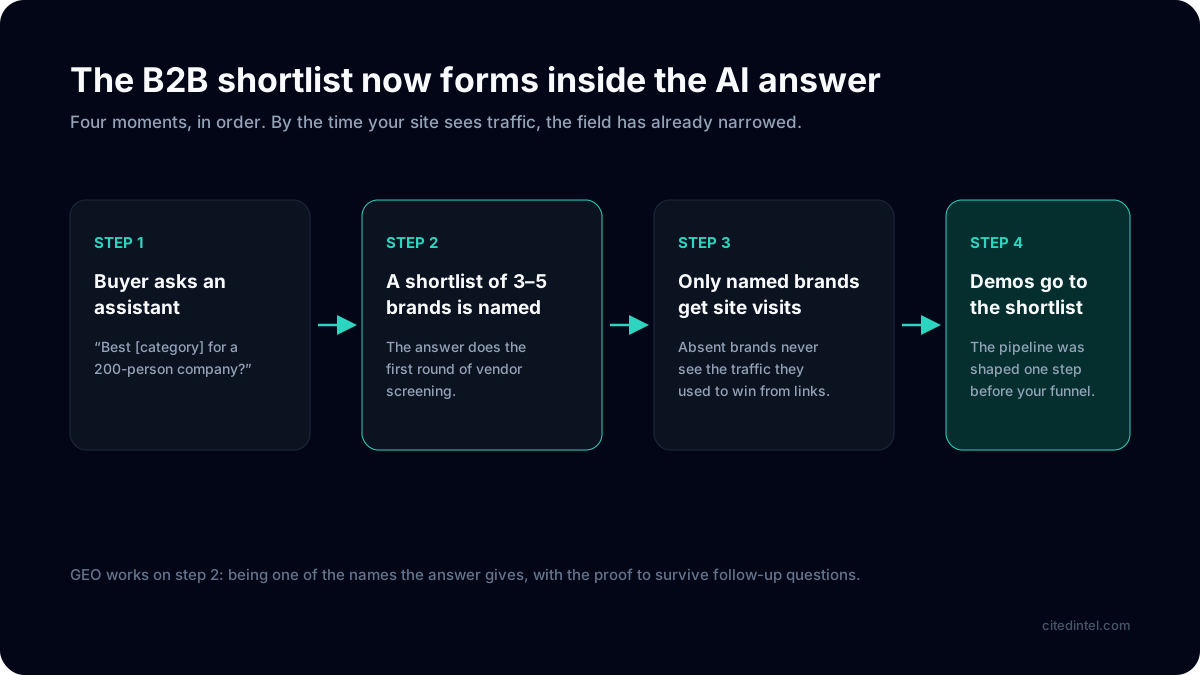
That changes the job of a B2B content team. A product page that attracts a click but cannot answer “how does implementation work with our ERP?” has not done enough work for the buying group. The page needs to make the relevant fact available when an answer engine assembles a shortlist.
Gartner reported in May 2026 that 45% of B2B buyers used generative AI during a recent purchase, consulted an average of seven information sources, and that 69% preferred validating AI-generated insights with sales representatives. Your AI search content therefore has two jobs: provide the initial answer and give sales a source-backed way to confirm it.
My view is simple: GEO belongs in pre-demo pipeline infrastructure. Traditional SEO still earns discovery, but AI search optimization affects which vendors enter the conversation before your team knows the account is active.
One purchase creates seven different AI questions
The right planning unit for B2B GEO is a stakeholder-prompt matrix, not a keyword list. One buying committee can produce seven different questions about the same procurement software category, and each question requires different evidence.
The embedded platform observations point to a practical problem: the broad category prompt is only the opening question. The useful signal appears in the follow-ups about risk, integration, cost, adoption, and the tradeoff against the incumbent.
Forrester’s January 2026 research puts the typical business purchase at 13 internal stakeholders and nine external influencers, with procurement participating as a decision-maker in 53% of buying cycles. The exact committee varies, but the planning consequence is stable: different people ask AI assistants to defend different parts of the purchase.
Use the matrix below as a fill-in artifact. Replace the bracketed fields with the language your buyers use, then attach one proof source to every row before creating new content.
| Stakeholder | Prompt to test | Decision criterion and likely objection | Evidence layer to publish or strengthen |
|---|---|---|---|
| Champion | “What are the best [procurement platforms] for a [team size] company replacing [incumbent]?” | Fit, workflow coverage, time to value. “Will this solve the approval bottleneck without a large change project?” | Use-case page, workflow screenshots, customer outcome with method, implementation overview, incumbent comparison. |
| Technical evaluator | “Which [procurement platform] integrates with [ERP, HRIS, accounting stack] and supports [required workflow]?” | Integration depth, APIs, data flow, permissions. “Will the connection work beyond a marketing-level integration claim?” | Integration directory, API documentation, data-flow diagram, supported objects, sandbox details, release notes. |
| Security reviewer | “Is [vendor] suitable for [industry] teams with [data residency, access control, compliance] requirements?” | Risk, controls, incident response. “Can our security team verify the claim without a sales call?” | Security center, certifications, subprocessor list, encryption details, retention policy, incident process, trust contact. |
| Finance owner | “How does [vendor] pricing compare with [incumbent] for [users, spend volume, entities]?” | Total cost, contract shape, payback assumptions. “What costs appear after the first quote?” | Pricing page, packaging rules, implementation fees, calculator assumptions, contract terms, cost comparison with dates. |
| Procurement | “What should we ask [vendor] before buying [category] software for [region and company size]?” | Supplier risk, terms, service levels, renewal exposure. “Can this vendor pass our purchasing process?” | RFP response library, SLA, support policy, legal terms, insurance details, vendor questionnaire, renewal language. |
| Executive sponsor | “Which [procurement platforms] can reduce [cost, cycle time, leakage] without disrupting [business priority]?” | Strategic impact and adoption risk. “Will the result be visible at the operating level?” | Executive brief, benchmark methodology, quantified customer results, adoption plan, governance model, board-ready summary. |
| End user | “Which [procurement tool] is easiest for [requesters, approvers, buyers] using [current process]?” | Usability and daily friction. “Will employees bypass the system?” | Product tour, role-based guides, accessibility statement, training plan, user documentation, workflow examples. |
The matrix should contain the buyer’s context, constraint, and incumbent. Google reported in May 2026 that the average AI Mode query was three times longer than a traditional Search query, while planning-related queries were growing faster than AI Mode queries overall. Short category phrases leave out the details that make a B2B recommendation useful.
Write prompts as sequences, too. Start with a shortlist question, then add “challenge the security claims,” “compare total cost with [incumbent],” and “recommend one for a phased rollout across [regions].” A vendor that appears in the first answer but disappears after the pricing or implementation question has a visibility problem tied to evidence, not reach.
Match proof to the person asking the question
Each AI answer draws on a different proof requirement, so one homepage cannot carry the entire buying group. The evidence layer should match the person asking the question and the fact that person needs to repeat internally.
A product marketing manager should audit claims by decision, not by URL. For every matrix row, record the claim, the owned source, the independent source, the publication date, and the person who can approve an update. That sheet becomes the editorial queue.
Champions need fit language they can repeat
Champions need language that helps them explain why a vendor belongs on the shortlist. A procurement software brand should state the buying situation it serves, the workflows it replaces, the company size it fits, and the tradeoff that may make another option better.
A comparison page earns more trust when it names the incumbent, pricing shape, migration burden, and missing capability. “Best-in-class” gives an answer engine little to quote. “Fits distributed finance teams that need purchase requests, approvals, and supplier records connected to [ERP]” gives the engine a defensible selection rule.
Technical and security reviewers need public verification
Technical evaluators and security reviewers need public documentation that can survive exacting follow-up questions. Integration pages should name supported objects, authentication methods, sync direction, limits, and ownership rather than stopping at a partner logo.
Security pages should separate current certifications from planned work. Include the certification scope, effective date, data locations, subprocessors, retention rules, access controls, and incident response contact. If the answer requires a gated document, publish a useful public summary so AI search can connect the vendor with the relevant requirement.
For a B2B healthcare procurement platform, the security row may focus on protected data handling and audit access. For a logistics procurement platform, the technical row may focus on multi-entity permissions, supplier onboarding, and integrations with warehouse or transportation systems. The prompt portfolio stays consistent, but the evidence vocabulary follows the category.
Finance and procurement ask for different forms of certainty
Finance asks for a number, a boundary, or a comparison. A pricing page should state whether charges depend on seats, spend volume, entities, modules, transactions, or contract length. It should date the information and identify fees that sit outside the subscription.
Procurement needs a different layer. The useful sources include service levels, renewal terms, liability language, insurance, support coverage, implementation responsibilities, and the vendor questionnaire. These documents may not be high-traffic assets, but they answer the questions that determine whether a shortlist survives internal review.
IDC’s January 2026 guidance says recommendation visibility improves when knowledge assets are structured, consistent across credible channels, and supported by trusted third parties such as analyst research and independent benchmarks. Treat third-party evidence as a required field in the matrix, not as a public-relations extra.
Executives and end users require evidence of impact
Executives need a defensible business case. Publish the metric definition behind every outcome, the baseline, the time period, the customer context, and the limits of the result. “Reduced purchasing time” is weak without the workflow measured and the conditions that produced it.
End users need proof that the product fits their daily work. Role-based guides, product tours, accessibility details, and training plans give answer engines material for questions about adoption. They also give a champion something concrete to send around after the first shortlist.
Documentation deserves a place in pre-sale planning. In B2B software, documentation answers the questions that marketing pages avoid and gives an AI assistant a source it can cite without stretching a claim.
Procurement software shows why category depth matters
A focused GEO program should own one category’s buying vocabulary before it expands. Procurement software is a useful working example because the category combines finance scrutiny, supplier risk, integrations, employee adoption, and measurable process change.
Procurement prompts differ by market because buying requirements differ by company location, legal exposure, and operating model. A platform selling to teams in the United States may need to explain ERP integrations and audit controls, while a buyer in India may ask about local invoicing workflows, regional support, and implementation partners. A UK buyer may add data protection and supplier governance to the same shortlist question.
Do not create separate country pages that repeat the same claims with a flag swapped into the title. Create market-specific evidence where the requirement changes, then link that evidence to the relevant matrix row. Country, language, currency, data location, and contract terms belong in the prompt fields when those factors affect the buying decision.
Here is how three procurement prompts change the editorial work:
- Finance-led purchase: “Compare [vendor] and [incumbent] for 300 employees, five entities, and [annual spend].” The source set needs packaging rules, implementation costs, and an assumption-led calculator.
- Security-led purchase: “Can [vendor] meet [industry] access-control and data-retention requirements in [market]?” The source set needs current certifications, retention rules, data locations, and a security contact.
- Operations-led purchase: “Which platform can standardize purchase requests across [teams] without forcing every employee into a complex workflow?” The source set needs role-based product evidence, adoption guidance, and workflow examples.
These prompts may name the same product, yet they create different chances to be cited. The content calendar should therefore be organized around buying decisions such as supplier onboarding, purchase approvals, contract controls, and ERP migration, not around repeated variations of “procurement software.”
Use the first 90 days to repair the proof chain
A 90-day B2B GEO rollout should begin with an evidence audit, then connect sources to stakeholder prompts, publish the highest-risk fixes, and measure answer quality. Publishing a large batch of generic articles before the evidence exists creates more pages without improving the shortlist.
Days 1 through 30: map real questions
Start with 30 to 50 prompts drawn from sales calls, win-loss notes, support tickets, RFPs, security questionnaires, and pricing objections. Group each prompt by stakeholder, buying stage, incumbent, market, and required proof.
- Collect language: copy the buyer’s wording, including product names, internal acronyms, competing systems, and regional requirements.
- Mark stakes: label each prompt as shortlist, validation, comparison, risk, pricing, implementation, or adoption.
- Attach sources: add the best owned page, public documentation, third-party source, and missing proof for every prompt.
- Record gaps: flag claims that are vague, outdated, gated, contradictory, or unsupported outside the company website.
Run the same prompt set across your chosen answer engines and save the full responses, not only screenshots of brand mentions. Citedintel can audit buyer-intent prompts across ChatGPT, Perplexity, Claude, and Gemini, giving a content team a repeatable starting point for this baseline.
Days 31 through 60: repair the evidence path
Fix the sources that support the highest-value stakeholder questions. A security gap may outrank a category explainer if security review removes the vendor from consideration, while a pricing gap may take priority when finance controls the shortlist.
- Connect facts: link product pages to documentation, integrations, pricing, security, implementation, and customer evidence.
- Rewrite claims: state who the feature serves, under which conditions, and what tradeoff applies.
- Publish proof: add dated benchmarks, independent reviews, analyst references, or customer outcomes with methods and scope.
- Remove conflict: resolve different pricing, security, integration, and product-limit claims across public pages.
Use answer engine optimization techniques at the passage level. Put the direct answer near the start of each page section, use descriptive headings, define the subject in every paragraph, and keep the claim beside its supporting detail. A retrieved passage should make sense without the rest of the page.
IDC reported in June 2026 that only 35% of organizations had enterprise-wide content capabilities, and described connected product information, documentation, knowledge bases, and externally available data as part of the required foundation. The practical lesson is narrow: connect the evidence you already have before commissioning a new article for every prompt.
Days 61 through 90: publish and prepare the handoff
Publish the priority fixes in an order that follows the buying group. Start with the page or document that supports several high-stakes prompts, then add the comparison, market, implementation, and role-specific assets that close the remaining gaps.
Rerun the same prompt sequences after publication. Compare shortlist inclusion, brand position, citation sources, factual accuracy, competitor presence, and whether the answer survives the follow-up question. Give sales the cited sources and the unresolved questions so a representative can validate AI-generated information without improvising.
My disagreement with common GEO advice is that weekly publishing is a poor default. Weekly review of the same buying questions is better. If the evidence is stable and the answer remains accurate, the next task may be an independent review or a security document, not another blog post.
Track whether the recommendation survives scrutiny
Measure B2B GEO by stakeholder-specific answer quality, not by aggregate brand mentions. A useful dashboard shows whether the right buyer sees the right claim, whether the claim is cited, and whether the source holds up through follow-up questions.
Choosing software for this? The 10 best GEO tools, checkers and trackers ranks the field with published pricing.
| Metric | What to record | Why it matters before the demo |
|---|---|---|
| Prompt presence | Whether the brand appears for each prompt and stakeholder row. | Shows whether the vendor enters the relevant conversation. |
| Shortlist position | Where the brand appears among recommendations for the same prompt. | Separates a usable recommendation from a late reference. |
| Citation quality | Which owned or independent sources support the answer. | Shows whether the recommendation has evidence a buyer can verify. |
| Answer accuracy | Whether pricing, integrations, security, regions, and limits are represented correctly. | Prevents visibility gains that create objections during sales validation. |
| Follow-up survival | Whether the brand remains relevant after comparison, risk, pricing, or implementation prompts. | Tests consideration quality rather than a single favorable response. |
| Qualified influence | AI-referred visits, self-reported AI discovery, demo questions, and opportunity notes. | Connects AI search optimization to buyer conversations without claiming unsupported revenue attribution. |
Track the matrix by stakeholder, market, and prompt sequence. A single blended score can hide a serious problem, such as strong champion visibility paired with zero security evidence in the United States or weak pricing clarity in the UK.
Google announced in June 2026 that Search Console would expose insights for pages appearing in generative AI features, including impressions, surfaced pages, and countries. Use those platform signals alongside your owned prompt panel. Search Console can show where pages surface; prompt testing shows whether the answer represents the business accurately.
Set a review rule for every important row. Recheck pricing after packaging changes, security after certification updates, integrations after product releases, and customer outcomes when the source period expires. A stale citation can keep a brand visible while sending the buying group toward a wrong conclusion.
A same-day matrix you can run from existing buyer language
You can produce a useful baseline from the questions your team already receives. Use a procurement software page, sales call transcript, or recent RFP dated August 2026 as the source for the first entries.
- Choose one category: write “procurement software for [company type]” at the top of a sheet.
- Name seven roles: champion, technical evaluator, security, finance, procurement, executive sponsor, and end user.
- Write one prompt each: use this pattern: “Which [category] fits [company context] that needs [constraint] and currently uses [incumbent]?”
- Add a follow-up: append one of these: “Compare pricing,” “challenge the security claims,” “list implementation risks,” or “show the required integrations.”
- Mark the evidence: for every answer, record the page, document, independent source, publication date, and unresolved claim.
- Run the set: save each answer from your selected AI assistants on August 24, 2026, then mark presence, shortlist position, citation, accuracy, and follow-up survival.
- Pick three fixes: choose one missing owned asset, one unclear claim, and one missing independent source. Assign an owner and a publication date.
The visible result is a prioritized repair list tied to real buying questions, not a pile of keywords. A free Citedintel audit automates the scaled version by checking buyer-intent prompts, recommendation signals, citations, and competitor presence across a wider set of questions.
Know when the matrix should wait
A prompt portfolio should wait if the product facts are unstable or the business cannot publicly support its core claims. AI search optimization work cannot compensate for contradictory pricing, missing documentation, or a product that has not settled on its market and buyer.
For an early B2B software business still changing its category language each month, first create one accurate product source, one implementation page, and one security or trust page. Then expand the matrix when sales can identify recurring questions. The limitation is practical: a larger prompt set magnifies unclear positioning instead of fixing it.
Once the evidence is dependable, generative engine optimization becomes a coordinated operating practice. Your content team can improve the passage a champion cites, your security lead can maintain the risk proof, and your sales team can validate the answer without rebuilding the case from scratch.
That is the standard I would use for AI search optimization for B2B software: not whether a brand was named once, but whether every important stakeholder can find a defensible reason to keep it on the shortlist.
Keep reading
- The B2B SaaS Playbook for AI Search Recommendations
- Mentions vs citations vs recommendations: the metrics that matter
- Choosing your first AI search optimization platform
Frequently asked questions
What is generative engine optimization for B2B software?
Generative engine optimization for B2B software organizes buyer prompts and source-backed evidence so AI assistants can recommend a vendor accurately. The article applies this through a stakeholder matrix covering fit, integrations, security, pricing, procurement, business impact, and usability.
How does AI SEO help B2B brands before a demo?
AI SEO helps a brand appear in research conducted before a prospect visits the website or books a demo. The practical approach is to publish citable proof for the questions that champions, security reviewers, finance owners, and other stakeholders ask.
How should answer engine optimization handle security and pricing questions?
Answer engine optimization should connect security prompts to public details such as certification scope, effective dates, data locations, subprocessors, retention rules, and incident contacts. Pricing content should explain whether charges depend on seats, spend, entities, modules, transactions, or contract length, including fees outside the subscription.
How many prompts should I test for a B2B GEO baseline?
Start with 30 to 50 prompts drawn from sales calls, win-loss notes, support tickets, RFPs, security questionnaires, and pricing objections. Group each prompt by stakeholder, buying stage, incumbent, market, and required proof, then rerun the same sequences after publishing fixes.
Does SEO for AI replace traditional SEO for B2B brands?
No. Traditional SEO still supports discovery, while SEO for AI influences which vendors enter an AI-generated shortlist before the account is visible to sales. The article recommends measuring both page visibility and whether AI answers cite accurate sources through follow-up questions.