
A buyer types a shortlist prompt into ChatGPT, Claude, or Gemini, and a competitor shows up first while your brand is absent. If that keeps happening, your problem is not traffic, it is recommendation eligibility, and you can test it with the same prompts your buyers use.
To show up in AI answers, your brand has to be easy to cite and recommend inside answer engines. Generative engine optimization, or GEO, covers the broader job of earning inclusion in AI answers, while answer engine optimization, or AEO, focuses more narrowly on shaping one answer so it can be quoted without friction.
What recommendation engines reward in B2B SaaS
Recommendation engines reward pages that settle a buying question quickly and unambiguously. In B2B SaaS, that usually means category pages, comparison hubs, integration pages, proof pages, and consistent third-party profiles.
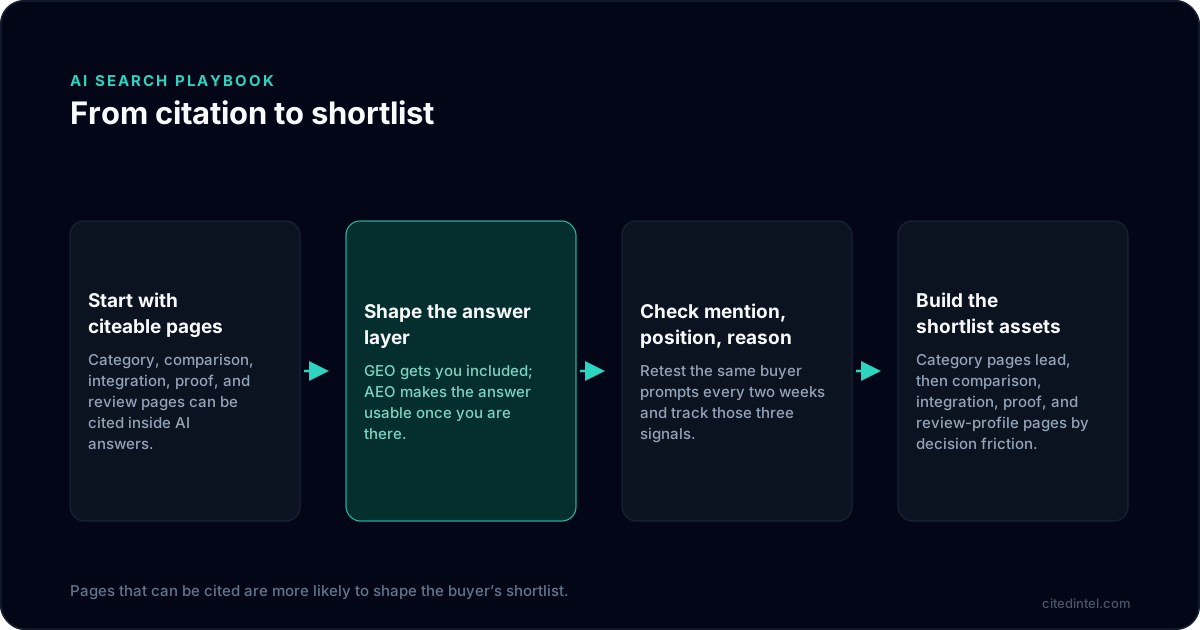
The pages that win are the ones a buyer could hand to a teammate and still keep the same conclusion. If the page only sounds polished, it is weak; if it can be cited, it has a chance to shape the shortlist.
What actually moves you into the answer layer
Category clarity: say what you are, the buyer you serve, and where you stop fitting. A buyer should not need a decoder ring to know whether your product belongs in the conversation.
Comparison readiness: name the real alternatives and the tradeoffs. AI answers tend to favor pages that help a buyer compare, not pages that pretend the market has no competitors.
Integration specificity: list the systems, the data flow, and the setup edge cases. That is what makes a page usable when a buyer is checking fit against existing tools, permission models, and the integrations already in play.
Proof density: show security, compliance, docs, implementation detail, or workflow screenshots when the category is technical or regulated. The more risk in the sale, the more the page has to prove.
Entity consistency: keep your category language aligned across your site, review profiles, partner pages, and regional pages. If your own naming shifts, the model has to choose which version of you is real.
In practice, GEO and AEO work best as a single program. GEO helps you enter the answer set, and AEO makes the cited answer easier for a buyer to act on.
The OpenAI Search and Deep Research guidance tells users to ask current or detailed questions, use citations, and check linked sources before deciding. Microsoft’s Copilot Search update says it surfaces clickable citations and trusted sources, which means your public pages need source-ready claims, not keyword stuffing.
Which page types win the queries buyers actually ask
The queries that matter most are category, comparison, and integration questions. Those are shortlist queries, and shortlist queries are where the recommendation surface gets decided.
When a page cannot help a buyer decide, it should not be the first thing you optimize. Start with the page that gives the assistant a clean basis for recommendation, then add the supporting page only after the first one can answer the decision in two sentences.
Category queries
Category queries matter when the buyer is still framing the problem. Questions like “best HR tech for hourly workforces,” “top devtools for API observability,” or “best vertical SaaS for clinics” reward pages that define the category, state fit, and name the alternatives worth comparing.
These pages answer the first question in the chain: what kind of tool is this, and who should consider it?
Comparison queries
Comparison queries are where shortlist formation gets real. Prompts like “X vs Y,” “best alternative to Z,” or “CRM for sales-led B2B SaaS vs product-led teams” are the moments when a comparison hub can win or lose the recommendation.
Forrester’s October 2025 B2B marketing post says 95% of B2B buyers plan to use genAI in at least one area of a future purchase, and over half say genAI helped them consider more or different vendors while saving time. That is the environment comparison pages now live in, and it is why they need a visible tradeoff table, named alternatives, and migration notes, not just a title optimized for search.
Integration queries
Integration queries matter when compatibility decides the deal. Questions like “does this integrate with Snowflake,” “works with Shopify,” or “supports Okta” are not curiosity prompts, they are purchase filters.
Integration pages win because they answer three questions in one place: what connects, what data moves, and what setup is required. A useful page has enough detail that a buyer can confirm the connection without opening support docs first; if it only shows logo walls, the recommendation signal is too weak to matter.
| Query type | What the buyer wants | Page type that usually wins | What to prove |
|---|---|---|---|
| Category | What the product is and where it fits | Category page | Category name, fit statement, alternatives, constraints |
| Comparison | Which option is safer or better for this job | Comparison hub | Tradeoffs, migration notes, use-case fit, named alternatives |
| Integration | Whether the product fits the buyer’s current tools | Integration page | Supported systems, setup steps, data flow, edge cases |
How to audit AI search presence without fooling yourself
Track recommendation behavior instead of classic keyword movement. Without a fixed prompt set on a schedule, you can publish content that feels useful and never change the shortlist.
Use three checks for each prompt: mention, position, and reason. Mention tells you whether the brand appears at all, position tells you whether it is first or buried, and reason tells you what the assistant thinks you are good for.
A practical rule is to test 12 to 20 prompts per category across AI assistants, then repeat the same set every two weeks. That is enough to see whether your category page, comparison hub, or integration page is moving the answer surface without pretending the result is a perfect market sample.
Use the prompt mix to separate page problems from message problems:
- Category prompts: “best [category] for [constraint]” tells you whether the category page is readable.
- Comparison prompts: “[your brand] vs [competitor]” tells you whether the comparison page is credible.
- Integration prompts: “[product] with [platform]” tells you whether the integration page is specific enough to cite.
To see a visible change, compare page changes rather than vanity traffic. After a rewrite, the useful question is whether AI answers shift from generic category mentions to your brand in prompts such as “best data analytics platform for a UK team that needs Snowflake integration” or “open-source alternative to [competitor],” which tells you the page changed the cited recommendation instead of just the click path.
One hard limit: if your category story is muddy, measurement will not rescue it. AI search optimization cannot fix weak positioning.
Build the right pages first, not more pages
The biggest early gains usually come from page type, not page count. In B2B SaaS, the sequence that makes sense is category definition, comparison hub, integration depth, proof pages, then review-site consistency.
The sequence matches how buyers ask. First they ask what category the product belongs to, then what to compare it against, then whether it works with the systems and permissions they already rely on.
| Page type | Job | Minimum proof elements | Deprioritize |
|---|---|---|---|
| Category definition | Place the product in the right buying bucket | Category name, fit statement, alternatives, buyer constraints | Brand poetry, vague mission copy |
| Comparison hub | Win shortlist questions | Competitor names, tradeoffs, use-case fit, migration notes | Feature dumping, unsupported superiority claims |
| Integration page | Answer compatibility questions | Supported systems, setup steps, data flow, edge cases | Logo walls without explanation |
| Proof page | Reduce risk | Security, compliance, docs, architecture, implementation details | Testimonials with no substance |
| Review profile | Reinforce third-party credibility | Current category language, complete fields, aligned messaging | Old positioning, sparse profiles |
For CRM, set the bar at one strong category page, three comparison pages against common alternatives, and one migration page before broad editorial work. That page has to answer the same three questions buyers ask in the shortlist: which motion the CRM supports, what a switch costs in effort, and which constraints change the choice, with named alternatives and migration steps on the page.
For payments infrastructure, set the bar at integration pages, compliance proof, and region-specific clarity. Buyers in the UK or UAE will look for settlement path, regulation, and compatibility before homepage language matters, so those details should be surfaced on the page, along with the exact rails and controls it supports.
For devtools, set the bar at technical docs, stack compatibility pages, and use-case comparisons written in the buyer’s terminology. If engineers cannot map the product to their environment in one read, recommendation engines will not do it either, so the page has to name inputs, outputs, supported workflows, and the integration path in plain technical language.
For vertical SaaS, set the bar at one category page per core workflow, one proof page per regulated or complex step, and one comparison page that names the real alternatives. A clinic platform, logistics system, or legal tech product needs to read like part of that workflow, not like a general platform with an industry keyword pasted on.
When budget is tight, fund the page type that removes the most decision friction first. In most B2B SaaS categories, that means comparison before blog volume, then integration depth, then review-site cleanup, because those three moves change what the assistant has to work with and improve the odds that the answer can be cited at all.
Entity consistency is a global task, not a cleanup task
Entity consistency is the work of making the same category story show up across your site, review profiles, partner pages, and local market pages. It is one of the quickest ways to improve AI search optimization across more than one country at once.
When the US site says one thing, the UK partner page says another, and the India or UAE listing uses different category language, the assistant has to reconcile the mismatch. It often chooses the cleaner entity.
Market changes affect the proof buyers ask for. A UK buyer may care about compliance language and procurement detail, while India buyers typically care about deployment speed and local stack fit.
Use one category statement, then adapt the supporting evidence by region. A fintech vendor can keep the same core positioning while changing the proof around compliance, settlement, or partner coverage depending on whether the buyer is in the US, UK, India, or the UAE.
Local pages should translate proof, not rename the product. If they rename it, you are teaching the model that your own category story is negotiable.
For a regional check, ask one buyer-style query in the US, UK, India, and UAE version of the product story. If the answer shifts category names from market to market, the entity is not stable enough yet.
The first play to run this week
Here is a check you can run with nothing but a browser and a spreadsheet: keep one prompt log, one page-type column, and one note for the missing proof that would make the answer cite-ready.
- Pick one category. Use the category you should already own, not the broadest one you can think of.
- Run 9 prompts. Three category prompts, three comparison prompts, and three integration prompts in each engine you track.
- Log four fields. Prompt, whether you were mentioned, your position, and the page type that would have made the answer easier to cite.
- Mark the gap. Classify each miss as category, comparison, integration, proof, or entity inconsistency.
- Set one rule. If the page cannot answer the prompt in the first two sentences, it needs a rewrite this week.
For a scaled-up version of that workflow, Citedintel turns the same audit into a repeatable operating motion and shows which page type is missing before you spend on the wrong content.
What to stop doing
Some habits look productive and do nothing for recommendation behavior. Cut them fast by focusing the team on pages that can be cited, compared, or verified:
- More generic blogs: if the category page is weak, more posts only add noise.
- Keyword-only comparisons: if the page does not name real tradeoffs, it will not earn trust.
- Logo-only integrations: if you do not explain the workflow, the page becomes decoration instead of evidence.
- Unaligned profiles: if review sites use different category language, the entity gets muddled.
- One-off prompt tests: if you do not repeat the same prompts, you cannot tell whether the answer layer moved.
Forrester’s October 2025 B2B predictions say 61% of purchase influencers report their organization has or will use a private genAI engine to support purchasing. That is a direct reason to treat AI search as part of internal buyer workflow, not just external traffic.
The OpenAI deep research update says users can restrict web searches to trusted sites and synthesize findings with clear citations from web sources. Pages that are structured for verification are simply easier to use in that environment.
The blunt takeaway is this: if someone wants a shortlist, your site should already contain the page that makes you the easy answer. That is the work of GEO and AEO in B2B SaaS, and it starts with cleaner pages, stricter thresholds, and fewer claims the assistant cannot verify.
Frequently asked questions
What should a B2B SaaS company build first for AI search optimization?
Start with a clear category definition page and fix your entity language everywhere it appears. Those two moves help AI systems understand what you are, who you are for, and when to recommend you. From there, add comparison, proof, and integration pages that answer the most common buyer questions.
Why do comparison pages matter so much for AI recommendations?
Comparison pages help buyers and assistants eliminate options quickly. They work best when they explain fit, tradeoffs, migration concerns, and integration constraints without spin. Thin feature lists rarely help a model decide which vendor belongs on a shortlist.
Is my homepage enough for AI search optimization?
Usually not. Assistants need a cleaner answer layer than most homepage copy provides, especially when buyers ask about use case, region, integrations, or alternatives. The article recommends building dedicated pages that make those decisions easy to cite.
How do I know whether AI assistants are recommending my brand?
Run a repeatable prompt set in ChatGPT, Claude, and Gemini and track mention rate, position, and recommendation context. The important question is not only whether you appear, but why you appear and what competitors are being chosen instead. That points you to the missing page type or signal.
Does this playbook change by category?
Yes. CRM, payments infrastructure, devtools, martech, and vertical SaaS all rely on different proof points and buyer questions. The article argues that the content mix should match how people decide in each category, not follow a generic template.
Does classic SEO still matter, or is it all SEO for AI now?
Both, in sequence. An AI search engine leans on crawlable, authoritative pages, which classic SEO discipline already produces. SEO for AI adds a second test on top: is the claim quotable, sourced and specific enough for an engine to lift into an answer? Teams that treat AI SEO as a replacement usually just lose the rankings that fed their citations.