
When calls and demo requests decline while rankings stay steady, the missing measure is often answer-layer presence: whether an assistant recommends your company before a buyer reaches a search result.
AI SEO for small business works when public pages, customer reviews, and business profiles give answer engines a consistent basis for recommending the company. Generative engine optimization earns brand exposure in machine-generated responses, while answer engine optimization improves the page-level clarity and evidence that make a source quotable.
Rankings can hold while buyer discovery moves elsewhere
Traditional SEO asks where a page appears; AI search optimization asks whether the brand enters the response a buyer reads before visiting a website. A field service software company may retain its position for “field service management software” while losing consideration when an assistant is asked for the best option for a five-person HVAC business.
AI-mediated discovery now belongs in the main acquisition funnel. Pew Research Center reported in June 2026 that 49% of U.S. Adults had used an AI chatbot, 42% had used chatbots for information searches, and 38% of employed adults had used them for work tasks.
Google supplied another useful signal in May 2026: the average U.S. AI Mode query is three times longer than a traditional Search query. Planning-related queries also grew 80% faster than AI Mode queries overall during the preceding six months, which favors pages that address an entire buying situation rather than pages built around isolated terms.
For a small software business, the change does not require abandoning keyword research or technical SEO. Add a second review question: “Could an assistant describe our fit, tradeoffs, pricing, proof, and next step without filling in gaps?”
| Traditional SEO question | AI SEO question | Small-business action |
|---|---|---|
| Which query does this page target? | Which buyer question does this page resolve? | Put the question in the heading and answer it in the opening paragraph. |
| Where does the URL rank? | Does the brand enter an AI search shortlist? | Run the same buyer prompts on a fixed monthly schedule. |
| How many links point to the page? | Which evidence supports the recommendation? | Build reviews, customer examples, and independent profile coverage. |
| How much organic traffic arrived? | What will a high-intent visitor need to verify next? | Publish pricing, implementation, integrations, and fit details. |
My view is that rankings remain useful evidence of demand and discoverability. They are no longer a sufficient account of how a small business gets considered.
Make the category page answer the buying situation
An answer-shaped category page gives the buyer and the AI assistant the context needed to assess a category: the problem, the intended customer, the constraints, the alternatives, the proof, and the next action.
A weak field service software page says “all-in-one scheduling and dispatch.” A useful page answers a fuller question near the top: “What field service software suits a small HVAC company with office dispatch, recurring maintenance visits, mobile technicians, and a limited implementation budget?”
That wording helps an assistant quote the page without guessing who the product serves. It also gives a product marketing manager a destination for sales conversations that happen before a demo.
The page architecture worth publishing
- Category statement: Explain the product’s job and name the operating model it supports.
- Fit conditions: State the relevant team size, service model, scheduling needs, mobile work, and geographic requirements.
- Decision criteria: Cover dispatch, estimates, invoicing, customer communication, reporting, and integrations.
- Proof block: Add product documentation, customer evidence, implementation details, screenshots, or a recorded walkthrough.
- Objection answers: Address migration, training, contract terms, support, data handling, and switching effort.
- Next action: Give the visitor one clear way to inspect the product, request information, or speak with the team.
Each block should answer one question in its first sentence. Keep important explanations in visible page text rather than placing the only version inside an image, tab, or downloadable document.
Google’s May 2026 guidance on optimizing for generative search emphasizes original material, clear organization, useful media, and page experience. For a small software company, original material includes setup decisions, support limits, customer terminology, product boundaries, and workflow details that an interchangeable AI draft cannot supply.
A field service company can create sections for HVAC, plumbing, electrical, and appliance repair when those workflows differ in a meaningful way. If the sections only exchange trade names while repeating the same claims, one well-supported category page is the better asset.
Use one comparison page to carry the decision
A deep comparison page can produce more AI search value than a cluster of thin comparison posts because assistants need defensible tradeoffs, not several URLs with nearly identical feature claims.
Deloitte describes LLM-led discovery as a shift toward recommendations shaped by needs, constraints, and context. Its adjacent consumer research recorded a 693% year-over-year rise in traffic from generative AI tools to retail sites during the 2025 holiday season. That is consumer evidence, not B2B proof, but it signals why a recommendation-led discovery path deserves a useful destination.
A field service software comparison page should distinguish different ways of solving the operating problem. It could compare an all-in-one platform, a scheduling specialist, an accounting-led workflow, and a group of separate tools. The page should not imply that every option serves the same kind of contractor.
Build the comparison around decisions, not feature theater
Open with a short answer that states who should consider each option. Follow with a table that uses buyer language and identifies the evidence behind each assessment.
| Decision area | Question to resolve | Evidence to publish |
|---|---|---|
| Operating model | Does the option fit recurring work, emergency jobs, or both? | A workflow example and the scheduling rules the product supports. |
| Technician workflow | Can technicians receive, update, and close jobs from the field? | Public documentation, screenshots, or a product walkthrough. |
| Office workload | How does dispatch handle changes, cancellations, and no-shows? | A process description with role ownership. |
| Commercial fit | How does cost change as technicians or locations increase? | Published pricing language and a clear quote boundary. |
| Switching effort | What must a contractor migrate or retrain? | Migration stages, support details, and prerequisites. |
Use competitor names when the comparison is fair and current. Quote public documentation, record the date checked, and distinguish a documented capability from your own judgment.
I would consolidate before publishing another “best software” post. A comparison page earns its URL when it helps a buyer choose between real alternatives; a page that only repeats feature lists creates more maintenance without clarifying the decision.
Google’s current recommendations favor useful, non-commodity pages over publishing volume for its own sake. That approach also protects a small team from spending its month maintaining articles that do not help a buyer act.
Give assistants independent proof to verify the recommendation
A review footprint gives AI answers external language for validating a recommendation, which makes review work part of AI search optimization rather than an isolated customer-support task.
Forrester reported in January 2026 that social media was the second most meaningful information source for B2B buyers, behind generative AI search tools. A field service software buyer may accept an initial summary from an assistant, then look for customer and expert evidence before asking for a demo.
A review program should request a specific experience instead of generic praise. “What changed in dispatch after implementation?” can invite useful detail about missed appointments, technician communication, billing handoff, or office workload without scripting a positive response.
- Request timing: Ask after a documented milestone, such as the first completed billing cycle or a successful workflow rollout.
- Question focus: Ask what problem existed, what changed, and which team member noticed the difference.
- Source variety: Maintain relevant business profiles, industry listings, customer stories, and independent commentary.
- Response discipline: Reply with useful specifics and correct inaccurate company or product details.
- Compliance check: Do not offer rewards for positive sentiment or pressure customers to remove fair criticism.
The review should preserve the customer’s words, while the company page can explain the workflow behind them. “Easy to use” carries limited decision value; a review describing how a dispatcher assigns a same-day repair and closes the invoice gives an assistant more usable context.
Review volume is a weak success measure on its own. Check whether the footprint addresses fit for a small team, onboarding effort, support quality, integrations, pricing expectations, and outcomes that can be described without overstatement.
Keep company facts aligned across every public profile
Entity consistency reduces conflicting signals when AI assistants assemble a business recommendation. The company name, category, location, services, leadership, contact details, pricing language, and positioning should agree across public sources.
A field service software company serving the United States, United Kingdom, India, and the UAE should preserve its core facts across markets while stating local currency, support hours, tax language, integrations, and availability accurately. One global description is not a substitute for correct regional details.
A founder can audit the website, business profiles, review sites, social profiles, directories, partner pages, and event listings. Record the exact wording in a shared sheet instead of relying on memory.
| Fact type | Check for | Repair example |
|---|---|---|
| Company identity | The same public-facing name and domain | Replace old abbreviations with the approved company name. |
| Category | A consistent description of the product’s job | Use “field service management software” instead of rotating vague labels. |
| Geography | Accurate office, service, and support locations | Separate supported markets from physical office locations. |
| Commercial terms | Pricing language that does not conflict | State starting-price conditions and quote-only items consistently. |
| Proof | Customer names, dates, and outcomes that match | Update an old case-study figure everywhere or remove it. |
Google’s June 2026 updates describe more inline links, previews, and controls around sources used to ground AI responses. The practical inference is modest: consistent facts are easier to understand and check across the public web.
Regional checks need their own prompt set. A business may be familiar in its home market yet absent from recommendations in the United States or the EU because its independent proof, pricing language, or category wording exists only in one region.
Make the monthly prompt check a fixed operating habit
A monthly 10-prompt review reveals whether a small business appears in relevant AI answers, which competitors are recommended, which sources are cited, and where the answer gets the company wrong.
Google announced Search Console insights in June 2026 for appearances in AI Search features, including impressions, pages shown in AI responses, and countries where those appearances occur. Search Console covers the site layer; a fixed prompt record covers the answer layer that a ranking report cannot show.
The ten prompts to save and repeat
- Category discovery: “What field service software should a five-person HVAC company consider?”
- Category discovery: “What software helps a small plumbing business schedule recurring maintenance?”
- Fit: “Which field service platforms suit a business with mobile technicians and office dispatch?”
- Fit: “What should a small electrical contractor check before choosing field service software?”
- Comparison: “Compare field service software options for recurring jobs, invoicing, and technician updates.”
- Switching: “What are practical alternatives for a small contractor leaving spreadsheets?”
- Pricing: “How should a small HVAC company compare field service software pricing?”
- Implementation: “Which field service tools are easier for a small team to implement?”
- Trust: “Which field service software providers have credible customer reviews?”
- Regional fit: “Which field service software supports contractors operating in the United Kingdom?”
Run the same prompts on the same date each month and save the complete answers. Add five fields to the sheet: brand presence, recommendation position, cited source, competitor named, and factual correction required.
The field notes embedded in this article show why answer wording matters more than a simple presence mark. Record whether the brand appears for the right buying situation, whether the recommendation places it among serious options, and whether the cited page supports the claim being made.
OpenAI’s August 2026 enterprise report describes business AI use moving toward repeatable delegated workflows. A fixed self-check follows that pattern: a stable routine creates a trend that a content team can discuss, while an occasional search creates an anecdote.
Citedintel’s AI SEO platform handles the scaled version by auditing buyer-intent prompts, showing recommendation and citation patterns, prescribing publishable fixes, and rechecking visibility. Teams can begin with the free AI search audit or inspect how Citedintel supports the audit-to-fix workflow.
Turn prompt gaps into pages, proof, and ownership
The prompt log should produce publishing decisions rather than another dashboard that no one opens. Sort every gap by the page or external proof asset that can address it.
- Missing answer: Create or revise the category page that handles the buyer’s complete question.
- Weak comparison: Expand one decision page with tradeoffs, conditions, and current evidence.
- Unsupported claim: Add documentation, a customer story, a review request, or an independent profile.
- Wrong fact: Repair the source page and every public profile carrying the old information.
- Regional absence: Add accurate local commercial and support details, then test prompts in that market.
A content marketer should assign one owner and one evidence source to every repair. A useful ticket might say: “Update the small-team implementation section, cite the onboarding documentation, request two workflow-specific reviews, and retest prompt four next month.”
For B2B SaaS companies, the buying conversation often progresses from category fit to comparison, price, implementation, and risk. A content plan covering only educational discovery leaves the pages nearest to a sales conversation underdeveloped.
AI-driven content marketing for B2B should prioritize pages that carry evidence. A useful page lets a buyer verify fit without waiting for a representative, which aligns with Gartner’s March 2026 finding that 45% of surveyed B2B buyers had used AI during a recent purchase and 67% preferred a rep-free buying experience.
Know when AI SEO is not the first repair
AI SEO is not the right first investment when the offer is unclear, conversion paths are broken, or the company has no public proof for its central claims. Better page structure can improve how a business is described, but content cannot repair a product that buyers cannot understand or trust.
AI answers also vary by prompt, market, language, date, and account context, so a monthly sample is directional rather than a promise of universal presence. Use the record to find missing evidence and page problems, then confirm important changes in Search Console, analytics, sales notes, and customer conversations.
My second strong opinion is that small businesses should spend less time chasing every new AI SEO tool and more time repairing the source material those tools expose. Monitoring has a place, but publishing the missing answer and earning the missing review is what gives a business a stronger basis for recommendation.
Start with one category and one buyer decision
Begin with one commercial category, one comparison decision, and ten buyer prompts. That scope can expose meaningful gaps without creating a second content department for a founder or product marketing manager to run.
For a field service software company, the first publishing cycle might include an answer-shaped page for small HVAC teams, a comparison page covering recurring maintenance and emergency dispatch, a review request tied to a completed implementation milestone, and a profile audit across priority markets.
Use the free GEO tool to establish a baseline before changing the pages. Preserve the prompt wording, answer date, cited sources, competitor recommendations, and factual errors so the next review measures change rather than memory.
Citedintel’s small-business plan is CITED PRO, which includes the Business Impact Report for teams sharing work across content, demand generation, and leadership. The free Starter tier is the first-look option, not the small-business recommendation.
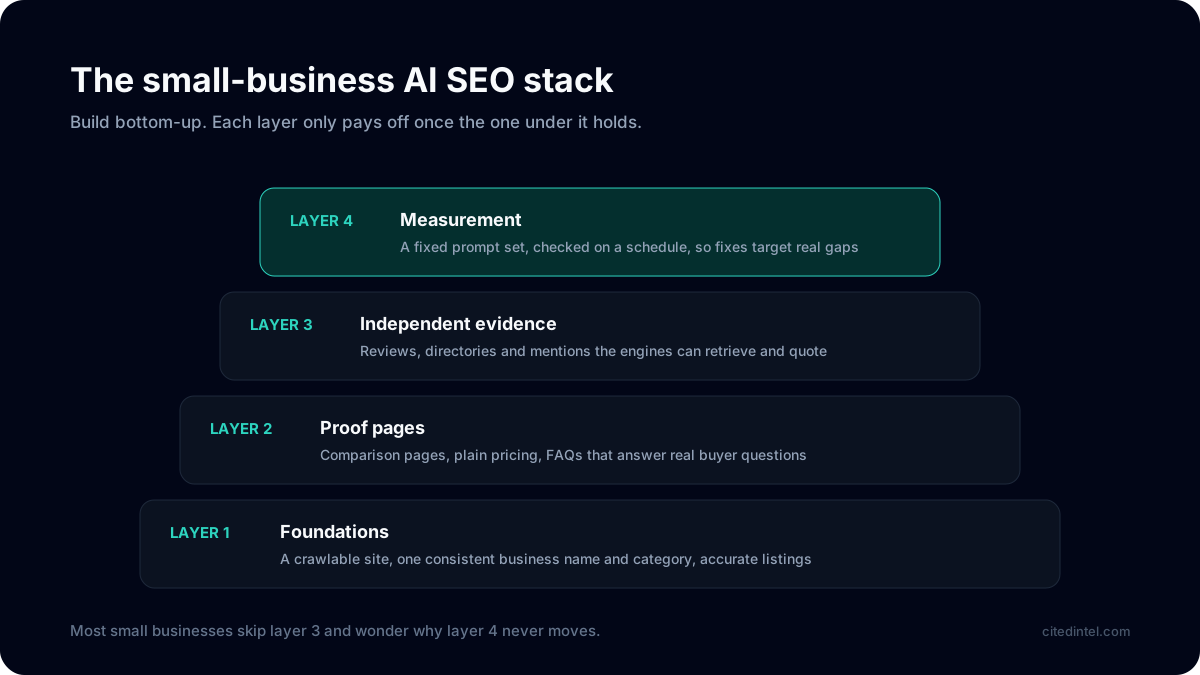
AI SEO for small business is a publishing discipline with a measurement loop: answer the complete buyer question, consolidate the comparison, build external proof, align company facts, and review ten prompts every month. Businesses that make those tasks routine give buyers and answer engines better reasons to choose them.
Frequently asked questions
What is AI SEO for small business?
AI SEO for small business improves the public information assistants use when recommending a company. It combines clear answer-shaped pages, customer reviews, independent profiles, consistent company facts, and regular prompt checks.
What should an AI SEO comparison page include?
It should compare real alternatives by operating model, technician workflow, office workload, commercial fit, and switching effort. Each assessment should identify supporting evidence, such as documentation, screenshots, workflow examples, or published pricing.
Is GEO different from AEO?
Generative engine optimization focuses on earning brand exposure in machine-generated responses. Answer engine optimization focuses on making page-level information clear and well-supported so an assistant can quote or rely on it.
How many prompts should a small business track for AI search optimization?
The article recommends starting with 10 buyer prompts covering discovery, fit, comparison, pricing, implementation, trust, switching, and regional needs. Run the same prompts on the same date each month and record brand presence, recommendation position, cited source, competitors, and factual corrections.