
When shoppers ask an assistant what to buy, the answer names a handful of products, and that short list is the shelf now. Product feeds and product detail pages decide placement on it; they serve as evidence, not storefront copy. A missing variant, vague ingredient claim, or review footprint limited to the brand’s own site can keep a D2C product out of a serious AI recommendation.
Generative engine optimization for ecommerce helps consumer brands earn inclusion in AI-generated product recommendations by making product facts, shopper fit, reviews, and trust signals easy to retrieve and corroborate. The work spans the PDP, merchant feed, marketplaces, review networks, expert commentary, and the claims connecting them.
How AI assistants assemble a product recommendation
AI assistants assemble ecommerce recommendations by weighing product metadata alongside evidence about fit, availability, price, quality, reviews, and seller credibility. The resulting recommendation resembles a compact buying argument rather than a conventional search result.
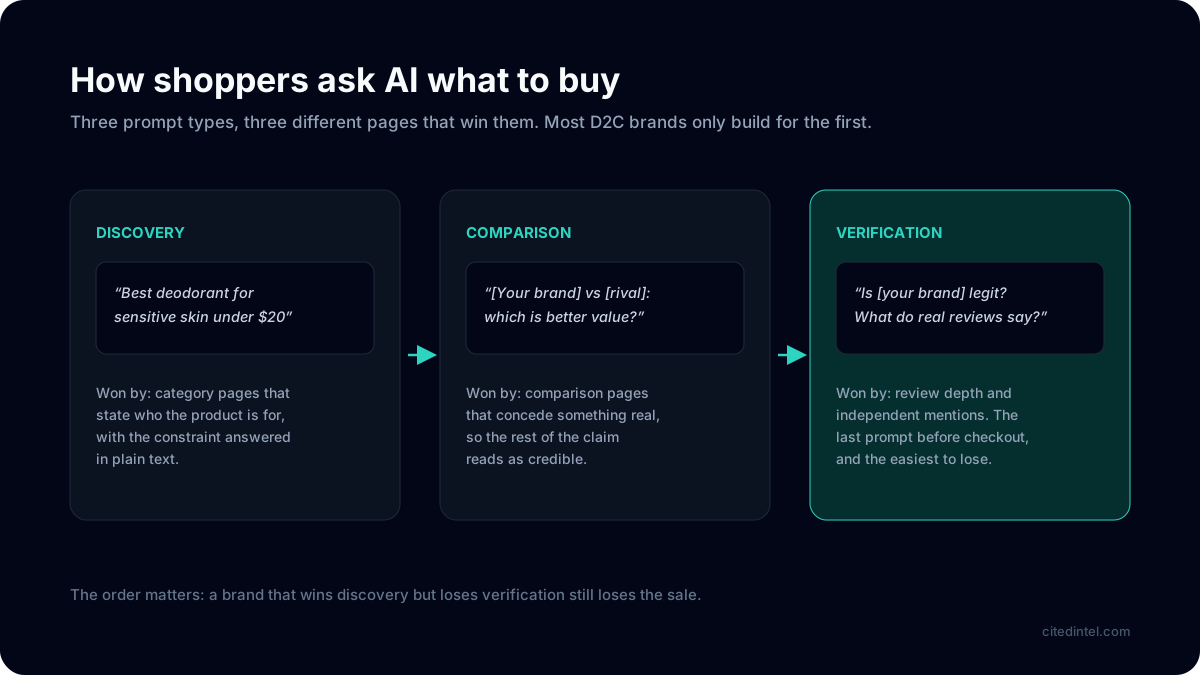
OpenAI’s shopping documentation, updated in August 2026, says product results can draw on structured data from first-party and third-party providers, as well as price, descriptions, availability, reviews, quality, and whether the merchant is the maker or primary seller. A skincare brand answering a question about vitamin C serum for sensitive skin therefore has several separate facts to support.
The assistant needs to identify the product category, understand the skin concern, locate the ingredient concentration, check availability, and find evidence about customer experience. If those details sit in disconnected places, the answer has to bridge the gaps through inference. Inference is a poor foundation for a product recommendation.
ChatGPT, Claude, and Gemini may encounter the same product through different public sources. Perplexity’s shopping experience can also draw on a merchant-owned page, a product feed, a retailer listing, a review site, a community discussion, or an editorial buying guide. The source mix changes with the question and market, so every public product fact belongs in the brand’s answer footprint.
My view is straightforward: ecommerce GEO starts with merchandising discipline. A polished brand story cannot repair a product page that says “made for everyday radiance” while omitting the concentration, texture, size, compatibility, or people who should choose another product.
The product detail page is the answer source
A PDP earns quotation by stating shopper decision facts in short, explicit blocks. The first screen should identify what the product is, who it suits, its defining specification, and the limitation that could change the purchase.
The fields below deserve priority because they address the follow-up questions shoppers ask after an assistant gives them a broad recommendation.
- Plain product name: State the category, primary function, format, size, and meaningful differentiator. “12% Vitamin C Serum for Sensitive Skin, 30 ml” gives an assistant more usable material than “Glow Theory Radiance Veil.”
- Fit statement: Say who should consider the product and who should select another option. Include skin type, dietary preference, age range where relevant, device compatibility, garment fit, or household setting.
- Specifications: Publish dimensions, weight, concentration, materials, power details, serving size, warranty, included parts, and care requirements in labeled fields.
- Ingredient or material list: Use full names and standardized units. For supplements and wellness products, separate active ingredients from other ingredients and avoid implying medical outcomes.
- Usage instructions: Explain frequency, amount, preparation, storage, charging, cleaning, or pairing requirements. A shopper should not need a support article to use the product safely.
- Tradeoffs: State texture, taste, scent, learning curve, noise, drying time, fit limitations, subscription terms, or replacement costs. Comparison answers need a reason to select one option over another.
- Availability: Keep stock status, price, currency, delivery region, shipping window, and variant availability aligned with the feed.
- Policy facts: Make returns, exchanges, warranty, allergen notes, recycling, and subscription cancellation visible near the purchase decision.
Google’s January 2026 retailer update added data fields for common product questions, compatible accessories, and substitutes across its conversational commerce work. A home and kitchen brand should answer “what works with this?” and “what should I buy instead?” on the PDP, rather than leaving those decisions to an assistant with partial information. Google’s retailer update describes the change in concrete terms.
Product naming deserves its own review. OpenAI says titles and descriptions may be simplified from third-party data. A poetic name can help with memory, but it should sit beside a functional name that remains understandable when another system shortens or rewrites it.
The field notes embedded in this article show a consistent pattern in observed buyer prompts: recommendation signals gather around product fit, specific attributes, recurring review language, and evidence beyond the brand’s storefront. Use those notes to shape your audit, while keeping the final test specific to your category and market.
Write PDP copy in quotable blocks
Each important fact should work as a standalone answer. “This electrolyte powder contains 2 g of sugar per serving and is designed for everyday hydration, not medical treatment” is easier to retrieve and safer to interpret than a paragraph built around lifestyle language.
Use one field format across variants. If the 30 ml serum lists its concentration and the 50 ml serum does not, an assistant may treat the larger size as a separate, less documented product. Variant pages need their own price, stock, dimensions, ingredients, and identifier.
Do not hide important product facts inside tabs that fail to render, image text, or expandable sections missing from the server-delivered page. A technical review should confirm that visible text, structured data, canonical URL, and merchant feed describe one product. The technical access checks used in classic SEO still matter here, but the ecommerce consequence is more direct: an inaccessible field can change the recommendation.
Feed hygiene turns a product into a reliable entity
A merchant feed should agree with the PDP, checkout, marketplace listings, and fulfillment system on every fact that can change a shopper’s decision. Feed hygiene is part of generative engine optimization because assistants need confidence that a recommended item can be bought on the stated terms.
OpenAI’s June 2026 merchant-feed terms call out missing fields, formatting inconsistencies, discrepancies between feeds and merchant properties, and technical integration problems. Treat those requirements as an operating checklist rather than a setup task that disappears after launch.
| Field | What to reconcile | Failure a shopper may see |
|---|---|---|
| Title and identifier | Product name, SKU, GTIN where applicable, and canonical URL | The assistant joins reviews to the wrong size or model |
| Variant | Color, flavor, scent, size, pack count, capacity, and parent-child relationship | A recommendation names an unavailable or unsuitable version |
| Price | Current price, sale price, currency, subscription price, and unit price | The quoted price conflicts with the cart |
| Inventory | In-stock status, backorder language, regional availability, and quantity limits | The product is recommended after it becomes unavailable |
| Shipping | Destination, delivery estimate, cutoff time, and shipping charge | A local shopper receives an answer based on another market |
| Policies | Returns, warranty, cancellation, age restrictions, and required disclosures | The purchase sounds lower-risk than the actual terms |
Google’s March 2026 Universal Commerce Protocol update added a catalog capability that lets agents retrieve retailer-controlled variant, inventory, and pricing details. Stale commerce data can affect whether an assistant treats a product as a usable recommendation, not only whether a shopper converts after reaching the PDP. Google’s UCP update provides the date and catalog context.
Run the reconciliation by market. A beverage brand selling in the United States, United Kingdom, India, and the UAE may have different pack sizes, currencies, tax treatment, delivery promises, and permitted claims. One generic promise across those markets creates ambiguity for shoppers and answer engines.
Marketplaces provide useful corroboration when their listing facts match the source of truth. They also reveal contradictions quickly. If an authorized retailer shows an old ingredient panel or a different warranty, correct the retailer record or publish a dated clarification on the brand site.
My opinion is that a feed belongs to ecommerce operations, not to an invisible SEO backlog. The person responsible for stock and catalog quality has the information needed to prevent a recommendation from ending in a dead product, the wrong variant, or a price dispute.
Reviews are evidence, not decoration
Reviews help assistants summarize repeated shopper experiences, but ratings and review summaries do not prove that a product claim is true. OpenAI says its shopping review summaries use reviews from public websites and are not independently verified, while Perplexity says its Instant Buy flow analyzes reviews across multiple sites before filtering products for a shopper’s needs.
Review footprint is therefore a GEO input with two dimensions: coverage and language. A product reviewed only on its own PDP has less independent context than a product discussed by verified customers across a retailer, a community, and an editorial source.
- Collect attributes: Ask reviewers about decision facts such as scent strength, fit, texture, mixability, battery life, noise, packaging, or ease of cleaning.
- Preserve negatives: Do not remove fair criticism because it lowers the average rating. Recurring dislikes help an assistant describe who should skip the product.
- Separate variants: Attach reviews to the correct size, flavor, shade, model, or formula so evidence does not bleed between products.
- Answer precisely: Respond to questions about allergens, shipping, returns, durability, and use instructions with sourced facts rather than promotional language.
- Watch distribution: Track review volume, rating spread, date mix, verified status, and repeated attribute terms across owned and external channels.
UGC adds detail that a star rating cannot provide. A short video showing how a pet-care product fits a nervous dog, or how a kitchen appliance sits on a small countertop, gives an assistant context about the product in an ordinary setting.
Expert commentary supplies a different form of support. A registered dietitian discussing label interpretation, a licensed esthetician explaining an ingredient list, or an electronics reviewer measuring battery performance can help corroborate facts. The expert should state qualifications, testing conditions, and limits. A vague endorsement adds little.
For health, wellness, supplements, and insurance, keep the evidence standard higher. Product copy should not turn a review into a medical result, and an insurance page should separate general education from personalized financial advice. Third-party evidence can improve understanding without supporting a claim the evidence does not establish.
The review and independent-source work behind brand visibility on ChatGPT is relevant here, but the ecommerce task is narrower: build an evidence trail around the attributes shoppers use to choose between products.
Three product categories, three evidence problems
GEO for D2C brands changes by category because shoppers ask different fit and risk questions. The PDP, feed, and review plan should reflect the decision language of the category instead of applying one generic content template.
Beauty and skincare
A skincare PDP should make formulation and use conditions easy to compare. For “best vitamin C serum for sensitive skin,” publish the form of vitamin C, concentration, fragrance status, size, storage guidance, recommended use, and a cautious suitability statement.
Reviews should distinguish irritation, scent, pilling, absorption, packaging, and visible cosmetic preferences. Expert commentary can explain ingredient terminology, but the brand should not present general education as proof of a specific result.
Beverages and supplements
A beverage PDP should answer label questions before lifestyle questions. For “healthiest electrolyte drink that isn’t loaded with sugar,” the relevant fields include sugar per serving, sodium and other disclosed nutrients, serving size, sweeteners, flavors, pack count, and price per serving.
Feed variants need to preserve the distinction between single units, mixed packs, and subscription bundles. Reviews can add taste and dissolving detail, but they should not support disease prevention, treatment, or other health claims that require stronger evidence.
Consumer electronics
An electronics PDP should state compatibility in model-specific terms. “Works with most devices” is weak evidence for a shopper asking whether a charger supports a particular phone, laptop, connector, wattage, or regional plug.
Publish power output, dimensions, included accessories, operating requirements, warranty, noise, battery capacity, and testing conditions. Marketplace listings and specialist reviews are valuable corroboration when the testing method and model number are clear.
These category differences should shape the prompts you monitor. A skincare team should test sensitivity and routine-order questions. A beverage team should test nutrition, taste, and value. An electronics team should test compatibility, performance, and replacement questions.
Try this today: the one-product evidence sheet
Build one evidence sheet for a hero product and run the same shopper questions across the live PDP, feed, marketplaces, reviews, and expert sources. The result should show which facts an assistant can quote, which facts it may confuse, and which facts have no public support.
- Choose the product: Record the hero SKU, parent product, active variants, target countries, current price, and stock status as of August 2026.
- Run shopper prompts: Use these questions without adding brand language: “What is the best vitamin C serum for sensitive skin?”, “Which serum has no added fragrance and a clear ingredient list?”, “What should I compare before buying this type of product?”, “Is this suitable for a beginner?”, “What are the common complaints?”, “What is a better alternative if I dislike sticky texture?”, and “Can I buy it in [country] with a simple return policy?”
- Capture answer evidence: For each answer, record named products, quoted facts, cited pages, review themes, missing attributes, price, availability, and the date. Give each answer engine its own source field instead of combining observations into one row.
- Score the PDP: Mark each field as present, absent, ambiguous, or contradictory: category, audience fit, ingredient or material detail, usage, limitation, variant, price, stock, delivery, returns, and compatibility.
- Score the review footprint: Record the external sites with relevant reviews, recurring likes, recurring complaints, review dates, variant association, and whether a third-party source challenges a brand claim.
- Rewrite one block: Use this pattern: “[Product] is a [category] for [specific shopper]. It contains or includes [key specification]. Choose it when [fit condition]. Choose another option when [limitation].” Add the source or testing detail beside any claim that needs proof.
- Reconcile commerce data: Compare the rewritten block against the merchant feed, checkout, marketplace listings, and fulfillment promise. Fix the first contradiction before adding new copy.
- Repeat the follow-up: Ask, “What would make you choose another product?” and “What information is missing?” Those questions expose tradeoffs that broad category prompts hide.
Use Citedintel’s free GEO checker to turn the hero-product prompt set into a dated baseline, then assign each missing fact to ecommerce, content, customer care, or partnerships.
A 30-day repair plan for one hero product
A 30-day GEO repair plan should fix the product record before expanding the content program. One well-documented hero product gives a D2C team a cleaner learning loop than ten lightly edited PDPs.
Days 1 to 7: establish the source of truth
Export the current PDP fields, feed fields, checkout facts, marketplace attributes, and customer-care answers. Mark contradictions in price, stock, ingredients, pack size, delivery, returns, and variant identifiers.
Rewrite the title, fit statement, specification table, usage instructions, and limitation block. Keep the emotional brand voice in the introduction and supporting sections, but reserve decision fields for plain language.
Days 8 to 14: repair retrieval and merchant data
Connect each variant to the right identifier and canonical URL. Check that structured product data, visible page content, feed values, and regional availability agree. Confirm that important text renders without requiring an interaction.
Add common-question answers to the PDP. For a pet-care product, those questions may cover size selection, cleaning, adjustment, and suitable animal types. For apparel, they may cover measurements, fabric weight, opacity, shrinkage, and exchanges.
Days 15 to 21: build independent evidence
Map recurring review language to product attributes. Invite verified customers to describe their experience without scripting positive conclusions. Ask retail partners to correct outdated listings and supply current product facts where their pages differ.
Identify two or three credible editorial, expert, or community contexts where the product category is discussed. Offer a factual product sheet with ingredients, specifications, testing conditions, and limitations. Do not ask writers to repeat a claim they cannot verify.
Days 22 to 30: retest the buying questions
Repeat the original prompt set across priority countries and languages. Compare product inclusion, quoted facts, cited sources, review themes, alternatives, price, and availability against the August baseline.
Separate a content problem from a distribution problem. If the PDP contains the fact but assistants cite a retailer with an outdated value, the next task is source correction. If the product has no external review language for a key attribute, the next task is customer evidence and credible commentary.
Citedintel keeps this product-level work organized across the major answer engines, with weekly prompt checks, missing-signal diagnoses, editable content recommendations, and executive reporting. The product catalog still belongs to the ecommerce team. The benefit is a dated view of which facts and sources are shaping shopper answers.
Measure recommendation quality, not page activity
AI search optimization for ecommerce should be measured through recommendation inclusion and evidence quality, then connected to shopper behavior where analytics can support the link. Page sessions alone cannot show whether an assistant presented the product as a credible choice.
Track the product’s appearance for category, comparison, fit, ingredient, specification, alternative, price, availability, and follow-up prompts. Record its position in the answer, the facts quoted, the cited sources, competing products, and whether the answer reflects the correct market and variant.
- Recommendation rate: How often the hero product is named for prompts that describe its real fit.
- Evidence coverage: How often the answer includes correct product facts from the PDP, feed, marketplace, or independent source.
- Contradiction rate: How often price, stock, ingredients, specifications, or policy terms conflict across sources.
- Review support: Whether recurring customer language matches the attributes the brand wants shoppers to evaluate.
- Commercial path: Whether cited visits, assisted sessions, product views, add-to-cart events, and repeat purchases change after a documented fix.
Do not claim revenue from an AI recommendation unless your measurement setup can support that claim. A shopper may see an answer on one device, search elsewhere, buy through a retailer, and return later through email. The responsible goal is to connect changes in AI search optimization to observable behavior without pretending attribution is cleaner than it is.
My view is that ecommerce GEO is a catalog and evidence practice before it becomes a publishing practice. When the product record is precise, reviews describe real tradeoffs, and independent sources support the important facts, assistants have material they can use. When those layers disagree, more blog posts will not solve the selection problem.
Start with one hero product, one market, and one prompt set. Fix what shoppers and assistants cannot establish, then carry the useful fields, review questions, and feed checks into the next product.
Frequently asked questions
What is generative engine optimization for ecommerce?
Generative engine optimization for ecommerce is the practice of making product facts, shopper fit, reviews, availability, and trust signals easy for AI assistants to retrieve and corroborate. It covers the product detail page, merchant feed, marketplaces, review networks, expert sources, and the claims connecting them.
How does GEO help D2C brands get product recommendations from AI?
GEO gives AI assistants clearer evidence about what a product is, who it suits, how it compares, and whether it can be purchased on the stated terms. Accurate PDP fields, aligned feeds, independent reviews, and specific tradeoffs make a product easier to include in a recommendation.
How do I improve product pages for AI search?
Use standalone blocks for the product category, audience fit, specifications, ingredients or materials, usage, limitations, variants, price, stock, delivery, and policies. Keep visible page text, structured data, canonical URLs, and merchant feeds aligned, and do not hide decision facts in inaccessible tabs or image text.
What should an ecommerce product feed include for AI recommendations?
The feed should reconcile titles, identifiers, variant relationships, prices, currencies, inventory, regional availability, shipping, returns, warranties, and other purchase conditions with the PDP and checkout. Market-specific feeds should reflect local pack sizes, taxes, delivery promises, and permitted claims.
How can reviews improve AI product recommendations?
Reviews add repeated customer language about attributes such as scent, texture, fit, mixability, battery life, noise, or cleaning. Brands should collect this detail, preserve fair criticism, associate reviews with the correct variant, and build review coverage beyond the brand's own website.