
ChatGPT visibility rises when a brand becomes easy to retrieve, easy to describe, and easy to defend. Publishing more pages rarely solves a missing-evidence problem.
To increase your brand's visibility on ChatGPT, build a public trail of consistent facts, useful buying assets, and independent proof. Generative engine optimization (GEO) covers the wider work of earning presence in AI-generated responses; answer engine optimization (AEO) focuses on making individual pages and passages clear enough to quote.
1. Give your category a sentence people can repeat
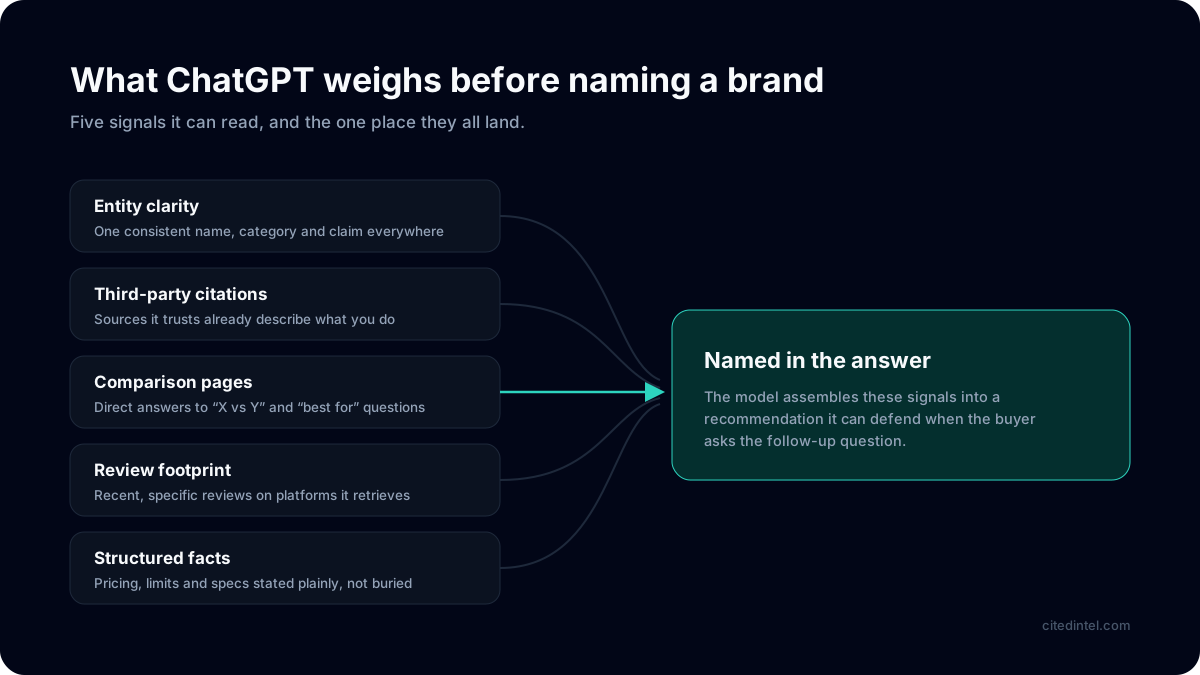
A brand becomes easier to retrieve when its category, buyer, and core job appear in one repeatable sentence. Your homepage, company profile, product descriptions, and third-party listings should make the same basic claim.
For a logistics technology business, “Route planning and dispatch software for regional delivery fleets” gives an answer engine more usable context than “The future of connected operations.” The sentence identifies the product class, the operating environment, and the problem.
Use this template:
- Category: Name the product type buyers already use.
- Customer: State who buys or operates the product.
- Job: Describe the decision or workflow the product supports.
- Boundary: Say what the product does not cover when confusion is likely.
My view is simple: a clever positioning line that changes from page to page costs more in retrieval than it gains in creativity. Give the market one description it can repeat.
2. Make every public profile describe the same company
Consistent entity language helps ChatGPT connect your website with your LinkedIn company page, YouTube channel, review profiles, and other public references. Deloitte Belgium’s April 2026 GEO methodology recommends defining the brand through its category, experts, problems solved, and supporting evidence, then carrying that wording across public surfaces.
Audit the following fields as one record rather than as separate channel work:
- Brand name: Use the same spelling, capitalization, and legal name.
- Category phrase: Repeat the same product classification.
- Customer description: Keep the company size, market, or operating context accurate.
- Product scope: Describe the supported workflows and integrations consistently.
- Proof language: Use the same factual claims, dates, and customer evidence.
A logistics software company that calls itself “fleet management” on its website, “last-mile delivery intelligence” on LinkedIn, and “driver productivity software” on review sites creates three possible entities. ChatGPT may understand the relationship, but you are asking the retrieval layer to resolve avoidable ambiguity.
Check country-level profiles too. A company that leads in India but uses different product wording on its US or UK pages can appear less relevant when buyers ask for vendors in those markets.
3. Build the buying pages an assistant needs
ChatGPT needs more than a polished product page to answer a buyer’s comparison question. It commonly needs a page that explains fit, integrations, implementation, pricing context, limitations, or alternatives.
IDC’s June 2026 analysis describes AI-generated buyer answers as drawing from analyst coverage, peer-review sites, press, forums, social media, and vendor pages. Citedintel’s August 2026 live corpus study reaches the same practical conclusion for buying questions: review platforms, community discussions, and comparison pages frequently appear in citation lists.
Build an asset map around the questions a logistics buyer asks before a purchase:
| Buyer question | Page to publish | Evidence to include |
|---|---|---|
| Can it handle our delivery model? | Industry or workflow page | Fleet size, delivery regions, route constraints, and operating limits |
| Will it connect to our stack? | Integration documentation | Supported systems, data exchanged, setup steps, and ownership |
| How does it compare? | Comparison or alternatives page | Best-fit conditions, tradeoffs, switching costs, and exclusions |
| What happens after purchase? | Implementation guide | Timeline, training, migration work, dependencies, and support |
| Can procurement approve it? | Security and compliance page | Controls, hosting details, access rules, and documentation dates |
Do not hide the useful answer behind a form. A gated sales brief may help your pipeline team, but a public implementation page gives an assistant something it can quote.
4. Put the answer before the explanation
Answer-first pages give ChatGPT a sentence it can lift without reconstructing your argument. Put the recommendation, definition, requirement, benchmark, or limitation in the first two sentences under each meaningful heading.
Deloitte Belgium’s April 2026 guidance favors direct openings, descriptive headings, bullets, and comparison tables. Apply that advice to pages built for a real decision, not to every paragraph on your site.
Replace this opening:
Modern delivery teams face increasing pressure to improve efficiency while meeting customer expectations across a complex network of routes, drivers, and facilities.
With this:
Route optimization software is useful for regional delivery fleets that need to assign stops, account for driver constraints, and revise routes during the day. It is a poor fit when dispatchers only need static maps and manual scheduling.
The second version gives ChatGPT category, fit, and a limitation in two sentences. Follow it with evidence, examples, and a clear explanation of how the claim was established.
Use headings that answer a prompt:
- Best fit: Which delivery operation should use this product?
- Integration detail: Which transportation management systems connect to it?
- Buying limit: When does route optimization add little value?
Classic SEO tools can help you find language, but a ranking report cannot tell you whether a passage gives an assistant enough material to defend a recommendation. That is why classic SEO and AI search work need separate checks.
5. Ask independent sources to describe a real difference
Third-party proof increases brand visibility when it contains specific language about customers, results, limits, or product differences. A directory entry that only repeats your tagline gives ChatGPT little help during a comparison.
Deloitte Belgium’s April 2026 research advises brands to expect cross-checking against independent reviews and other authoritative sources. Ask reviewers, partners, trade publications, and customers to describe a concrete fact that a buyer could use.
- Specific customer: Identify the operation, company size, or workflow discussed.
- Specific problem: Name the scheduling, dispatch, or communication issue.
- Specific change: Describe what the product altered without inflating the result.
- Specific boundary: Explain a condition where another approach may be better.
“Easy to use” is weak evidence. “Designed for regional fleets that need same-day route changes without rebuilding the entire schedule” is a usable description, provided the source can support it.
Give customers a factual review brief, not scripted praise. Suggest the topics they may cover, then let them write in their own words. Fake review bursts are especially poor practice because unusual timing, repeated phrasing, and low-detail accounts can damage trust across the very sources an assistant consults.
6. Let comparison pages state where you lose
Comparison pages help ChatGPT recommend a brand when they explain which option fits which condition. A page that declares your product superior in every category reads like an advertisement and gives the answer engine no credible decision rule.
For logistics technology, compare route optimization, dispatch coordination, proof of delivery, driver communication, and reporting as separate buying needs. State the conditions that favor your product and the conditions that do not.
| Comparison element | Useful wording | Weak wording |
|---|---|---|
| Customer fit | Best for regional fleets with variable daily routes | Best for every delivery business |
| Implementation | Requires clean stop data and dispatcher training | Simple setup for any team |
| Integration | Supports the listed systems through documented connections | Works with all business software |
| Tradeoff | More useful for changing routes than fixed weekly schedules | Better than spreadsheets in every situation |
Include “who should not buy this” as a heading. That phrase gives a buyer and an assistant a defensible boundary, which can matter more than another benefits section.
7. Organize customer proof around buyer questions
Customer evidence works better when the source states the operating context and the observed change in plain language. Product marketers should organize evidence by buyer question rather than by campaign date.
For a field service or logistics software page, create a proof bank with entries such as:
- Workflow: What task changed, such as route assignment or delivery confirmation?
- Starting condition: What was difficult before the product was introduced?
- Observed outcome: What did the customer report, measure, or document?
- Time frame: When did the customer observe the change?
- Source: Where can a reader verify the statement?
Keep the claim narrower than the evidence. “Reduced missed delivery communication during a seasonal peak” is safer and more useful than “transformed fleet performance.” Assistants can quote the narrower statement without guessing what “transformed” means.
My position is that one dated customer sentence with operating detail beats ten anonymous testimonials. The former can support a recommendation; the latter mainly decorates a landing page.
8. Publish evidence that others can reference
Original evidence creates reasons for independent sources to mention your brand. Publish a small dataset, field benchmark, integration test, or buyer survey with the sample, date, method, and limit beside the finding.
A logistics software company could publish delivery exception patterns by route type, provided the data is lawful, anonymized, and explained. A useful page might state the observation first, show the table next, and explain the sample directly below it.
Community participation matters when the answer solves the question before the brand appears. A technical explanation of how to clean address data can earn more durable recognition than a promotional reply that links to a product page.
Microsoft Research’s April 2026 analysis of more than 200,000 human-ChatGPT interactions found that almost 80% of queries were “non-searchable,” meaning open-ended questions that conventional search may not handle well. For searchable questions, the study found less diversity in ChatGPT responses than in Google results across most topics. Distinctive expertise therefore gives a brand a better chance of entering a narrower answer set, especially when the evidence is public and specific.
9. Remove contradictions before commissioning another page
Contradictory facts reduce the chance that ChatGPT can represent your brand accurately. Before commissioning another article, compare pricing language, integration lists, customer size claims, geographic coverage, and product names across your public pages.
Use a single editorial record with these columns:
- Claim: The sentence your brand wants repeated.
- Owner: The team responsible for checking it.
- Sources: First-party and independent pages that support it.
- Review date: The date the claim was last confirmed.
- Conflict: Any public wording that needs correction.
Update old documents, not only the homepage. A stale integration page can be the source ChatGPT cites when a buyer asks a technical follow-up, even if your new product page has the correct information.
Use consistent terminology in videos too. YouTube descriptions, episode titles, captions, and transcripts are public evidence surfaces, not separate brand worlds.
10. Run these ten prompts against your brand
A ten-prompt self-test shows whether your brand appears for buyer questions and whether the cited evidence supports the answer. Run the same prompts in ChatGPT with web search available, save the answer, and record the observation date.
- What are the best route planning tools for a regional delivery fleet?
- Which vendors support our listed dispatch integration?
- What are the strongest alternatives to [brand]?
- How does [brand] compare with [competitor] for changing daily routes?
- What is the most affordable option for a fleet of [size]?
- Which product fits a company operating across [country or region]?
- What are the common drawbacks of [brand]?
- How long does implementation usually take for [brand]?
- Which vendor is best for proof-of-delivery workflows?
- Who should not buy [brand]?
Record four fields for every answer:
| Field | What to record |
|---|---|
| Presence | Named, absent, or mentioned only after competitors |
| Position | Where the brand appears in the recommendation order |
| Citedintel page | The URL ChatGPT used, if one is shown |
| Accuracy | Any wrong, stale, or unsupported product statement |
Do not ask only branded prompts. A brand can answer its own name while remaining absent from category discovery and comparison questions. Deloitte Belgium’s April 2026 methodology recommends a larger audit of 50 to 100 real buyer prompts; ten gives a practical first sample for a content team deciding what to fix next.
Citedintel scales this observation process across buyer-intent prompts and funnel stages, then shows the missing content and proof areas to address; start with the free GEO audit.
11. Separate being named from being recommended
A raw mention count can hide weak brand visibility on ChatGPT. Track whether the brand appears, where it appears, which source supports it, and whether the answer describes the brand accurately.
Citedintel’s August 22, 2026 live corpus study analyzed more than 63,000 ranked brand appearances. The median answer named 10 brands, while 55% of mentions appeared in position six or later. A brand that appears tenth has a different commercial opportunity from a brand that appears among the first recommendations.
Use this weekly scorecard:
- Prompt presence: The share of tracked buyer questions where the brand appears.
- Top-five rate: The share of answers where the brand reaches the first five recommendations.
- Citation quality: Whether the cited URL supports the claim being made.
- Accuracy rate: Whether the answer gets product facts right.
- Independent proof: Whether outside sources support the same recommendation.
A demand report may show growing branded searches while ChatGPT still omits the brand from category prompts. Those are different signals. AI search analytics should sit beside, not replace, conventional demand data.
12. Reject markup tricks and manufactured praise
Schema spam, LLM-bait pages, and fake review bursts do not replace evidence. Structured data can clarify a legitimate page, but repeated organization fields or manufactured “AI answer” text cannot create independent trust.
LLM-bait pages often announce the answer in unnatural language, repeat the brand name, and add little information for a human buyer. They may be easy to detect as promotional copy, and they rarely answer the follow-up questions that decide a purchase.
Use this filter before publishing:
- Human value: Would a buyer save the page for its information?
- Source value: Can an independent writer cite a specific passage?
- Claim support: Does every material statement have evidence?
- Maintenance: Does an owner have a date and reason to refresh it?
Schema remains useful for representing real facts such as organization details, products, reviews, and events. It cannot compensate for conflicting public descriptions or an empty review profile. My advice is to repair the evidence trail before adding markup.
What can move within days
ChatGPT searches the live web, so a published correction can surface within days after the relevant page is crawled or recrawled. Citedintel’s August 2026 field notes recorded a visible citation shift roughly six days after a search-layer change, while retrieval of some sources continued beyond that point.
That observation supports a careful operating rule: recheck a published fix after several days, but do not treat speed as a ranking promise. Recrawl timing varies by page, source, engine, and query.
Google Search Console adds a useful directional signal during this work. In Citedintel’s August 2026 GEO work on citedintel.com, unusual and highly specific comparison queries, including operator-heavy searches, appeared in Search Console without obvious human traffic. Those queries may indicate discovery or evaluation by assistants and research agents, but they do not prove buyer volume.
When a new comparison page is published, watch for three things together: the page’s indexing and impressions, changes in the cited source during prompt checks, and whether the answer now describes the brand correctly. One signal alone is too easy to misread.
Put the evidence gaps in publishing order
The right next page is the one that removes the largest recommendation gap, not the one that adds another broad keyword. Sort each failed prompt from the self-test by missing evidence, incorrect representation, absent third-party proof, or weak recommendation position.
A practical queue looks like this:
- Correct: Repair contradictory entity language and stale product facts.
- Support: Add the comparison, integration, implementation, or limitation page missing from the answer.
- Prove: Secure an independent review, technical reference, customer explanation, or original finding.
- Recheck: Run the same prompt after recrawl and record the cited source.
If you run content for a logistics software business, that queue may begin with route-planning fit, then move to dispatch integrations and implementation requirements. The same logic applies to legal tech or hospitality technology, but the evidence changes with the buying question.
Citedintel provides the scaled version of this loop by auditing answer presence, position, cited sources, missing recommendation signals, and publishable fixes in one workspace. The result you want is not a larger mention tally. It is a brand that appears in the right buyer conversation with a source strong enough to survive the next question.
Parth Sesodia is Founder, Citedintel.
Frequently asked questions
What is GEO for ChatGPT brand visibility?
Generative engine optimization, or GEO, is the broader work of earning visibility in AI-generated answers. For ChatGPT, it means creating consistent public facts, useful buying pages, and independent proof that support accurate recommendations.
How do I show up in AI search for category questions?
Start with a clear category sentence that names your product type, customer, and core job. Then publish public pages covering fit, integrations, comparisons, implementation, pricing context, and limitations so ChatGPT has material for non-branded prompts.
Do AEO pages help ChatGPT recommend my brand?
Answer engine optimization helps individual passages state their answer clearly enough to quote. Put the recommendation, definition, requirement, or limitation in the first two sentences under each meaningful heading, then support it with specific evidence.
What should I publish to improve ChatGPT visibility?
Publish pages that answer buying questions, including industry or workflow guides, integration documentation, comparison pages, implementation guides, and security information. Add customer proof with operating context, dates, observed outcomes, and source links.
How can I measure AI search optimization for my brand?
Run a consistent set of buyer prompts with web search available and record whether your brand appears, where it ranks, which URL ChatGPT cites, and whether the product description is accurate. Track prompt presence, top-five rate, citation quality, accuracy rate, and independent proof over time.