
AI search is now a media channel. Buyers form vendor impressions inside an answer before they visit a website, just as they once formed them through trade press, analyst notes, or paid placements. The shortlist can take shape in the answer, whether the buyer clicks afterward or skips the site entirely.
My view is direct: the answer is the placement, evidence is the creative, retrieval is the distribution, and artificial intelligence search optimization, AI SEO for short, is the discipline that decides which brands get seen. A brand buys its way into that placement with credible evidence, not with spend alone and not with a page-production quota.
AI search is a media channel before the first click
Traditional media shaped demand by deciding which companies appeared in front of a relevant audience. AI search does something more consequential for complex purchases. It can summarize the category, compare vendors, explain trade-offs, and recommend a shortlist in one response. The buyer may arrive at a site later, but the first impression has already happened.
McKinsey’s May 2026 Global B2B Pulse Survey places generative AI among the top five channels used to discover and assess suppliers. That makes answer presence relevant before a prospect reaches a pricing page, starts a trial, or books a demo.
The media analogy is practical, not decorative. Reach means appearing across the buying questions that matter. Share of voice means being named and recommended against competitors. Placement quality means appearing in a precise, trustworthy answer rather than a vague category list. Creative quality means supplying evidence that supports the recommendation. Measurement means connecting answer exposure to recall, referrals, branded demand, and opportunity influence.
Artificial intelligence SEO is therefore not a renamed version of classic SEO. Classic SEO helps pages become accessible, indexable, and discoverable. AI SEO helps a brand become retrievable, representable, and defensible inside an answer. The distinction between conventional SEO tools and AI search monitoring matters when deciding which problem a new platform should solve.
| AI SEO activity | What the budget covers | Route to revenue | Question to ask first |
|---|---|---|---|
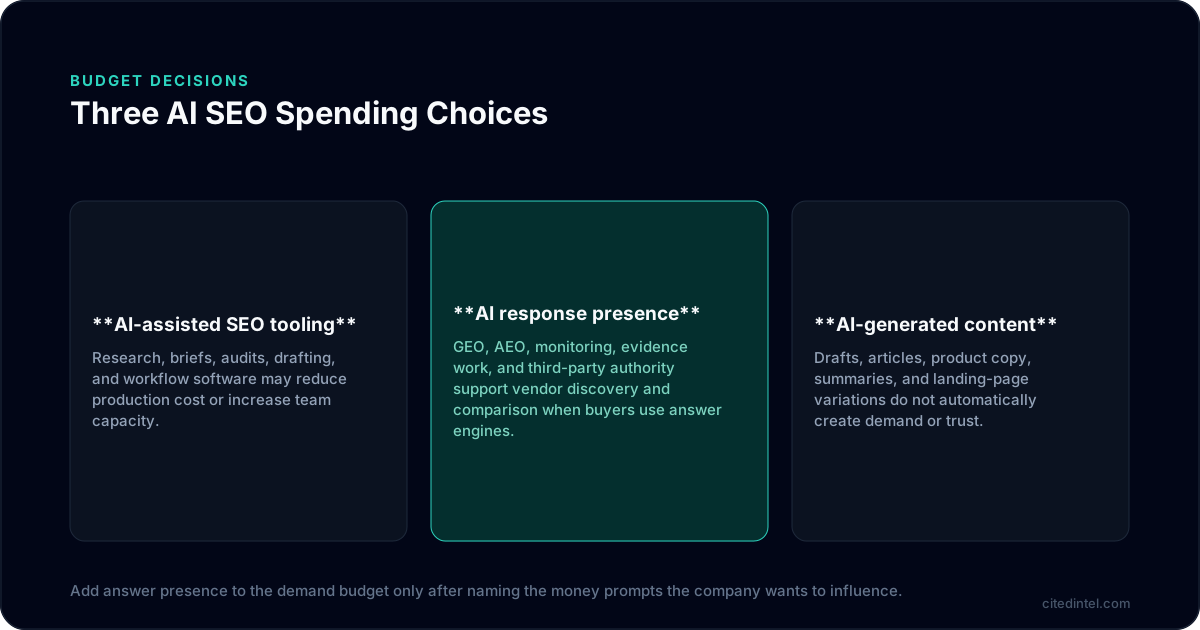
| AI-assisted SEO tooling | Research, briefs, audits, drafting, and workflow software | Indirect. The investment may reduce production cost or increase team capacity. | Which known bottleneck becomes cheaper or faster? |
| Presence in AI-generated responses | Generative engine optimization (GEO), answer engine optimization (AEO), monitoring, evidence work, and third-party authority | Direct when buyers use answer engines to find and compare vendors. | Which commercial prompts produce a recommendation, citation, or referral? |
| AI-generated content | Drafts, articles, product copy, summaries, and landing-page variations | Variable. More words do not automatically create demand, trust, or answer presence. | What buyer evidence will this asset add? |
The placement is an answer supported by evidence
An answer engine can mention a company without giving it meaningful commercial visibility. The stronger placement is a recommendation that explains fit, names relevant capabilities, states limits, and cites sources a buyer can inspect. A brand may be present yet still lose the consideration battle if a competitor receives the clearer explanation.
Our platform audits repeatedly surface a gap between a vendor’s preferred positioning and the evidence an answer engine can use to support that positioning. The commercial question is not whether a brand appears somewhere. It is whether the answer contains enough accurate proof to place that brand in a buyer’s consideration set.
That proof can live in product documentation, customer reviews, partner pages, analyst material, forums, technical references, or the company website. McKinsey reported in October 2025 that a brand’s own website may account for only 5% to 10% of sources referenced in AI-powered responses. Editing owned pages cannot repair every answer gap.
This changes the creative brief. A generic article about a category is not enough when the buyer asks which platform supports a particular workflow, integration, region, security boundary, or implementation model. The useful asset is the evidence that lets the answer make a specific and accurate claim.
A brand with zero useful mentions has an invisible brand problem, but a brand with weak or inaccurate mentions has a placement-quality problem. The invisible brand problem in AI search often looks like a writing problem from inside the editorial calendar. The missing asset may actually be a comparison, review, technical reference, or current statement of product limits.
Baseline the channel before you buy the budget
A marketing lead should investigate current answer-engine responses before commissioning new pages or buying AI SEO software. The baseline should preserve the prompt, answer wording, named brands, cited sources, absent evidence, market, engine, and next buyer action.
Questions for a media-channel baseline
- Reach: Which category, comparison, pricing, implementation, and replacement prompts linked to revenue return the brand?
- Share of voice: Which competitors are named, recommended, or given the strongest explanation?
- Creative: Which claims are supported by current facts, and which answer passages rely on weak or generic evidence?
- Distribution: Does the response depend on the company website, customer reviews, partner pages, analyst material, forums, documentation, or other outside references?
- Action: What does the buyer do next, and can that action be observed through analytics, forms, sales notes, or opportunity data?
- Referral signals: Are visits from chatgpt.com entering analytics and the CRM with usable referral information?
Perplexity and other answer services may send fewer measurable visits than traditional search, but that does not make their answers irrelevant. A buyer can learn the category, narrow the shortlist, and arrive through direct navigation, branded search, a sales referral, or an untagged browser session.
Forrester reported in January 2026 that 94% of business buyers use AI during the buying process, while twice as many buyers consider generative AI or conversational interfaces an important information source compared with any other source. Forrester also found that buyers who use AI instead of traditional search are one-tenth as likely to click through to a website.
That lower click rate makes traffic a weaker proxy for influence. It does not prove that every untracked answer creates pipeline. It does mean the measurement plan needs referral data, self-reported discovery, branded demand, sales notes, and opportunity influence beside sessions.
Budget the channel by reach, share, and placement quality
Budget follows channel logic. The first question is not how many pages a team can publish. It is which high-value buying answers the company needs to influence, how often the brand is currently retrieved, what evidence controls the placement, and how the change will be measured.
AI SEO can still involve AI-assisted SEO software, work that improves a company’s representation in generated responses, or content produced with generative systems. Those activities have different owners, costs, and routes to commercial value.
A content director purchasing drafting software is making a capacity decision. A product marketing lead funding generative engine optimization is making a market-presence decision. When those decisions blur together, teams report more output while sales receives no additional confidence from prospects.
My view is direct: add answer presence to the demand budget only after naming the money prompts the company wants to influence. “Improve our AI presence” is not a budget brief. “Be considered for workforce scheduling software by multi-location field service companies” is one.
When each line item deserves money
- Fund assistance: Choose AI-assisted SEO software when the team has a known research, editing, or technical backlog and can compare saved effort with the software cost.
- Fund answer presence: Choose GEO work when buyers ask answer engines which vendors fit a real problem and the company can repair the evidence behind those responses.
- Use generation selectively: Use AI-generated content when every asset contributes original product facts, customer proof, expert review, or a buying decision that readers can verify.
A demand team selling procurement software might eventually use all three categories. The sequence still matters. First establish whether answer engines recommend the company for supplier intake, spend control, or purchase approvals. Then repair the missing proof. Only then decide whether assisted production can extend the work without weakening product accuracy.
I would not approve a large AI content budget because a competitor publishes at high volume. High volume can widen the evidence shortage. Hundreds of pages may repeat broad claims while buyers still cannot verify implementation effort, supported systems, security boundaries, or customer fit.
Legal tech shows why placement quality matters
Legal tech makes the channel argument concrete because buyers need more than category education. They need a defensible answer about matter type, jurisdiction, workflow fit, integrations, review risk, and the evidence behind a vendor’s claims.
A product marketing manager for legal operations software should separate prompts by buying decision. “What is contract lifecycle management?” measures broad education. “Which contract lifecycle management products support procurement teams with Salesforce integration and regional data controls?” tests whether a vendor belongs in a commercial shortlist.
Legal technology depends heavily on product boundaries and trust signals. A vendor needs current material covering permissions, audit logs, retention, integrations, review workflows, deployment options, and the limits of automation. A polished article about legal operations cannot replace those facts.
Logistics technology exposes a different evidence gap. A fleet management vendor may need proof about route planning, dispatch rules, driver communication, offline access, regional coverage, and onboarding. A buyer comparing platforms needs a defensible trade-off tied to operating conditions, not a broad statement about efficiency.
Hospitality technology creates another variation. A platform serving independent hotels should make supported property systems, booking workflows, payment boundaries, reporting, and implementation requirements easy to verify. A generic “best hotel software” page gives an assistant too little material for a precise recommendation.
The categories differ, but the channel decision stays consistent. Fund the evidence that can improve a high-value placement, then observe whether qualified conversations reflect that change.
Measure influence, not just clicks
Forrester’s February 2026 research reported that B2B companies had seen traffic declines of 10% to 40% over the prior year. The sensible response is not to discard classic SEO. Place sessions beside answer presence, cited sources, referral quality, self-reported discovery, and assisted pipeline.
As buyers complete more research within generated responses, content teams will be judged less by page traffic and more by whether reliable passages influence commercial answers. A page remains the publishing container, but the buyer’s answer becomes the unit that deserves review.
Gartner reported in May 2026 that 45% of B2B buyers used generative AI mainly to gather information on vendors and products, while 69% preferred validating AI-generated information with sales representatives. AI search can place a company into consideration, but sales and product experience still have to resolve commercial doubt.
That is why I would not award pipeline credit to a citation simply because the sentence sounded favorable. Pull referral domains from analytics, record assisted conversions, monitor branded searches related to tracked buying questions, add AI discovery to form fields, and preserve the language buyers use in sales calls.
The report I would want next quarter
- Answer coverage: The share of priority buying prompts where the company is named, recommended, or supported by a relevant source.
- Evidence quality: The proportion of responses supported by current first-party facts and credible independent references.
- Commercial referrals: Sessions and conversions that originate at AI answer services, including referral domains recorded in analytics.
- Buyer recall: Mentions of AI-assisted discovery in form submissions, sales notes, and win-loss interviews.
- Opportunity influence: Opportunities where AI-assisted discovery appears before evaluation, even when the first measurable visit came through another channel.
Build the evidence that wins the shortlist
A pipeline-first AI SEO budget should cover three jobs: finding high-value answer gaps, producing or updating evidence, and checking whether those changes affect buyer conversations. Page count is a delivery measure, not the reason for the investment.
For a B2B software business, the budget may include research software, product marketing time, technical documentation, customer proof, review development, digital public relations, analytics work, and sales enablement. The mix should match the cause of the gap. A missing integration page needs a product and documentation fix. A missing independent reference needs customer, partner, or editorial work.
Citedintel, at citedintel.com, audits real buyer-intent prompts across answer engines, shows where a company is named or absent, identifies recommendation signals associated with competing vendors, and turns findings into editable content and third-party evidence priorities. Teams can use the free GEO tool to establish an initial view before committing to a broader program.
The value is not another dashboard line. The value is avoiding a quarter of activity aimed at the wrong answer, source, or buying stage. Weekly rechecks give a team a current view when product facts, citations, and response wording change before a quarterly report catches the movement.
Google’s June 2026 Search Console update made generative-result visibility a more distinct reporting concern by exposing information about pages appearing in generative features, including impressions, appearing pages, and countries. A company selling in the United States, United Kingdom, India, UAE, or another market should separate country-level answer presence from one global average.
A strong response in one market does not prove that the same evidence is available in another language, source environment, or buying context. A product marketing team expanding from India into the United States should compare commercial prompts and cited sources in both markets rather than transfer a home-market result into an international forecast.
Do not treat this as a reason to buy a larger stack by default. It is a reason to define the commercial question before choosing AI SEO software. If a company sells through a small, relationship-led market where answer engines rarely influence vendor choice, sales research and customer proof may deserve the budget first.
A same-day baseline for your revenue prompts
You can build a useful AI search optimization baseline by running a fixed set of commercial prompts, recording the response and source evidence on August 26, 2026, and matching each result to a measurable buyer action.
- Choose five prompts: Write one category prompt, one “best for” prompt, one comparison prompt, one implementation prompt, and one replacement or alternative prompt for the product line with the greatest revenue potential.
- Use buyer wording: Pull phrases from sales calls, lost-deal notes, support tickets, pricing objections, and customer interviews.
- Record the response: Save the date, engine, country or language setting, exact prompt, recommended brands, cited URLs, product claims, and qualifications or limits.
- Classify the gap: Label each absent fact as product proof, comparison proof, implementation proof, customer proof, independent source, or conversion path.
- Connect the action: Add columns for AI referral session, demo request, organic lead, “heard about us” response, and opportunity note. Use “unknown” instead of assigning unverifiable credit.
- Assign the asset: Choose one evidence asset for the highest-value gap, with an owner, subject-matter reviewer, publication location, and supported buyer question.
- Repeat the prompt: After publication, run the same prompt with the same market context and compare recommendation, cited source, claim accuracy, and downstream buyer signals.
For a field service software company, the sheet might reveal that the brand receives category treatment for dispatch but lacks support for technician communication and offline operation. That finding supports a product proof page or customer evidence project. It does not support another broad article about field service management.
Teams that need this record across many prompts and markets can use Citedintel to bring the answer audit, evidence diagnosis, publishing priorities, and repeat checks into one working view rather than leaving findings in a one-off spreadsheet.
The budget decision I would defend
I would approve AI SEO spend when the proposal names revenue-linked prompts, identifies the evidence needed to improve those placements, and includes measurement that admits unknown attribution. I would reject a proposal built around generated word count, raw mentions, or traffic forecasts alone.
The strongest proposal assigns work beyond editorial production. Product marketing owns positioning and trade-offs. Customer teams help source proof. Sales records buyer recall. Analytics preserves referrals and assisted actions. Leadership receives a report tied to opportunities rather than a display of activity.
Treat AI search the way you would a new media channel. Buyers form vendor impressions inside answers before any website visit, so the budget question is reach, share of voice, placement quality, evidence, and measurement. Budgeting is a consequence of treating AI search as a channel, not the thesis itself.
My prediction for the next planning cycle is specific. Content leaders will defend fewer pages and more answer-level citations, while the citations that survive budget review will be attached to qualified conversations. If a citation cannot connect to a buyer question, a source worth trusting, or a measurable commercial signal, it should not outrank the evidence that can.
Teams ready to turn that baseline into an operating program can start with Citedintel and make AI SEO accountable to the channel it now serves.
Frequently asked questions
Why should AI search be treated as a media channel?
Because buyers can form a vendor shortlist inside an AI answer before visiting a website. The answer functions as the placement, evidence functions as the creative, and retrieval determines distribution.
What does AI SEO decide?
AI SEO decides whether a brand is retrieved, represented accurately, recommended for relevant buying questions, and supported by credible evidence. It is distinct from classic SEO, which focuses on crawl access, indexation, rankings, and landing pages.
Should AI SEO budgets be based on page volume?
No. Budget should follow channel logic, including reach across priority prompts, share of voice, placement quality, evidence gaps, and measurement. Page production is only one possible delivery cost.
How can companies measure AI search influence when clicks are limited?
Measure answer coverage, cited-source quality, AI referral sessions, self-reported discovery, branded demand, sales recall, and opportunity influence. Use unknown attribution rather than claiming pipeline credit that cannot be verified.
What evidence should a company fund first?
Fund the evidence most likely to improve a high-value buying answer. Depending on the gap, that may be product documentation, integration details, customer proof, independent reviews, partner references, implementation constraints, or a comparison that explains meaningful trade-offs.