
When someone asks AI assistants for a shortlist, the same three brands often show up again and again. That is usually a proof problem, not a brand problem.
Making a brand easy for assistants to verify, compare, and recommend is the work of AI search optimization. Answer engine optimization is the buyer-facing version of that same job, where fit, tradeoffs, and proof need to read cleanly without extra interpretation. Teams that treat generative discovery and answer readiness as one evidence program usually ship stronger proof than teams that manage them on separate calendars.
What the shortlist is actually rewarding
AI search shortlists reward brands that are easy to verify, not brands with the loudest positioning. When a mid-market software team asks for the best vertical billing platform for multi-entity invoicing, the systems tend to favor pages that answer the tradeoff question directly, with limits and fit stated before feature praise.
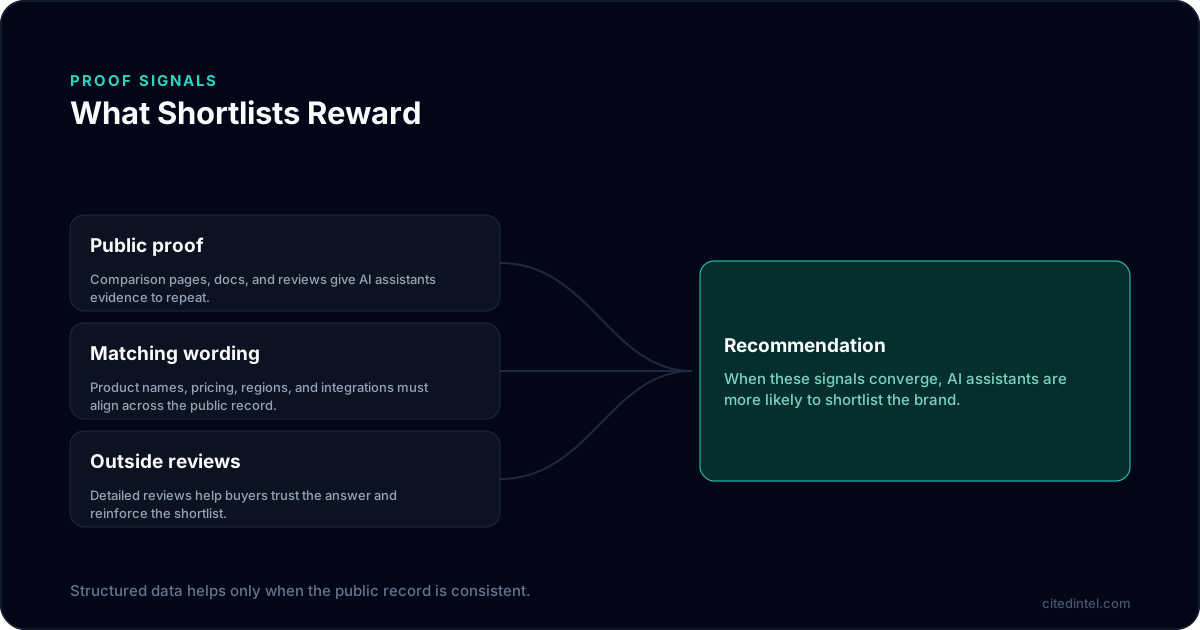
Prompt audits keep showing the same pattern: when the query is narrow, the names that surface are usually the ones with readable comparison pages, documentation, and outside proof that echo the wording of the question. That is the practical shape of AI search optimization. The goal is to become a name an assistant can repeat without having to smooth over the evidence.
One OpenAI clue sharpens the point: the guidance on search and research frames these tools as source-backed evaluation helpers, and its shopping research docs note that buyers can ask follow-up questions about preferred brands, size ranges, and priorities like performance versus price. Once the system starts narrowing the field, the assistant is no longer solving for reach, so vague positioning gets filtered out early.
In a Forrester, June 2026 post, the firm said B2B buyers are relying less on traditional discovery and more on AI-driven answers, curated sources, and trusted signals. That helps explain why brands are fighting for placement inside answer surfaces, not just blue links, where being cited can matter more than ranking.
Why some strong brands stay out
Good product depth is not enough when public proof is fragmented. A solid vendor can still miss AI search shortlists when its naming drifts, its comparison pages are thin, its docs bury important limits, or its reviews never describe the use case in a way an assistant can restate. The failure is usually not lack of proof, but proof that cannot be re-used without cleanup.
Most teams spend too much time polishing homepage language and too little time fixing the evidence stack underneath it. A cleaner test is whether the same product name, limit, and use case survive a comparison page, a doc page, and a review snippet without drifting. If the source material is inconsistent, AI search optimization will be patchy no matter how elegant the homepage looks, because assistants cross-check names, limits, and use cases before they repeat a brand.
The patterns that keep showing up in AI recommendations
The brands that keep appearing in AI answers usually share four traits: they publish comparison pages that answer the buyer’s real question, they have enough review depth to validate claims, they maintain documentation that is easy to quote, and they keep naming consistent across the public web. None of those wins by itself. Together, they give the assistant four separate chances to reach the same conclusion without improvising.
Classic SEO still matters, but classic SEO tools mostly track rankings. AI SEO tools and related workflows have to track whether engines recommend you in the first place, which is a different question and a different reporting layer. A useful check is to log three things for each prompt: whether the brand appears, whether the framing is correct, and which source type supported the answer.
| Pattern | Operational threshold | What to look for | Effect on AI search optimization |
|---|---|---|---|
| Comparison coverage | Start with 5 live comparison or alternatives pages before expanding feature content; each page should name 3 to 5 credible alternatives, state who the page is not for, and include at least one direct tradeoff. | Head-to-head pages, replacement pages, and use-case comparisons with visible limits. | Raises the chance that assistant answers can map a prompt like “best X for Y” to your brand. |
| Review depth | Treat 10 to 15 detailed reviews as a starting bar, and require at least 3 reviews that mention the same workflow, implementation pain, or switching trigger. | Specific language about setup, support, migration, integrations, and why the buyer chose the product. | Gives answer engines and buyers repeated corroboration they can trust. |
| Documentation quality | Require the core docs set, product page, setup guide, pricing page, integration docs, FAQ, and at least one troubleshooting page for any feature that needs shortlist consideration. | Docs with labeled steps, product names that match the site, and limits stated plainly. | Makes the product easier to summarize correctly during AI-assisted evaluation. |
| Structured facts | Use a pass/fail rule: pricing, integration names, plan limits, supported regions, and feature names must match across homepage, docs, and support pages with no conflicting wording. | Schema, consistent headings, stable product names, and repeatable page patterns. | Reduces confusion when engines cross-check facts across sources. |
| Cross-source consistency | Flag any naming mismatch that appears on 2 or more public pages as a fix-now issue. | Same category language on site, docs, reviews, and partner pages. | Helps AI search results treat the brand as a stable entity instead of a loose set of references. |
Comparison coverage beats vague category pages
Comparison pages do more work than broad category pages because they match the buyer’s question. A procurement lead asking for the best field service software for multi-region scheduling wants tradeoffs, not a manifesto.
A martech page that works is not “why our platform is innovative.” It is “which platform fits a lean team, which fits a complex enterprise stack, and where each option breaks.” That forces the page to name the decision line instead of circling it. For e-commerce platforms, the useful comparison often centers on catalog complexity, checkout flexibility, and integration depth. For logistics tech, region coverage and implementation burden matter more than generic feature breadth.
OpenAI’s BrowseComp benchmark tests whether a browsing system can pull together the right answer from scattered public clues, not just from the first obvious result. In practice, discoverability and verifiability have to work together.
Review depth matters more than review count optics
Review quantity helps only if the reviews say something useful. A review that says “great product” is barely evidence. A review that names the use case, the switching trigger, the implementation burden, and the post-sale experience is the kind of text a buyer and an assistant can both use. If you are asking customers for proof, steer them toward the workflow, the reason they switched, and the part of onboarding that took real effort.
Anchor every review you want to matter on three things: the workflow, the reason for purchase, and the implementation shape. In healthcare SaaS, that might mean compliance, onboarding friction, and staff adoption. In devtools, it often means API reliability, documentation quality, and support responsiveness. In procurement software, buyers care more about approval logic and auditability than interface praise. If a review cannot name one workflow and one switching trigger, it is decoration, not proof.
Gartner’s May 2026 press release says 69% of buyers turn to sales reps to validate AI-generated insights. That is a useful warning: AI shortlists influence the conversation, but they do not close the case on their own.
Documentation is a public recommendation asset
Documentation is no longer just post-sale support. It is one of the strongest public proof layers in AI search because it shows the product’s operating range, its limits, and how much effort adoption takes. A docs page that names setup steps, failure states, and supported regions gives an assistant something it can restate without guessing, which is why sparse docs weaken recommendation confidence so quickly.
For a payments infrastructure company, the docs that matter most are the ones that answer implementation, region support, API behavior, and failure states. For HR tech, it is onboarding, permissioning, and payroll or HRIS integration. For vertical SaaS, the key is not feature sprawl, it is whether the docs make a niche workflow look credible and manageable.
OpenAI’s source-backed research guidance points in the same direction: assistants work better when the evidence is readable and specific. Public docs do the same job for AI search optimization. If your docs are sparse or inconsistent, you are making it harder for search systems to recommend you with confidence. A useful test is whether a stranger could restate your setup path, limits, and one failure state after reading only the docs.
Structured data helps only when the facts underneath are disciplined
Schema is support, not salvation. If the product facts conflict across the homepage, docs, and pricing page, structured data will not rescue the answer. The safer rule is simple: if a field cannot stay identical in public, do not mark it as settled in markup yet. A quick preflight check is to compare the homepage, pricing page, and docs for the same product name, plan label, and region label before any markup goes live.
Keep the product name, plan name, region label, and integration label unchanged on the homepage, in documentation, in FAQs, and on support pages. If a VP is checking readiness, any inconsistency across those touchpoints should count as a failure. This matters even more for brands selling across North America and major Asia-Pacific and Gulf markets, since buyers phrase the question differently but still expect public proof to match.
Harvard Business Review, June 2026 says generative AI is shifting B2B discovery, evaluation, and recommendation into AI-mediated environments that companies do not own or fully understand. That reinforces the shift from keyword search toward AI-mediated product selection.
What the public evidence says, and what it does not
Public sources now make the direction of travel clear: assistants are browsing, citing, and comparing. What they do not yet give us is a clean analyst-grade measure of repeat-brand shortlist behavior across every market, so the safer read is directional rather than universal. That means the practical question is not whether shortlists exist, but whether your public evidence is structured enough to keep appearing inside them.
The shopping research product from OpenAI says it generates a personalized buyer’s guide and helps users find the right products. That matters because the shortlist is now being assembled inside the research flow, where sources have to support a recommendation rather than just a result.
Microsoft’s Copilot Search positions AI search as a discovery and research workflow rather than a simple query box. The practical read is simple: SEO for AI search now has to cover answer surfaces, not only blue links.
McKinsey’s B2B growth research says generative AI has risen into the top five channels for supplier discovery and evaluation in B2B buying, with supplier websites, in-person interaction, web search, and videoconferencing alongside it. That puts AI discovery work inside the buying process, not beside it.
Reuters Institute’s 2025 generative AI report flags concern that people increasingly rely on AI-generated answers instead of clicking through search results. That dynamic can reduce direct traffic while increasing the importance of being cited inside the answer itself.
A boundary worth stating: if you sell a highly bespoke product with very few public comparables, AI search shortlists will be harder to influence than in categories with standard buying criteria. That is not a reason to stop, only a reason to set expectations differently and invest harder in docs, proof, and naming consistency.
What to change first
Begin with the assets most likely to change shortlist inclusion, not with twenty content ideas. If you are deciding what to publish next, prioritize the work that moves share of prompt mentions, branded comparison-page traffic, and assisted conversion rate before you spend another month on feature content.
- Publish five comparison pages first. Expected impact: fastest improvement in shortlist inclusion, because assistants are already looking for explicit tradeoffs. Effort: medium. KPI: share of prompt mentions and branded comparison-page traffic.
- Fix the documentation set next. Expected impact: higher answer confidence on follow-up questions. Effort: medium to high, depending on product complexity. KPI: assisted conversion rate and time on docs for high-intent pages.
- Normalize naming across public pages. Expected impact: immediate reduction in entity confusion. Effort: low to medium. KPI: branded AI search mentions and fewer mismatched citations in answer audits.
- Upgrade review prompts and review capture. Expected impact: better proof language in answer engines and vendor evaluation tools. Effort: medium. KPI: review depth, review-to-shortlist inclusion rate, and branded comparison-page traffic.
- Add structured data only after the content is clean. Expected impact: modest on its own, stronger when paired with disciplined facts. Effort: low. KPI: citation consistency across AI answers and search snippets.
Comparison pages usually move shortlist inclusion faster than feature pages because they match the buyer’s exact question. If you want the gap list before you rewrite anything, you can run a free Citedintel audit, and the workflow behind it is explained at /why-cited. The fastest first edit is often the title line itself: name the use case, the alternative, and the tradeoff in one pass so the page can be quoted without translation.
Check your own shortlist standing
Run this once and you will know whether your AI search optimization is real or mostly cosmetic. Use one real query, not a generic test prompt.
- Write one buyer prompt. Example: “What is the best e-commerce platform for a mid-market brand that needs multi-store support and complex tax rules?”
- Run it across three assistants. Try ChatGPT, Claude, and Gemini first, then repeat the test with one market limit, like the US, India, or the UAE.
- Score the output. Use this pass/fail sheet: is your brand named, recommended, correctly framed, and supported by a comparison page, docs page, or review source?
- Record the evidence type. Note whether the answer leans on comparison pages, reviews, docs, or third-party coverage. If a rival is easier to verify, that is the problem to fix first.
- Choose one fix. If comparison coverage is missing, outline the page today. If docs are weak, update the highest-intent page today. If reviews are thin, tighten the language you ask customers to use.
For dozens of prompts and markets, Citedintel turns those gaps into a repeatable audit-and-rewrite workflow instead of a one-off test. The point is not more testing for its own sake, but a tighter loop between prompt results, source pages, and the specific page that needs repair.
Why this matters beyond search traffic
AI search shortlists shape who gets considered before a buyer has a chance to compare properly. That affects brand visibility, sales conversations, and the quality of the shortlist you enter, even when classic SEO traffic looks healthy.
In practice, GEO and AEO share the same evidence path: engines pull from public proof, and the buyer tends to trust the answer more than the homepage. If your comparison pages, docs, and review language stay aligned, you earn the slot. If they drift, you get a mention or nothing at all, which is why naming discipline and comparison coverage matter so much.
Reuters Institute’s 2025 report also notes that awareness of AI brands remains uneven and many users still have little opinion even after hearing of a tool. That is a reminder that trust and familiarity are still being formed in AI-mediated environments.
In Citedintel audits completed through August 2026, the category leader appears in 25% of answers, while 58% of surfaced brands appear only once. The method here is a multi-brand audit set across 4,152 distinct AI answers covering 8,353 brands, enough to show a long tail, not enough to claim universal behavior.
Google’s AI Overviews and answer engines do not care how hard your team worked on positioning. They care whether the public record supports a clean answer. To improve AI discovery and answer visibility together, start with the evidence stack, not the slogan. If a brand name, limit, or use case changes from page to page, that drift is the first thing to fix before any new content is drafted.
For a repeatable way to diagnose those gaps, Citedintel is the fastest path from a prompt-level audit to a publishable fix set, with the evidence trail already organized around the pages that need repair.
Reports by Cited
Take this report with you
Get the full report as a premium PDF: color-coded takeaways, section infographics and everything above, formatted to share with your team.
Your download is starting. Keep an eye on your downloads folder.
Work email only. No spam, ever.
Frequently asked questions
Why does my brand get mentioned but not recommended in AI search?
Usually because the assistant can recognize your name but cannot verify your fit as confidently as a rival. The article shows that comparison pages, review detail, docs clarity, and consistent naming are what turn a mention into a recommendation.
What kind of content helps a B2B brand show up in AI shortlists?
The strongest assets are direct comparison pages, detailed documentation, and reviews that describe real use cases and switching reasons. These give assistants concrete evidence to summarize instead of vague marketing claims.
Is structured data enough to improve AI search optimization?
No. Structured data helps assistants parse stable facts, but it cannot fix weak or inconsistent content underneath. The article argues that schema works best when the page already has clear, disciplined product facts.
Why do some categories surface more consistently than others?
Categories with obvious comparison dimensions, like CRM or payments infrastructure, are easier for assistants to shortlist. Vague positioning or highly custom implementations make it harder for AI systems to recommend one brand with confidence.
How can I test whether my brand is shortlisted in AI answers?
Run a real buyer prompt in ChatGPT, Claude, and Gemini, then score whether your brand is named, recommended, and correctly described. The article’s shortlist test helps you identify whether the missing piece is comparison coverage, review depth, docs clarity, or structured facts.
How do the recommended brands use AI search analytics?
Quietly and continuously. The pattern in shortlisted brands is not a one-time audit but standing AI search monitoring: which prompts name them, which sources the engines cited, and what changed since last month. That feedback loop, artificial intelligence SEO run as an operating rhythm, is why their position compounds while occasional checkers stay surprised.