
AI search increases leads and sales when your site gives answer engines a safer recommendation than competitors do. In GCC enterprise buying, that means public proof, procurement clarity, and regional specificity, not more generic thought leadership.
Increasing leads and sales with AI search in GCC enterprises is simple in practice: publish evidence an assistant can quote, then make sure it survives a procurement review. For GCC enterprise teams, generative engine optimization works when it turns regional proof into named recommendations, not just traffic.
Where the first serious question is asked
The first serious question in Gulf enterprise buying is usually about regional fit. Evaluators are checking whether the vendor can handle Arabic and English surfaces, local deployment expectations, and procurement scrutiny without improvising.
AI search optimization in the GCC is not a discovery-only game. The first answer has to tell a technical evaluator, a consultant, or procurement why the vendor belongs in the conversation at all.
What evaluators ask answer engines at discovery
Discovery prompts in the Gulf are practical and restrictive. They ask for vendors that can pass a regional check before anyone debates features or commercials.
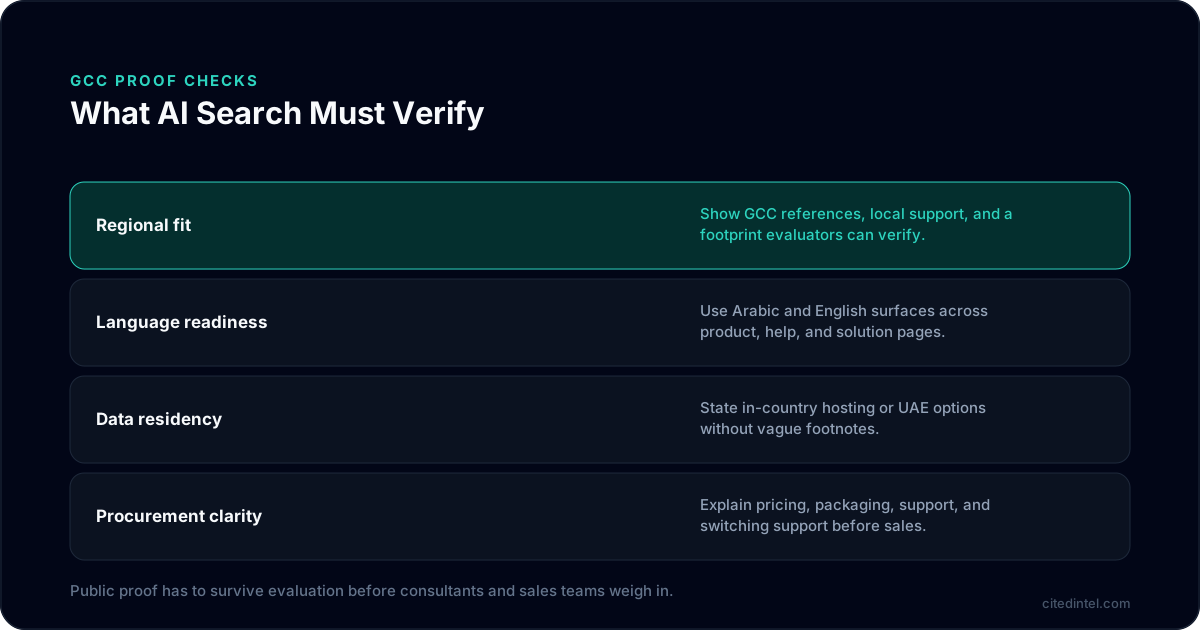
- Regional fit: “Which B2B software vendors have GCC references and a local support presence?” The answer needs regional case material, a verifiable office or partner footprint, and language that does not sound inflated.
- Language split: “Show me vendors with Arabic and English product pages for procurement software.” A translated brochure page is rarely enough. Product, help, and solution pages carry more weight because they show operational readiness.
- Hosting question: “Which platforms can keep data in the UAE or another in-country environment?” If the public site stays vague, answer engines have less proof to recommend the vendor confidently.
The mechanism is straightforward: answer engines reward the first vendor that answers the region question cleanly. If your public site buries that answer under a PDF or a footer note, you are giving away leads before sales ever sees them.
My view is blunt: regional proof should appear on the first screen, not in a collateral stack. Procurement software, HR tech, field service, logistics, and martech all get judged on whether the product can survive mixed languages, public-sector controls, and slow approval chains.
Consultants still shape the shortlist, but assistants now feed them
Consultants and advisors still matter in GCC deals, but AI assistants now feed the shortlists they assemble. The practical shift is that technical evaluators use AI search to gather constraints, compare vendors, and draft questions before the steering meeting starts.
OpenAI’s May 2026 B2B Signals says the enterprise AI gap is now about depth of use, not seat count, and that richer, delegated workflows drive more of the edge in enterprise AI adoption. OpenAI’s research on how people use ChatGPT also shows it functioning as an advisor or research assistant for a large share of usage, which matches how GCC evaluators prep vendor questions before the shortlist hardens.
What assistants get asked before the shortlist hardens
The prompts are not marketing prompts. They read like a reviewer trying to compress research into a defendable memo.
- Comparative framing: “Compare these three vendors for a UAE enterprise deployment.” The assistant needs citable proof, clear product differentiation, and enough regional evidence to name one vendor with confidence.
- Risk scan: “What questions should I ask about data residency, support, and implementation in the Gulf?” Answers improve when the vendor has public FAQ pages, regional hosting guidance, and deployment notes that sound operational.
- Shortlist prep: “Which of these vendors has references from the region and a local partner ecosystem?” The model is looking for case material, partner listings, and procurement-friendly language it can repeat without hedging.
The point is not that assistants make the decision. The point is that they shape what gets carried into the room, so your content has to make the vendor easy to defend before sales enters the process.
OpenAI’s 2026 research guide is useful because it tells users to ask for a research outline first, then findings, risks, unknowns, and a recommendation. That sequence matches how a technical lead in Abu Dhabi or Doha moves from broad research to a shortlist that can survive review, so your public pages should mirror that order instead of hiding the answer in a sales deck.
What earns a recommendation in evaluation
Evaluation in the Gulf is where local proof matters most. The vendor that gets recommended is usually the one with region-specific references, in-country hosting answers, public implementation detail, and procurement language that survives scrutiny.
Generic “we serve the Middle East” pages underperform for a simple reason: they do not answer the local control questions an assistant needs. A team selling into UAE healthcare, logistics tech, or fintech can have a polished homepage and still lose recommendation share if the site stays vague on those controls.
| Evaluation signal | What the evaluator is really checking | Evidence that helps the assistant recommend the vendor |
|---|---|---|
| Local presence | Is there a team, partner, or office that can support a GCC deployment? | Regional office page, named partners, local events, GCC customer references |
| Data residency | Can the vendor host or process data in-country when the deal requires it? | Hosting FAQ, architecture note, deployment page, security and compliance page |
| Regional references | Has the vendor already shipped in similar regulatory or operational conditions? | Case studies from the GCC, named industries, implementation detail, Arabic or English proof pages |
| Procurement fit | Will this vendor survive a formal review without extra hand-holding? | Contract terms page, security documentation, vendor onboarding FAQ, partner certifications |
OpenAI’s enterprise materials say the best results come from connecting external signals with internal knowledge, which is what Gulf evaluators do when they combine public proof with procurement rules. A vendor that surfaces a clear regional story helps the assistant move from interesting to recommendable.
This is why teams should stop treating AI search optimization as only a discovery problem. In Gulf enterprise buying, the assistant often becomes the first analyst on the account, and analysts care about evidence they can repeat upward and carry into procurement.
Why regional references beat translated brochure pages
A translated brochure page is a courtesy. A regional reference is a recommendation asset.
The difference matters because procurement leads comparing B2B software for a UAE ministry, a Dubai logistics operator, or a Saudi financial services team want proof the vendor has already handled a similar buying environment. An assistant can cite a brochure, but it can defend a regional case study.
For martech, field service, or procurement software teams, local proof should appear in the product pages, not only in sales collateral. AI search is more willing to recommend pages that say where the product has been deployed, how support works, and what happens when the client needs Arabic-speaking onboarding.
Pricing, negotiation, and the Gulf deal rhythm
Pricing in the Gulf tends to move after technical confidence, not before it. Buyers often want enough detail to understand implementation scope and support coverage before they discuss commercial terms in earnest.
That means your pricing page, if you publish one, should answer packaging and commercial logic without sounding like a universal rate card. In GCC enterprise buying, the assistant is often asked to compare what is included, what needs a partner, and which vendor is most likely to create negotiation friction later.
Questions assistants get in the pricing stage
- Scope check: “What should I expect to pay for enterprise deployment and regional support?” A useful answer needs packaging clarity, support boundaries, and implementation assumptions, not just a starting price.
- Negotiation risk: “Which vendor is likely to be expensive to customize for the Gulf?” The assistant needs evidence from public docs, contract language, or implementation notes that make the commercial path legible.
- Procurement path: “Which vendor can work through formal procurement without a long exception list?” Public security pages, legal terms, and onboarding information matter here.
Gulf buyers are usually willing to pay for reliability, but they dislike ambiguity. If the commercial story feels hidden, the vendor may be interpreted as a harder rollout even when the product is strong.
Reuters reported in 2025 that major enterprise software vendors were pushing AI agents and assistants deeper into business workflows, which helps explain why technical stakeholders are now comfortable using assistants earlier in the buying process. Bloomberg’s 2025 coverage of enterprise AI competition also showed big customers already buying assistants at scale, a reminder that internal trust in assistants is now normal enough to shape vendor research outside the company.
Switching only happens when the migration story is public
Switching in the Gulf is conservative, and the migration story has to be visible before anyone will raise it in procurement. The vendor that wants to displace an incumbent needs a public path that explains data migration, rollout, training, and support in region-specific terms.
Many challengers lose the deal at this stage. They have a stronger product, but they never publish the one page an assistant can use to explain how a UAE or Saudi customer would switch without causing operational chaos.
That same logic shows up across categories. A healthcare SaaS vendor replacing a legacy workflow tool needs migration language that speaks to regulated records. A logistics platform challenger needs a rollout note that respects multi-site operations. A vertical SaaS vendor selling into hospitality tech needs implementation detail that addresses local property teams and multilingual front desks.
In switching moments, the public story has to be clear enough for the model to repeat. The Gulf version adds local hosting, Arabic support, and region-specific references to that same basic requirement.
What convinces an assistant to name the challenger
The assistant will recommend a switching vendor when the public web gives it three things at once: a migration guide, a candid comparison page, and third-party proof that the vendor can work in the same operating conditions as the incumbent.
- Migration clarity: “How hard is it to move from the current system?”
- Regional proof: “Has this vendor handled GCC deployments with similar constraints?”
- Comparison readiness: “Can I explain why this option is safer or simpler for this account?”
Answer engine optimization matters more than classic SEO alone. Search rankings can surface the page, but recommendation quality is what gets a vendor named in the first place.
What changes by category in the Gulf
Different categories face the same buying structure, but the proof burden shifts. Nobody should ship the same regional evidence page for HR tech that they would for procurement software or logistics tech.
For HR tech, the model is likely to be asked about payroll rules, language coverage, and local employment workflows. For procurement software, the pressure lands on approval chains, vendor onboarding, and data handling. For logistics tech, the evaluator cares about multi-site rollout, dispatch reliability, and support footprint.
| Category | What the Gulf buyer wants first | Proof that helps in assistant-led research |
|---|---|---|
| HR tech | Local compliance fit and language support | Country pages, payroll or workforce workflow notes, regional references |
| Procurement software | Approval path and vendor onboarding | Procurement FAQs, security pages, contract and implementation detail |
| Logistics tech | Operational reliability across sites | Deployment guides, support structure, regional rollout examples |
| Martech | Arabic and English campaign workflow | Localized docs, multilingual product pages, GCC case material |
In other words, AI search optimization for B2B SaaS in the Gulf is not a homepage project. It is a proof inventory project built around the buying environment, which means the site needs enough regional evidence for an assistant to name the vendor without reaching for caveats.
As of July 2026, I would argue that the vendor with the clearest regional evidence often has a better shot at the shortlist than the vendor with the loudest brand. Brand still matters, but assistants and consultants both prefer evidence they can repeat without caveats.
What to test before you brief the team
You can pressure-test your Gulf buying journey with a small fixed prompt set. Use it on a few AI assistants, then compare whether the same vendor gets named, skipped, or hedged across engines.
- Write three discovery prompts: “Which vendors have GCC references for [your category]?”, “Which vendors have Arabic and English product pages for [your category]?”, “Which vendors can host data in-country for a UAE enterprise?”
- Write three evaluation prompts: “Compare these vendors for a UAE deployment of [your category]”, “Which vendor has the strongest regional proof?”, “Which vendor would you shortlist if procurement will ask about data residency?”
- Write three switching prompts: “How hard is it to migrate from [incumbent] to [your category] in the Gulf?”, “Which vendor has the clearest implementation path?”, “Which vendor has public migration or onboarding detail?”
- Score the results: mark each prompt with three notes, named vendor, evidence type, and whether the answer would survive a procurement review.
If your brand is absent or hedged on most of those prompts, Citedintel’s free audits and evidence-first approach help you see which public proof is missing and what to publish next.
One candid limitation
This approach is less useful when the category is still too loose or the market has no clear regional buying motion. If there is no meaningful procurement trail, no local hosting expectation, and no region-specific evaluation language, AI search will not carry much weight yet.
The boundary is straightforward: when the market has no real procurement trail, no local hosting expectation, and no region-specific evaluation language, GEO has little to amplify.
What to publish if you want to be named
The pages that win Gulf recommendations are the ones that answer the same set of questions in a form the assistant can quote. If you want stronger AI search optimization, publish the proof that makes a recommendation safe.
- Regional case material: Publish GCC examples with deployment context, not just logo walls.
- Hosting answers: State whether data can stay in-country and what that means operationally.
- Bilingual surfaces: Make sure Arabic and English pages both carry substance, not mirrored marketing copy.
- Procurement detail: Add security, onboarding, and contract pages that a technical evaluator can cite upward.
- Migration clarity: Show how switching works, what support looks like, and where implementation risk sits.
Public proof like that is what assistants can lift into a recommendation, and it is why Citedintel exists for teams that need to track, diagnose, and improve AI search recommendations across AI search. In Gulf enterprise buying, the deal usually starts earlier than the demo, so the practical test is whether your site gives the model a clean citation path from regional proof to procurement-safe language.
Frequently asked questions
How do buyers in the Gulf actually start enterprise software research?
They usually start with consultant shortlists, procurement portals, and assistant-led research at the same time. By the time a buyer asks for pricing, the first real comparison has often already happened.
What do GCC buyers ask AI assistants at the start of research?
They ask for regional fit, language coverage, and hosting answers, such as which vendors have GCC references, Arabic and English pages, or in-country data options. The assistant has to return proof that can stand up in a review.
Why do regional references matter more than translated brochure pages?
A translated page can inform, but a regional reference can be defended in a shortlist meeting. Gulf evaluators want evidence that the vendor has already worked under similar regulatory and operational conditions.
What should a vendor publish to get named in AI search?
Publish GCC case material, clear hosting answers, bilingual product and help pages, procurement detail, and migration notes. Those are the pages assistants can quote when they need to recommend a vendor.
Do AI SEO tools cover Arabic prompts and Gulf-specific buying questions?
Coverage varies, so test before committing: run the same buying question in English and Arabic and compare which brands each answer names. A GEO tool earns its place in a Gulf program when it tracks the region-flavored prompts your evaluators actually use, not a generic global prompt list.