
If AI assistants do not cite your comparison pages, docs, and trust pages, they are filling the shortlist with someone else’s proof. AI search optimization for B2B software starts by fixing the pages answer engines can quote, not by publishing more posts.
The step-by-step guide to AI-driven search for B2B software brands is simple enough to run in a week and disciplined enough to repeat every week after that. Measure the answers you already own, map the prompts that matter, diagnose why competitors get recommended, fix the foundation pages, publish the pages the assistant cannot yet quote, then re-check on a weekly rhythm.
Start by measuring the answers you already own
Run a prompt audit before you plan any new content. If you do not know which AI answers mention your brand, you cannot tell whether AI search optimization is improving or whether you are just producing more pages.
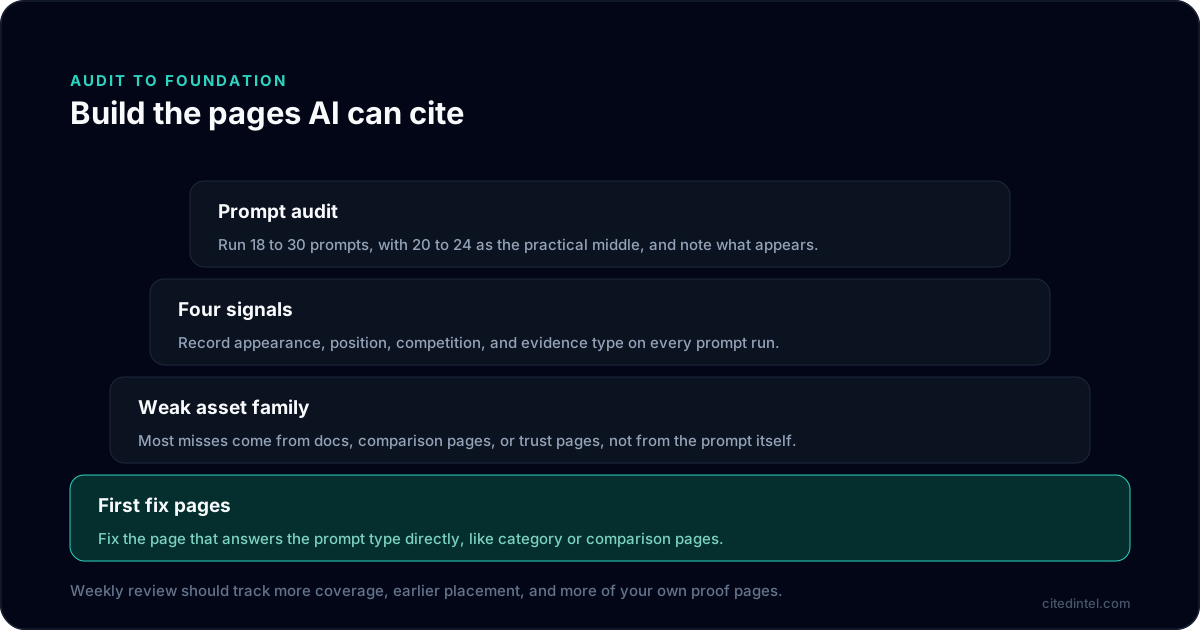
For the marketing lead at a B2B software brand, the baseline should show three things: which prompts surface the brand, which assistant returns it, and which competitor gets cited instead. Keep the first pass to 18 to 30 prompts, with 20 to 24 as the practical middle, so the work finishes in one sitting and still exposes a real pattern.
Use prompts buyers actually ask
Write prompts the way buyers, consultants, and founders research software. Category prompts, use-case prompts, comparison prompts, and operational prompts each reveal a different part of the answer layer.
- Category prompts: “best HR tech for distributed teams,” “top devtools for API testing,” “leading martech platforms for lifecycle campaigns”
- Use-case prompts: “logistics tech for route optimization,” “healthcare SaaS for referral management,” “procurement software for approvals”
- Comparison prompts: “[your brand] vs [top competitor],” “alternatives to [top competitor],” “which is better for enterprise rollout”
- Operational prompts: “supports SSO and SCIM,” “has API docs,” “works with Salesforce,” “offers role-based access”
Do not write prompts for curiosity. Write the prompt set around decisions buyers make, because that is where answer engine optimization shows up first.
Record four signals on every run
For each prompt, capture whether you appear, where you appear, who replaces you, and what source type seems to support the answer. That is the smallest baseline that still tells you whether the engine is classifying your category the way buyers do.
| Signal | What to note | Why it matters |
|---|---|---|
| Appearance | Present or absent | Shows whether the engine can place you at all |
| Position | First block or later | Early placement shapes shortlist formation |
| Competition | Who gets named instead | Reveals which brand owns the category logic |
| Evidence type | Docs, reviews, articles, comparison pages, trust pages | Shows which source format is doing the work |
A useful internal benchmark is that the category leader can appear early while many surfaced brands show up only once. That spread tells you the answer layer is ranking proof, not just counting visits. My view: that is why traffic charts can look healthy while AI search optimization quietly weakens.
Use one audited example, not a theory
On the prompt “best devtools for API testing,” one audited answer in ChatGPT cited a third-party roundup and recommended Postman first. The miss was not product quality. The miss was thin comparison language and weak sourceable proof on the brand’s own site, so the answer engine had no clean page to retrieve.
That is the diagnostic standard you want. For a software brand, the first question is not why the engine is clever, it is which page gives it a clean line to quote.
Map the prompts that matter by category, not by channel
The right prompt set for HR tech is not the right prompt set for devtools, and neither matches logistics tech or healthcare SaaS. AI search optimization improves when you map prompts to category decisions, not to a generic channel plan.
GEO means earning visibility inside AI-generated answers. AEO means making one page quotable and citable. Put together, generative engine optimization and answer engine optimization form one operating system, but the prompt map always comes first.
What changes by category
| Category | Prompts that matter most | What tends to get rewarded |
|---|---|---|
| HR tech | Team fit, rollout speed, permissions, compliance, integrations | Clear category language, implementation detail, support material |
| Devtools | SDKs, API coverage, deployment model, latency, developer experience | Docs depth, examples, precise technical language |
| Martech | Lifecycle workflows, segmentation, data sync, campaign operations | Comparison pages, use-case pages, clear feature boundaries |
| Logistics tech | Route planning, dispatch, exception handling, regional coverage | Operational detail, integration proof, industry language |
| Healthcare SaaS | Referral workflows, privacy, access control, implementation support | Trust pages, documentation, compliance language |
A devtools company usually loses on docs before it loses on brand. A logistics tech vendor usually loses on implementation detail before it loses on features. A healthcare SaaS vendor usually loses on trust pages and privacy proof before it loses on functionality. Use that as the diagnostic order: docs, then comparison language, then trust proof.
The category leader often appears early in answer sets, while many surfaced brands show up only once. In practice, that pattern is the field, not a quirk, because it shows which source type is carrying the category.
Buyers in different countries ask for different proof
Across the United States, the United Kingdom, India, the UAE, South Korea, Thailand, and Indonesia, the prompt shape stays similar, but the proof that lands differs by market. A buyer in Britain may focus on procurement terms and data handling, while someone in India may care more about setup speed, pricing clarity, and implementation support.
If you sell globally, include region-specific prompts in the audit. The category answer stays the same, but the proof buyers trust changes by market.
Google, May 2026 says SEO best practices still matter because AI features in Search are grounded in Google’s core ranking systems. For software teams, that means the page has to be quotable inside the answer layer, not just visible in classic rankings.
Diagnose why competitors get recommended instead of you
When a competitor appears ahead of you, treat that as a source problem, not a mystery. In most cases, the answer engine is pulling from one page type you have underbuilt or ignored, so the fix starts with the asset family, not the prompt list.
If you cannot explain why a competitor was recommended, you have not diagnosed the miss yet. You only know that you lost the answer.
The four signals that most often decide the answer
- Entity clarity: the brand is described consistently as the thing it sells, so the engine can place it in the category
- Comparison proof: there are pages that compare the vendor against alternatives or break down fit by use case
- Documentation depth: product docs answer practical questions directly and are easy to extract
- Third-party presence: review sites, communities, and neutral articles mention the brand in sourceable ways
“Build authority” is too vague to act on. The sharper question is which source type made the competitor eligible for the answer, and which page on your side fails that test?
Read one answer like an editor
Use this review pattern after every audit run.
- Wording: what phrase made the competitor eligible
- Fit: category fit, use-case fit, or comparison fit
- Sources: docs, reviews, neutral articles, directories, or general web pages
- Buyer test: what proof would make the recommendation feel safe
In cybersecurity, trust pages and deployment language often do the work. In martech, comparison pages usually carry the shortlist. In vertical SaaS, narrow category wording plus industry-specific proof tends to matter more than a broad brand narrative. I prefer reading that as a page assignment, not a branding problem.
OpenAI’s 2025 guidance on search and research is useful because it frames search as fast orientation and research as the citation-backed layer beneath it. That split matches B2B buying behavior, which is why source quality matters so much.
The first task is not to outwrite competitors. It is to make your proof easier to retrieve than theirs.
Fix the foundation pages before you publish more content
Some AI search problems are content volume problems, but many are foundation problems. Muddy homepage, category, docs, and trust pages give answer engines weak signals to work with, which means the wrong page gets quoted even when the product is strong.
Rewrite the pages that define what you are before you add more supporting articles. That is the sequence.
Use this decision tree
| Condition | Highest-ROI fix | Why first |
|---|---|---|
| The homepage cannot name the category in one sentence | Rewrite the homepage hero and first screen | Classification fails before the assistant can place you |
| The category page is vague or full of internal language | Rewrite the category page | This is the page most likely to anchor the answer |
| Competitor prompts keep naming “alternatives” or “vs” queries | Create or tighten comparison pages | Comparison pages are the easiest evidence for shortlist prompts |
| Docs are thin, indirect, or hard to navigate | Fix docs first | Especially high ROI for devtools, cybersecurity, and logistics tech |
| Trust questions keep blocking the answer | Expand security, compliance, and support pages | Highest ROI for healthcare SaaS, payments infrastructure, and cybersecurity |
Devtools usually benefit first from docs and setup pages. Cybersecurity and payments infrastructure usually need trust pages and compliance language before anything else. Healthcare SaaS often needs comparison pages too, but only after the privacy and access story is legible.
If your category is still fuzzy, comparison pages alone will not save you. They work once the market already knows the category boundary; they fail when the boundary is still blurry.
Make the brand legible everywhere
Check whether the homepage, product pages, docs, and directory listings all describe you in the same terms. If one page says “customer growth platform,” another says “revenue engine,” and a third says “lifecycle orchestration suite,” you are forcing the model to guess.
Use one plain category statement, then support it with the adjacent terms buyers actually ask for. Software businesses win more often when they are boringly clear.
Google’s search guidance on original, high-quality content reinforces the same point. Pages that read like real product evidence are easier to trust than pages that sound like marketing copy.
Publish the pages the assistant cannot yet quote
Once you know what is absent, publish to close those gaps. That is the core of generative engine optimization, and it is where AEO turns a page from visible to citeable because the answer layer needs text it can lift and trust.
Write for the prompt, not the slogan. If the prompt is specific, the page has to answer the exact decision, the likely constraint, and the proof buyers will check next.
Use the right page type for the job
- Category pages: one clear page that states what you are and who it is for
- Comparison pages: Brand vs Brand, alternatives, and “best for” pages with real tradeoffs
- Use-case pages: specific jobs, workflows, or implementation scenarios buyers search for
- Support content: docs, FAQ pages, trust pages, and integration pages that answer operational questions
A martech platform can win the “which one fits lifecycle segmentation” query faster with a comparison page than with another top-of-funnel post. A healthcare SaaS vendor usually gets more from a trust page and a privacy page than from a feature explainer. A logistics tech company often does better with narrow use-case pages because the prompt itself is operational.
Make the answer sourceable
Every page should include a plain definition in the first paragraph, specific integrations or deployment modes, a comparison table where useful, short headings that mirror buyer language, and internal links to the proof pages a buyer would check next.
For teams in B2B software, answer engine optimization improves when the page removes ambiguity instead of adding clever copy. A plain category line in the first paragraph, followed by one proof detail, gives the assistant a cleaner extraction path.
Pew Research Center, June 2026 found that a substantial share of U.S. adults now use AI chatbots to search for information. That makes the answer itself a real battleground, not just the click after it.
One prompt, one page, one proof asset
When a prompt keeps failing, do not try to fix it with three assets at once. Pick the page type that best matches the miss, then add one proof asset that makes the page believable.
A docs gap needs a docs page. A comparison gap needs a comparison page. A trust gap needs a security, privacy, or support page. That sequence keeps the work from turning into content noise.
Start with these three prompts
Use this artifact now. It is short enough to finish before your next planning meeting and structured enough to show where the biggest holes are.
- Open one AI assistant in a fresh tab and keep the others for later comparison.
- Run these six prompts, replacing the brackets with your category.
- Category: “Which [category] options fit [team size or use case] best?”
- Fit: “Which [category] matches [industry or compliance need]?”
- Comparison: “[Your brand] vs [top competitor], which is better for [use case]?”
- Alternatives: “What are the top alternatives to [top competitor]?”
- Integration: “Which [category] tools are easiest to implement with [integration]?”
- Region: “Which [category] vendors are recommended for [region or buying constraint]?”
- For each answer, mark four columns in a simple sheet: Appears, Position, Competitor named first, Missing proof.
- Pick the single most repeated missing proof item and assign one task from it, usually a comparison page, trust page, docs update, or category-page rewrite.
That single pass is enough to surface a visible result. For a larger rollout, Citedintel turns the same workflow into a weekly operating loop with the audit, diagnosis, drafts, and re-checking in one place.
Ship the first wave of fixes in one working sprint
Skip a rebuild. One focused sprint can change the evidence stack fast if you start with the pages answer engines actually pull from.
Do the highest-leverage work first, then leave the nice-to-have pieces for later. A sprint with clear thresholds beats a quarter of vague AI search experimentation.
Prioritize by effort and expected lift
| Asset type | Effort | Expected visibility lift | Why it ranks first |
|---|---|---|---|
| Homepage hero rewrite | Low | Fast category clarity | Fixes classification |
| Category page rewrite | Medium | High on broad prompts | Anchors the category answer |
| Comparison page | Medium | High on “vs” and alternatives prompts | Matches shortlist behavior |
| Docs or setup page | Medium to high | High in devtools and logistics tech | Answers implementation questions directly |
| Trust page | Medium | High in regulated categories | Supports privacy and procurement questions |
For devtools, update the docs and one integration page first. For cybersecurity, update trust pages and security docs first. For payments infrastructure, update compliance, settlement, and integration pages first. For healthcare SaaS, start with comparison pages and privacy pages, then add proof assets.
Which proof assets to touch first
The asset that changes the answer fastest is usually not the flashiest one. It is the one that removes doubt.
- Docs pages: native integrations, setup steps, permissions, migration paths
- Trust pages: security posture, compliance language, support commitments
- Comparison pages: criteria, tradeoffs, feature boundaries, best-fit language
- Category pages: one sentence on what the product is, then proof
If you only have bandwidth for one change, start with the page the assistant is most likely to quote. For broad prompts, that is usually the category page; for “vs” prompts, it is the comparison page; for technical queries, it is the docs page.
Teams often over-invest in blog output because it feels productive. The answer layer rarely cares that you published more. It cares that the right page became easier to quote, with the right proof near the top.
Re-check weekly and treat AI search optimization like an operating rhythm
Once the first fixes ship, keep the loop running. Answers drift as sources change, competitors publish, and buyer language shifts, so the same prompt set should keep reappearing in your weekly review.
Weekly checking is enough for most software businesses. If you wait a month, you are no longer managing visibility, you are looking at a stale source mix and calling it a trend.
What the weekly rhythm should look like
- Run the core prompt set again in the same AI assistants you used last week
- Compare mentions, position, and competitor movement against last week
- Note which page changed the answer, if any
- Decide whether the next move is a rewrite, a new comparison page, or a proof update
A buyer in the UAE may need different procurement proof than a buyer in the US, and a team selling into the UK may need different trust language than one selling into India. Multi-market AI search optimization matters because it is how global software gets shortlisted, one market at a time.
Pew Research Center’s October 2025 survey reports that AI answer boxes are now part of the search experience for most U.S. Adults, with many seeing them often or extremely often. That level of exposure is enough to change how B2B buyers narrow the field.
What to watch in the report
Track three things, and only three things, so the report stays useful: are you appearing on more prompts, are you appearing earlier, and did the cited source type change from a competitor-friendly page to your own proof page?
- Coverage: more prompts
- Position: earlier placement
- Reasoning: stronger brand proof, weaker competitor pull
This is the difference between vanity tracking and an operating metric. The point is not to admire the chart, it is to choose whether the next move is a category page, comparison page, docs update, or trust page.
That is also where Citedintel fits naturally, because the value is not another dashboard, it is a repeatable loop that keeps the evidence set current and the next decision obvious.
Keep the loop grounded as the buying process shifts
AI-driven search changes discovery, not judgment. Buyers still compare, read docs, check reviews, and ask peers, but the shortlist now starts inside the answer layer.
My view: classic SEO, GEO, and AEO should be run as one system. SEO helps you get found, GEO helps you get named, and AEO helps the answer become precise enough to trust.
OpenAI’s research guidance says outputs can include citations, source comparisons, and gaps or weak signals. That is the right mental model for B2B software visibility, because the page that wins the answer layer earns the right to shape the next click.
The practical move is simple. Measure the answers, fix the source gaps, publish the missing pages, and keep checking the same prompt set.
Try this today
Run this audit before your next content meeting.
- Open three assistants: use ChatGPT, Claude, and Gemini in fresh tabs.
- Paste these prompts: one category prompt, one comparison prompt, one operational prompt, one alternatives prompt, and one regional prompt for your main market.
- Score each answer: mark Appears, Position, Competitor named first, Missing proof.
- Pick one fix: if you miss on category language, rewrite the homepage or category page. If you miss on comparisons, draft a comparison page. If you miss on trust, write the security or privacy page.
- Ship one artifact: publish or edit a single page and rerun the same prompts the next day.
If you want the scaled version, Citedintel turns this exact audit, diagnosis, draft, and re-check loop into a working system.
This is how AI search optimization becomes an operating habit instead of a quarterly slogan. For the larger setup, start here.
Frequently asked questions
What is AI search optimization for B2B software?
It is the process of making your brand show up inside AI-generated answers for category, comparison, and operational queries. In this article, the work starts with prompt audits and then moves to the pages the assistant can quote, like category, docs, comparison, and trust pages.
How do I show up in AI search for my SaaS brand?
Start by measuring which prompts already mention your brand and which competitor gets cited instead. Then fix the page type that matches the miss, usually your homepage, category page, docs, comparison page, or trust page.
What is the best AI SEO tool for monitoring AI search optimization?
The article does not rank tools, but it does recommend a repeatable audit loop for AI search optimization. The useful test is whether your workflow can track appearance, position, competitor movement, and the source type behind each answer.
How is GEO different from AEO in AI search?
GEO is about earning visibility inside AI-generated answers, while AEO is about making a page quotable and citable. The article treats them as one operating system, with the prompt map and proof pages doing the real work.
How do I improve answer engine optimization for a B2B website?
Rewrite the pages that define what you are before publishing more content. The article recommends one plain category statement, specific proof near the top, and support pages that answer the exact questions buyers ask next.