
Google Search Console tells you which queries earn impressions and clicks. AI answer tracking tells you whether assistants recommend you on buying questions GSC never sees because no search impression exists when the assistant answers first.
That is why weekly workflows for monitoring when Google Search Console misses AI answer visibility matter for B2B SaaS. McKinsey said in October 2025 that AI-powered search had become a “new front door to the internet,” and OpenAI said in May 2026 that more people are starting shopping in ChatGPT to explore, compare, and decide what to buy. For Indian software businesses, the measurement job is to watch Google demand and AI search optimization side by side.
Why GSC and AI answer tracking answer different questions
GSC measures search demand that reaches your site. AI answer tracking measures whether your brand appears inside the answer layer buyers now use to compare options and narrow choices.
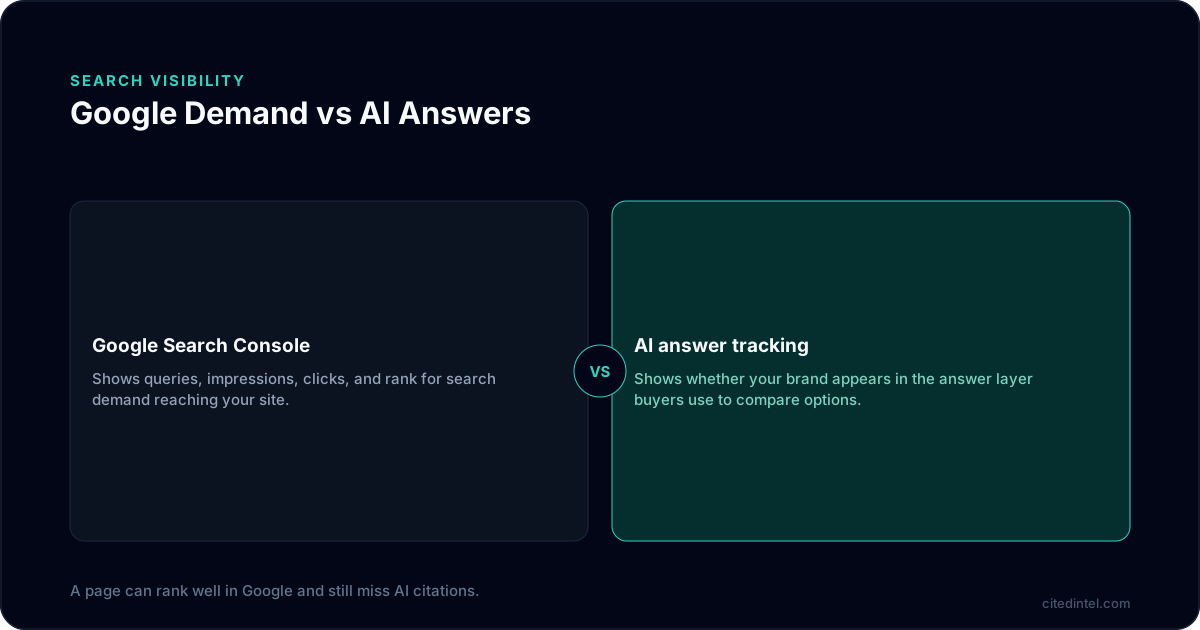
The split matters because a PMM can see healthy branded clicks in GSC while a commercial prompt in AI assistants names a rival first. McKinsey’s October 2025 research said half of consumers already use AI-powered search and a majority of those users call it their top digital source for buying decisions, which is enough to treat answer-layer visibility as a separate measurement problem, not a SEO footnote. McKinsey’s “new front door to the internet” report is the cleanest external proof of that shift.
GSC still matters. It shows the words people entered into Google, while AI answer tracking shows which prompts an assistant can surface your brand inside. The two channels overlap, but they leave different proof trails and need different fixes.
A weekly operating loop for Indian SaaS teams
The best weekly loop is spreadsheet-first. A PMM, SEO lead, or agency strategist at a B2B SaaS company can run it in under an hour, and the sheet will expose the exact gap between Google search visibility and AI search citations before a platform adds automation.
Start with rising queries in GSC, map them to buyer stage, convert the commercial ones into tracked prompts, and compare Google rank with answer-layer presence. That loop is the simplest way to practice AI search optimization without turning the team into dashboard managers.
1) Pull the queries that are rising, not the vanity terms that already peaked
Export the last 7 days of GSC queries, then compare them with the prior 7 days. Look for rising impressions, stable clicks, or a jump in average position.
For an Indian HR tech vendor, that list may surface payroll compliance, contractor onboarding, or leave management. For a procurement platform, it may be vendor onboarding, purchase approvals, or invoice matching. For a devtools company, it may be integration questions, security checks, or API limits.
- Rising impressions: people are discovering the topic, even if you are not winning the click yet.
- Position gains: Google is testing you against stronger pages on the same topic.
- Branded lift: your category pages may be creating demand that later shows up as direct or branded search.
Do not over-filter this step. A query that moved from page 3 to page 2 can be more useful than a static keyword sitting on top.
2) Sort each query by buyer stage
Every rising query should land in one of three bins: discovery, evaluation, or commercial comparison. That keeps a content team from stuffing every topic into one template.
Discovery queries are broad and educational. Evaluation queries compare methods, workflows, or features. Commercial queries ask which vendor, which plan, or which option is best for a named use case.
| Buyer stage | What the query looks like | What to do next |
|---|---|---|
| Discovery | “How do teams handle leave approvals in India?” | Strengthen educational pages and glossary content |
| Evaluation | “Best payroll software for startups with contractors” | Turn it into a comparison page or structured guide |
| Commercial | “What is the best HR software for Indian SMEs?” | Track it as an AI prompt and record which vendors get named |
For Indian software teams selling into the US or UAE as well, the stage label matters even more because the same query can sit at different maturity levels in different markets. A “best” query in India may still be an evaluation query in the UK, while a local compliance query may already be commercial in India because the buyer needs a vendor shortlist this quarter.
3) Turn commercial queries into assistant prompts
Take the buying queries and rewrite them as prompts a real buyer would ask in an assistant. Keep the prompt close to the problem, the constraint, and the category wording buyers actually use.
OpenAI said in May 2026 that shopping research in ChatGPT is built for deeper decision-making, which is why a short keyword list is too blunt for AI search monitoring. OpenAI’s product discovery update makes the point plainly: people are exploring, comparing, and deciding inside the assistant before they ever click a search result.
If GSC shows “best contract management software India,” your tracked prompts might become:
- Prompt 1: “What is the best contract management software for a B2B SaaS company in India with sales and procurement teams?”
- Prompt 2: “Which contract management tools are easiest to approve, redline, and store for Indian legal and ops teams?”
- Prompt 3: “What contract management software should a mid-market software business choose if it needs audit trails and integrations?”
That prompt set does two jobs. It mirrors how assistants answer, and it reveals whether your public proof can survive the comparison stage without sales help.
4) Put Google rank beside AI answer presence
The weekly view gets interesting here. A page can rank well in Google and still fail to be named in AI answers. A page can also appear often in AI answers without holding a top Google position.
Pew Research found in July 2025 that users were less likely to click links when a Google AI summary appeared, and many searches ended without an outbound click. Pew’s short read on AI summaries is still useful in August 2026 because it explains why click data can fall even when visibility is present.
| Google result | AI answer result | What it usually means |
|---|---|---|
| High rank, no mention | Absent | The page is readable to search, but not reusable enough for the answer layer |
| Low rank, named often | Present | The brand has useful public proof, but search visibility still needs work |
| High rank, named often | Present | The page is doing both jobs and deserves protection |
My view: this is the point where classic SEO reporting ends and answer engine optimization begins. Google decides whether you can win the click. AI assistants decide whether you enter the conversation at all.
Why a page can rank #1 and still miss AI citations
A top Google page can miss AI citations when the page is hard to quote, thin on structure, or short on third-party corroboration. Rank alone does not make a page defensible to an answer engine.
The field notes above show the pattern clearly. Pages with good Google visibility lose answer presence when the copy reads like a landing page instead of a source an assistant can reuse. That matters most on comparison and recommendation prompts, where the assistant wants language it can lift and support.
Where the breakdown usually sits
If a page ranks but never gets named, check three things first: whether the answer appears early, whether the page uses specific comparison language, and whether outside sources repeat the same claim. In practice, these are the gaps that keep generative engine optimization stuck at monitoring instead of changing outcomes.
- Structure: the answer is buried under a long intro or a dense feature list.
- Specificity: the page says “all-in-one platform” instead of naming the use case and constraint.
- Corroboration: no review, analyst note, community mention, or partner page repeats the same position.
Google’s AI search guidance has also said AI responses can include prominent links and source citations. That means the visibility gap is worth tracing, not dismissing. If a page ranks but never gets cited, the issue is often the page itself, not the keyword.
For a martech vendor, the fix may be a tightly structured comparison asset with clear integrations, proof points, and a short recommendation summary. For a legal tech company, it may be a compliance explainer backed by standards bodies and practitioner commentary. For a healthcare SaaS product, it may be a restrained page with definitions, regulations, and public references instead of a conversion-heavy pitch.
One useful boundary to keep in mind
AI answer tracking is less useful when a category has very little public content or when the buying question is too internal to surface in an assistant. In those cases, GSC stays the better weekly compass because it shows actual search demand before answer-layer visibility exists.
Run this in a spreadsheet today
Use a spreadsheet and one review meeting. A platform is optional at the beginning. The goal is a repeatable page-by-page log, not a dashboard that hides the query trail.
- Export 20 queries: pull the last 7 days from GSC and sort by rising impressions.
- Mark intent: tag each query as discovery, evaluation, or commercial.
- Rewrite five prompts: turn the top five commercial queries into full questions a buyer would ask AI assistants.
- Check the answer: search each prompt in one assistant and capture whether your brand is mentioned, compared, or omitted.
- Assign one fix: for every omission, choose one content action, such as a FAQ block, a proof section, a citation refresh, or a comparison asset.
Use this first with one category page and one comparison page. The visible result should be a short list of prompts where your brand is missing, plus the pages that need work. Citedintel automates that same audit-to-fix loop once the spreadsheet gets too manual to keep up with weekly monitoring.
How to turn the gaps into content without bloating the backlog
The weekly output should be a short action list, not a backlog dump. A PMM should leave the meeting knowing which page to rewrite, which prompt to retest, and which proof source to add.
My view: comparison pages deserve priority when a commercial prompt is rising and your brand is absent. Educational pages deserve priority when the query is still broad but the topic is trending upward in GSC.
Use this routing rule:
- Absent in AI, strong in Google: tighten the page structure, add a quotable summary, and add support from outside sources.
- Absent in both: either the query is too early or the page does not deserve to exist yet.
- Present in AI, weak in Google: build searchable depth around the answer you already own.
For B2B SaaS in India, this often shows up in three places. HR tech teams need clearer compliance language. Fintech teams need side-by-side vendor pages. Devtools teams need stronger docs and implementation pages that assistants can lift without guessing.
Google’s AI Mode and shopping features have made the search and assistant boundary much thinner by August 2026, which means fresh, structured, publicly understandable pages travel farther than clever copy. Bloomberg’s February 2026 report on Google’s AI shopping push is useful context here because it shows why software buyers may get a shortlist before they ever reach your site.
That is why the right content fix is usually a page with a clean answer, proof, and comparison language, not a bigger blog calendar.
What Citedintel adds after the spreadsheet stage
Citedintel helps teams move from “we think we are missing” to “we know which prompts, answers, and proof points need work.” The outcome is a weekly readout on AI search optimization, plus the next content move, instead of a pile of screenshots.
That matters because the bottleneck is usually not data. It is deciding what to fix first after the team sees a query in GSC and a different brand in the answer layer.
Used well, Citedintel closes the loop that spreadsheet tracking opens. It tracks buyer-intent prompts, shows where the brand is mentioned or missing, diagnoses why competitors get recommended, and turns the gaps into editable drafts and proof gaps the team can close. The point is less guessing, not more monitoring.
If you are already working on AI search optimization or generative engine optimization, this is where the weekly rhythm becomes manageable. The sheet shows the pattern. The platform keeps the loop from falling apart once the prompt list grows.
One candid limitation: if you only care about raw traffic and not about shortlist formation, answer tracking will feel secondary. That is fine. In that case, GSC stays your primary weekly source and AI search monitoring becomes a second layer, not the operating center.
What to check next week
The most useful weekly question is not “did traffic go up?” It is “which rising query in Google is already being answered elsewhere without us?”
Answer that once a week and you stop treating SEO and AI answer visibility as separate reporting silos. You also catch the moments where a page is winning rank but losing the conversation, which is where AI search optimization starts to matter in a real operating plan.
Next week, pull the top 20 rising queries from GSC, tag the commercial ones, and test the resulting prompts in AI assistants. Then mark three columns in the sheet: rank in Google, named in an AI answer, and next fix.
For a broader India-specific framing for the market shift, see AI search optimization in India. If you want help turning the gap list into publishable fixes, start with why Citedintel or try the free Citedintel audit.
Frequently asked questions
How do I show up in AI search if Google Search Console says I am already ranking?
Ranking in Google does not guarantee an assistant will cite you. The article recommends turning commercial queries into full prompts, checking whether your brand appears in the answer layer, and then fixing the page with a clearer summary, stronger structure, and outside proof.
What is AI search optimization and how is it different from GSC?
AI search optimization is whether assistants mention your brand inside the answer itself. GSC only shows queries that produced impressions or clicks on Google, so it misses cases where the assistant answers first and no search impression exists.
What are the best AI SEO tools for weekly monitoring?
The article starts with a spreadsheet rather than a platform, using GSC exports, intent tags, and assistant prompt checks to find gaps. Citedintel is presented as the next step once manual tracking gets too slow for weekly review.
How does AEO fit into a weekly SEO workflow?
AEO starts where classic SEO reporting stops: after you see which pages rank, you check whether assistants actually reuse and cite them. The workflow pairs GSC queries with AI answer presence so you can see whether a page wins the click, the citation, or neither.
What is the difference between GEO and AI search engine optimization?
In the article, generative engine optimization is the answer-layer work of making your content reusable in assistant responses, while AI search engine optimization covers the broader job of winning both Google visibility and AI citations. The practical test is simple: rank, prompt, and citation all need to be checked separately.