
Most UAE B2B teams do not have a lead problem, they have a visibility problem inside AI assistants that are already shaping shortlist behavior. If ChatGPT cannot confidently name your category, local proof, and next-best alternative, the buyer often never reaches your site in the first place.
Growing leads with ChatGPT for a B2B company in the UAE means creating pages and proof that the model can reuse when buyers ask commercial questions in English or Arabic. The goal is not to chase every answer engine, but to make ChatGPT echo your value, your UAE relevance, and your evidence in a way that turns visibility into inquiries.
AI SEO for UAE brands is the weekly work of checking how AI assistants answer real buying questions, then fixing the pages and proof that shape those answers. For a marketing lead in Dubai or Abu Dhabi, the job is to convert that into a repeatable operating rhythm, a budget line, and a board report that speaks in buyer odds, not SEO jargon.
Start with the questions Gulf buyers actually ask
The first audit should begin with 10 to 20 real buying prompts in English and Arabic, then widen each one into category, location, and competitor variants. For a UAE brand, the useful test is whether ChatGPT can name you for the category, the local market, and the alternatives a buyer would compare next.
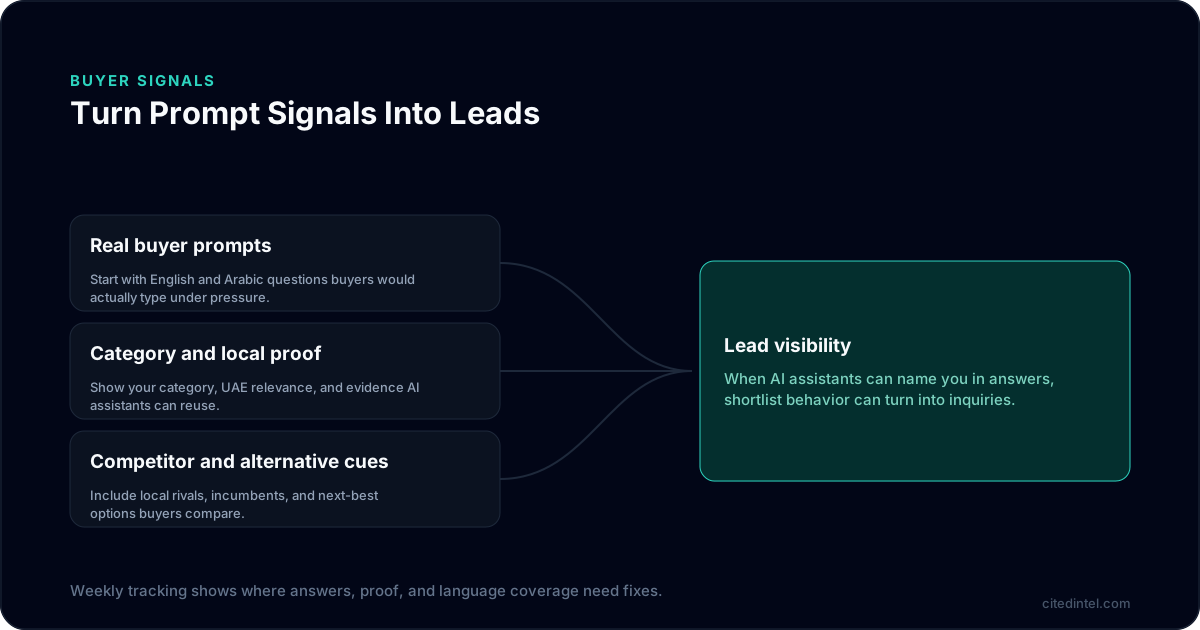
Do not start with keywords. Start with the sentence a procurement lead, founder, or functional buyer would actually type under pressure, because that is what reveals whether ChatGPT can surface you when a UAE buyer is ready to compare vendors.
For a Gulf audience, the prompt set should cover four shapes:
- Category prompts: “best HR software for UAE companies”, “best logistics tech for Dubai warehouses”, and the Arabic equivalent if your buyers use it.
- In-UAE prompts: “best B2B payments platform in the UAE”, “top procurement software in Abu Dhabi”, or “which CRM vendors have local support in Dubai”.
- Constraint prompts: “with Arabic support”, “with data residency in the UAE”, “for DIFC-regulated firms”, “for multi-branch operations”, and similar filters.
- Alternatives prompts: “alternatives to [regional incumbent]”, “alternatives to [global incumbent] in the UAE”, and “which is better for UAE buyers, [brand A] or [brand B]”.
The English and Arabic phrasings matter because AI answers often surface different evidence depending on language, and the buyer may switch languages mid-research. A marketing lead at a B2B software company in Abu Dhabi should test both versions of the same commercial question, then compare whether ChatGPT prefers the English page, the Arabic page, or someone else’s distributor page.
In the UAE, translated brochure pages usually fail this test. They repeat the product name in Arabic, but they do not add local evidence, local deployment language, or local proof, so the model has nothing solid to reuse.
If you need a first-pass list this week, build it around three category clusters:
- Software category: what the product is, who it serves, and the decision-maker’s constraint.
- In-market variant: UAE, Dubai, Abu Dhabi, GCC, or free-zone phrasing, depending on where you sell.
- Alternative name: one regional incumbent and one global incumbent, because buyers compare both.
The anonymized prompt data embedded with this article points to a pattern many in-house teams miss: once the prompt includes a local constraint, the model becomes stricter about proof, and broad pages stop carrying the answer. For a PMM, the useful part is not just whether you are named, but which proof type the model needs before it can recommend you with confidence.
Use the GCC enterprise buying questions framework if your company sells into regulated or consultative deals, because the shortlist questions in Gulf markets tend to arrive earlier than teams expect. If your category is more transactional, keep the same structure but reduce the procurement language and increase the comparison language.
Set a weekly routine before anyone asks for a dashboard
The weekly owner routine should check the same prompt set, note which engines mentioned the brand, and route every miss into content, proof, or product-page work. One owner can run it in under an hour when the tracking list is tight and the handoff rules are clear, which is the part that keeps the process from turning into a reporting exercise with no fixes attached.
I would rather see a rough weekly ritual than a polished monthly report. The weekly habit changes what gets shipped.
What to inspect every week
Track five things on the same day each week so the pattern is visible before a quarterly review flattens it.
- Answer presence: did the assistant mention the brand for each prompt?
- Position in the answer: was the brand first, buried, or absent?
- Competitor drift: did a regional incumbent or global brand start showing up where you used to appear?
- Proof gaps: did the answer lean on certifications, customer evidence, case studies, pricing, or local support details you do not surface clearly?
- Language split: did English and Arabic prompts produce different names, different citations, or different exclusions?
Route missing category pages, comparison pages, local proof pages, support pages, and Arabic pages with thin substance to content. Send data-residency language, security documentation, local hosting claims, or country-specific references to product or web teams, because those are the proof elements an assistant will quote back.
What you ignore is just as important. Do not chase one-off vanity prompts, screenshots with no repeatability, or a single answer that looks strange but does not recur across your core set. The weekly file should stay disciplined: if the same miss does not repeat, it is not yet a content problem.
What content needs from the weekly review
Send prompt misses into rewrites when the answer is weak because the page is vague, too generic, or too brochure-like. Send them into new assets when the model needs a comparison, a local proof page, or a use-case page that simply does not exist.
For example, a vertical SaaS company selling to logistics operators in the UAE may need a page on Dubai warehouse workflows, while a fintech vendor may need a DIFC or ADGM trust page that explains compliance and deployment in plain language. A broad homepage rarely fixes that.
Weekly tracking also shows whether Google Search Console and AI answer tracking are pulling in different directions. They usually are. Search Console tells you what people queried in Google, while AI answer tracking tells you what the assistant said back when the buyer tried to narrow the shortlist.
Choosing AI SEO tools in-house comes down to coverage, evidence, and speed
Choose an AI SEO tool by asking whether it covers the assistants your buyers actually use, whether it tracks prompts instead of loose keywords, and whether it gives you evidence you can forward upstairs without rewriting it. A spreadsheet is still enough when you have a small prompt set, one market, and a single owner who can check answers manually each week.
The candid line is this: if your team is tracking 10 prompts across one or two assistants, a sheet plus a disciplined process can carry you for a while.
| What to evaluate | Why it matters in the UAE | When a spreadsheet is enough | When software becomes worth it |
|---|---|---|---|
| Assistant coverage | UAE buyers may compare across different AI assistants and answer engines | One market, few prompts, one or two engines | Multiple engines and multiple language variants |
| Prompt-level tracking | Category, Dubai variant, Abu Dhabi variant, and alternatives prompts behave differently | Stable prompt list with no frequent changes | Prompt set expands each month |
| Evidence you can forward | Leadership wants the answer, the competitor, and the fix in one place | Small team, informal reporting | Board or budget season needs a clean view |
| Fix loop | Visibility without a shipped action stalls fast | Manual content team can act quickly | Several teams need a shared workflow |
The evaluation questions that matter are practical:
- Engine spread: Does the tool cover ChatGPT, Claude, Perplexity, and Gemini, plus Google AI Overviews where relevant?
- Prompt quality: Can it track full buyer questions in English and Arabic, not just fragments?
- Competitor view: Does it show which regional and global incumbents are taking the answer layer from you?
- Leadership-ready output: Can you export a clean report that shows what changed, what mattered, and what to ship next?
For in-house teams, the real threshold is whether the tool helps the marketing lead move from “we are not showing up” to “here is the page and proof gap causing it.” That is where Citedintel fits naturally, because the platform is built to show the prompt, the answer, and the next fix in one workflow so the team can assign a specific page, proof item, or language gap instead of debating the symptom.
Use the AI search optimization platform checklist if you are still sorting out what belongs in monitoring versus what belongs in action. If you want to test the workflow before budget season, begin with the free audit and keep the prompt set small.
What to ship after the audit, and what to leave alone
Ship the pages and proof that answer the missing buyer question, then leave isolated outliers alone until they repeat. The best next move is usually not more content volume, but one stronger page with clearer local evidence.
Here is the rough order that works for UAE brands: category page first, comparison page second, local proof page third, Arabic version fourth, and support or trust pages where the question is about risk rather than fit.
Do not spend the content calendar on every prompt miss. If the miss comes from a stray query, an engine glitch, or a one-off answer that does not recur, ignore it and keep the weekly set stable. The test is repetition: only misses that show up across the same prompt pattern deserve new pages or proof work.
When the miss is consistent, the fix often looks like this:
- Category clarity: state what the product is in the first paragraph and in the page title.
- Local proof: surface UAE deployment details, Arabic support, regional references, and data-residency language where true.
- Comparison depth: write the page buyers want when they type alternatives to a named incumbent.
- Trust surface: publish security, compliance, support, and implementation details in language an assistant can reuse.
Translated-brochure pages fail at this step. They translate claims, but they do not localize the evidence, so the model has no reason to treat them as the strongest answer for a Dubai or Abu Dhabi buyer.
Localized evidence works because it answers the next question, not just the first one. If the buyer asks about data residency, implementation in the UAE, or in-country proof, the assistant needs a page that addresses those points plainly.
Board report: one chart and three numbers the leadership team will read
The board report should show one chart: answer presence by prompt over time, with your brand and the top two competitors on the same line. Pair it with three numbers, written in buyer odds, not SEO vocabulary: how often you show up, how often you lead, and how often a competitor takes the answer instead.
That is the executive story in one sentence. If the chart and three numbers do not tell it, the report is too busy and should be trimmed until the leak, the win, and the competitor pressure are visible at a glance.
Write the numbers like this:
- Show-up rate: “In our tracked UAE buying prompts, our brand appears in X out of Y answer situations.”
- Lead rate: “In the prompts that mention us, we are first or near the top in X out of Y situations.”
- Competitor take-rate: “A named rival appears before us in X out of Y commercial comparisons.”
Those are buyer odds. They tell leadership whether the brand is being considered early, whether it is being displaced, and where the commercial leak sits. That wording also keeps the report grounded in what matters, visibility in AI answers rather than classic rankings alone.
Google’s own Search blog says AI Overviews are driving more searches, more complex queries, and more clicks of higher quality, while still sending billions of clicks to the web daily. That is why leadership should track visibility in AI answers rather than classic rankings alone. Google Search blog
Pew found that users clicked less often when an AI summary appeared in the results, which is another reason the report should show answer-layer presence and not just referral traffic. Pew Research
Gulf-specific cautions: data residency, proof inside the country, and Arabic pages that actually help
In the UAE, the assistants often surface questions about data residency, local hosting, in-country support, and whether a vendor has real regional proof. If your public pages do not answer those plainly, AI assistants will fall back to brands that do.
For a PMM at a fintech, healthcare SaaS, or HR tech company, the proof questions usually look like this:
- Data location: Where is customer data stored, and does the product support UAE or regional residency options?
- Regulatory fit: Does the vendor publish anything useful for DIFC, ADGM, or other local compliance contexts where relevant?
- In-country proof: Are there UAE references, local partners, local support hours, or case studies that an assistant can cite?
- Language proof: Does the Arabic page carry original substance, or is it only a translation of the English brochure?
The pages that win here are rarely the prettiest ones. They carry specific, defensible evidence a model can reuse without hesitation, which is why a plain-language proof page often outperforms a polished brochure page in the answer layer.
That matters because AI answers are getting more source-sensitive. Anthropic says Claude web search now provides up-to-date, cited answers for research and sales tasks, and OpenAI’s shopping research uses public product information plus merchant data to surface alternatives as users refine constraints. Anthropic OpenAI Help
For UAE brands, the practical lesson is blunt: local proof beats translated brochure copy. A translated page can help with language coverage, but localized evidence is what helps the model defend a recommendation.
Try this today: a UAE prompt sheet you can score
If you need a visible result before the week ends, use this exact sheet and score each prompt from 0 to 2, where 0 means absent, 1 means mentioned, and 2 means recommended near the top. Keep the prompt list fixed for two weeks so the same gap can be compared after each round of edits.
- Write one category prompt in English: “best [category] for UAE companies”.
- Write one Dubai variant: “best [category] in Dubai”.
- Write one Abu Dhabi variant: “best [category] in Abu Dhabi”.
- Write one Arabic version of the category prompt.
- Write one alternatives prompt naming a regional incumbent.
- Write one alternatives prompt naming a global incumbent.
- Run the set in ChatGPT and the other assistants you track.
- Record the brand names that appear, the rivals that appear, and the page types cited.
- Circle the missing proof type, then assign it to content, web, or product.
For the fuller version of this workflow, see why Citedintel compresses the audit, diagnosis, and re-check into one loop, or scope an enterprise program per use case, funnel stage and market (early-stage brands can begin on the free Starter tier).
What a sane in-house rhythm looks like by next quarter
A sane rhythm is one owner, one weekly prompt set, one monthly content fix list, and one board slide. That is enough to start measuring AI search optimization without turning the team into a dashboard factory, because the loop stays tied to one audit, one action, and one re-check.
If your UAE brand sells software, the point is not to watch AI answers for sport. What matters is seeing whether the buyer who asks “which vendor should we trust” sees your brand, your rival, or neither, since that answer shapes whether you get shortlisted at all.
Use the manual path first if the scope is small. Use software when the prompt list expands, the languages multiply, or leadership wants proof that is ready to forward without interpretation.
Citedintel earns its place in the stack for in-house teams because it shortens the loop from audit to diagnosis to publish to re-check, and it does so in a way a marketing lead can actually report upward without translating the whole story twice.
For UAE brands, that discipline matters more now because AI answers are already part of discovery and comparison. McKinsey has reported that many consumers use AI-powered search for brand discovery and purchase decisions, and Gartner has found that GenAI is changing research habits rather than replacing search outright. McKinsey Gartner
The board does not need a theory. It needs to know whether your brand is showing up when the shortlist forms. That is the job now.
Frequently asked questions
How do I increase leads with ChatGPT for my B2B business in the UAE?
Start with real buyer questions in English and Arabic, then check whether ChatGPT names your brand, your local proof, and your alternatives. Fix the pages that answer the missing question, especially category pages, comparison pages, and UAE proof pages. Leads improve when the assistant can reuse evidence that sounds specific and local.
What prompts should I test for ChatGPT lead generation in the UAE?
Use category, Dubai, Abu Dhabi, constraint, and alternatives prompts. Keep them close to what a buyer would ask when comparing vendors, including local support, data residency, and Arabic language needs. The point is to test commercial questions, not keywords.
What content helps ChatGPT recommend my B2B company?
ChatGPT needs pages that say what you do, where you work, and why you are credible in the UAE. Strong category pages, comparison pages, local proof pages, and Arabic pages with real substance usually matter more than broad homepage copy. Translated brochure pages rarely carry enough evidence.
How often should I check AI search optimization for my UAE brand?
Check it weekly if you want the work to affect shipping decisions. A fixed prompt set makes it easier to spot competitor drift, missing proof, and language differences before a quarterly review hides the pattern. Weekly review is enough for most in-house teams at the start.
What is the best AI SEO tool for a UAE B2B team?
Pick the tool that tracks the assistants your buyers use, follows full prompts in English and Arabic, and gives you evidence you can act on. If your prompt set is small, a spreadsheet can work for a while. As the scope grows, software becomes easier to defend.