
Organic lead generation works better when the buyer question comes before the content format. For a US legal tech company with no ad budget, the first target should be a narrow AI search shortlist question such as “Which contract lifecycle platform fits a 200-person law firm?” rather than a broad topic like “What is legal technology?”
Generate leads without paid ads by becoming a source an AI answer can use, then giving the arriving buyer a self-serve way to check fit. AI search optimization connects comparison pages, pricing clarity, third-party proof, and a measured conversion path into one demand system.
Start with the US buying question, not the blog calendar
For US legal tech companies, the strongest organic lead generation playbook starts with buyer questions that contain a decision, a constraint, and a consequence. The work then moves through four stages: select the questions, publish answer-ready evidence, earn trusted references, and convert the buyer who arrives already informed.
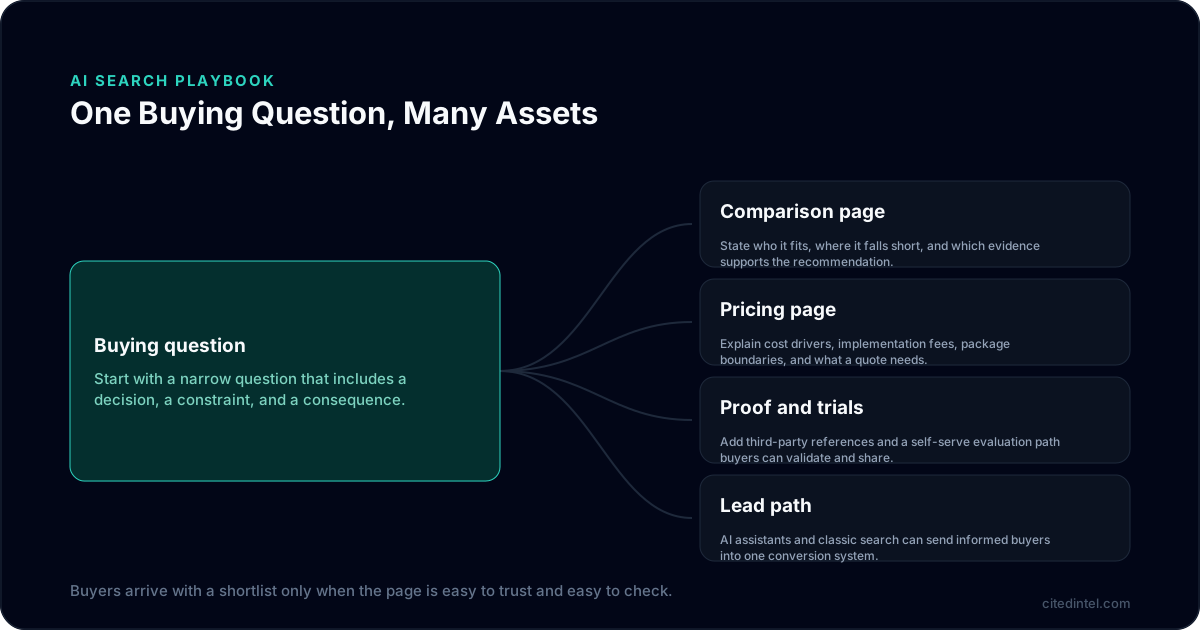
The opportunity is larger than a change in referral traffic. In January 2026, Forrester reported that the typical B2B buying group included 13 internal stakeholders and nine external influencers, while more than 60% of buyers used trials to evaluate solutions. An AI answer may create the shortlist, but legal operations leaders, consultants, procurement teams, and internal champions still need material they can validate and share.
My view is simple: AI search should not replace organic marketing. It should be treated as a filter that affects which vendors receive the first serious look. Classic search remains useful because buyers click conventional results, compare pages, inspect documentation, and send links to colleagues.
Teams building an AI SEO strategy for the United States should start with one category and one buying moment. Legal tech is a useful example because the purchase involves workflow fit, data handling, implementation effort, security review, and several people who may never attend the same sales call.
Which legal tech questions can create a sales conversation?
The first questions to win are not broad educational prompts. They are buying questions where the answer must weigh product fit, implementation risk, pricing, security, and alternatives.
Build the initial list from sales-call notes, lost-deal records, implementation tickets, procurement questionnaires, and support conversations. Those records contain the conditions that change a recommendation. A keyword export can show demand, but it rarely tells you that a buyer needs Microsoft 365, outside counsel access, or a two-month rollout.
Turn vague searches into decisions
A useful question names a recognizable buyer, a defined job, and a reason the choice is difficult. “Best legal software” is too broad to guide a page. “Which contract lifecycle management platform works for a US legal department with Salesforce, outside counsel review, and a two-month rollout target?” gives the content team a real brief.
- Category choice: Which contract lifecycle management platform fits a mid-market legal department?
- Operating constraint: Which platform supports US data residency, SSO, approval rules, and Microsoft 365 workflows?
- Comparison: What should a legal operations team compare before replacing spreadsheets with contract software?
- Commercial question: What does contract lifecycle software cost when users, repositories, implementation, and integrations vary?
- Risk question: What security and audit evidence should a law firm request before adopting legal workflow software?
These prompts also give an AI tool for marketing a useful source brief. A writer can answer them with documented facts, while a sales representative can identify which constraint appears late in the deal and causes the buyer to pause.
Microsoft Research found in April 2026 that nearly 80% of more than 200,000 real-world ChatGPT queries were “non-searchable” open-ended questions. For a legal tech team, the implication is practical: write for natural questions about fit, switching, implementation, and trade-offs, not just short keyword phrases.
A legal tech founder should separate questions that attract attention from questions that create a conversation. “What is contract lifecycle management?” may bring early research traffic. “What should a 200-person legal department check before changing contract systems?” gives the reader a reason to download a checklist, request documentation, or start a trial.
Score the questions before assigning writers
Score each question on buying intent, answerability, available evidence, and lead value. Put a question near the front of the queue when the reader is close to a shortlist and your team can support the answer with public documentation.
| Question type | Page to publish | Evidence required | Lead path |
|---|---|---|---|
| Best-fit shortlist | Category comparison | Use cases, limits, integrations, customer type | See fit, request evaluation |
| Replacement decision | Switching guide | Migration steps, data export, implementation ownership | Migration checklist, technical review |
| Pricing question | Pricing explainer | Cost drivers, package boundaries, implementation fees | Estimate scope, speak with sales |
| Risk question | Security and governance page | Policies, controls, retention, access model | Request documentation |
Pick three questions for the first publishing cycle. A small team that produces ten generic articles will usually learn less than a team that publishes three complete answers and watches which questions create qualified conversations.
For a US legal tech company, a useful opening set might include one replacement question, one pricing question, and one security question. Those subjects reach different members of the buying group without scattering the team across unrelated topics.
Build a page set that answers the shortlist
Answer engine optimization for US legal tech shortlists needs a connected set of pages, not one oversized guide. Each page should make a decision easier, state who the product fits, explain where it does not fit, and point to evidence the buyer can inspect.
A comparison page should not read like a product brochure. It should explain how the options differ for a law firm, an in-house legal department, or a company with a large contract repository. If the product lacks a named integration, the page should say so instead of making the reader discover the gap during a sales call.
Five assets worth publishing first
Start with five assets that cover the questions appearing in a legal tech evaluation. Each asset can be concise if its facts are specific and easy to quote.
- Category page: State the job the product performs, the legal team it serves, the workflow it replaces, and the operating conditions that affect fit.
- Comparison page: Compare your product with the status quo, adjacent categories, and the criteria used in US legal operations reviews.
- Pricing page: Explain whether cost changes with seats, repositories, business units, contract volume, integrations, implementation, or support.
- Proof page: Bring together customer evidence, named contributors, measurable workflow changes, and the boundaries of each claim.
- Evaluation page: Give the buyer a trial plan, data checklist, security questions, and a definition of what a successful evaluation should show.
The pricing page deserves special attention. IDC wrote in January 2026 that AI-mediated buying content benefits from machine-readable structure, trusted third-party references, authoritative sources, and consistent facts across credible channels. For legal tech, pricing, data handling, retention, security review, and implementation details should not conflict between the website, sales deck, review profile, and procurement response.
Give the pricing page a real answer even when the product uses custom quotes. Explain what changes the quote, what a typical evaluation includes, which services cost extra, and what information a buyer should bring to a pricing call. “Contact sales for pricing” leaves an answer engine with little usable material and leaves the reader with another research task.
Google’s December 2025 guidance says existing SEO fundamentals remain relevant to AI features. Pages still need to be crawlable, indexable, useful, accurate, and supported by clear internal links and accessible text. There is no special file that substitutes for a useful legal tech page, and there is no schema setting that promises inclusion in an AI answer.
Use headings that mirror the buyer’s question. “How much does contract lifecycle software cost?” is stronger than “Flexible plans for modern legal teams” because the first heading tells both the reader and the answer engine what the passage resolves.
Place the answer near the beginning of each page. Follow it with qualification, evidence, and limitation. A passage about migration should say whether historical contracts can be imported, which fields require mapping, and who owns the work before it moves into a longer explanation.
If your team needs a broader content workflow, the guidance in making organic marketing work when buyers ask AI first gives useful context. Apply that thinking to one legal tech category, one buying committee, and one quarter of publishing capacity.
Earn the references that make a recommendation believable
Owned pages explain your product, but independent sources help establish why a buyer should include it. AI search optimization therefore includes review profiles, analyst references, professional associations, legal operations communities, implementation partners, and publications that can verify a claim.
Do not buy a pile of vague mentions. Google’s guidance warns against inauthentic mention-building, and a January 2026 Microsoft Research study on source preferences found that model preferences can be shaped by context and source selection. The practical lesson is to seek relevant evidence rather than volume for its own sake.
Match each claim to a trusted source
For each priority question, list the sources a US legal tech buyer would trust before approving software. Assign one factual contribution to each source. A review site might cover usability, a customer story might document implementation, and a security page might support governance claims.
- Independent reviews: Keep company descriptions, customer type, integrations, and pricing logic consistent with your own site.
- Customer references: Describe the starting process, the change made, the people involved, and the limits of the result.
- Professional sources: Contribute useful commentary to legal operations groups, bar associations, or specialist publications without turning the contribution into an advertisement.
- Partner pages: Name the workflow, integration, or implementation boundary that the partnership supports.
- Research pages: Publish original findings only when the method, sample, date, and limitations are visible.
A US legal tech company should also check whether its public facts make sense to a buyer in another market. A product can be clear in the United States and still become confusing in the United Kingdom, India, or the UAE when legal terminology, data rules, or contract practices differ. Keep the US page specific, then create market pages when the product, evidence, and buying process genuinely differ.
My view is that third-party proof belongs in the product marketing backlog, not in a separate public relations drawer. If your team cannot show where a pricing claim, security statement, or implementation promise came from, remove the claim or add the missing evidence before publication.
Make the request specific when contacting a publisher or partner. Ask for a factual update to a product profile, a documented implementation note, or a comparison of a stated workflow. A vague request for “a mention” gives the source no reason to publish and gives the buyer no useful evidence.
Make the first page visit useful to a buyer who already researched
AI-referred visitors often arrive with a category, a shortlist, and several assumptions already in place. Your landing page should confirm or correct those assumptions within the first screen, then help the buyer choose a low-friction next step.
A Gartner study released in May 2026 examined 645 B2B buyers and found that 45% had used generative AI, primarily to research vendors and products. The same research reported that 70% preferred fully digital, self-service buying, while 69% wanted a sales representative to check AI-produced information. The page needs both options: enough substance to proceed alone and a human checkpoint for uncertainty.
Put fit, limits, and the next action together
Place these elements near the top of each high-intent page:
- Fit statement: “This platform is for US legal departments managing high-volume agreements across sales, procurement, and outside counsel.”
- Boundary statement: “It is a poor fit when a team needs a full e-discovery system rather than contract workflow management.”
- Next step: “Review the evaluation checklist, request security documents, or book a product demonstration.”
The fit statement reduces the work required to interpret the page. The boundary statement prevents a low-quality lead from becoming a confused sales opportunity. The next step gives the buyer control without hiding the route to a sales representative.
Add a short source note to pages that use research, benchmarks, or customer numbers. Add a date to pricing, integrations, compliance material, and product availability. A legal tech buyer should be able to tell whether a page reflects September 2026 information or an older product state.
Gartner’s March 2026 research points to fewer website visits but higher-converting visitors as AI use rises. That makes the arrival page a buyer-enablement asset rather than a general company brochure. Put the evaluation checklist, pricing logic, security route, and product limits where a visitor can find them without a guided tour.
A founder should inspect the first screen on mobile and desktop, then ask one question: could a legal operations manager tell whether this product belongs on the shortlist without speaking to sales? If the answer is no, the page needs better qualification before it needs more traffic.
Ask how the visitor found you
Use one required field that asks, “How did you hear about us?” Give the buyer choices that preserve AI influence without pretending the answer can prove revenue attribution.
- AI assistant: An answer engine or conversational search tool
- Google: Standard search result, AI Overview, or AI Mode
- Review source: Review site, analyst page, or comparison article
- Referral: Colleague, consultant, partner, or community
- Other: Free text for a source the form did not anticipate
Ask the question again after a trial or demonstration only when the answer changes a sales decision. A short optional field such as “What did you read or ask before contacting us?” can reveal the buyer’s wording, but a long attribution form creates friction before the conversation begins.
For measurement design, use the guidance in what AI search revenue attribution can and cannot prove. Track the source response beside landing page, qualified conversation, opportunity stage, and closed revenue. An AI mention is a useful leading signal, not a booked deal.
Try this today: build a six-question evidence sheet
You can create a usable first brief from six prompts and a simple evidence sheet. Run the prompts in your chosen AI assistants, then record the answer, source links, recommended vendors, missing facts, and page that should resolve each gap.
- Category: “Which contract lifecycle management platforms suit a US legal department with 200 employees, Microsoft 365, Salesforce, and a small legal operations team?”
- Comparison: “Compare the leading options for contract requests, approvals, repository search, reporting, and outside counsel collaboration. State what evidence supports each recommendation.”
- Pricing: “What cost questions should a US buyer ask before comparing contract lifecycle management software? Separate license, implementation, integration, support, and usage costs.”
- Risk: “What security, privacy, retention, audit, and access questions should a US legal team ask during software evaluation?”
- Switching: “What makes migration from shared drives and spreadsheets difficult, and which vendor claims should be verified before signing?”
- Fit: “Which type of legal team should avoid a contract lifecycle management platform and choose a different approach?”
Record five fields for every answer: recommended vendor, reason for recommendation, cited source, missing evidence, and proposed page. Turn one missing-evidence field into a published update, one into a third-party proof request, and one into a sales enablement asset.
Run the same sheet again after publication and record the date. Google Search Console now includes reporting for generative AI features, with worldwide rollout reported by August 31, 2026. Pair those impressions with form responses and qualified conversations rather than treating an impression as a lead.
For a free starting point, use the AI search check to inspect how your current pages appear around buyer questions. Citedintel can take the same question set across ChatGPT, Claude, Perplexity, and Gemini, show where competitors receive recommendations, turn missing evidence into editable content work, and let your team recheck the results each week. See how Citedintel supports that workflow.
Give the work two to three months to compound
Organic lead generation through AI search rarely produces a dependable pipeline in the first publishing week. Plan for two to three months of compounding work because pages need to be published, indexed, referenced, reviewed by buyers, and connected to a conversion path.
The first month should produce the question set, comparison page, pricing explanation, and arrival-page changes. The second month should add independent proof, customer evaluation material, and updates based on missing answers. The third month should compare answer presence, cited sources, qualified form responses, trial activity, and sales feedback.
| Period | Team decision | Useful output |
|---|---|---|
| Weeks 1 to 4 | Which three US legal tech questions deserve ownership? | Prompt sheet, page briefs, fact register |
| Weeks 5 to 8 | Which missing proof blocks recommendation or evaluation? | Comparison update, pricing detail, proof requests |
| Weeks 9 to 12 | Which answer presence turns into buyer action? | Source responses, assisted conversations, pipeline review |
Do not judge the program by impressions alone. A page that receives fewer visits but creates more evaluation requests may be doing its job, while a page that earns many visits but produces no useful conversation may need a sharper fit statement or a better next step.
This approach is not the right tool for a business that has no public evidence, cannot update product facts, or has no owner for follow-up. AI search optimization can expose those gaps, but it cannot replace customer proof, pricing decisions, product documentation, or a sales process that responds to informed buyers.
My advice is to publish fewer claims and support more of them. When a buyer asks an AI search engine what to buy, the advantage is rarely another broad article. It is a precise answer, backed by a source the buyer can inspect, followed by a page that respects the questions already forming in the buyer’s mind.
If you want to see the workflow before committing budget, the Citedintel demo is a product demonstration, not independent research or a promise of lead volume. Bring three real US legal tech buying questions, run the sheet, and let the evidence determine which page your team publishes first.
Parth Sesodia
Founder, Cited
Frequently asked questions
How do I use AI SEO to generate leads without paid ads?
Start with narrow buying questions drawn from sales calls, lost deals, implementation tickets, and support conversations. Publish comparison, pricing, security, and evaluation pages that answer those questions with citable evidence and a clear next step.
What should a legal tech company publish for AI search?
Begin with a category page, comparison page, pricing explainer, proof page, and evaluation page. Each page should explain product fit, limitations, evidence, and the action a buyer can take without needing a sales call first.
What is the best AEO approach for legal tech buyers?
Answer specific questions about workflow fit, integrations, pricing, security, migration, and implementation. Put the answer near the top of the page, then add supporting evidence, limitations, source notes, and internal links.
How does answer engine optimization help a legal tech company get shortlisted?
Answer engine optimization gives AI systems clear, supportable information they can use when buyers compare vendors. Independent reviews, customer references, partner pages, and consistent facts across your website and external profiles make those recommendations easier to trust.
How long does AI search engine optimization take to produce leads?
The article recommends allowing two to three months for pages to be published, indexed, referenced, and connected to a conversion path. Review answer presence alongside form responses, qualified conversations, trial activity, and pipeline rather than impressions alone.