
Consumer AI search optimization is won on proof, not prose. If your ingredients, reviews, retailer data, and comparison pages do not line up, AI assistants will usually recommend a cleaner rival before they recommend you.
For D2C brands, AI search optimization is the chance to be named, compared, or recommended inside answers from AI assistants when shoppers ask what to buy. GEO is the wider practice of earning that visibility across AI-generated answers, while AEO is the page-level work of becoming the source an answer can quote, compare, and trust.
What AI search optimization means for consumer brands
AI search optimization for consumer brands is the likelihood that a product appears inside the shortlist, not just on the results page. The practical test is simple: when a shopper adds a constraint, does your product still fit the answer, or does the engine switch to a brand with cleaner facts?
Pew Research Center’s June 2026 AI survey includes a dedicated section on AI search summaries, which is a useful signal that AI-assisted search has moved into mainstream behavior. McKinsey also said in June 2026 that more than half of consumers already rely on AI to guide purchase decisions, and that shopping is shifting from an attention economy to a trust economy. McKinsey
My view: consumer AI search behaves more like merchandising than classic SEO. The job is not to rank a page and hope the shopper notices. The job is to make the product legible enough for an assistant to surface, narrow enough to match the prompt, and credible enough to repeat.
A skincare brand is judged on ingredient clarity, irritation risk, and skin-type fit. A beverage brand is judged on sugar, caffeine, sodium, taste, and serving size. A home and kitchen brand is judged on dimensions, materials, and durability. Those are not content problems first. They are evidence problems.
How assistants decide which products to recommend
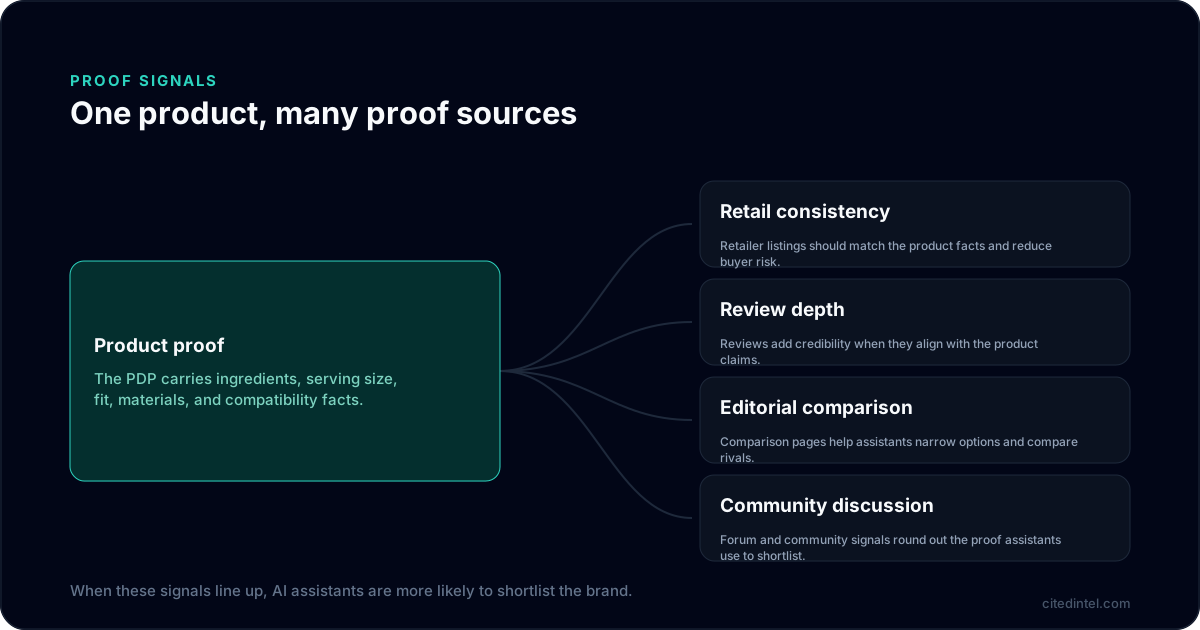
Assistants recommend consumer products when they can assemble a defensible answer from public proof. The winning product usually has aligned facts across the PDP, retailer listings, review language, editorial roundups, and community discussion, so the engine can tell one coherent story instead of stitching together five partial ones.
McKinsey’s June 2026 shopping guidance is blunt about this shift. It says agentic experiences need a knowledge engine with content that answers customer questions, plus machine-readable credibility signals such as detailed specs, verified reviews, and expert input. That maps closely to how consumer AI search optimization appears to work in practice. McKinsey
The evidence stack that tends to matter
- Review language: detailed reviews answer the “why this one” question better than star ratings alone.
- Retail structure: titles, ratings, prices, availability, and attributes give the assistant cleaner facts.
- Editorial comparisons: “best of” roundups often supply the side-by-side frame the shopper asked for.
- Community discussion: Reddit and similar threads surface objections, comparisons, and tradeoffs assistants often reuse.
- Product pages: ingredient, material, size, compatibility, and usage facts still matter when the engine checks the source.
OpenAI says ChatGPT shopping results use structured metadata, first- and third-party data, and public review content, and that merchants can provide product feeds so results reflect fresher product information. Google says its shopping system uses the Shopping Graph, which it describes as containing more than 50 billion product listings. The practical rule is simple: if your variant names and attribute fields do not point to one sellable item, the assistant may recommend the wrong product. OpenAI Help Center Google Shopping blog
Ingredient transparency matters most in beauty, skincare, supplements, and personal care because assistants look for a fast way to reduce risk. A vitamin C serum that hides concentration, texture, or irritation notes is easy to skip. A low-sugar electrolyte drink that does not show sodium and serving size is easy to misread.
In practice, the engine is not “understanding” beauty or beverages in a human way. It is looking for enough aligned evidence to justify a recommendation without hedging, and brands that publish the proof plainly make that job easier.
Why consumer AI search is different from B2B answers
Consumer answers depend more on proof density and product clarity than on a single authoritative page. B2B answers often reward documentation depth and implementation detail. D2C answers reward sentiment, retail completeness, and fast comparison.
| Signal | Consumer D2C brands | B2B software businesses |
|---|---|---|
| Primary proof | Reviews, ratings, Reddit, editorial roundups, retailer data, product pages | Docs, comparisons, case studies, integration pages, reviews |
| Typical prompt | “best X for Y,” “is brand X good,” “what is the healthiest option” | “best tool for X,” “which vendor supports Y,” “compare A vs B” |
| Trust trigger | Transparency, sentiment, price, availability, fit for use case | Fit, implementation risk, compliance, technical depth |
| Main failure mode | Opaque ingredients, thin reviews, messy variants, weak retail data | Thin docs, vague positioning, missing comparisons, inconsistent entities |
A D2C team should not copy the playbook from AI search optimization for B2B SaaS. A skincare brand does not need more generic AI content. It needs better product legibility, stronger review capture, and cleaner retail representation.
That difference matters because shortlist formation starts before the PDP. The assistant often checks whether the product is clear enough to explain in one or two lines, and if the answer is muddy, a competitor with cleaner proof gets the nod.
One more point teams miss: visibility shifts by market. A product can appear in the US and then fall out in the UK or India if the review ecosystem, retail presence, or product language changes. If you sell across the UAE or Southeast Asia, watch local retailer pages and local-language prompts, because AI search optimization changes with the market.
In other words, a D2C brand needs one evidence stack per market, not one global page copy-pasted everywhere.
What a D2C growth team should track every week
A D2C growth team should track whether assistants mention the brand, where the brand appears in the answer, and what proof the answer is leaning on. Weekly monitoring matters because the shortlist can move when reviews, retail data, community discussion, or editorial coverage changes, and those shifts usually show up before traffic does.
Use a 0 to 3 rubric for each prompt: 0 means omitted, 1 means mentioned but outside the first recommendations, 2 means in the first three, and 3 means first-slot or clear recommendation. Treat 2 as the minimum pass for core prompts, and treat any prompt that drops from 2 to 1 for two consecutive weeks as a problem to fix.
Track the source type beside the score. That tells you whether the issue is review density, retail data, ingredient transparency, or weak comparison content.
| Metric | Good | Watch | Bad |
|---|---|---|---|
| Mention rate | Brand appears on most core prompts | Appears inconsistently | Frequently omitted |
| First-slot rate | Shows up first or among the first recommendations on priority prompts | Appears later in the answer | Never leads |
| Proof mix | Answer draws from reviews, retailer data, and product pages | Mostly one source type | Relies on weak or irrelevant sources |
| Competitor displacement | Your brand replaces a rival on the highest-value prompts | Mixed results | Competitors own the shortlists |
NIQ reported in May 2026 that 42% of consumers now use AI tools to shop and 17% have used AI for product recommendations in its early-2026 U.S. Monthly survey. McKinsey’s April 2026 consumer study also found that 63% use AI to compare options, 55% to learn about a product or category, and 46% to discover or get inspiration for purchases. NIQ McKinsey
That means AI search analytics should focus on discovery and comparison, not only final purchase language. If your weekly report only tracks branded queries, you are missing the moment where assistants decide who gets into the shortlist.
For beauty, track skin type, irritation language, and ingredient comparisons. For beverages, track sugar, caffeine, sodium, and taste. For apparel, track fit, fabric, and returns. For home and kitchen, track size, materials, and durability. Prompt wording should stay stable week to week, or the test becomes noise.
Ask the three questions shoppers bring to the shelf
Run one prompt set and score it, and you will know more than most dashboards tell you. Test the same five prompts across AI assistants, then record what each one says.
- Pick five real prompts: “best vitamin C serum for sensitive skin under $40,” “healthiest electrolyte drink with low sugar,” “best protein bar that does not taste chalky,” “best travel-size skincare set,” and “best reusable water bottle for commuting.”
- Score each answer: 3 if your brand is first or clearly recommended, 2 if it appears in the first three, 1 if it appears later, 0 if omitted.
- Log the proof: write down whether the answer leaned on retailer data, reviews, Reddit, editorial roundups, or your product page.
- Mark one fix: if you scored 0 or 1, choose one change only, such as clearer ingredients, better retailer titles, stronger review capture, or a comparison page.
This exercise turns answer engine optimization into something you can inspect by hand. The scaled version is what a visibility tracker helps teams automate when the manual checks start to sprawl. If you want the repeatable version, start a free audit.
What good consumer signals look like in practice
Good consumer signals make the buying decision easier to verify. A brand that explains the product plainly has a better shot at AI search optimization than a brand that leans on polish alone.
Beauty and skincare
Shoppers ask about skin type, active ingredients, texture, and irritation risk. AI answers tend to reward brands that explain concentration, usage, and who should avoid the product.
If your vitamin C serum is for sensitive skin, that should be visible without scrolling through a tab. If the product page hides the concentration, the assistant has to work harder than it should.
Beverages and supplements
Here, transparency matters most. Sugar, caffeine, sodium, flavor, serving size, dosage, and testing should be easy to find. A wellness brand that overclaims usually loses trust faster than a brand that is plain.
McKinsey’s March 2026 consumer sentiment survey said 19% use AI to discover and/or decide on brands, products, or services. That is the consideration phase, which is where many beverage and supplement prompts live. McKinsey
Apparel, consumer electronics, and home and kitchen
Apparel prompts usually hinge on fit, fabric, care, and return policy. Consumer electronics hinge on compatibility, battery life, warranty, and setup friction. Home and kitchen often turns on dimensions, materials, and durability.
If you sell in these categories, the same principle applies: the assistant is trying to reduce regret before the purchase. The more precisely your pages answer the shopper’s first question, the more likely the product is to stay in the shortlist.
My rule of thumb is simple: if the PDP cannot answer the shopper’s first comparison question in one screen, the assistant will look for a cleaner source.
That is why generic brand storytelling underperforms here. The assistant is not looking for mood. It is looking for proof it can reuse without risk.
How to improve AI search optimization without chasing every trend
Raise AI search odds by tightening the public proof around your products, not by publishing generic AI content. The strongest D2C brands make the product legible from the listing itself: what it is, who it serves, why it deserves trust, and where it fits against alternatives.
Many teams overinvest in storytelling and underinvest in product legibility. If your assortment, naming, reviews, and retailer data are messy, no amount of blog output will compensate.
In B2B, a generative engine optimization strategy often starts with comparison pages, use-case pages, and proof-rich documentation. In D2C, the first move is usually the product page, the retailer listing, and the review ecosystem. The work is similar, but the proof objects are different.
A 30/60/90-day plan
| Window | Priority | Effort | Expected impact |
|---|---|---|---|
| 30 days | Standardize product names, variants, and core attributes across site and retailer listings | Low to medium | Better match rate and fewer wrong-product answers |
| 30 days | Rewrite product pages to answer the shopper’s actual question first | Medium | Higher recommendation relevance and clearer AEO signals |
| 60 days | Build comparison pages for your main buying questions, such as sensitive skin, low sugar, travel size, or family use | Medium | More first-three mentions and stronger shortlist placement |
| 60 days | Improve review capture on retailer pages and on-site review modules | Medium to high | Stronger proof density and more favorable answer framing |
| 90 days | Clean product feeds and sync availability, pricing, and structured attributes | Medium to high | Better product accuracy and fewer stale recommendations |
McKinsey said in July 2026 that brands should invest in GEO alongside SEO and audit how products appear in AI-generated answers, with emphasis on structured data, rich product attributes, and authoritative content. That is the right order: fix the facts first, then the content around them. McKinsey
Do not treat the 30/60/90 plan as equal-priority work. Fix naming and answerability first, then comparisons, then feeds. If the product itself is still hard to explain, a feed will not save you.
Candid limitation: if your product is truly undifferentiated, AI search optimization will not create demand for it. It can only make the existing proof easier to find and easier to trust.
How Citedintel measures consumer share of voice
Citedintel measures consumer share of voice as the portion of tracked prompts where a brand is mentioned or recommended in the answer layer for a defined prompt set, market, and engine set. A gain means the brand appears more often, appears earlier, or displaces a competitor on the prompts that matter.
That matters because visibility in AI search is not one number. A brand can be mentioned without making the shortlist. It can also make the shortlist in one market and disappear in another.
A simple report might track “best vitamin C serum for sensitive skin,” “best low-sugar electrolyte drink,” and “best protein bar that does not taste chalky.” If your serum appears in two of three answers but only one of three is first-three placement, mention share is acceptable and first-slot share is weak.
Citedintel tracks that kind of answer-layer share across ChatGPT, Perplexity, Claude, and Gemini, then shows which recommendation signals are missing so the team knows what to repair next. The point is not just monitoring. The point is deciding what to change.
For a D2C team, the useful view is prompt family, market, and answer position together. If your brand wins in the US but not in the UK, the fix may be local proof, not more content. If you win on beauty prompts but not beverage prompts, the issue may be transparency, not traffic.
That is the difference between AI search analytics and a vanity report. One tells you where you stand. The other tells you what moved the shortlist.
What to repair first when the assistant skips you
If the assistant is not recommending your product, start with the public pages that shape trust fastest. Do not begin with a content calendar. Start with the facts the engine can verify, then work outward to reviews and retailer data.
- Review your top shopper prompts. Use phrases real buyers type, not internal category language.
- Check product titles and variants. Remove ambiguity across your site and retailer pages.
- Audit ingredient or spec pages. Lead with the facts before the tabs and secondary copy.
- Search your brand on Reddit and review sites. Know what objections repeat.
- Compare yourself to the brands AI keeps naming. Look at the public proof you lack.
That sequence usually shows the real gap within a week. Sometimes the problem is content. Often it is evidence. Sometimes it is a muddy product entity that assistants do not trust yet.
For D2C brands, the repair order is usually: product facts, retail consistency, review depth, and comparison content. A blog post cannot fix a confused SKU.
If you want to see where your brand is appearing across AI assistants, run a free audit. If you need the fuller workflow, Citedintel also shows the missing recommendation signals and the next fixes in one place.
Consumer AI search optimization is now a weekly operating problem, not a quarterly experiment. The brands that win are the ones that make the answer easy to verify, then keep checking whether the shortlist still includes them.
More from the library
- Best Searchable Alternatives for B2B Brands to Track AI Search Visibility in 2026
- How Shoppers Ask ChatGPT What to Buy
- Why AI search shortlists keep recommending the same brands
Frequently asked questions
What is AI search optimization for D2C brands?
It is the chance that your product shows up in the shortlist inside an AI answer, not just on a search results page. For D2C, that visibility depends on proof the assistant can verify, including product pages, reviews, retailer data, and comparison content.
How do I show up in AI search for my brand?
Start by standardizing product names, variants, and core attributes across your site and retailer listings. Then rewrite product pages so they answer the shopper's first question, and build comparison pages for the buying prompts people actually use.
What does GEO mean in AI search?
GEO, or generative engine optimization, is the broader work of earning visibility across AI-generated answers. In this article, it sits above the page-level AEO work of becoming the source an answer can quote, compare, and trust.
How is AEO different from AI SEO for D2C brands?
AEO focuses on the page-level proof an answer can reuse, while AI SEO is the broader practice of being visible in AI-driven search experiences. For D2C brands, that means cleaning up product facts, review signals, and retail data before chasing more content.
What are the best AI SEO tools for tracking AI search optimization?
Look for AI search analytics that track mention rate, first-slot rate, proof mix, and competitor displacement across a fixed prompt set. The useful tools show which recommendation signals are missing so you know what to repair next.