
Small businesses lose AI search recommendations when their pages make an assistant infer fit, price, proof, or limitations. The fix is usually not more publishing. It is a smaller set of pages that answer buying questions at the moment those questions arise.
Small businesses win buyers at every funnel stage with GEO when each page supplies a quotable answer for discovery, a defensible reason for shortlisting, and enough proof for a purchase decision. A generative engine optimization plan should follow buyer questions rather than the company’s content calendar.
Give each stage a separate commercial task
Awareness pages earn inclusion in category answers, consideration pages help buyers compare vendors, and decision pages remove the risks that delay a purchase. Each stage needs its own evidence and page format.
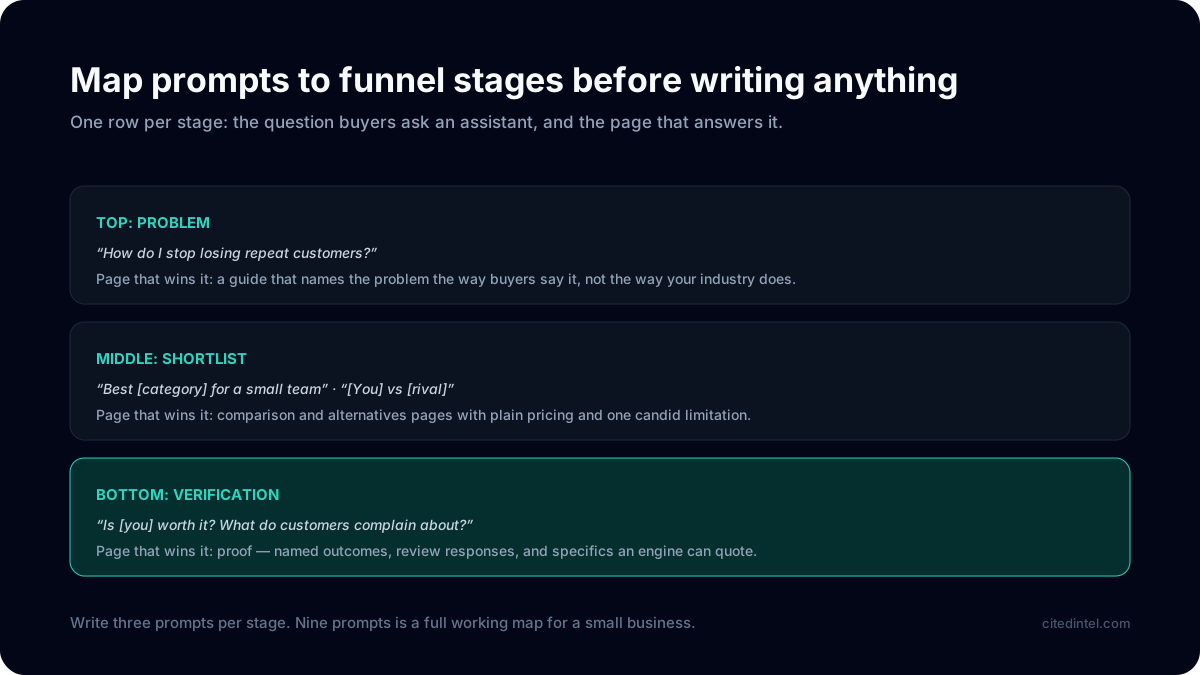
Consider a small legal-tech company selling contract automation to regional law firms. “What is the best contract review software for a five-lawyer firm?” requires a different answer from “ContractFlow vs. Manual review” or “How much does contract automation cost?”
My view: a lean team should own fewer buying questions with greater precision. Ten pages that explain fit, limitations, and proof can do more commercial work than fifty broad articles with interchangeable advice.
Awareness pages should earn category inclusion
Awareness content should give an AI search engine a complete recommendation candidate: category, buyer fit, operating context, limitation, and evidence. A generic explanation of contract automation gives an assistant little reason to mention one vendor over another.
Gartner reported in February 2026 that 60% of B2B buyers use GenAI to shape purchase decisions. For a small legal-tech company, “best contract review software for a five-lawyer firm” is therefore a commercial page brief, not an abstract SEO topic.
Start with the language already reaching your team
Customer calls, support tickets, proposal questions, and lost-deal notes contain better awareness prompts than a keyword list alone. Copy each question into a spreadsheet without smoothing its wording, then mark the category, constraint, location, and concern it contains.
- Category phrase: “What contract review software works for a small law firm?”
- Constraint: “Can a five-lawyer firm use contract automation without an IT team?”
- Commercial question: “What does contract review software cost per month?”
- Risk question: “Can contract AI handle client confidentiality and audit trails?”
Run those prompts through the answer engines your buyers use. Record the date, country, answer wording, named vendors, cited pages, and missing facts. Keep one row per service so a change in one answer does not disappear inside a blended score.
For the first test, use these services as separate source fields:
- ChatGPT: Record the answer, recommendation order, and linked sources.
- Claude: Record whether the response names vendors and which evidence it references.
- Perplexity: Preserve the displayed citations and the claims attached to each source.
- Gemini: Note product fit, limitations, and any local context in the answer.
- Google AI Overviews: Capture the summary, supporting links, and follow-up questions shown with the result.
Regional wording belongs in the prompt set. A UK law firm may ask about solicitor workflows and UK GDPR, while a firm in India may ask about local data hosting, vernacular agreements, or links to an existing practice-management system. A vendor that only describes a US workflow can remain absent from a useful answer in another market.
Build a small cluster around one expensive problem
One awareness page rarely supplies every passage an assistant needs for a recommendation. Build four connected assets around one expensive problem: the category answer, a practical checklist, a customer evidence page, and a proof page containing a sample output or documented workflow.
- Category answer: State who the product suits, what job it handles, where it operates, and who should choose another approach.
- Buying checklist: List the requirements a small law firm should verify, such as clause coverage, review permissions, export options, and retention rules.
- Customer evidence: Describe the starting workflow, the implementation conditions, the observed change, and the boundary of the result.
- Proof asset: Show a redacted contract review, implementation plan, sample report, or security response that a buyer can inspect.
In a May 2026 search documentation update, Google emphasized valuable, unique content and called out local, shopping, image, video, and emerging AI-agent experiences. A legal-tech team can apply that advice by adding original clause examples, service-area details, screenshots, product attributes, and a short recorded review workflow instead of another broad explainer.
Google also described article suggestions, inline links, website previews, and query fan-out in May 2026. That change raises the value of connected pages. An answer about contract automation may lead to a follow-up question about migration, security, pricing, or integrations, so each page should point to the next proof source.
Use the phrase “best contract review software for a five-lawyer firm” as a heading only if the page truly answers it. The opening copy should name the best fit, explain the trade-off, and identify the evidence below. A comparison heading followed by a product pitch creates a weak source for both an assistant and a buyer.
Google’s eligibility requirements for AI search results still matter at this stage. A valuable passage cannot help if the page is blocked, excluded from indexing, or missing the rendered text that a search system needs to access.
Consideration content has to make a shortlist defensible
Consideration pages earn a shortlist position by making vendor differences easy to verify. The page should align the company’s public facts, serve several buying roles, and provide independent proof that does not depend on a sales call.
A legal-tech shortlist page needs more than feature names. A law-firm operator cares about review speed and training. A partner cares about professional risk. A firm administrator cares about user permissions and billing. A technical evaluator cares about data handling and integrations.
Bring every public description into agreement
Inconsistent public information weakens a shortlist because an assistant cannot tell which claim to trust. McKinsey’s May 2026 Global B2B Pulse Survey found that inconsistent information across teams was the top reason buyers cited for switching suppliers.
Audit the homepage, product page, pricing page, Google Business Profile, review listings, partner pages, PDFs, and sales deck in one row-based document. Compare five fields: customer type, locations served, implementation time, core capabilities, and pricing logic.
- Customer fit: Use the same description for a solo practice, regional firm, or enterprise legal department wherever that fit appears.
- Coverage: Name supported document types, jurisdictions, languages, and integrations without allowing sales copy to outrun the product.
- Implementation: State the conditions behind “quick setup,” including data migration, training, permissions, and internal ownership.
- Price logic: Explain whether cost changes by user, matter, document volume, feature tier, or contract length.
An agency lead preparing a client report should treat contradictions as work items, not editorial imperfections. A pricing PDF that says “per user” while the website says “per matter” can change the recommendation produced by an answer engine and the questions asked by a procurement lead.
Publish one page that can travel through the buying group
Forrester reported in January 2026 that a typical business purchase involves 13 internal stakeholders and nine external influencers. One comparison page should therefore contain separate risk answers for the operator, finance lead, technical evaluator, and executive sponsor.
| Reader inside the buying group | Question the page must answer | Evidence to place beside the answer |
|---|---|---|
| Firm operator | Which daily review task changes? | Annotated workflow or sample deliverable |
| Finance lead | What drives the quote and expected commitment? | Pricing range, variables, and add-ons |
| Technical evaluator | What data, permissions, and integrations are required? | Security FAQ and implementation checklist |
| Executive sponsor | Why change the current process now? | Customer evidence, risk register, and success measure |
The page should survive forwarding without a sales explanation. Each section needs a named subject, a direct answer, and a nearby source or artifact that lets the next reader verify the claim.
Spend scarce outreach time on outside proof
Third-party proof gives an AI search shortlist more support than another company-authored feature page. Prioritize specific customer reviews, partner mentions, expert interviews, and independently useful data before commissioning a large content series.
Ask reviewers to describe the workflow rather than rate the product with adjectives. “We used the system to review vendor agreements with two approval stages” gives a future buyer more usable evidence than “great software.” Request the starting condition, the job performed, the result observed, and the situation where the product was not used.
My view: one detailed review from a credible legal-operations source can be worth more than a month of polished awareness posts. Small teams should spend scarce outreach time on proof that names the buyer’s setting and decision criteria.
OpenAI’s March 2026 product-discovery update described side-by-side recommendations using price, features, reviews, and buyer constraints. For B2B software, the practical response is a maintained capabilities page with ideal-fit criteria, implementation requirements, current pricing or ranges, and trade-offs that an assistant can compare.
Decision pages must settle comparison, price, and trust questions
Decision content should let a buyer choose a path without asking the vendor to translate its own claims. Comparison pages, pricing explanations, security answers, sample deliverables, and implementation plans give AI search and human evaluators material for validation.
Gartner reported in May 2026 that B2B buyers use an average of seven information sources, while 45% use GenAI primarily to research vendors and products. A buyer may encounter your comparison page, a review, a partner mention, a pricing page, and a sales answer before deciding whether a demo deserves time.
Make “X vs Y” depend on a real situation
“Product A vs Product B” is a weak page brief unless the comparison names the decision condition. A legal-tech vendor should publish separate sections for a five-person firm, a firm with migration risk, and a regulated practice that needs stronger controls.
- Small-team fit: Compare setup effort, training needs, minimum users, and the work that remains manual.
- Migration risk: Compare import formats, historical matter handling, permissions, and rollback options.
- Regulated work: Compare retention controls, audit records, access management, and the documents available for review.
- Budget fit: Compare starting cost, usage limits, contract terms, and the events that create add-on charges.
State where the competitor is the better choice. A comparison earns more trust when it says a manual workflow may suit a low-volume firm, or that another vendor may fit a team needing a particular integration. The goal is a defensible recommendation for a stated condition, not a universal winner.
Use “X vs Y” pages to correct predictable misunderstandings. If buyers confuse document storage with contract review, explain the boundary in a short table. If buyers assume every plan includes implementation support, show the plan-by-plan difference beside the price.
Put enough price in public view
Transparent pricing remained the top vendor request in TrustRadius’s July 2026 survey, and 83% of buyers shortlisted three or fewer products. A small business should publish a starting price, pricing variables, minimum commitment, likely add-ons, and the reasons a final quote changes.
A usable pricing block might say: “Plans start at $X per user each month. The quote changes with document volume, archive migration, and dedicated implementation support. A two-year commitment is not required. Custom security work is priced separately.” Replace the placeholder with the real commercial rule.
Pricing pages should also answer the question behind the number. “What does contract automation cost?” may mean “Can I approve this without a procurement process?” Include a low-commitment entry point, a sample monthly scenario, billing frequency, cancellation terms, and the person who can approve an exception.
Do not hide a range behind “contact sales” if a range can be published. A visible range may disqualify a poor-fit buyer, but it gives a suitable buyer and an AI search engine something reliable to compare.
Let prospects verify before they book time
Gartner found in May 2026 that 70% of B2B buyers prefer fully digital self-service, while 69% prefer to check AI-produced vendor information with sales representatives. The useful response is a self-serve proof path with human help reserved for interpretation and risk reduction.
- Inspect: Provide a redacted sample deliverable and explain the inputs required to produce it.
- Calculate: Show a calculator using users, documents, implementation support, and contract length.
- Verify: Publish security answers, data-processing terms, uptime history where available, and an implementation plan.
- Reference: Offer a customer reference or specific review that matches the buyer’s firm size and workflow.
- Try: Provide a trial, guided sample, or limited evaluation with clear success criteria.
A founder should enter the conversation after a prospect has seen the evidence, not repeat facts already available on the website. The human exchange then focuses on migration risk, workflow judgment, and exceptions that a standard page cannot resolve.
One legal-tech product, three different buying moments
Legal-tech companies need distinct pages for category discovery, vendor comparison, and purchase validation. Reusing one product page across all three stages leaves important buyer questions unanswered.
| Funnel stage | Prompt a buyer may ask | Page to publish | Proof to attach |
|---|---|---|---|
| Awareness | “What is the best contract review software for a five-lawyer firm?” | Category guide with fit and limits | Workflow screenshots and firm-size criteria |
| Consideration | “Which contract automation tools support a small legal team?” | Scenario comparison page | Capabilities matrix and customer review |
| Decision | “ContractFlow vs manual review: which costs less?” | Comparison and pricing page | Calculator, sample output, terms, and implementation plan |
For someone running product messaging, the table becomes a publishing queue. For the content owner, it becomes a claims review. For a founder, it shows which missing artifact is blocking a buyer conversation before another article gets assigned.
The same structure works for a payroll product answering “best payroll software for a 20-person nonprofit” or a fractional finance service answering “what does a fractional CFO cost?” The category changes, but the required evidence remains buyer fit, constraints, proof, and commercial terms.
A prompt sheet you can use today
You can produce a visible starting point with a dated prompt sheet, a simple evidence column, and one rewrite per stage. Use the following artifact for a legal-tech product, then replace the bracketed terms with your own category.
- Record the date: Write “September 2026” at the top and add the country for each test, such as United States, United Kingdom, India, or UAE.
- Run awareness prompts: Ask “What is the best [category] for [specific buyer size]?” and “What should [specific buyer] check before buying [category]?”
- Run consideration prompts: Ask “[Vendor] alternatives for [buyer condition]” and “Which [category] supports [integration, location, language, or compliance requirement]?”
- Run decision prompts: Ask “[Vendor] vs [competitor or current process],” “How much does [category] cost?” and “What are the risks of switching to [vendor]?”
- Capture answer evidence: Record every named vendor, cited URL, price statement, limitation, and missing fact in a separate row.
- Score the page: Mark each answer as “supported,” “unclear,” or “unsupported” for fit, capabilities, price, implementation, trust, and limitations.
- Rewrite one block: Use this pattern: “[Product] fits [buyer] when [condition]. It handles [specific job]. It may not fit [boundary]. Evidence: [source or artifact].”
- Publish the proof: Add the missing screenshot, review detail, pricing rule, security answer, or comparison evidence to the page that the prompt exposed.
Repeat the same sheet after the next material page change, preserving the original answer so you can see whether the buyer’s conversation changed rather than relying on traffic alone.
Citedintel’s free GEO checker gives a small team a starting audit for this evidence gap, while the paid workspace lets teams review buyer prompts across leading assistants with recurring checks and reports.
When page work cannot solve the problem
GEO cannot repair a product that lacks a clear market fit, credible proof, or a workable buying experience. If a legal-tech company cannot state who should use the product, what it costs, or how client data is handled, better page structure may expose the weakness without removing it.
That limitation is useful. The prompt sheet shows whether the next task belongs to content, product, legal, customer success, or sales. A missing security answer should not become another blog post.
Measure coverage of buying questions
Small teams should measure whether the right buying questions produce a stronger answer, a better source, and a clearer next step. Page count and conventional rankings cannot show whether a vendor entered the AI search shortlist for a specific situation.
- Question coverage: Count the awareness, comparison, pricing, implementation, and risk prompts that have a published answer.
- Recommendation position: Record whether the vendor is absent, mentioned, or placed among the first recommendations.
- Source quality: Check whether the cited page contains the current price, fit statement, limitation, and supporting proof.
- Market coverage: Compare the same prompt across the countries and languages where the company sells.
- Commercial response: Track qualified inquiries, pricing-page visits, trial starts, and sales questions tied to each buying condition.
Citedintel helps teams audit real buyer-intent prompts, see which competitors receive recommendations, and turn missing evidence into editable content and third-party proof priorities. The team still reviews the claims and publishes the final material in its own voice.
The small-business AI SEO playbook is useful for teams setting their first recurring review, but funnel-stage work needs a stricter question: which buyer decision is the next page meant to support?
I’d argue that question is the best allocation rule for a lean content team. Awareness earns the conversation, consideration earns the shortlist, and decision content earns the right to be evaluated on price, proof, and fit.
Frequently asked questions
How do I use GEO to show up in AI search at every funnel stage?
Create separate pages for discovery, comparison, and purchase validation. Each page should answer the buyer's question for that stage, state fit and limitations, and link to proof such as reviews, pricing details, security answers, or sample deliverables.
What should an AI SEO strategy include for a small business?
Start with real questions from sales calls, support tickets, proposals, and lost deals. Test those questions across ChatGPT, Claude, Perplexity, Gemini, and Google AI Overviews, then publish pages that fill the missing gaps around fit, price, implementation, trust, and limitations.
How does answer engine optimization help buyers compare vendors?
Answer engine optimization gives assistants clear facts they can compare, including customer fit, capabilities, locations, implementation requirements, pricing logic, and trade-offs. A scenario-based comparison page is more useful than a generic feature list because it explains which vendor fits a stated buying condition.
What should I put on a pricing page for AI search?
Publish a starting price or range, the variables that change the quote, any minimum commitment, likely add-ons, billing terms, cancellation rules, and a sample monthly scenario. Explain why the price changes so both buyers and AI systems can interpret the number correctly.
How can a small business measure GEO results?
Track coverage of awareness, comparison, pricing, implementation, and risk questions. Record whether the business is absent, mentioned, or recommended in each answer, then check whether the cited page contains current fit, pricing, limitations, and proof.