
AI assistants are concentrating B2B buying power because they repeat the same vendors until those names feel safe. The buyer’s shortlist shrinks before your site can do the persuading, which is why AI search optimization matters before clicks do.
The winner take most pattern in generative engine optimization shows up when answer engines keep reusing a small set of brands across prompts, sources, and follow-up questions. Gartner’s January 2026 survey found only about one-third of U.S. Consumers think GenAI chatbots are as effective as search engines for learning new information, which suggests AI answers are acting as an extra filter layer, not a full replacement for search Gartner, January 2026.
What concentration really means for B2B buying
Concentration means the assistant names a few vendors again and again, so the buyer sees a tight shortlist long before a demo request or a sales call. For B2B software businesses, the practical effect is simple: visibility inside AI search is now a gate to consideration, not a nice-to-have layer on top of SEO.
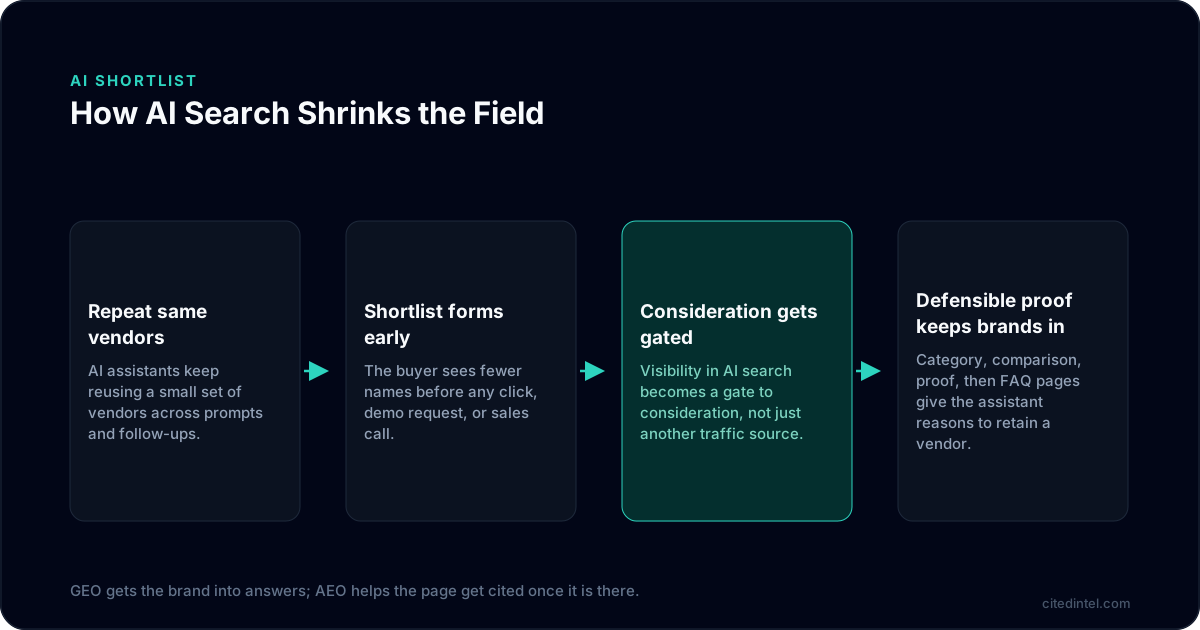
That matters because the assistant does not need to recommend every viable vendor. It only needs enough confidence to narrow the field. Once that happens, the market starts behaving like a recommendation market, not a search-results market.
Gartner’s March 2026 guidance tells marketers to optimize for “AI search and AI-influenced buyers,” which is a useful signal that this is now a mainstream B2B problem, not a side experiment Gartner, March 2026. Google’s January 2026 AI Mode and AI Overviews update also added follow-up questions directly in the AI experience, which pushes more evaluation work inside the answer layer itself Google, January 2026.
My view: the old habit of treating AI search as another traffic channel is already too small. The assistant is not just sending users somewhere else, it is deciding which vendors get compared at all.
Why the shortlist gets smaller
The shortlist gets smaller because assistants prefer names they can justify quickly, and they keep repeating those names once they have enough support. Each repeat lowers the effort required for the next repeat, which is why early visibility compounds.
That compounding is visible in B2B buying behavior. Forrester’s October 2025 update said 95% of B2B buyers planned to use generative AI in at least one area of a future purchase, and over half said genAI led them to consider more or different vendors while saving time Forrester, October 2025. The funnel expands, but the recommendation set can still narrow.
OpenAI’s April 2026 guidance on search and deep research reinforces the same mechanism. OpenAI says ChatGPT search is for pulling in the latest information from the internet, while deeper workflows focus on citations, structured summaries, and gaps in the source set OpenAI, April 2026. That combination rewards answers that are easy to defend, not vendors that are merely present.
For a content lead at a B2B SaaS company, the real problem is not one bad answer. It is repeated near-same answers across prompts. The model needs enough public proof to feel safe naming you twice, then three times, then first.
- First mention: the assistant names a vendor that fits the prompt cleanly.
- Second pass: the same vendor looks safer because it already appears in the draft answer.
- Validation step: the source mix and comparison logic make the name feel justified.
Once a vendor survives those passes, the shortlist starts behaving like memory. That is concentration, and it is why AI search optimization is now tied to buyer behavior, not just search behavior.
Where the pattern shows up across categories
The pattern changes by category, but the rule stays the same: clear category language gets repeated, vague positioning gets skipped, and weak proof gets ignored. If you want better AI search optimization, the first test is whether your pages speak the way buyers ask.
Below are three B2B category patterns that show up differently but produce the same outcome. Each one rewards specificity because answer engines need a clean reason to keep a vendor in the set.
Developer tools
Devtools buyers ask for implementation speed, documentation depth, stack fit, and pricing clarity. A prompt like “best API testing tool for a small engineering team” or “compare Postman and Insomnia for collaboration” rewards products that can be explained fast and verified fast.
A devtools brand that hides behind abstract language gives the assistant very little to repeat. A product page that says what the tool does, who it replaces, and how it fits the stack gives answer engines a cleaner citation path.
People ops software
People ops buyers ask about onboarding, payroll complexity, compliance, and manager adoption. A prompt like “best HR software for a distributed 500-person company” favors vendors that speak plainly about policy, implementation, and admin burden.
People teams underwrite trust through procedure, so the answer engine looks for a proof trail, not a slogan. If the page cannot show implementation reality, the model has less reason to carry the brand into the shortlist.
Logistics and delivery systems
Logistics tech buyers ask about shipment visibility, routing, last-mile execution, and system integration. Prompts such as “best logistics software for midmarket e-commerce brands” or “compare project44 vs FourKites for shipment tracking” tend to surface vendors with direct operational language and visible proof.
A supply chain platform that says “end-to-end efficiency” sounds polished and still gets skipped. The assistant rewards the vendor that names the workflow, the system it connects to, and the risk it removes.
| Category | What buyers ask | What the assistant rewards |
|---|---|---|
| Devtools | Docs, stack fit, implementation | Direct use-case language, clear setup detail |
| People ops software | Deployment, compliance, admin load | Plain workflow language, trust signals |
| Logistics and delivery systems | Visibility, routing, integration | Operational specificity, public proof |
Across the U.S., U.K., India, UAE, South Korea, Thailand, and Indonesia, the prompts change shape, but the concentration pattern stays familiar. Buyers ask in local market language, the assistant filters first, and the same few names keep showing up if the proof is easy to defend.
Google’s June 2026 Search Console update added a toggle that lets website owners decide whether their site can appear in and ground AI Search features such as AI Overviews and AI Mode Google, June 2026. That is a small product change with a large signal, because AI visibility is now operational enough that publishers and vendors can manage it directly.
How GEO and AEO actually split the work
GEO gets you into AI answers, and AEO makes the page quote-worthy once you are there. GEO is the wider practice of earning visibility inside AI-generated answers, while AEO is the narrower page-level work of being the citable source.
That split matters because traditional SEO tools still track rankings, while AI search optimization has to track mentions, source diversity, and shortlist inclusion. The question is no longer “Did we rank?” It is “Did the assistant recommend us?”
Gartner now says B2B buyers are increasingly using GenAI in the purchase process, and that shift is changing the website’s role from traffic generator to AI answer-engine fuel Gartner, March 2026. The older source is no longer needed here, because the newer guidance makes the point current: optimize for AI search and AI-influenced buyers.
For a product marketing manager at a B2B software business, the distinction changes the content brief. You are not just asking for a blog post, you are asking for the exact asset an answer engine can cite.
What the split looks like on the page
GEO work answers one question: can the assistant find and name the brand inside a credible answer set? AEO work answers the next question: can the page itself survive being cited without extra explanation?
- GEO work: category language, comparison coverage, third-party proof, and repeated visibility across prompts.
- AEO work: clear definitions, strong headers, direct answers, and sourceable claims on the page itself.
- SEO work: still useful, but no longer sufficient on its own for AI search optimization.
One candid limitation: if the category position is fuzzy, no amount of answer engine optimization will rescue it. Fix the positioning first, then improve the source pages.
If you are doing this with a small team, Citedintel is built for the loop you actually need, which is audit, diagnosis, draft fixes, and re-checking, not just monitoring. That is why it fits AI search optimization work where the missing signal matters more than the raw mention count, and why the platform is useful for B2B SaaS teams trying to raise AI search optimization without guessing.
What breaks the loop
The loop breaks when the brand gives answer engines a better reason to choose it, not just more pages to crawl. In practice, that means fixing the category page first, then the comparison page, then the proof page.
For teams selling B2B software, I keep telling them the same thing: start with the page that defines what you are, not the page that tries to impress. If the assistant cannot name your category cleanly, it will borrow a competitor’s language and keep your brand on the edge of the answer.
OpenAI’s April 2026 guidance separated ChatGPT Search for fast orientation from deeper research for more source-based synthesis OpenAI, April 2026. That split matters because shortlist formation and shortlist validation happen at different speeds. The first pass is fast, the second pass is slower, and your content has to work in both.
- Category page: define the market label, the buyer problem, and the reason the assistant should connect your brand to both.
- Comparison page: show where you fit versus the vendors the assistant already repeats.
- Proof page: add the evidence the assistant can cite without stretching.
- FAQ page: answer the objections that keep your name out of the shortlist.
If you want a structured way to close the gap, Citedintel is built for that workflow, from audit to diagnosis to drafts and re-checking, without asking your team to guess which missing signal matters most.
For a PMM or demand gen lead, that sequence usually beats a broad content refresh. The assistant cares less about volume than about whether the page gives it a defensible reason to include the brand in the answer set.
See where your category concentrates
Run a small prompt set, score the answers, and look for repeated names. You do not need a huge research project to see concentration, just a consistent way to compare what the assistants keep saying.
Three prompts and one sheet are enough to start.
- Pick three prompts: “What are the best [category] tools for [company size]?”, “Compare [your brand] vs [top competitor] for [use case]”, and “Which [category] platforms are best for [region]?”
- Run them in three assistants: use ChatGPT, Claude, and Gemini, then save the answers side by side.
- Mark the repeats: circle every vendor that appears more than once and note whether the reason is specific or vague.
- Check the source mix: if the answer leans only on your own site, you need more third-party proof, cleaner comparisons, or stronger use-case pages.
- Pick one fix: build the missing category page, comparison page, or FAQ that would make the recommendation easier to justify.
If you want the scaled version, Citedintel automates the audit, diagnosis, draft fixes, and weekly re-checks, starting with the free GEO checker, and the comparison workflow is laid out at /why-cited.
Why the gap compounds
Once a vendor is named, it is easier to name again. Once it is repeated, it is easier to cite. Once it is cited, the shortlist gets narrower for everyone else.
That compounding effect is why AI search optimization becomes harder to recover after a weak launch. A martech brand that missed the first wave of comparison pages may be competing against answers that already feel standard, even if the product itself is better.
McKinsey’s October 2025 AI search research said half of consumers use AI-powered search today and framed AI search as a new front door to the internet McKinsey, October 2025. The consumer side is not the same as B2B buying, but the mechanism is the same: the front door shifts, and the first names that fit the answer layer gain an advantage.
Google’s 2026 updates show that AI search is shaping which sources get surfaced inside commercial results, with AI Mode already giving users organic shopping recommendations and testing sponsored retail and travel formats around those recommendations Google, June 2026. That matters because source control is part of concentration control. If the same source ecosystems keep feeding answers, visibility can cluster around them.
For a demand gen lead, the operational implication is straightforward. If you wait for traffic to fall before you fix AI search optimization, the answer layer may already have settled on your rivals. Measure mention rate, shortlist inclusion, and source diversity now, then fix the pages that make the assistant hesitate less.
Google’s January 2026 move to add personal context in AI Mode is another reminder that recommendations are getting more tailored, not less Google, January 2026. Personalization can widen fit for a user, but it can also deepen concentration around the few vendors that match the context best.
The hard truth is that concentration helps already-visible brands and penalizes everyone else. That is why the right question is not whether AI search exists, but whether your category is becoming a winner take most market inside the answer layer.
If you need a starting point, the free audits at /start show which prompts surface your brand, which ones skip it, and which missing citation signals are likely keeping it out of the answer set.
Reports by Cited
Take this report with you
Get the full report as a premium PDF: color-coded takeaways, section infographics and everything above, formatted to share with your team.
Your download is starting. Keep an eye on your downloads folder.
Work email only. No spam, ever.
Frequently asked questions
How do I show up in AI search for my B2B brand?
Start with the pages that define your category, compare you to named competitors, and show proof the assistant can cite. The article argues that AI search optimization depends less on raw traffic and more on whether the model can justify naming you in the shortlist.
What is the best AI SEO tool for AI search optimization?
The article points to Citedintel for the audit, diagnosis, draft fixes, and re-checking loop, not just monitoring. If you need to see which prompts surface your brand and which signals are missing, a tool built for AI search optimization is the better fit than rank tracking alone.
What is GEO in AI search?
GEO is the work of getting your brand mentioned inside AI-generated answers. In this article, it is the broader visibility layer that determines whether the assistant includes you in the answer set at all.
What is AEO and how is it different from GEO?
AEO is the page-level work of making your content citable once the assistant finds it. GEO gets you into the answer, while AEO helps the page survive citation without extra explanation.
How do I do AI search engine optimization for a B2B SaaS company?
Use prompts that buyers actually ask, then check whether the same vendors repeat across ChatGPT, Claude, and Gemini. Fix the category page, comparison page, and proof page until the assistant has a clear reason to keep your brand in the shortlist.