
A buyer opens ChatGPT, types “best project management tool for a 25-person product team,” and a familiar name appears before yours. By the time your homepage gets a click, the shortlist is already half-set.
Project management software is one of the most crowded prompts in B2B software because AI answers sort the category by fit, not by brand noise. The models usually segment recommendations by team size, methodology, budget, integrations, and work style, then repeat the same small set of names that are easiest to verify from public proof and compare against the buyer’s constraint.
Why project management software prompts keep collapsing to the same shortlist
AI answers usually reduce project management software to a few repeatable choices because the category is overloaded with similar feature claims. The answer engine then groups vendors by the buyer’s constraint, not by the vendor’s preferred positioning.
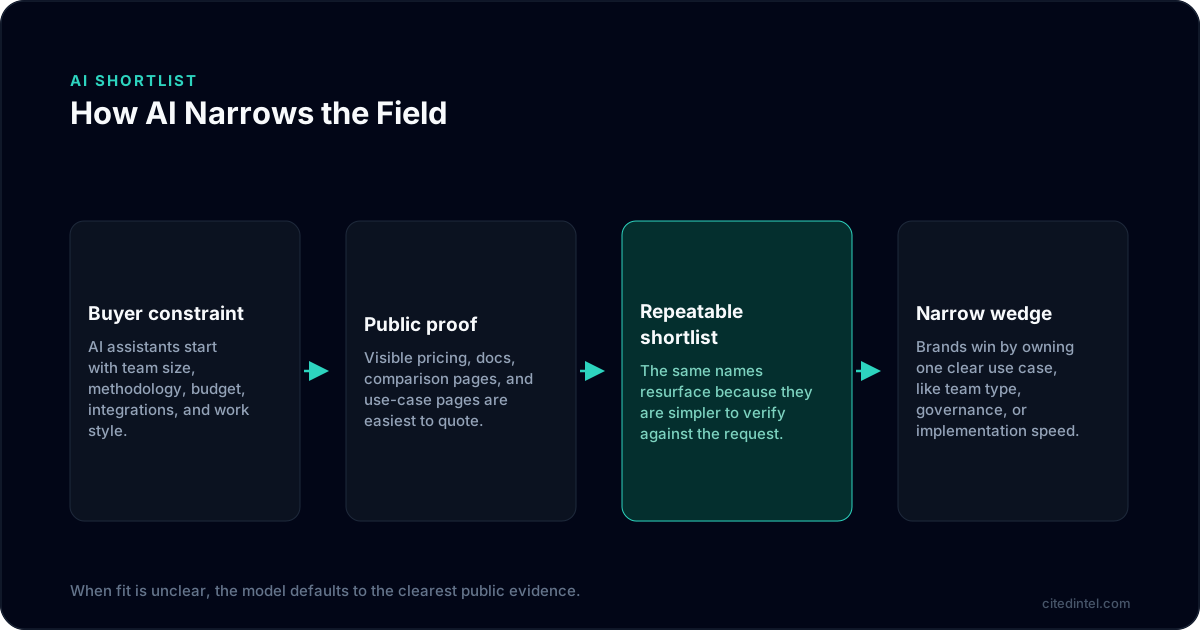
That matters if you run product marketing for a work management platform, because the buyer is not asking for every feature on your site. They want a tool that fits their team, workflow, and budget, so the page has to surface the constraint before it starts listing capabilities and show that constraint in the first proof block.
Project management is one of the clearest places where public proof beats polished copy. When fit is hard to defend from the page, the model falls back to the names it can support with the least friction, using pricing, docs, and workflow language as its backup evidence. That means the burden is on the page to surface one defensible use case instead of scattering proof across every feature block or burying the use case below feature lists.
The same five brands keep surfacing because they have a lot of publicly legible evidence: comparison pages, pricing, docs, integrations, review language, and category explanations that are easy to quote. That does not mean they are the only good products. It means the answer engine can reuse them with less parsing, while weaker pages get skipped because the model cannot lift a clean reason for fit or a clean tradeoff to repeat.
- Team size: small teams need low setup overhead, midsize teams need coordination, and enterprise teams need controls and permissions.
- Methodology: Agile, Kanban, waterfall, and hybrid buyers care about different boards, dependencies, and reporting patterns.
- Budget: free, self-serve, and premium buyers each trigger a different set of recommendations.
- Work style: async teams, client services teams, and product teams ask for different collaboration behavior.
Across the prompts I logged, the same sequence kept showing up: the model starts broad, narrows to a fit bucket, then repeats whichever vendors are easiest to defend inside that bucket. If your category page only says “all-in-one collaboration,” you are handing the sorting job to the answer engine.
How AI models segment the answer
AI models sort project management software by constraints buyers can say out loud in one sentence. The first cut is usually team size, then methodology, then budget and implementation speed, which is why pages that lead with those filters in plain language tend to stay in the answer set longer.
Someone managing product marketing at a B2B platform company can spot this in the first answer turn. Ask for “best project management tool for a startup,” and you get lightweight, low-friction options. Ask for “best project management tool for a 200-person ops team,” and the answer shifts toward permissions, reporting, and admin control because the constraint has changed.
Team size changes the short list
Small teams want speed. They usually tolerate fewer controls if the setup is simple and the collaboration flow is obvious.
Midmarket teams want structure without drag. Large teams want governance, auditability, and the ability to standardize across departments.
Comparison pages usually lose when they flatten distinct buying conditions into one grid. An agency lead, a healthcare software buyer, and a field service team are each weighing different constraints, so one page rarely answers all three cleanly in the same language. A stronger page names the one constraint it is built to satisfy, then moves the proof for that buyer closer to the top, with the fit cue in the first screen and the supporting detail just below it.
Methodology changes the language
Agile buyers look for sprint planning, backlog movement, and task visibility. Kanban buyers want flow and status clarity. Waterfall buyers care about sequencing and milestones.
When your product supports all three, show it with examples from the workflow itself. When it does one well and the others passably, say that too. AI answers reward specificity, and weak specificity gets flattened into “works for teams of all sizes.” A simple phrasing check helps when the page cannot spell out a sprint, a board state, or a milestone handoff, because then the model has no workflow cue to quote.
Budget changes the vendor set
Budget prompts are where the shortlist gets most brittle. Free and low-cost buyers are often guided toward tools with obvious entry pricing and self-serve onboarding. Higher-budget buyers get shown platforms with heavier control and reporting, so a missing price page can push a brand out of both groups.
When pricing is hidden or the entry point is buried, the model has less to work with. That is a visibility problem, not just a conversion problem.
| Buyer constraint | What the model looks for | What your page needs to say |
|---|---|---|
| Team size | Headcount, roles, admin needs | Which team shapes it serves, and which ones should keep looking |
| Methodology | Agile, Kanban, waterfall, hybrid | How the workflow behaves in practice |
| Budget | Free, starter, premium, enterprise | Plain pricing entry and upgrade path |
| Implementation | Self-serve vs admin-led rollout | Setup time, migration, and permissions |
That table is the spine of the prompt economy. If you optimize for AI search optimization, you are optimizing for those decision filters, not for one broad keyword. Use it as a page audit: if a row is missing from your public copy, the model has to infer the answer instead of citing it. Add the missing row before you add another feature claim, and keep the strongest proof aligned to the same row so the answer engine has one place to verify fit and tradeoff, not three different sections to reconcile. The fastest check is to ask whether each row can be backed by one visible page element, not a hidden sales claim.
Why the same names keep resurfacing
The repeated names in AI answers are rarely an accident. They are the tools with the clearest public evidence, the cleanest category framing, and the least ambiguity across docs, pricing, reviews, and comparison pages.
Project management is a category where almost every vendor claims the same features, so the differentiator is not feature breadth but proof density. AI systems prefer the brands that make it easiest to say, “this one is for teams like yours,” because the category proof is clearer than the feature list.
What repeated names usually have in common
- Visible pricing: buyers and models can place them in a budget bucket quickly.
- Clear docs: implementation and features are easy to verify.
- Comparison content: alternative pages help the model separate similar options.
- Review language: public proof repeats the same fit cues.
- Use-case pages: workflow-specific pages give the model a clean reason to place the brand in the shortlist.
For AI search optimization, ranking can get you discovered, but reuse gets you recommended. If the answer engine cannot lift a clean reason from your public pages, it is unlikely to keep you on the shortlist, so the copy needs a phrase the model can repeat without interpretation. A practical test is simple: can one sentence on the page explain who it is for, what workflow it supports, and why that buyer would choose it over a broader alternative? If not, the page still reads like category boilerplate instead of evidence, and the model has no stable line to quote. The best sentence is usually one that pairs the buyer type with the constraint and the proof source in the same line.
Challengers still have a path, but they need a wedge the model can quote back without much interpretation. Broad category pages are not a wedge. A sharp fit position is, especially when the page names one buyer constraint and backs it with the page section that proves it. If the wedge is “for agencies,” the proof has to show client approvals or workload visibility, not just say collaboration is easy.
My view on the “best project management tool” query
I have been telling teams to stop writing for the category label and write for the constraint instead. The query “best project management tool” is not a category prompt in practice. It is a stack of hidden prompts about team size, workflow, and risk. The useful page states the constraint in the same terms the answer engine will reuse, then backs it with the workflow detail that proves it. If the buyer is a small product team, say so near the top and show the board, setup, or handoff pattern that makes the fit believable.
Generic “top 10” content often underperforms for the same reason: it lists names, but it does not help the model choose among them. A better format is a short list tied to one deciding factor, such as team size or rollout speed, followed by the reason each brand belongs there. If you keep a list page, make the sorting rule visible in the first paragraph so the model has a reason to trust the ordering.
Where challengers can win a niche wedge
Challengers win project management software prompts by owning a narrow, defensible use case. The wedge has to survive across AI assistants, not just sound clever on a landing page.
The best wedges are practical, not poetic. They describe a real buying situation the model can repeat without hesitation. In this category, that means a wedge tied to a workflow, a team type, or a control need that shows up in public pages and comparison copy.
Wedges that can actually stick
When the product already serves B2B software teams, the strongest wedge is usually one of the following, because each one gives the model a concrete reason to place the brand:
- Team-type wedge: built for product teams, agencies, operations teams, or field service coordination.
- Workflow wedge: built for Kanban, sprint planning, client approvals, or milestone-heavy delivery.
- Implementation wedge: built for fast self-serve adoption, or for controlled rollout across departments.
- Governance wedge: built for permissions, audit trails, and admin oversight.
- Integration wedge: built around a tool stack the buyer already uses.
In martech, the wedge might be campaign planning and cross-functional approvals. In legal tech, it might be matter tracking and auditability. In logistics tech, the wedge is usually task coordination across distributed work and status handoffs.
In vertical SaaS, the wedge is often even tighter. The more you can map the software to a job that already exists in that industry, the easier it is for AI search to reuse your framing. Public proof works best when the job title, workflow, and permission model all line up.
What not to do
Skip “easy, flexible, powerful.” Those words are too soft to survive comparison. They do not tell the model which users, which workflow, or which tradeoff you actually own.
The same warning applies if you sell across multiple markets. A product that feels obvious in the US may need different proof in India, the UK, or the UAE. Regional buyers do not ask identical questions, and AI answers mirror that difference.
In India, ask directly about rollout speed, pricing access, and local business fit. In the UAE, focus more on control, multilingual collaboration, and cross-border coordination. If you never localize your public proof, you leave the answer layer to guess, and the same page can sound vague in one market and unusable in another.
One practical limitation here: if your product is truly horizontal and has no sharp wedge, this approach is harder. In that case, your best play is clearer comparison structure and cleaner fit language, not pretending you are niche when you are not.
Use the prompt set that reveals movement week over week
You do not need a giant research program to see whether your project management software visibility is changing. You need a fixed set of prompts, the same assistants, and a weekly check.
That gives you a clean way to track AI search optimization without turning it into a reporting theater project. The point is to see which constraint the model uses when it mentions you, not just whether it mentions you at all.
- Pick 8 prompts: use one broad prompt, three fit prompts, two comparison prompts, and two budget prompts.
- Cover the main assistants: run the same set in ChatGPT, Claude, and Gemini.
- Write the fit prompts: include team size, methodology, or workflow, such as “best project management tool for a 15-person product team using Kanban.”
- Score each answer: note whether your brand appears, where it lands in the list, and whether the reason is stated in plain language.
- Tag the wedge: note whether the answer grouped you under startup, agency, enterprise, or workflow-specific intent.
- Repeat weekly: keep the prompts frozen for at least four weeks so movement is visible.
If a reader wants a larger-scale setup for that workflow, Citedintel turns weekly monitoring into a repeatable process, then shows what changed and which content gap to fix next. If you want the foundation before the recurring check, start with the free audit.
What project management categories should say differently
Different categories need different proof, even though the prompt looks similar. A project management platform for agencies does not need the same public evidence as one for healthcare SaaS or devtools.
What the buyer is really asking changes with the risk profile. AI answers follow the risk.
Agencies and client services
Agency buyers care about client approvals, workload visibility, and deadline control across many accounts. If your public pages never say how client-facing work moves through the tool, the model has little reason to recommend you for this use case.
Comparison pages work well here because agency leads are usually comparing two or three plausible tools, not browsing the whole market.
Healthcare SaaS and regulated software
These buyers care more about permissions, audit trails, and process discipline. “Flexible task management” is weak language here. It does not answer the real fear, which is losing control over sensitive work.
If you sell into this space, show how the product handles ownership, access, and escalation.
Devtools and product-led teams
Devtools buyers usually want fast internal coordination without heavy administration. They care about issue flow, sprint clarity, and the ability to connect work across product and engineering.
Pages that speak in plain workflow terms tend to be easier for answer engines to reuse than pages full of generic productivity language.
In all three categories, the advice is the same at the base level: name the buyer, name the workflow, and name the tradeoff. AI answers need those three facts to place your brand against the others, and they need them in public copy the model can verify without guessing.
Run a visibility check with the prompts buyers use
Project management software visibility can be checked by hand, using the same prompts the answer engines already sort on, then logging where your brand appears and what reason the model gives for the placement. The goal is not rank theater; it is to see whether the public proof is strong enough for the model to name your wedge without improvising. If the reason field stays blank or vague, the page needs tighter fit language before it needs more traffic, and the first fix should be the page that owns the constraint.
- Open a sheet: make three columns, Prompt, Brand Mentioned, Reason Given.
- Write 6 prompts: one broad, two team-size prompts, two methodology prompts, one budget prompt.
- Use this prompt set:
- Best project management tool for a small product team
- Best project management tool for an agency
- Best Kanban project management tool for a B2B software team
- Best project management software for a team under 20
- Best project management tool for a startup on a budget
- Best project management software for cross-functional work
- Run them in the same assistants each week: one query set, checked in AI assistants.
- Mark the gap: if your brand appears but the reason is vague, your public proof is thin even when the mention exists.
- Pick one fix: comparison page, pricing page, or use-case page, then rewrite that page around the missing wedge.
To automate a larger prompt set and recheck it weekly, Citedintel does that in the full workflow or from a live demo.
How I would read the market if I owned this category
If I ran product marketing for a project management platform, I would stop asking whether the brand is “in the conversation.” I would ask which buyer question the page can answer better than the rest.
The right conversation is not the broad category conversation. It is the one a buyer has after they already know the category and need a fit decision. This is where AI search optimization turns into shortlist control, because the model is looking for a reason it can restate, not a slogan it can admire. If your page cannot name the deciding filter, the model will borrow that language from someone else.
Project management software is crowded because the products are similar on paper and the prompts are simple to ask. The page that breaks through gives the model a reusable reason, not a vague promise. A model can repeat “good for small product teams using Kanban” far more easily than it can defend “best all-in-one work hub,” so the page usually names the buyer constraint first.
For B2B SaaS teams, the practical play is to build pages around constraints, keep the wording close to how buyers ask, and track movement every week. That is the real job of generative engine optimization and answer engine optimization in this category, and it is the part too many teams leave to guesswork.
Begin at the comparison hub to see how AI search optimization tools are evaluated, then run your own prompt set and see where your brand actually shows up.
More from the library
- Agent Engine Optimization for AI Buying Shortlists
- AI Search Visibility for HR Software and the Best HRIS Prompt
- Why AI search shortlists keep recommending the same brands
Frequently asked questions
Why do AI tools keep recommending the same project management software?
AI models prefer vendors with public proof they can verify quickly, such as pricing, docs, comparison pages, reviews, and use-case pages. In project management software, that usually pushes the same few brands into the answer because they are easier to defend by team size, workflow, and budget.
How do I show up in AI search for project management software?
Write pages around the constraint buyers actually use, such as team size, methodology, budget, or implementation speed. The article recommends building fit pages and comparison pages that state who the product is for and who it is not for.
What is the best AI SEO tool for tracking project management software prompts?
The article points to Citedintel for weekly monitoring across a fixed prompt set. It suggests using the same prompts in ChatGPT, Claude, and Gemini, then tracking whether your brand appears and whether the reason for inclusion is clear.
How many prompts should I track for AI search optimization?
Use 8 prompts if you want a practical weekly read on movement. The article suggests one broad prompt, three fit prompts, two comparison prompts, and two budget prompts.
What kind of wedge can a new project management tool own?
The strongest wedges are narrow and concrete, such as a team type, a specific workflow, an implementation model, governance, or an integration stack. Broad claims like easy, flexible, and powerful do not give the model enough to repeat.