
ChatGPT search is now a buying surface, not a novelty. If your product data, comparison pages, and third-party proof are weak, you can disappear before a buyer ever reaches your site.
OpenAI says ChatGPT search automatically uses the web for questions that benefit from current information, and its answers can include inline citations plus a Sources panel. That makes ChatGPT search results a visible step in the buying process, where brands can be named, compared, or skipped.
Buying questions are already routing through ChatGPT search
ChatGPT search picks up questions with current, comparative, or verification intent. That includes prompts like “help me choose between,” “best option for,” “alternatives to,” “is this worth it,” and “what should I use if I need X.”
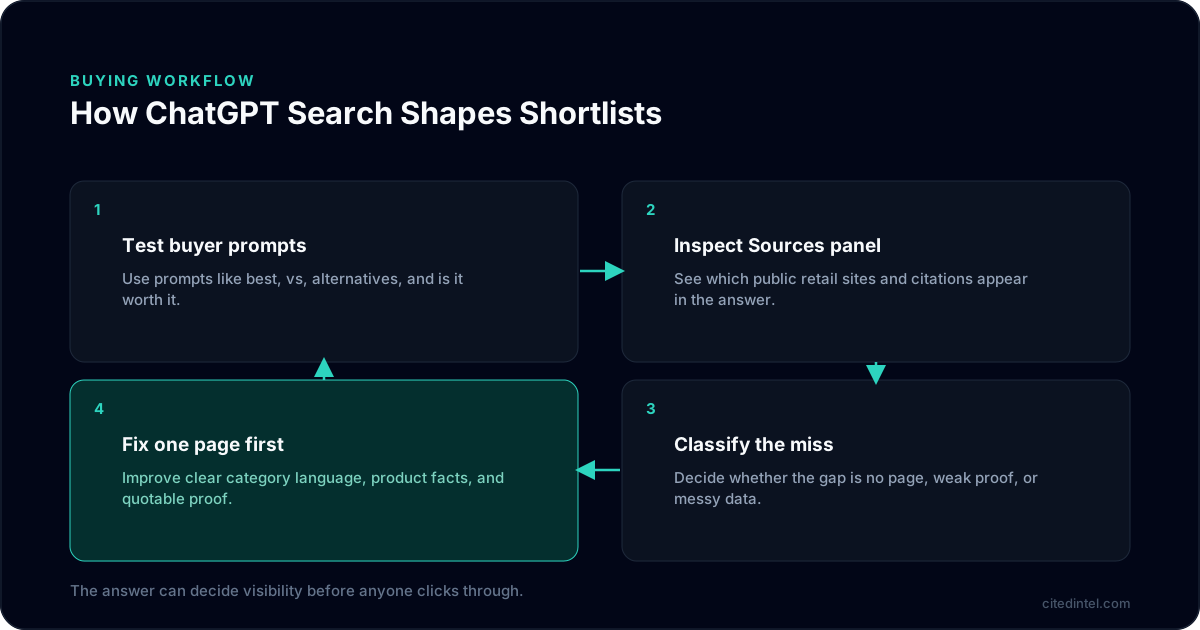
My view: this is where AI search optimization starts to matter commercially, because those prompts are close to shortlist formation. A PMM at a B2B software company is no longer only competing for a search result, they are competing for a named place inside an answer.
OpenAI has also made the shopping layer explicit. Its shopping research says the experience is built for buying-intent prompts, the results are selected independently, they are not ads, and they are based on public retail sites. That is a clear signal that brands can win or lose visibility at the moment a buyer narrows options, not just after they click a blue link. OpenAI’s shopping research
The prompts that matter most
These are the buying questions that route well through ChatGPT search:
- Shortlist prompts: “best [category] for [job],” “top tools for [team size],” “which vendor should I pick if…”
- Comparison prompts: “X vs Y,” “alternatives to X,” “how does X compare with Y on price, support, or compliance?”
- Verification prompts: “is X legit,” “does X support [feature],” “what do reviews say about X?”
- Switching prompts: “replace X with,” “migrate from X,” “best option if we are outgrowing X”
- Constraint prompts: “for SOC 2,” “for multi-region teams,” “for GDPR,” “for Arabic and English markets,” “for a 20-person team”
The field notes in this article show a pattern that should make every growth lead uncomfortable: the brands that appear most often are usually the ones with the cleanest public proof stack, not the loudest brand story. That is why answer engine optimization techniques now sit beside content marketing and SEO, instead of underneath them.
How ChatGPT search results get assembled
ChatGPT search pulls from live web retrieval, then synthesizes an answer with citations and source links. The visible answer is only the final layer; the system has already looked for pages that look usable, current, and defensible.
That means your content has to do two jobs at once: be easy for a human buyer to trust and easy for an answer engine to quote. If the page cannot support a recommendation cleanly, it is less likely to show up in the first place.
What the engine leans on
OpenAI’s help docs say shopping results consider query and context, including Memory or Custom Instructions, and may simplify product titles and descriptions from third-party sources. For a marketing lead, that means the system is normalizing messy inputs, not preserving your preferred phrasing. OpenAI’s improved shopping results docs
That normalization step is why structured product data matters so much. If your naming is inconsistent across your site, marketplaces, review sites, and merchant feeds, ChatGPT search has to reconcile the mess before it can recommend you.
| Input layer | What ChatGPT search tends to use | What marketers should check |
|---|---|---|
| Owned pages | Pricing, features, category pages, comparison pages, docs | Clarity, freshness, exact naming, crawlability |
| Public third-party pages | Reviews, editorial roundups, marketplace listings, forums | Mentions, consensus language, reputation signals |
| Merchant or product feeds | Titles, descriptions, availability, variants | Consistency, structured metadata, clean fields |
| User context | Need, budget, region, prior instructions | Whether your brand has clear fit for the stated constraint |
OpenAI also warns that shopping research can still make mistakes about price and availability and tells users to verify final details on the merchant site. That matters for B2B software too, because ChatGPT can open the door, but proof still has to live on your owned properties and support pages. OpenAI’s shopping research
Why some brands get named and others get skipped
Brands get named when the answer engine can defend them. If the model can find a clear category fit, visible proof, and a reason the brand is safe to mention, the brand has a better shot at being included.
That is why the same names often recur across AI search results. The engine is not rewarding hype, it is rewarding legibility.
The practical signals that tend to matter are boring, and that is good news for operators. They include:
- Category clarity: the brand page says what the product is without forcing the model to infer it.
- Public proof: customer reviews, third-party mentions, expert commentary, and comparison pages that are easy to quote.
- Structured facts: pricing, plans, integrations, compliance, and feature names that stay consistent across sources.
- Freshness: pages that reflect current product state instead of stale launch copy.
- Fit language: pages that answer who the product is for and what constraint it solves.
Gartner has been pointing in this direction for a while. It says AI summaries are appearing on most Google SERPs and that ChatGPT, Perplexity, and other answer engines are pushing CMOs toward answer engine optimization. Its later guidance frames generative AI as shifting enterprise search from information retrieval to information synthesis. Gartner on AI summaries and AEO and Gartner on enterprise search and synthesis
Forrester is making a similar point from the B2B side. It says AI-powered search is converging search experiences and disciplines, and that B2B buyers are increasingly using generative AI in the purchase process. For teams still keeping SEO, content, and product marketing in separate lanes, that is the adaptation gap in one sentence. Forrester on converging search disciplines
The adaptation gap is bigger than most teams admit
Most businesses do not know how they appear in ChatGPT search results today. They may know rankings, traffic, and ad performance, but they do not know which buying prompts trigger their brand, which competitors displace them, or which proof signals are missing.
That blind spot is expensive because the buyer is already doing invisible pre-sales work inside AI assistants. A procurement lead, a founder, or a PMM can arrive at your site having already seen a shortlist, and you never saw the prompt that shaped it.
OpenAI says more than 500 million people use ChatGPT each week, and it is already being used for market research and shopping experiences. Pew’s web-browsing analysis and 2026 survey also support the broader pattern that chatbot use is part of the information ecosystem buyers rely on. OpenAI global affairs note, OpenAI business note, Pew web-browsing analysis, and Pew 2026 survey
If you run content for a B2B software company, this is the mistake to stop making: treating AI search optimization like a future problem. It is a current discovery problem, and in some categories it is already a shortlist problem.
Where the gap usually sits
There are four common failure points:
- No prompt view: the team tracks keyword rankings but not real buying prompts in AI assistants.
- No source view: the team sees a mention but not the citations and public pages shaping it.
- No proof map: the team does not know which third-party signals are missing.
- No ownership: SEO, product marketing, and demand gen each assume someone else will fix the answer layer.
That is where a platform like Citedintel becomes useful, because it gives teams a way to audit how ChatGPT, Claude, Perplexity, and Gemini answer buyer-intent prompts, then shows what proof assets are missing and what to publish next. For this category, the point is not dashboards for their own sake, it is closing the loop between visibility, diagnosis, and the next draft.
How this plays out in different software categories
The buying questions change by category, but the evaluation pattern does not. Buyers want a shortlist, a reason to trust it, and a clear check on fit.
That is why AI search optimization for B2B SaaS has to be category-specific. Generic content loses because answer engines do not need a brand essay, they need a defensible recommendation.
HR tech
HR software buyers ask about payroll coverage, compliance, implementation effort, and integrations. If your pages do not state region support, payroll depth, and deployment constraints cleanly, ChatGPT search has to rely on weaker consensus signals.
HRIS vendors often need country-specific proof because the buyer’s risk is operational, not theoretical. A global brand can still be invisible in the answer if its public pages bury the exact payroll or compliance detail the model is checking.
Martech
Martech buyers ask whether a tool works with existing stacks, how much setup it needs, and whether the team can actually use it. The brands that show up tend to have strong docs, comparison pages, and practical use-case language that answer the implementation question fast.
In martech, vague category positioning hurts more than it helps. If the assistant cannot tell whether your product is for lifecycle, analytics, automation, or attribution, it will often reach for a more legible alternative.
Logistics tech
Logistics buyers care about geographies, shipment complexity, service levels, and proof that the platform handles exceptions. This category rewards pages that show operational detail, not broad claims about visibility or efficiency.
Here, third-party validation matters because buyers are not shopping for a nice interface. They are shopping for reliability under pressure, and answer engines tend to prefer brands that already look operationally credible.
That category variation is why a single generic content plan is weak. A strong generative engine optimization strategy treats each vertical’s buying language as part of the proof stack, not just its keyword list.
Try this today on three pages
Run this exercise on one category page, one comparison page, and one pricing or plans page. You will see the fastest answer engine optimization gaps without a full audit.
- Write 10 buyer prompts: use phrases like “best [category] for [constraint],” “X vs Y,” “alternatives to X,” and “does X support [feature].”
- Search the prompts: test them in ChatGPT search and note whether your brand appears, what name it uses, and whether a competitor appears instead.
- Check the citations: open the Sources panel and record which pages the answer engine cites for each prompt.
- Mark the gap: classify each miss as one of three problems, no page, weak proof, or messy data.
- Fix one page now: add a clearer title, one direct comparison block, one proof item, and one concise FAQ that answers the exact prompt.
If you want to scale that weekly instead of doing it by hand, Citedintel automates the audit, the diagnosis, and the publish-next step, so you can track AI search optimization without rebuilding the workflow every time. Start free.
What a marketing lead should change this quarter
Do not start with a content calendar. Start with the surfaces ChatGPT search is most likely to use, then fix the public evidence behind them.
That quarter plan is simple enough to run, but it needs cross-functional ownership. Product marketing owns the claims, content owns the pages, SEO owns discoverability, and growth owns the measurement loop.
| Quarter move | What to ship | Why it matters for ChatGPT search |
|---|---|---|
| 1. Refresh core pages | Category, pricing, comparison, and FAQ pages | These are the pages answer engines can cite fastest |
| 2. Clean product facts | Names, plan labels, feature labels, integrations, compliance | Consistency helps the engine normalize your brand correctly |
| 3. Build proof pages | Third-party review links, implementation notes, case-study summaries, press mentions | Public proof makes recommendations easier to defend |
| 4. Monitor prompt set | Weekly checks on core buying prompts | You need visibility into mentions, position, and drift |
The actual checklist
Run these checks this quarter:
- Title clarity: every core page says the category and the use case in plain language.
- Comparison coverage: you have at least one direct comparison page for the main alternative buyers ask about.
- Proof density: your pages surface trust signals above the fold, not buried in footers or hidden tabs.
- Data consistency: your names, prices, and feature labels match across site, docs, directories, and merchant-like listings.
- Prompt tracking: someone owns a repeatable prompt set and a weekly review of AI search results.
- Regional fit: if you sell globally, the pages that matter for the US, UK, India, UAE, and other markets reflect the buyer’s local constraint.
For B2B SaaS teams, this is where a generative engine optimization plan becomes operational. You are not writing more content for the sake of it, you are building the pages and third-party signals that ChatGPT search can safely reuse.
One candid limitation
ChatGPT search is not the right place to expect final proof. OpenAI itself tells users to verify shopping details on the merchant site, and that caution applies to software selection too.
So use AI search optimization to win discovery and shortlist position, then make your own site the place where pricing, implementation detail, procurement answers, and legal proof live clearly. If your owned pages cannot close the loop, the assistant can only do half the job.
That is also why I keep telling teams to stop separating SEO from answer engine optimization. Classic search still matters, but AI search optimization is now part of the same commercial surface, and the brands that adapt first will have an easier time being named, cited, and remembered when the buyer is ready to choose.
If you want a structured way to see where you stand across answer engines, use Citedintel’s workflow to review prompts, sources, and missing proof, or explore pricing once you are ready to run it every week.
Frequently asked questions
How do I show up in AI search for my brand?
Start with the pages ChatGPT search can cite fastest: category, pricing, comparison, and FAQ pages. Then make your product facts, proof signals, and naming consistent across your site and third-party sources. The article argues that AI search optimization comes from legible evidence, not just more content.
What is generative engine optimization for B2B SaaS?
Generative engine optimization is the work of making your brand easy for answer engines to name, compare, and defend. In this article, that means fixing public proof, structured facts, and comparison pages so ChatGPT search can reuse them in buyer-intent answers.
How is GEO different from SEO for AI?
SEO for AI still cares about discoverability, but GEO is about whether an answer engine can confidently use your pages and third-party proof in a synthesized response. The article shows that ChatGPT search is normalizing messy inputs, so consistency across sources matters as much as ranking signals.
What are the best AI SEO tools for tracking ChatGPT search?
The best AI SEO tools are the ones that show which prompts trigger your brand, which sources get cited, and what proof is missing. The article points to a weekly prompt audit workflow and says Citedintel automates the audit, diagnosis, and publish-next step across ChatGPT, Claude, Perplexity, and Gemini.
What should I check in AI search engine optimization first?
Check whether your core buying prompts return your brand, a competitor, or no clear answer at all. Then review the citations, look for weak proof or messy product data, and update one core page with clearer titles, a comparison block, one proof item, and a concise FAQ.