
A first-place organic result can still contribute nothing to an AI answer. Ranking reports measure where a page appears in a list; buyers increasingly need a separate record of whether an assistant names the brand, cites the page, and recommends it for a buying decision.
AI search optimization connects traditional search signals with evidence that answer engines can use in buyer conversations. A practical generative engine optimization (GEO) program tracks inclusion, source citations, recommendation context, and commercial prompts separately from rankings.
1. The page ranks first, but the answer leaves you out
A top organic position does not guarantee a source link or brand mention in an AI-generated answer. Google explains that its generative search features can use different models, techniques, and link sets, so a page can rank well in classic results while another source supports the answer.
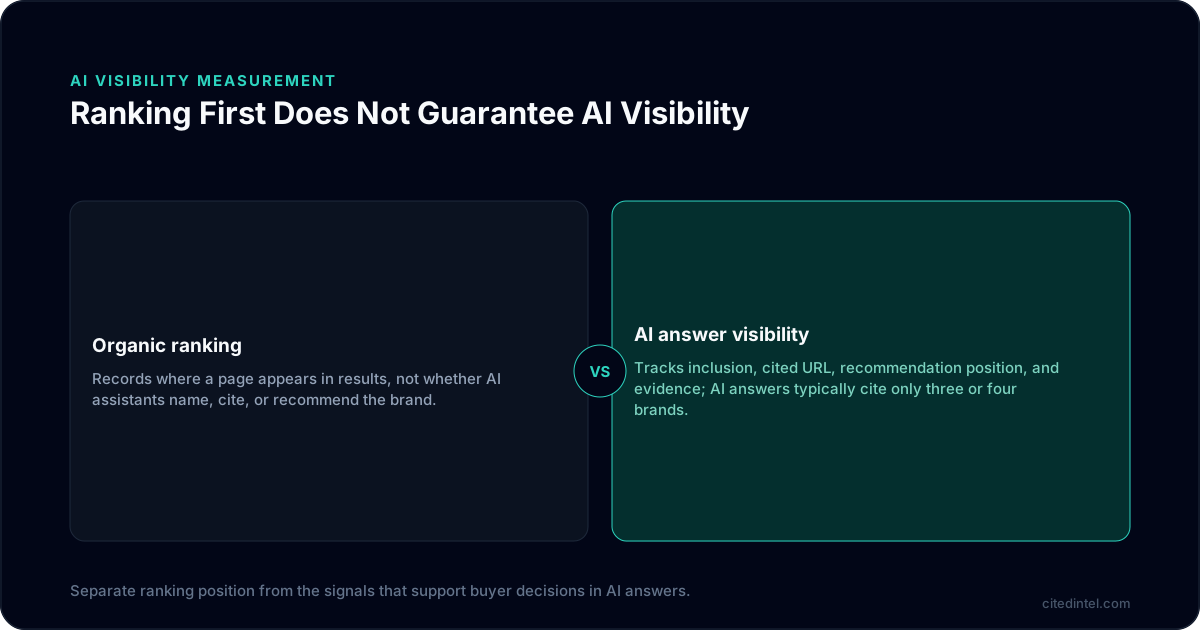
Compare the same commercial query in organic results and in the answer layer. Record the ranking URL, the brands named, the linked sources, and whether your brand appears in the first recommendation block. A logistics technology company might rank first for “fleet routing software,” yet disappear when buyers ask for the best option for multi-stop delivery in India.
Fix: report organic position and AI search citation rate as separate measures. Rewrite pages that rank but do not support decisions with specific buying evidence: supported fleet sizes, route constraints, implementation requirements, integrations, service limits, and a dated customer example. The page needs to give an answer engine a defensible reason to cite it, not merely a reason to index it.
PwC Strategy& reported in June 2026 that AI answers typically cite only three or four brands. That limited source set makes a ranking gap commercially meaningful. Citedintel lets teams audit buyer-intent prompts across answer engines, identify where competitors receive recommendations, and connect a missing signal to a page or external proof asset.
Track the distinction in a weekly sheet with four columns: organic position, brand inclusion, cited URL, and recommendation position. A page that moves from position two to position one but remains absent from the answer layer has not solved the buyer’s discovery problem.
2. A server rule quietly blocks AI search discovery
A page cannot contribute to an answer engine’s retrieval if the relevant search crawler is blocked by robots.txt, a content delivery network rule, a web application firewall, authentication, or a bot challenge. A Googlebot audit does not test every path that can bring a brand into AI answers.
The color-coded buyer-prompt panel embedded in this article illustrates the operational risk: recommendation signals can be missing even when the page team believes its content is available. Before revising copy, confirm that the intended crawler can reach the public page and receive the expected response.
Check access at every layer
- Robots file: Review allow and disallow rules for the search crawlers you want to serve. OpenAI says OAI-SearchBot needs access for ChatGPT search discovery and citation in its August 2026 publisher FAQ.
- Edge rules: Inspect CDN, firewall, rate-limit, and bot-management settings. A 403, 401, challenge page, or unusual redirect can stop retrieval even when robots.txt looks correct.
- Server evidence: Filter access logs for crawler requests, response codes, blocked paths, and repeated failures. Ask engineering to preserve these records during a launch.
- Page state: Test the canonical URL without authentication. Check that the answer-bearing text appears in the returned page rather than only after a client-side interaction.
Fix: decide which crawlers should support search discovery and which should not. Allow the search agents that can create qualified demand, while using noindex when a page should remain out of search results. Test the public URL after deployment and record the result with the date.
OpenAI also notes that a disallowed page may still appear as a bare link if it is found elsewhere, but access is needed for clearer discovery and citation. Treat crawler access as an eligibility check, not as a visibility guarantee. Relevance, page quality, outside corroboration, and the answer engine’s selection still affect whether buyers encounter the brand.
3. Your AI content program produces pages with the same fingerprints
High-volume AI content becomes a growth liability when pages repeat the same claims, structure, examples, and wording without adding evidence. Google says generating many pages with AI without creating value for users can fall under its scaled-content-abuse policy.
Look for page families that differ only by a city, industry adjective, or keyword substitution. A logistics software site with separate pages for “routing software for couriers,” “routing software for distributors,” and “routing software for delivery teams” has a problem if every page repeats the same integrations and generic benefits.
Use AI for research organization, outlines, and first drafts. Keep publication work human-led at the points that affect a buying decision:
- Original proof: Add measured operational results, methodology, product limits, or documented implementation details.
- Product fit: State who should choose the product, who should not, and which fleet or workflow it supports.
- Distinct purpose: Merge pages that answer the same decision. Create a new URL only when the buyer question, evidence, and next action differ.
- Expert review: Have a subject expert check technical claims, especially around dispatch logic, data imports, service levels, and compliance.
My view is blunt: AI writing should reduce the cost of adding evidence, not reduce the amount of evidence on every page. Ten thin pages can create index clutter while one well-supported comparison page earns the buyer conversation.
Use the AI slop audit for unchecked AI writing when a content calendar keeps generating near-duplicates. The resulting decision should be keep, merge, or retire, with each choice tied to a real buyer question.
Measure whether the page earns meaningful engagement, direct references, or citations after publication. A large URL count does not show that AI-driven content marketing is helping the business.
4. Your site makes the claim, but nobody independent backs it up
Owned pages explain what a product claims; independent sources help answer engines decide whether those claims deserve confidence. A brand with polished product copy but no credible third-party corroboration can lose a recommendation to a less visible competitor with better evidence elsewhere.
Forrester reported in June 2026 that B2B review sites and comparison content substantially inform the large language models behind answer engines. Gartner’s May 2026 survey found that 69% of B2B buyers validate AI-generated insights with sales representatives. The implication is practical: your website must give sales and independent publishers a consistent factual record to confirm.
Search for your company alongside terms such as “reviews,” “alternatives,” “implementation,” “pricing,” “security,” and “integrations.” Check whether independent pages describe the same product category, customer fit, regions served, and limitations as your own site. An outdated review that calls a logistics platform “for small courier teams only” can distort an otherwise accurate product page.
Fix: build a third-party evidence register with one row for each buying claim. Include the claim, owned URL, review profile, customer proof, analyst or trade publication reference, last verification date, and an owner. Correct factual errors rather than trying to bury them with more promotional copy.
For a logistics technology business, corroboration might include carrier or integration documentation, customer reviews that name dispatch workflows, regional implementation partners, and neutral comparisons that state trade-offs. Generic praise is weak evidence. Specific operational detail travels further.
Give sales representatives the same evidence register. When a buyer asks whether a product supports several depots, the answer should match the product page, review profile, implementation guide, and sales explanation. Conflicting public claims create a citation risk even when every individual page sounds persuasive.
5. Keyword coverage misses the questions that shape the shortlist
AI assistants are often asked broad evaluation questions before a buyer visits a vendor page. A content plan that covers only product keywords misses prompts about cost, switching risk, integrations, fit, and alternatives.
Forrester reported in June 2026 that B2B buyers increasingly ask broader questions and rely on synthesized answers earlier in evaluation. Gartner found that buyers used an average of seven information sources and that 45% used generative AI to research vendors and products. Your prompt library should reflect that behavior.
Build prompts from revenue evidence
Ask sales for questions that delay a deal. Ask support for questions that appear after implementation. Add procurement objections, win-loss reasons, review-site questions, and the wording customers use in demos. A logistics platform should test questions such as:
- Discovery: “What route planning software fits a regional delivery company with 200 daily stops?”
- Comparison: “Which logistics platforms handle driver breaks, time windows, and failed deliveries?”
- Switching: “What should a fleet prepare before moving from spreadsheets to route optimization software?”
- Risk: “Which route planning vendors have clear data retention and support policies?”
- Commercial: “What does route optimization software cost when dispatchers manage several depots?”
Tag every prompt by funnel stage, buyer role, geography, language, and business value. Map every prompt to the page or outside source that should support the answer. This makes AI and SEO work answer a sales question instead of adding another keyword-shaped article.
Disagree with a common content rule here: publishing a page for every keyword variation is not a strategy. A prompt set tied to stalled deals gives the content team fewer, sharper assignments and gives leadership a clearer connection to buyer conversations.
For an HR technology company, the prompts may ask about payroll integrations, works council requirements, or implementation during a merger. For legal technology, buyers may ask about audit trails, jurisdiction support, and data retention. The wording changes by category, so a generic prompt library will hide the questions that decide purchase.
6. One blended score hides different engine behavior
AI search optimization varies by engine because different products can return different answers, sources, and brand positions for the same prompt. A Google result cannot stand in for ChatGPT evidence, and one assistant’s citation cannot represent the whole market.
Google’s December 2025 documentation says its AI search features may use different models, techniques, and link sets. OpenAI separately documents OAI-SearchBot for ChatGPT search. These are checkable reasons to maintain platform-level testing rather than one blended score.
| Source to test | Record | Business question |
|---|---|---|
| Google AI features | Brand inclusion, cited URL, organic relationship, country | Does the page support high-volume informational and commercial searches? |
| ChatGPT | Recommendation wording, linked source, follow-up answer | Does the brand survive a buyer’s comparison and next question? |
| Claude | Brand mention, qualification, source quality | Does independent evidence support the product description? |
| Gemini | Brand position, source mix, language result | Does the offer remain legible across markets and languages? |
Use the same prompt wording, location, language, date, and logged-in state where possible. Save the answer, not just a score. A brand can be cited for a factual definition but omitted from a “best vendor for multi-depot delivery” question, which requires a different content response.
For a team selling logistics software, separate engine findings by buying moment. A Google citation to a technical integration page may help discovery, while an assistant’s comparison answer may rely on reviews or independent coverage. The fix depends on the missing source, not the logo on the dashboard.
Citedintel’s audits can show results across ChatGPT, Perplexity, Claude, Gemini, and Google AI Overviews when those sources are included in the account’s testing scope. Keep the executive report separated by engine, country, and prompt family so a strong result in one channel does not conceal a commercial gap in another.
7. An English answer set is mistaken for global coverage
Global AI search optimization needs per-language questions, proof, and product wording. Translating one English answer set leaves gaps in local terminology, pricing context, regulations, customer evidence, and competitor coverage.
Google announced expanded AI search experiences across additional languages in September 2025, and its Search Central updates continued to document changes through 2026. A logistics vendor can lead an English prompt for “last-mile delivery software” while losing the equivalent question in Hindi, Arabic, Korean, or Indonesian because local buyers use a different phrase or expect different proof.
Give each market its own answer set
- Local wording: Collect the terms used by dispatchers, carriers, procurement teams, and regional partners. Do not rely on literal translation.
- Regional proof: Add customer examples, service coverage, currencies, tax treatment, and delivery constraints that match the market.
- Language URLs: Publish genuinely localized pages with correct language targeting and hreflang implementation.
- Market reporting: Separate AI search optimization by country and language. A global average can hide a serious regional gap.
Use a country-specific prompt such as “Which route planning software supports delivery time windows for UK grocery fleets?” Then repeat the buying question in the relevant local language, not only in English. Compare the recommended brands, qualifiers, prices, and citations.
Do not assume a translated page has the same commercial meaning. “Dispatch,” “fleet,” “carrier,” and “delivery route” can point to different workflows in different markets. The answer engine needs local evidence to make the recommendation safely.
A company expanding from India into the UAE may need English and Arabic proof with different service details. A vendor entering South Korea may need local terminology and domestic customer references before an answer engine treats the product as a credible option. Measure each market on its own terms.
8. More mentions can hide a worse recommendation
A mention count can rise while the brand becomes less attractive to buyers. An assistant may name a product as expensive, difficult to implement, weak for enterprise fleets, or unsuitable for a specific country.
Review every appearance for four fields: sentiment, claim context, use-case fit, and competitor comparison. A logistics brand mentioned ninth in a long list with a warning about poor support should not receive the same value as a first recommendation linked to implementation documentation.
PwC Strategy& identified earned authority signals such as ratings, reviews, and platform endorsements as important to AI-generated brand visibility in its June 2026 analysis. Forrester’s review-site research from the same month supports the need to inspect independent descriptions, not just owned mentions.
Fix: create a recommendation log. For every high-value prompt, capture the brand’s position, exact qualifier, cited source, competitor named ahead of it, and the claim that could change the answer. Assign the issue to the right owner:
- Product issue: Improve the experience when the same criticism appears in real customer feedback.
- Proof issue: Publish credible documentation, reviews, or customer evidence that addresses the claim.
- Message issue: Clarify product fit and limitations where the assistant is guessing.
- Source issue: Correct outdated third-party information through factual updates and transparent outreach.
My view: a negative recommendation is more useful than a flattering mention. It tells the team which buyer objection has entered the answer layer, where a generic visibility report would hide it.
Sentiment also needs context. “Expensive for small teams” may be accurate and commercially useful if the product is built for complex operations. The remedy may be clearer fit language rather than an attempt to remove every unfavorable qualifier.
9. A published fix never reaches the next answer
Publishing a correction does not immediately change what an answer engine returns. Google says recrawling after a change can take several days to several months, depending on its refresh decisions.
Check the live answer after every material fix to pricing, positioning, product limits, integrations, or implementation details. A page may be technically corrected while an old answer still repeats the previous price or links to the wrong URL.
Keep a deployment trail
- Before publishing: Save the prompt, answer, cited sources, brand position, and the incorrect claim.
- At release: Record the URL, change type, deployment date, owner, and any recrawl request.
- After release: Check crawler access, index status, structured page content, and the same prompt in the affected market.
- At review: Compare the new answer with the saved answer. Mark the issue as changed, unchanged, or unclear.
Google’s June 2026 Search Console update added generative-AI visibility reporting with URL, country, device, and date dimensions. Use those dimensions alongside direct answer checks. Search Console can show that a page is receiving exposure, but the answer record tells you whether the buyer received the corrected claim.
Set a recheck schedule based on commercial risk. A broken security statement or incorrect price deserves earlier review than a minor wording change. Keep the original prompt unchanged so the comparison remains useful.
For a content marketer responsible for product pages, a deployment ticket should not close when the page goes live. Close it when the relevant crawler can access the page, the source is available, and the saved buyer prompt no longer carries the old information.
10. Vanity metrics replace share of voice on money prompts
Traffic and rankings can rise while competitors take the buyer prompts that create shortlists. For AI SEO, the business metric worth watching is share of voice across high-value prompts, paired with position, citation quality, and the next commercial action.
Define your money prompts as the questions closest to vendor selection. For a logistics software business, those prompts include “best route planning platform for multiple depots,” “alternatives to manual dispatch spreadsheets,” “route optimization software with driver app,” and “which vendor supports grocery delivery time windows.” Track how often the brand appears, where it appears, whether the answer cites a useful source, and which competitors are recommended first.
Separate the reporting layers:
- Presence: Was the brand named for the prompt?
- Position: Was the brand among the first recommendations or buried in the list?
- Support: Did the answer cite a page that accurately supports the claim?
- Fit: Did the answer recommend the product for the intended market and workflow?
- Business signal: Did branded searches, qualified visits, demo requests, or sales conversations change after visibility improved?
Do not promise revenue attribution from answer mentions alone. Connect AI search optimization to topline impact through dated prompt results, branded demand, qualified traffic, and CRM notes that record how buyers found or validated the company.
Try this today: create a dated money-prompt sheet
Use the following artifact with the prompt set you already have. Date the first run August 24, 2026, then preserve every answer so later checks show whether the recommendation changed.
- Choose ten prompts: Select four comparison questions, two alternative questions, two pricing or implementation questions, and two risk or integration questions tied to active deals.
- Run each prompt: Test each prompt in the answer engines your buyers use. Record country, language, engine, date, answer text, named brands, cited URLs, and your brand’s position.
- Mark the gap: Use one label per result: absent, mentioned late, recommended with a negative qualifier, recommended without a citation, or recommended with accurate support.
- Assign the fix: Choose one owner and one asset type, such as comparison page, pricing explanation, integration documentation, customer proof, review correction, or regional page.
- Set the next check: Add the deployment date and a review date. Rerun the unchanged prompts after the page and supporting sources have had time to be processed.
The first run gives your team a defensible baseline for which buyer decisions competitors own on August 24, 2026. The row-level record also shows whether the problem is missing presence, weak position, poor sentiment, unsupported claims, or a stale source.
For scaled work, Citedintel’s AI search optimization platform provides recurring audits, diagnosis, editable content drafts, third-party evidence recommendations, weekly rechecks, and executive reporting. The team still decides which claims to publish and which product issues need a business response.
Use this playbook as a decision system, not a publishing quota. AI search optimization creates business value when the right buyer question produces an accurate, favorable, well-supported answer, and when the team can prove that change over time.
Frequently asked questions
What is AI SEO and how does it differ from traditional SEO?
AI SEO connects traditional search signals with evidence that answer engines can use in buyer conversations. It tracks brand inclusion, source citations, recommendation context, and commercial prompts separately from organic rankings.
How do I show up in AI search when my page already ranks first?
Check whether the relevant crawler can access the page through robots.txt, CDN rules, firewalls, authentication, and bot challenges. Then add specific buying evidence such as supported use cases, integrations, service limits, implementation requirements, and dated customer proof.
What should an AI search optimization audit measure?
Record organic position, brand inclusion, cited URL, and recommendation position as separate fields. For each high-value prompt, also capture the answer text, competitor order, qualifier, country, language, engine, and date.
How can GEO improve recommendations for my business?
GEO improves the evidence available to answer engines by clarifying product fit, limitations, integrations, implementation details, and customer outcomes. It also strengthens independent corroboration through reviews, comparisons, partner documentation, and trade coverage.
What are the best AI SEO tools for tracking buyer prompts?
Choose AI SEO tools that test the engines your buyers use and preserve the answer, cited sources, brand position, country, language, and date. A useful platform should also separate presence from recommendation quality and connect each gap to a content, proof, product, or source fix.