
AI search now narrows martech categories before any page view lands, so the shortlist is already forming inside the answer layer. If the same three competitors keep appearing in assistant answers, buyers are deciding before they ever reach your site.
For marketing automation, AI search optimization means turning one buying reason into language assistants can carry without flattening it. Generative engine optimization (GEO) shapes whether the model can summarize your wedge, while answer engine optimization (AEO) shapes whether the reply preserves the buying reason when the question is blunt.
Why marketing automation gets compressed into a tiny shortlist
Marketing automation gets compressed because many vendors describe the same category with different adjectives. When the wedge is vague, AI responses often shove you into the long tail or skip you from the shortlist altogether.
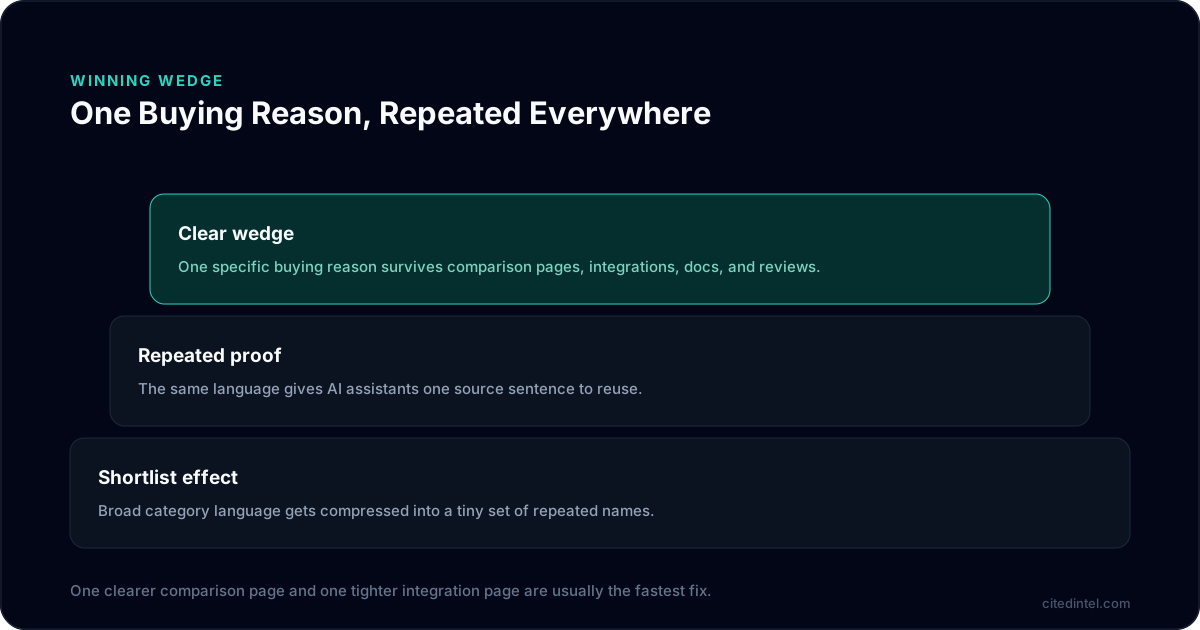
That is testable. If your pages, reviews, and comparison copy do not repeat one specific reason to choose you, the model will file you under the category and leave the shortlist to brands with a clearer wedge.
OpenAI says its shopping research flow in ChatGPT searches the web, asks clarifying questions, and produces a buyer’s guide, which is a concrete sign that assistants are already shaping shortlists inside the answer layer OpenAI shopping research. Microsoft says Copilot Shopping surfaces a small set of product cards with photos, store names, prices, and ratings, which reinforces the same point: AI search favors compressed comparison, not long lists Microsoft Copilot Shopping.
For product marketers in B2B software, the old split between SEO pages and buyer pages is fading. Pages now have to do buyer work, which means naming the wedge, the tradeoff, and the proof on the same page, so the answer layer has one source sentence to reuse across comparison and proof pages.
The core thesis
In marketing automation, the brands that win AI search shortlists usually have one repeatable wedge, and the brands that lose usually sound like everyone else. A quick check is whether the same assistant keeps naming the same buying reason when you ask a close variation of the prompt.
That pattern says the answer layer is narrow, repetitive, and unforgiving, so the shortest path to visibility is to tighten the source sentence the model keeps reusing on the pages assistants actually quote.
| Signal | What it means | How to read it |
|---|---|---|
| Repeated mention | The assistant has a stable reason to include you | Good sign on the prompt you care about |
| Single mention | You are present but not anchored | Weak wedge or weak proof |
| Omitted competitor | The assistant does not see a clear fit | Your positioning is probably too broad |
What answer engines reward in a crowded category
Answer engines reward clear positioning, consistent proof, and pages that answer the buying question in one pass. If your site, docs, and comparison pages tell different stories, the model often strips away the nuance and keeps only the generic category claim. A useful editorial check is to pull the wedge sentence, the buyer fit, and the tradeoff from each page and compare them line by line, especially on the pages assistants are most likely to pull from.
The practical rule is simpler than a content calendar: make the wedge legible before you add more pages. AEO follows the same logic, since direct questions reward short, specific, and repeatable answers. A page that cannot say the buyer fit, the replacement, and the reason that tradeoff matters will usually be reduced to category filler, which is why the comparison page should carry that wording first and the proof page should echo the same terms.
In marketing automation, the most useful signals are these:
Read them as a source audit, not a slogan test: the same wedge sentence should survive across the page types below.
- Wedge language: one reason to choose you, stated the same way across the site.
- Operational proof: comparison pages, integration pages, docs, and review language that match the wedge.
- Buyer fit: the kind of team, workflow, or market where your product is the obvious answer.
- Consistency: no page-level drift between “platform,” “suite,” “automation,” and “engagement” unless those terms mean different things.
In marketing automation, the wedge might be lifecycle orchestration, CRM handoff, regional compliance, or a narrow fit for product-led teams. The model does not need poetry. It needs the same claim to appear in the comparison page, the integration page, and the proof page, with the tradeoff named in the same terms each time.
Why broad claims fail
“All-in-one” sounds strong to a human reader and weak to an answer engine. It is too easy to apply to half the category.
A vendor that only says it offers automation, segmentation, and reporting is competing with nearly everyone serious in the space. A vendor that says it is built for lifecycle orchestration across email, SMS, and in-app messaging gives the assistant a cleaner reason to include it, because the use case is narrower and easier to preserve in a summary.
The same logic shows up in other B2B categories. In CRM, the answer often turns on migration, sales process, or pipeline governance. In payments infrastructure, trust, geography, compliance, and integration depth matter more. In HR tech, the wedge may be recruiting workflow or onboarding rather than “people operations” as a catch-all. The useful test is whether a page can name the job, the friction, and the proof without leaning on category wallpaper, and whether a reviewer could repeat that same reason in one sentence.
How the wedge changes by category
The wedge should change with the category since buyers do not ask the same question in every market. Marketing automation is won on workflow fit, CRM is won on process fit, and payments infrastructure is won on trust and regional fit. If the category question changes, the proof on the page should change with it.
The same pattern shows up in U.S. and U.K. buying, and in market-specific searches from India, the Gulf states, Korea, Thailand, and Indonesia. The phrasing changes by market and language, but the buying motive still has to stay visible if you want AI search to preserve it, which means regional pages need local wording without changing the wedge sentence.
| Category | Most useful wedge | What AI responses often preserve | What to rewrite first |
|---|---|---|---|
| Marketing automation | Lifecycle, CRM handoff, regional orchestration | Workflow fit, channel coverage, review language | Comparison page and integration page |
| CRM | Sales process, migration, pipeline control | Operational fit and implementation clarity | Category page and migration page |
| Payments infrastructure | Compliance, geography, platform depth | Trust cues and market coverage | Docs and regional pages |
| HR tech | Hiring workflow, onboarding, approvals | Use-case language and admin simplicity | Use-case page and proof page |
Marketing automation needs a tighter wedge than most teams think
Marketing automation is broad enough that feature parity is assumed. That makes vague positioning expensive, especially if you want AI search optimization for the buying question that decides the shortlist.
Here is how I would rewrite three common page types for a marketing automation vendor:
- Comparison page: replace “we automate marketing across channels” with “we are built for teams that need lifecycle automation across email, SMS, and in-app messages, with stronger CRM handoff and campaign governance.”
- Integration page: replace a logo wall with a plain explanation of what the integration unlocks, such as sync quality, event triggers, field mapping, or reporting handoff.
- Review snippet: ask for language that names the actual job, such as faster campaign launches, cleaner segmentation, or less manual ops, not just “easy to use.”
If the same vendor serves e-commerce, healthcare SaaS, and logistics tech, do not flatten those into one story. A logistics platform may care more about operational alerts and timing, while a healthcare SaaS buyer may care more about permissions and compliance. The wedge has to stay sharp enough to survive the summary.
A practical marketing automation example
Take a mid-market marketing automation vendor competing with HubSpot, Marketo, and Braze. The job is not to out-generalize those brands. The job is to own a buying context, such as lifecycle orchestration for teams that already live in a CRM and need stronger segmentation plus governed approval flows, then carry that phrase into comparison, integration, and proof pages.
That means the comparison page should lead with the tradeoff, the integration page should show why the CRM connection matters, and the review copy should talk about the actual operating pain. If the page says “best for complex workflows” but the review language says “simple and intuitive,” the wedge gets muddy.
Most teams lose here because they write for internal consensus, not external recommendation. The answer engine only cares about what can be repeated cleanly, so the page needs one claim, one proof point, and one boundary on the buyer fit. A useful edit is to cut any sentence that could describe a rival without changing the wording.
From live audits on the platform
Across live audits run on Citedintel in July and August 2026, a pattern showed up repeatedly in marketing automation prompts: the same small set of brands kept reappearing when the prompt asked for CRM sync, lifecycle email, and reporting. The exact prompt shape mattered more than broad category language.
Here are five prompt patterns from that sample:
| Prompt date | Exact prompt | Brands surfaced | Repeated reasons cited |
|---|---|---|---|
| July 2026 | Best marketing automation platform for a mid-market team that needs CRM sync, lifecycle email, and reporting | HubSpot, Marketo, Braze, ActiveCampaign, Klaviyo | CRM fit, lifecycle coverage, reporting clarity |
| July 2026 | Which marketing automation tools are best for a B2B software company with a lean ops team | HubSpot, ActiveCampaign, Customer.io, Braze, Marketo | Setup speed, workflow control, ops simplicity |
| August 2026 | Best marketing automation software for a company that already uses Salesforce and wants better segmentation | Marketo, HubSpot, Pardot, Braze, ActiveCampaign | Salesforce alignment, segmentation depth, enterprise familiarity |
| August 2026 | What marketing automation platform should a regional B2B software company choose for localized campaigns | HubSpot, Braze, ActiveCampaign, Iterable, Marketo | Localization, multi-region execution, lifecycle control |
| August 2026 | Best marketing automation tools for lifecycle orchestration across email, SMS, and in-app messaging | Braze, Klaviyo, Customer.io, HubSpot, Iterable | Channel breadth, orchestration, product-led lifecycle fit |
In that sample, the repeated names clustered around the same few reasons. If your brand is not inside that cluster on your exact wedge, you are not losing the whole category. You are losing the answer slot that matters.
At that point, AI search shortlists become commercially visible. Buyers do not need twenty options. They need three or five names that still sound credible after the assistant trims the field, which is why the same reason has to survive from query to answer.
How to track the real rivalry without turning it into a dashboard project
Track rivalry by testing the prompts buyers actually ask, not the phrases your team prefers. If a marketing automation vendor wants useful GEO and AEO results, the test set should include a direct buying prompt, an adjacent workflow prompt, and one regional prompt, so the same wedge is tested against both category intent and market intent.
Use five nearest competitors, three assistants, and six to eight prompts. Include one direct buying question, one workflow question, one regional question, and one comparison question so the result shows whether the wedge survives different forms of intent, then note which page the answer seems to borrow from.
The workflow I would use
- Choose five competitors: use the brands your team loses to most often, plus the names that keep appearing next to yours in AI answers.
- Run three assistants: test ChatGPT, Claude, and Gemini on the same prompts so you can see whether the wedge is stable.
- Use six to eight prompts: include broad category prompts, workflow prompts, and one region-specific prompt if you sell across markets.
- Mark the wedge mismatch: treat it as a mismatch if the answer names a competitor for the exact job you think you own, or if the answer describes your product with the competitor’s language.
- Fix one source at a time: rewrite the page that appears most often in the answer set, usually the comparison page or the integration page.
If three of the five nearest competitors are being recommended for the same wedge you claim, your positioning is too loose or too generic. If you are mentioned but the reason is wrong, the problem is not visibility, it is misframing. The fix is not more mentions, it is cleaner source language on the comparison page, the integration page, and the proof page the assistant keeps pulling from, with one wedge sentence repeated in each.
A visibility tracker can help you operationalize that workflow by monitoring prompt sets and recurring reasons, but the editorial call still belongs to you: which wedge should win, and which pages need to say it more clearly? Use it as a change log, not a scorecard, so the next rewrite targets the page that is actually losing the reason.
A martech shortlist check you can finish in one pass
You can finish this pass in a single coffee break and still leave with a visible result: a short list of prompts, competitors, and pages that need the wedge rewritten first.
- Write three prompts: one broad prompt, one workflow prompt, one regional prompt.
- List five competitors: pick the names that matter most in deals or in AI answers.
- Score each answer: for each assistant, mark whether your brand appears, whether the wedge is described correctly, and whether a competitor is named for the same job.
- Rewrite one page: edit the comparison page first if the wedge is muddled there, then the integration page if the proof is weak.
- Re-test the same prompts: if the answer still describes you with generic language, the page is not specific enough.
For the compact version of that process, why Citedintel turns prompt tracking into a repeatable weekly workflow so answer shifts surface fast and the pages that need rewriting stay visible.
What to publish if you want AI search answers to keep your wedge intact
Do not flood the site. Publish the pages that make recommendation easier, starting with the pages assistants are most likely to quote when they compress a shortlist.
For marketing automation, I would prioritize these four assets:
- Category page: define the exact kind of marketing automation you are, not every kind you could be.
- Comparison page: state the tradeoff between you and the nearest alternatives without softening the difference.
- Integration page: explain what the connection changes in the buyer’s workflow.
- Proof page: gather review language, docs, partner references, and product details in one sourceable place.
If one of those pages does not carry the wedge in plain language, the assistant usually fills the gap with generic category language instead of your differentiator. A simple audit is to ask whether the page would still make sense if you deleted the brand name and all superlatives.
That mix matters because answer engines need stable language to reuse. If your docs say one thing, your homepage says another, and your comparison page says a third, the model will flatten the whole thing into a generic option. The fix is editorial, not technical: choose one wedge sentence, then copy it into the comparison page, the proof page, and the integration page so the summary layer keeps seeing the same buying reason.
The real link between GEO and AEO is the handoff from summary to response. GEO is the summary layer, where the model decides what to keep from your wedge sentence; AEO is the response layer, where the model decides what to say when the buyer wants a direct comparison or a sharper recommendation.
As of July and August 2026, the teams that treat AI search as a shortlist problem rather than a traffic problem have the cleanest path. They stop asking how to get more mentions and start asking which wedge the answer should keep intact, then rewrite the pages that prove it, beginning with the comparison page and the proof page.
More from the library
- How Health and Supplement Brands Get Named in AI Search
- AI search optimization for D2C brands
- Why AI search shortlists keep recommending the same brands
Frequently asked questions
Why do some marketing automation brands get left out of ChatGPT answers?
Because answer engines compress similar options into a small shortlist, and broad positioning often looks interchangeable. If a brand does not have a clear wedge and repeatable proof across multiple sources, the model is more likely to leave it out or describe it generically.
What kind of positioning works best for AI search optimization in marketing automation?
Specific workflow or operational positioning tends to work best, such as lifecycle orchestration, CRM handoff, compliance, or regional fit. The article argues that the model rewards a single clear job to be done more than a general claim of being an all-in-one platform.
What should I track if I want to know whether we are showing up in AI search shortlists?
Track whether your brand appears at all, whether it shows up in the first three recommendations, and whether the model describes your wedge correctly. You should also note which competitors appear beside you and what source signals seem to be driving their inclusion.
Is publishing more content the fastest way to improve AI search optimization?
Not usually. The article says the faster path is publishing fewer, sharper assets that make your product easier to recommend, such as a category definition page, comparison page, integration page, proof page, and use-case page.
How is AI search optimization different from traditional SEO?
Traditional SEO focuses on winning the page, while AI search optimization focuses on winning the answer. In crowded categories, the question is less about ranking for keywords and more about whether the model can clearly explain why your product belongs on the shortlist.
Which AI SEO optimization moves matter most in a crowded martech category?
Wedge clarity beats volume. In a category this dense, AI SEO optimization starts with one narrow, provable claim engines can repeat without hedging, then comparison pages and reviews that verify it. AI content optimization tools can polish drafts, but they cannot invent a wedge; that positioning decision is still yours.