
A shortlist can tilt in ChatGPT on Monday while Friday’s monthly dashboard still looks clean. By the time the report lands, the decision set has already moved.
AI search optimization is whether your brand gets named, lands near the top, and shows up with a source in AI answers. Generative engine optimization (GEO) is the wider job of shaping that answer layer, while answer engine optimization (AEO) is the narrower work of earning the answer and the source link behind it.
What this workflow is for
This 45-minute weekly workflow is for B2B software teams that already publish enough content to test, usually around comparison pages, integration pages, trust pages, and product pages. The point is not to watch more dashboards, it is to catch when AI search starts naming someone else before your pipeline or traffic reports tell you.
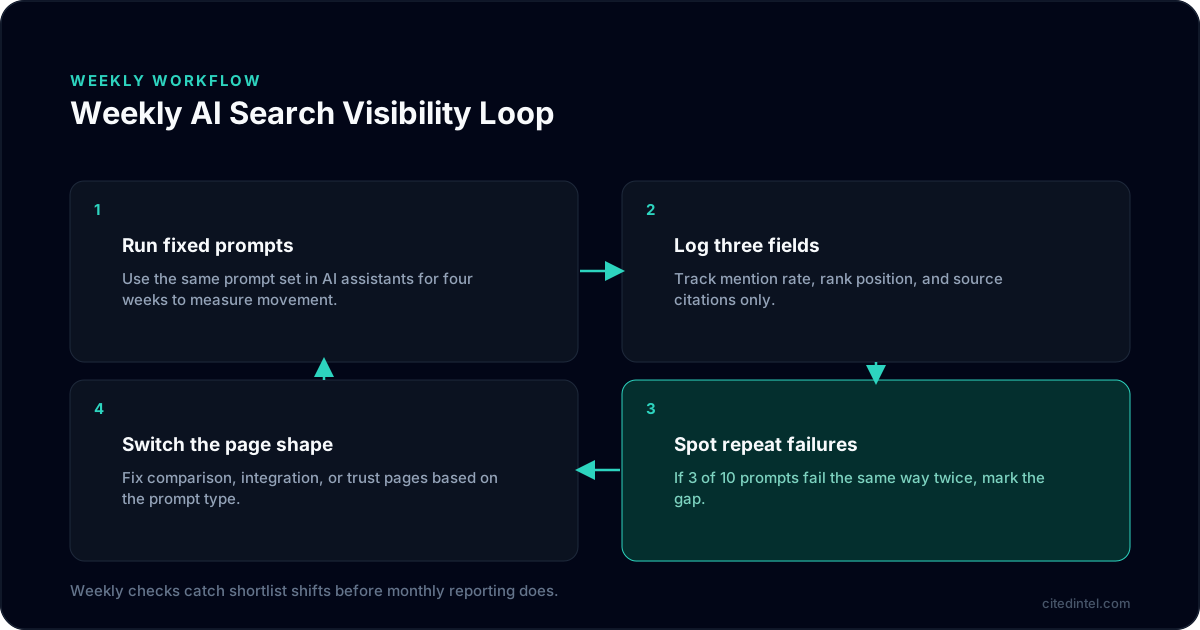
Weekly beats monthly because answer engines move faster than most reporting rhythms. If the shortlist shifts on Monday and your update lands on Friday, you are already playing catch-up.
The claim is falsifiable. Run the same prompt set for four weeks, and if mention rate, rank position, and source citations do not move, either the market is stable or your page set is wrong. If those fields move, the weekly cadence is doing real work.
That matters because the answer layer is no longer opaque. OpenAI Academy says ChatGPT Search brings current information into ChatGPT with citation links to original sources, and Google’s AI features guidance says AI features still depend on foundational SEO best practices, not special markup. You are working with a visible surface, not a black box.
For product marketing leaders in B2B software, the blunt question is whether you show up in the shortlist before the dashboard shows the click. If not, the operating problem is AI search optimization, not traffic.
Check movements
Check movements by running the same prompt set in AI assistants, then logging whether your brand is named, where it lands, and whether the answer cites a page you control. One run is a snapshot. Two runs, one week apart, show movement.
Start with at least 10 prompts, move to 15 when the category is crowded, and include at least three direct comparison prompts. If your pipeline spans more than one region, add one prompt for each demand market that matters, whether that is the United States, the United Kingdom, or priority markets in Southeast Asia, the Gulf, or East Asia.
- Mention rate: the brand is named in the answer.
- Rank position: the brand appears first, near first, or later.
- Source citations: the answer links to your page, a competitor, or no usable source.
| Field | How to score it | Why it matters |
|---|---|---|
| Mention rate | Named or not named | Shows whether you are in the buyer’s shortlist |
| Rank position | First, near first, or missing | Shows whether the engine favors you |
| Source citations | Your page, a competitor, or no usable source | Shows whether your content is being used as evidence |
Use the same fields every week. If you keep changing the scoring, you are measuring your own process instead of the answer layer. A simple rule helps: lock the prompt wording, the engine, and the scoring columns before week two so any shift points to the page, not the method.
Here is a small benchmark from a procurement software category review, using the same three fields. Before a page rewrite, the brand was mentioned in 2 of 10 prompts, ranked first in 0, and received 1 source citation. After one alternatives page rewrite and one new integration page, the brand was mentioned in 4 of 10, ranked first in 1, and received 3 source citations. That is not revenue attribution, but it is a visible change in AI search optimization, and a useful sign that the page shape is closer to the prompt shape.
Gartner says B2B buyers are using generative AI more often to gather information when weighing technology purchases, and advises demand gen leaders to strengthen human-trusted channels and correct misconceptions. In practice, that means your weekly check should flag where the answer is leaning on a competitor, a stale page, or no source at all. If your category depends on trust, that is a weekly monitoring problem, not a quarterly one.
One practical rule helps. If 3 of 10 prompts keep returning the same buying frame for two consecutive weeks, treat that as a real movement pattern. If fewer than 3 repeat, the prompt set is probably too loose to guide a decision. That threshold keeps the team from rewriting pages off a one-off answer drift and gives you a simple line between noise and a page problem.
OpenAI’s BrowseComp benchmark is a useful reminder that hard-to-find web information still trips up strong browsing systems. Breadth of coverage and clear evidence matter more than a monthly snapshot.
What to log each week
Keep the log boring. That is a compliment. Use one row per prompt so you can spot whether the same page keeps winning, missing, or getting cited by someone else.
| Prompt | Engine | Mention rate | Rank position | Source citations |
|---|---|---|---|---|
| Best martech platform | ChatGPT | No | Missing | Competitor cited |
| Martech platform vs competitor | Claude | Yes | Near first | Your comparison page cited |
| Which marketing tools integrate with Salesforce | Gemini | Yes | First | Your integration page cited |
When you run content for a martech company, the gap may show up on comparison prompts but not on feature prompts. In cybersecurity, the weak spot often sits in trust and compliance questions. In logistics tech, prompts about workflow fit can outrank generic category terms. Use that pattern to choose the next page type instead of debating the whole content map.
These two lanes overlap in practice, but they are not the same job. One lane changes whether engines mention you at all; the other changes what they quote and which link they attach when they do.
Google’s AI Overview guidance says those summaries appear when systems judge generative AI helpful for understanding information from a range of sources. That is why a weekly review should track both presence and source quality.
Diagnose one gap
Diagnose one gap by deciding whether the problem is comparison coverage, proof, or structure. Do not try to fix all three in the same week, because the answer layer is easier to read when you change one thing at a time.
Start from the prompt evidence. If the brand appears on broad category prompts but disappears on “vs” prompts, the comparison page is weak. If the brand appears but citations go to a competitor, the proof is weak. If the engine cites a page that still does not answer the question cleanly, the structure is weak.
Set the bar at 3 or more prompts out of 10 sharing the same failure mode for two weekly runs before you call it the gap to fix next. If fewer than 3 share it, keep monitoring before you rewrite.
| Failure mode | What you see | What to fix |
|---|---|---|
| Comparison coverage | Mentions on broad prompts, misses on “vs” prompts | Alternatives page or direct comparison page |
| Proof | Mentions without citations, or citations to a competitor | Proof-heavy page, tighter source section, clearer claims |
| Structure | The page is cited, but the answer is vague or incomplete | Rewrite the opening, headings, and proof blocks to match the prompt |
In vertical SaaS, the gap often shows up in a tight cluster of prompts like “best procurement software for mid-market manufacturing,” “procurement platform comparison,” and “which procurement tools integrate with NetSuite.” That pattern says the category story is incomplete in two places at once: the side-by-side page and the system-fit page.
Forrester’s 2026 buyer insights release says generative AI is reshaping how business buyers discover, evaluate, and purchase products and services, and that AI search tools can deliver incomplete or unreliable information. That combination is why proof and structure matter as much as visibility.
Here is a decision table you can use when reviewing the last two weeks:
| Signal | Meaning | Decision |
|---|---|---|
| Mentions but no citations | The engine knows the category but not your proof | Fix the source page first |
| Citations but low rank | The page is usable, but not decisive | Sharpen the opening answer and comparison framing |
| Missing on all prompts | Your page shape is off | Ship a new page type, not a longer blog post |
In healthcare SaaS, trust language often needs to appear earlier. In martech, the page may sound strategic but not operational. In devtools, buyers usually ask how the tool fits a workflow, so a use-case page can matter more than a polished overview.
Ship one asset
Ship one asset that matches the prompt shape, not the topic you wish buyers cared about. If the gap is in comparisons, publish a comparison page. If the gap is in integrations, publish an integration page. If the gap is in trust, publish a trust page or FAQ page.
Use a hard threshold before you create anything new. If 3 of 10 prompts share the same comparison frame, create or rewrite a comparison page. If 3 of 10 prompts are about integration, publish an integration page. If 3 of 10 prompts are about pricing, security, or deployment, build a trust page or FAQ page before you add another blog post.
- Comparison page: use for “best [category] software” and “[product] vs [competitor]” prompts.
- Integration page: use for “does [product] integrate with [system]” and “which tools work with [system]” prompts.
- Trust page: use for pricing, security, compliance, and deployment questions.
| Prompt shape | Page type | Schema type | Pass/fail trigger |
|---|---|---|---|
| Comparison | Alternatives or comparison page | FAQPage, Product | 3 of 10 prompts repeat the same comparison frame |
| Integration | Dedicated integration page | SoftwareApplication, Product | 3 of 10 prompts ask about the same system |
| Trust | FAQ or proof-heavy page | FAQPage, Product | 3 of 10 prompts cluster around risk, pricing, or deployment |
For a CRM team, the workable pattern is straightforward: if the prompt is “best CRM for mid-market manufacturing,” the page should open with that answer, then list selection criteria, competitor alternatives, and a short “choose this if” section. Add FAQPage schema for repeated objections and Product schema for the software itself. If the real question is implementation, publish a dedicated integration page with SoftwareApplication or Product schema where appropriate, so the cited page matches the wording of the prompt.
For martech, the fix is often a direct comparison page that says what the tool replaces and where it fits in the stack. For cybersecurity, a trust page usually needs the deployment and compliance answers earlier. In vertical SaaS, job-fit pages can beat broad category explainers because buyers want operational fit, not polish.
The common advice to add more keywords is weak for AI search. You usually need a better page shape, not a denser paragraph. The engine has to find an answer block it can lift, not a pile of adjacent terms. Think in blocks the model can reuse: answer first, proof second, then the supporting links.
One limitation: if your category has very low prompt volume or the product is too new for buyers to search by name, the first lift may show up in category prompts before branded ones. In that case, keep the prompt set small and avoid building pages nobody is asking for yet.
Log one decision for leadership
Log one decision memo, not a status update. The memo should say what moved in AI search, what you changed, what KPI you will watch, and what you will test next week.
Use a KPI that matches the buying stage. If the asset is late-stage and comparison-heavy, track sales-assisted sessions. If it is earlier and meant to create brand recall, track qualified branded search. If attribution is clean enough, influenced opportunities can sit beside those, but never replace them. The point is to keep the weekly memo tied to a business outcome, not to a vanity signal from the answer layer.
For a demand gen lead, the logic is simple. If the answer layer improves but pipeline-adjacent metrics do not move, the page may need a stronger conversion path. If both move, keep the next test close to the same prompt shape before widening scope.
Decision memo template: We changed one page type for one prompt frame. The expected business impact is directional, the brand should enter more buyer conversations earlier, which should improve the quality of traffic and the chance of being shortlisted. The KPI tied to pipeline is sales-assisted sessions when the asset is late-stage, and the next experiment is to keep the same prompt set for one more week before widening scope. Add the week-over-week change in mention rate, rank position, and source citations so leadership can see whether the page or the prompt set moved.
Use this weekly report format:
| Input | Action taken | Observed lift | Next experiment |
|---|---|---|---|
| 10 comparison prompts | Published an alternatives page and added FAQPage schema | Mention rate moved from 2 of 10 to 4 of 10 | Test a direct competitor page next week |
| 10 integration prompts | Built a dedicated integration page for the top system | Source citations moved from 1 of 10 to 3 of 10 | Expand to two more systems if the same frame repeats |
That memo is where GEO becomes a leadership report instead of a content task. It shows what changed in AI search optimization, which page did the work, and what the next test should isolate.
McKinsey reports that generative AI has moved into the top five channels B2B buyers use to find and assess suppliers, together with supplier websites, face-to-face contact, web search, and video calls. If you are not reviewing AI responses each week, you are missing one of the places buyers now begin.
For teams running AI SEO and GEO together, the weekly memo is also a clean handoff. It shows whether the answer engine changed, which page mattered, and what the next test should be.
Run week one of the loop today
Keep week one deliberately small, and keep the output narrow enough to compare week to week.
- Write 5 prompts a buyer would actually ask: one comparison prompt, one integration prompt, one trust prompt, one “best [category] software” prompt, and one market-specific prompt for a country that matters to you.
- Run those prompts in AI assistants, then keep the same wording next week so the comparison stays clean.
- Score each answer on three lines only: mentioned, first or near first, and source cited or not cited.
- If 3 of the 5 prompts show the same failure mode, assign one page type to fix next week.
- Write one sentence for leadership: “We changed one asset, and next week’s test is to see whether mention rate, rank position, or source citations move on the same five prompts.” Use that sentence to anchor the report before anyone asks for a broader content plan.
Citedintel turns the review, diagnosis, and reporting into a repeatable operating rhythm without forcing the team to rebuild the process every Friday.
For a guided start, the starting point is the fastest way to turn weekly prompt checks into an operating habit.
Weekly AI search optimization is a choice to measure the answer layer before it hardens into habit, then fix one page type at a time before the shortlist moves past you. The workflow only works if the prompt set stays stable long enough to show a real shift. Keep the prompt set narrow, the scoring fields fixed, and the page change isolated so the signal stays readable.
Frequently asked questions
How can I check my brand's visibility in AI recommendations?
You can manually simulate buyer-intent prompts using AI platforms or use tools like Citedintel to gather data on your brand's mentions and positions.
Why compare my AI mentions with competitors each week?
Comparing your mentions with competitors shows which brands are recommended more often and what signals you are missing. The workflow says to look at frequency, context, missing keywords, structure, authority, relevance, and engagement signals to pinpoint the gap.
How do I create content that improves AI search optimization?
Focus on creating content that addresses identified gaps, includes necessary keywords, and aligns with buyer-intent prompts to improve AI recognition.
What insights should I log for leadership?
Summarize changes in AI recommendations, highlight diagnosed gaps and shipped assets, and provide clear next steps for improving AI search optimization.
How can Citedintel help a weekly AI visibility workflow?
Citedintel can automate the manual work in each step. It aggregates AI share of voice data, diagnoses missing recommendation signals, generates missing content assets, and turns the week’s findings into executive-ready reports.
Do I need AI SEO tools to run this weekly workflow?
You can run the first few weeks manually with a prompt list and a spreadsheet. The ceiling arrives fast: AI search monitoring by hand does not scale past a handful of prompts, and you lose the week-over-week trend. That is the point where a dedicated GEO tool earns its cost, because the 45 minutes shifts from collecting answers to acting on them.